How Alina Vandenberghe Turned Sales Team Frustration into a $1B
SaaS GrowthStaying close to the customer’s problem, in product and in content, compounds into results that surface-level research never will.


Before high school, Alina Vandenberghe was already running a business. Growing up in communist Romania, she sold lipstick to pay for her own education. That early experience of building something from nothing, in a system designed to limit what was possible, became the baseline she carried into everything that followed.
She immigrated to the US in 2007 from Communist Romania with no safety net and no local network. Over the next decade she:
- Started as an intern, climbed to SVP.
- Built apps that reached 30 million users each.
- Got keynoted by Steve Jobs.
- Spent years embedded inside sales teams across finance, media, and education.

And through all of it, she kept ending up in the same place: watching sales teams work, understanding exactly where their tools were failing them.
In 2016, she co-founded Chili Piper. In 2021, it hit a valuation close to $1 billion. She had been building toward it for twenty years without knowing it.
From intern to SVP – why she spent a decade inside the problem before solving it
Most founders do customer discovery. They run interviews, map pain points, build a thesis. Alina did something different: she spent a decade inside the problem before she tried to solve it.
She went from an intern to SVP across finance, media, and education. Years embedded directly inside sales teams, watching how they handled inbound, how leads moved through their process, and where they fell out.
By the time she sat down to build Chili Piper, she already had the answer. The difference shows up in the product.
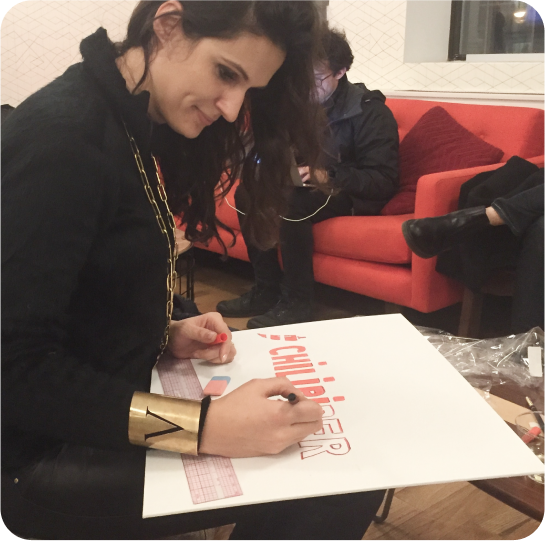
When an SDR at a customer’s company told her that 60% of inbound demo requests were never getting a response, she recognized it immediately. That insight did not require validation. She had watched that failure happen, in different companies, across different industries, for years. When Segment tested the fix, conversion jumped from 40% to 80%.
That is what spending a decade inside the problem gets you. Not just empathy for the customer, but the specific, hard-won knowledge of exactly where the process breaks down, and why the obvious solution keeps getting missed.
Building Chili Piper with your spouse: how it actually works
Most co-founding partnerships don’t survive one CEO transition. Chili Piper has been through three — and the company didn’t just survive them, it barely flinched. The reason isn’t personal chemistry or unusually high trust. It’s structural.
If your company’s stability depends on the org chart staying fixed, you have a fragility problem. Chili Piper’s structure survives role changes because the process for making decisions does not live in any one person’s head.
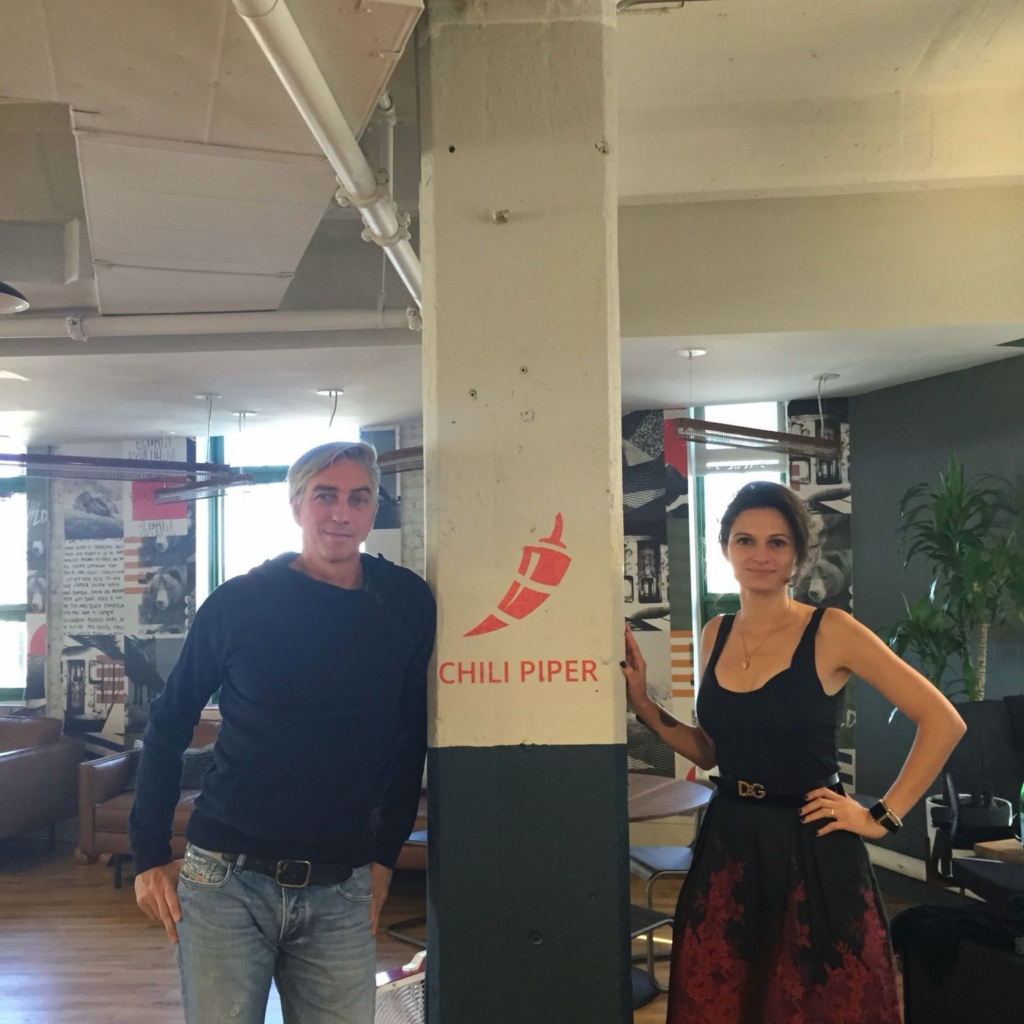
Alina and Nicolas Vandenberghe met at a startup he had founded. They eventually got married, and years later started Chili Piper together with a third co-founder, Ivan Dyachenko. It works because roles shift based on where each person can make the most impact. Over Chili Piper’s first eight years, her role shifted four times:
- Technical co-founder at launch.
- CEO as the company scaled.
- Product and engineering lead during maternity leave.
- Acting CMO on return.
Chili Piper runs with no middle managers across 150+ employees in 40 countries. Decision-making is fully documented and transparent. Anyone in the company can propose changes to pricing, strategy, or roadmap. The org chart is allowed to change because the decision-making infrastructure underneath it doesn’t.
The first $1M – cold calls, events, and a 40% conversion problem
The GTM story behind Chili Piper’s early growth is less about product-market fit and more about being willing to do things that do not scale.
Nicolas cold-called companies with a pitch that left no ambiguity: “You have a problem I can solve and you’re willing to prepay for it.” They attended every industry event they could get to, had 1:1 conversations with every potential customer who would talk to them, and built the first $1M ARR entirely through direct contact.
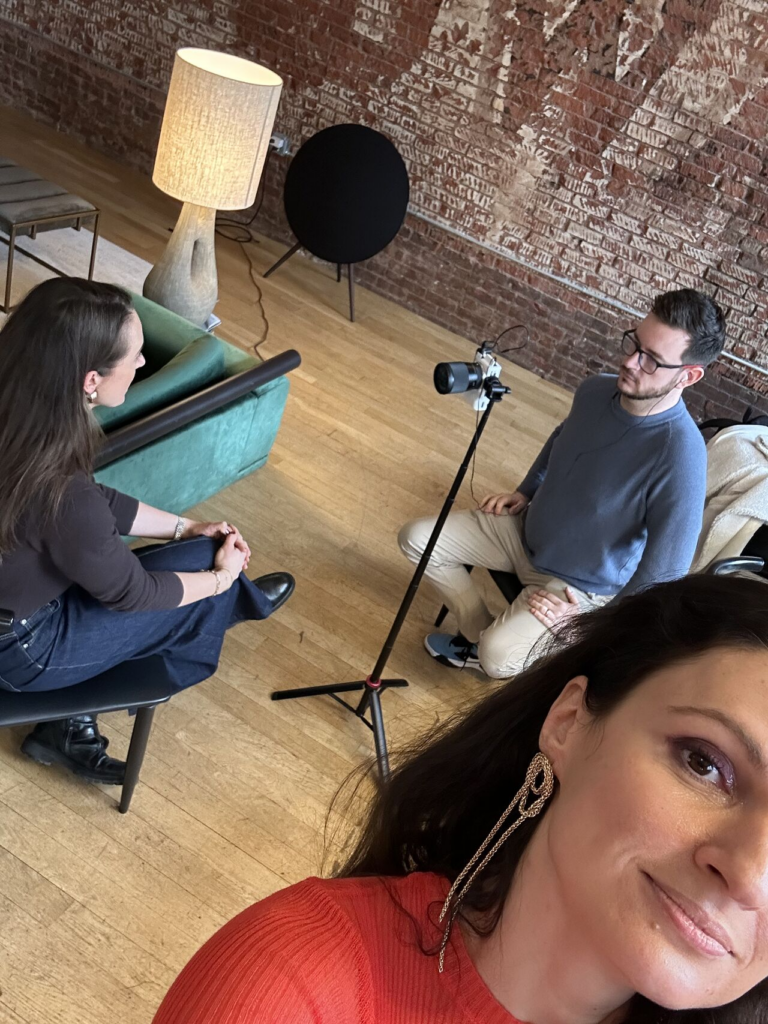
Then an SDR told them something that changed the company’s direction.
“60% of people asked for a demo and didn’t get one.”
The founding insight came from a customer’s sales team. SDRs were only converting 40% of inbound demo requests, meaning 60% of people who raised their hand and asked to see the product never got a response. When Segment tested Chili Piper’s solution, conversion jumped from 40% to 80%.
That single data point reframed everything. Chili Piper became a demand conversion platform, solving the gap between interest and conversation that was costing revenue teams deals they had already half-won.
Alina found that insight because she was close enough to the customer’s actual work to hear it.
Scheduling as a churn signal – the insight nobody talks about
Most SaaS companies track NPS, CSAT, and support ticket volume as churn indicators. Alina’s insight, drawn from Chili Piper’s own product data, is that scheduling velocity is a more reliable leading indicator than any of them.
When a customer stops booking meetings with your team, they are already disengaging. By the time that shows up in NPS scores or renewal conversations, the relationship is already lost. The meeting cadence drops first.
Chili Piper saw this pattern directly in their own customer data: accounts that stopped scheduling meetings were churning weeks before any NPS drop showed up.
If a customer who previously had weekly check-ins goes three weeks without booking anything, someone should be on the phone. NPS measures what has already happened. Scheduling velocity measures what is happening right now, before the customer has decided to leave.
How Alina’s personal brand became half the pipeline
At SaaStock USA in Austin in May 2025, Alina put a number on it:

Right now, my social media posts influence 50% of my open opportunities. Which is good, but it’s also terrifying because if I say something stupid, I’m not quite sure what’s going to happen.
Half the pipeline of a $43M ARR company came from one founder’s LinkedIn posts.
No agency or a content strategy document. Just whatever Alina wished she had known a few years earlier. She started posting for the version of herself that could have used it then.
34 growth plays, 14 active: why diversification beats betting on one channel
Alina has mapped 34 potential growth plays for Chili Piper. They actively run around 14. The number sounds abstract until you see what this looks like in practice.
Personal brand is the main anchor: 50% of pipeline came from LinkedIn content, as she shared at SaaStock. But the other plays running alongside it are just as deliberate.
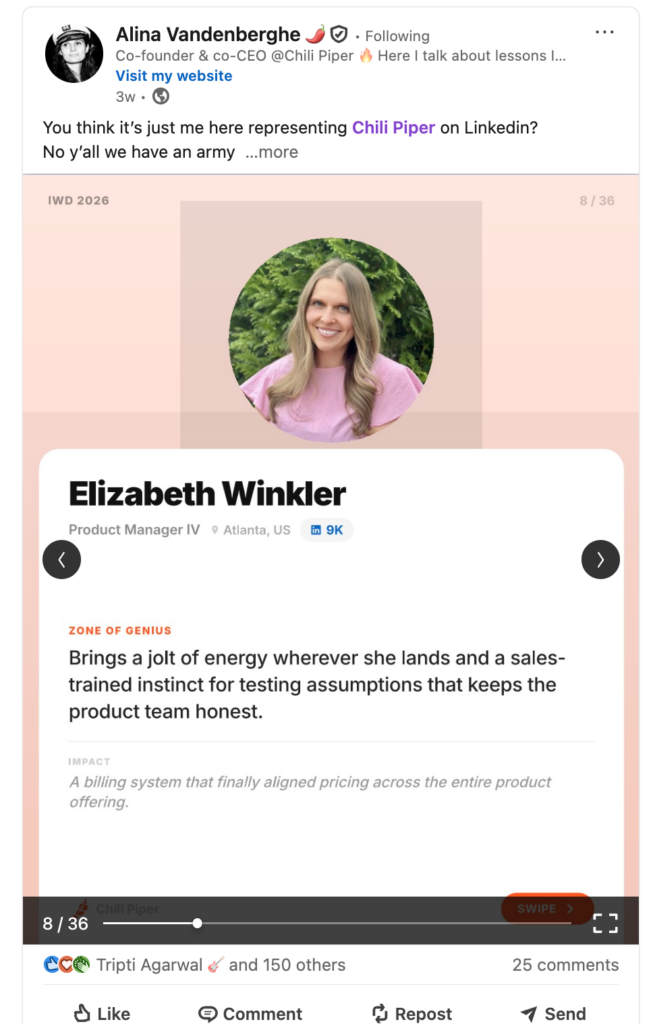
Influencer partnerships where Chili Piper helps creators grow their audiences rather than just paying them for posts. An ecosystem play where anyone buying Gong sees a Chili Piper offer automatically. A coordinated employee LinkedIn presence: not just Alina posting, but an army of teammates doing the same.
The point is not to copy their exact approach, but to study the logic behind it.
Founders who bet everything on one channel, particularly SEO in an era where AI overviews are eating organic traffic, are building on unstable ground. No single algorithm change or platform shift can take out a pipeline that runs across 14 different plays.
Personal brand holds its position in that mix because it is the hardest to replicate and the hardest to disrupt. Everything else can be copied. The relationship a founder builds with an audience over years cannot.
What GTM leaders can steal from Alina’s playbook
She built a large part of Chili Piper pipeline by writing for her past self.
“It’s a very unusual playbook,” she said about her LinkedIn approach. “I don’t think that anyone else can replicate it. I just post whatever goes through my head.”
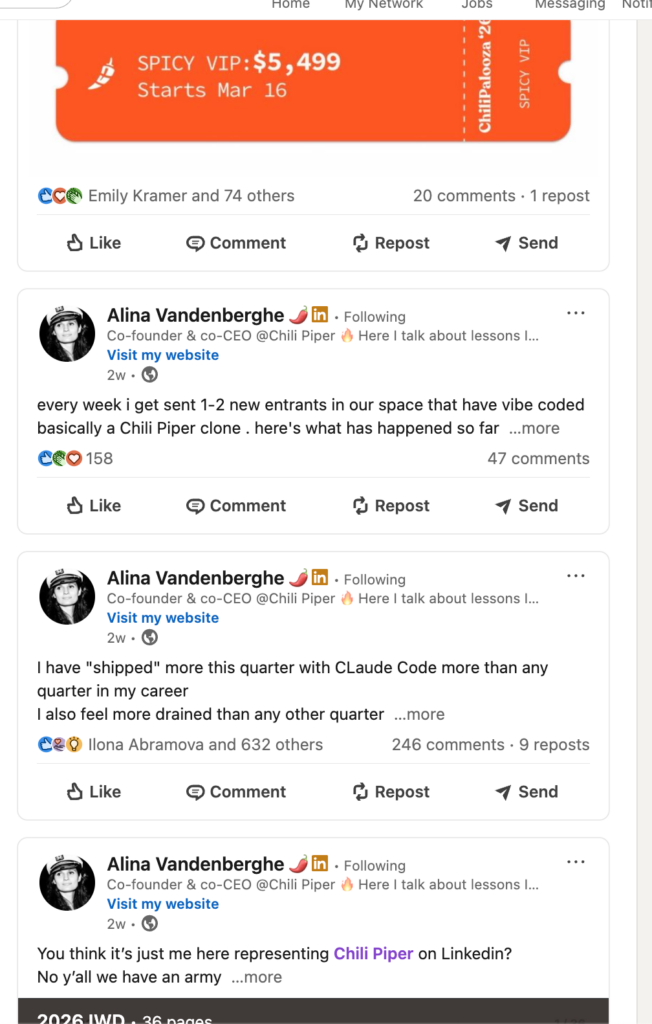
The frame she uses: write what would have helped you three years ago, two years ago, five years ago.
What I wish I’d known that I’ve just learned in the past couple of weeks that would have been helpful to the old Alina.
That framing sounds simple. Executing it for twelve months when nobody is reacting is not. The compounding takes time.
My biggest transformation came from just feeling comfortable to pressing the post button. It took me 12 months to just feel that. But it’s the most important piece.
Most founders stop well before that. Alina did not, and half her pipeline is the result.
Pick one person you were two or three years ago. Write your next post for them. Post it tomorrow, even if nobody reacts. Do that for twelve months. The results show up later than feels reasonable, and then all at once.
That is the kind of thing Alina talks about openly, and she is one of the founders you can access directly by joining the GTM Society.
Join the GTM Society. The room where GTM actually gets built. Founders, SDRs, and operators. No noise. Just systems.