LinkedIn Ads for Lead Generation: How to Get Qualified B2B Leads Without Wasting Budget

Burned through your first LinkedIn Ads budget at the speed of light? The clicks cost more, the leads cost more, and the people in marketing meetings start asking why you’re not just running Meta.
But the math checks out once you measure cost per qualified opportunity instead of cost per click:
LinkedIn ads cost 3 to 5 times more per click than Meta, with average CPLs running $50 to $200 in B2B. But LinkedIn leads convert to opportunities at 2 to 3 times the rate of paid social alternatives.
We pulled this guide together from several sources: how Expandi customers coordinate paid LinkedIn campaigns with direct outbound, 2026 benchmarks from Dreamdata, LinkedIn’s official reports, Tamarind’s B2B House, and GTM Society interviews with leaders, including:
- Chris Walker, founder of Refine Labs and Passetto.
- Wes Bush, founder and CEO of ProductLed.
- Dave Gerhardt, founder of Exit Five.
- Alina Vandenberghe, co-founder and CEO of Chili Piper.
What you’ll get below:
- What LinkedIn ads cost in 2026 and what good performance looks like
- The formats and targeting that drive qualified leads instead of vanity clicks
- A budget framework anchored to pipeline instead of arbitrary monthly spend
- Underused playbook for coordinating paid LinkedIn campaigns with the outbound work your sales team is already doing
Key Takeaways
- Document Ads with Lead Gen Forms and Thought Leader Ads consistently outperform standard Sponsored Content on cost efficiency. Lead Gen Forms convert at 6 to 12% versus 2 to 4% for external landing pages.
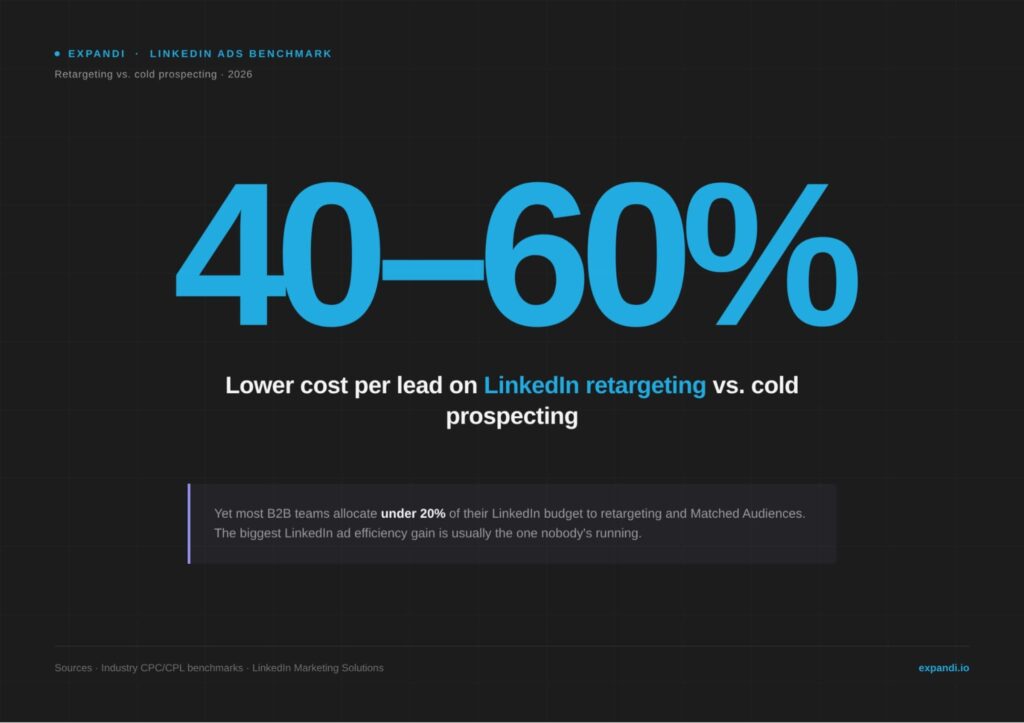
- Retargeting and Matched Audiences cut LinkedIn CPL by 40 to 60% compared to cold prospecting.
- Budget at least $50 to $100 per day per campaign. Below that, you generate data too slowly to optimize.
- Expandi pairs naturally with paid LinkedIn campaigns: marketing warms accounts with ads, sales runs targeted Smart Sequences to the same contacts, and Signals tells reps when an ad-touched prospect is ready for a personal message.
LinkedIn Ads for Lead Generation: How to Get Qualified B2B Leads Without Wasting Budget

LinkedIn ads are expensive in 2026 — here’s why B2B teams keep spending more on them
LinkedIn ads cost 3 to 5 times more per click than Meta, with B2B CPLs averaging $50 to $200.
But LinkedIn delivers higher MQL-to-SQL conversion rates and better deal economics, which is why share of B2B paid budgets keeps climbing.
The numbers in this guide synthesize the two most-cited 2026 benchmark sources for B2B LinkedIn ads:
- Dreamdata’s 2026 paid social report (covered in PPC Land).
- Tamarind’s B2B House LinkedIn ad benchmarks.
The 2026 benchmarks tell a consistent story across industries. Average CPC for Sponsored Content runs $5.50 to $12, with C-suite and enterprise targeting pushing $15 to $25 — roughly 3 to 5 times higher than Facebook’s $1 to $3 range.
CPM lands between $28 and $60, compared to Meta at $7 to $15.
LinkedIn vs Meta vs Google: B2B paid benchmarks (2026)
| Metric | Meta (Facebook/Instagram) | Google Ads | |
|---|---|---|---|
| Average CPC (B2B) | $5.50–$12 (C-suite/enterprise: $15–$25) | $1–$3 | $5.50–$14 (Business Services ~$5.58; SaaS non-brand $8.50–$14) |
| Average CPM | $28–$60 | $7–$15 | Search runs on CPC, not CPM (Display/PMax ~$3–$10) |
| Average CPL (B2B) | $50–$200 ($45–$65 for Document Ads + Lead Gen Forms) | $30–$80 standard$150+ for MQL/SQL-qualified | $67–$104 (Business Services avg; SaaS SQLs $800–$2,500) |
| Lead → opportunity conversion | 2–3x higher than paid social alternatives | Baseline | Higher intent — captures existing demand rather than creating it |
| YoY CPC change | +8 to 12% since 2024 | CPC roughly flat; CPL +~21% YoY | CPC modest rise (~$5.42 avg); CPL fell to ~$67 — first decline in years |
| Best fit for B2B | $5,000+ ACV, multi-decision-maker cycles, ABM motion | Lower-friction offers, awareness, broader reach | Bottom-funnel, high-intent search queries |
Sources: Dreamdata 2026 paid social report; WordStream 2025–26 Google Ads & Facebook Ads benchmarks; Tamarind’s B2B House LinkedIn benchmarks
Within that $50–$200 range, most B2B verticals land between $60 and $150 on Tamarind’s benchmarks, with Document Ads via Lead Gen Forms typically at the low end ($45–$65).
LinkedIn CPCs have increased 8 to 12% year over year since 2024, so expect the floor to keep rising. Looking at those numbers next to Meta, LinkedIn looks like a bad deal.
The math changes when you stop measuring cost per click and start measuring cost per qualified opportunity.
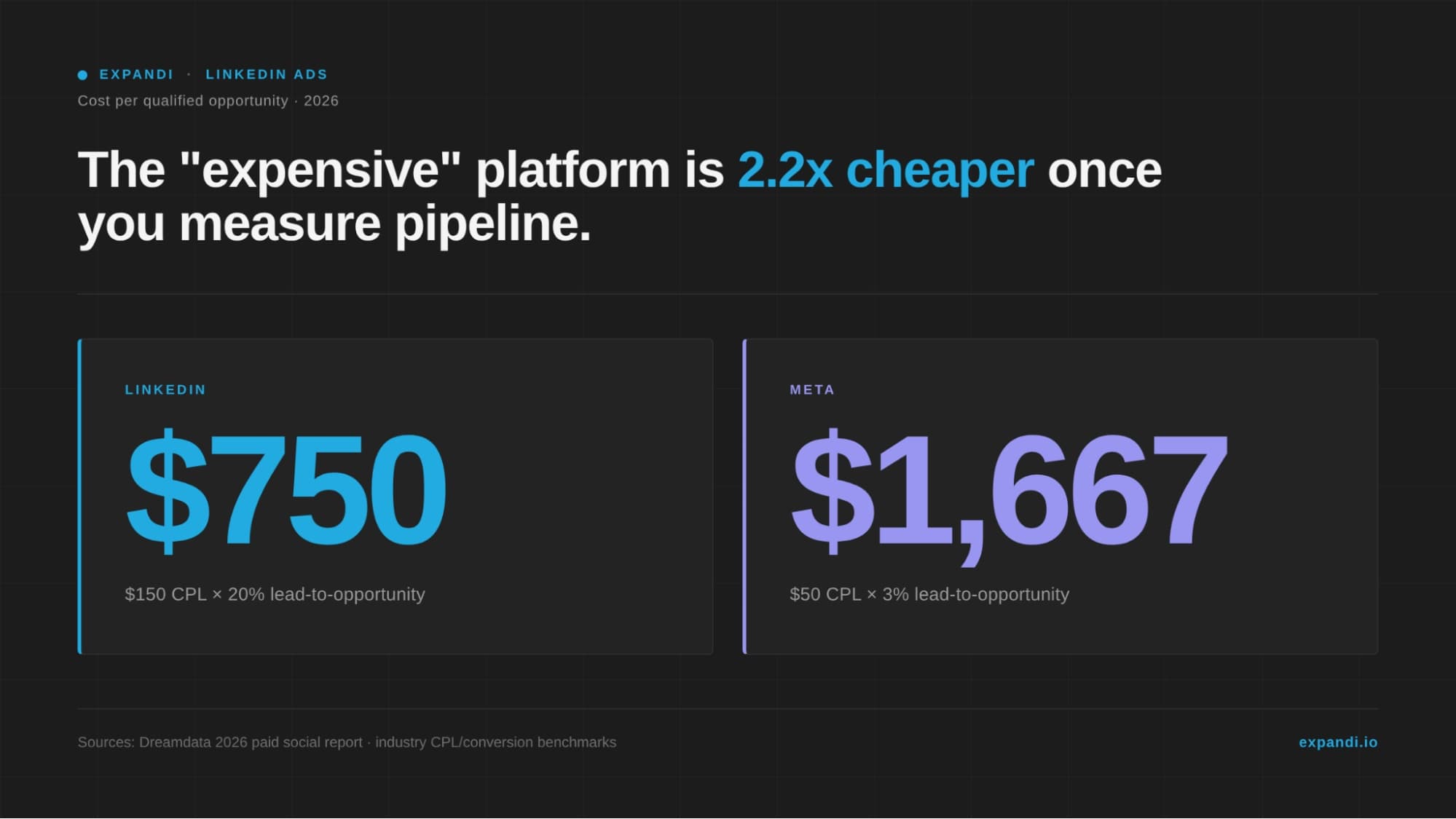
A $150 LinkedIn CPL that converts to pipeline at 20% costs you $750 per qualified opportunity. A $50 Meta CPL that converts at 3% costs you $1,667 per qualified opportunity.
The cheaper-looking platform is more than twice as expensive once you measure what matters.
According to Dreamdata’s 2026 benchmark report, B2B teams measuring across the full sales cycle now see LinkedIn ROAS of 121%, up from 113% the year before.
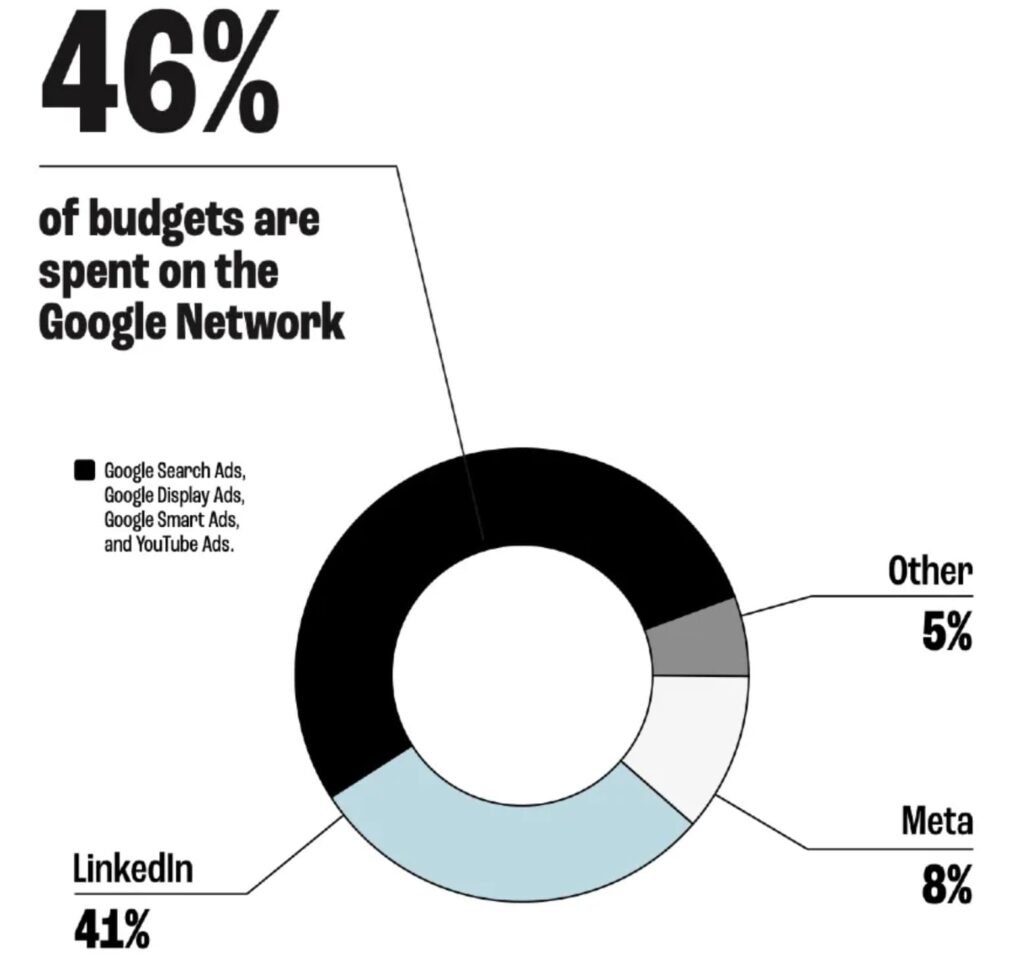
LinkedIn now accounts for 41% of total B2B paid media budgets, up from 39% the year before.
Chris Walker, who’s worked with 100+ B2B SaaS companies through Refine Labs and Passetto, frames the underlying problem this way:
“Marketing crushes their MQL target. Sales misses quota by 30%. Why? Because the MQL metric is not aligned with closed won customers.”
His fix is to change the goal from leads to HIRO pipeline (pipeline that sales wins at over 25%) and revenue. Once you do that, campaigns that generate cheap low-quality leads stop looking like winners.
Tamarind’s B2B House puts the same idea in operational terms:
“There’s no point in churning out hundreds of low quality leads from Facebook and making your sales team busy with rubbish leads. It will backfire and marketing will lose the seat at the decision-making table.”
The quality framing is everything. If your LinkedIn ads are generating leads that sales ignores, the problem is usually what you’re optimizing for.
8 LinkedIn ad formats for B2B lead generation (with 2026 benchmarks)
LinkedIn’s Ads Guide lists 14 ad formats.
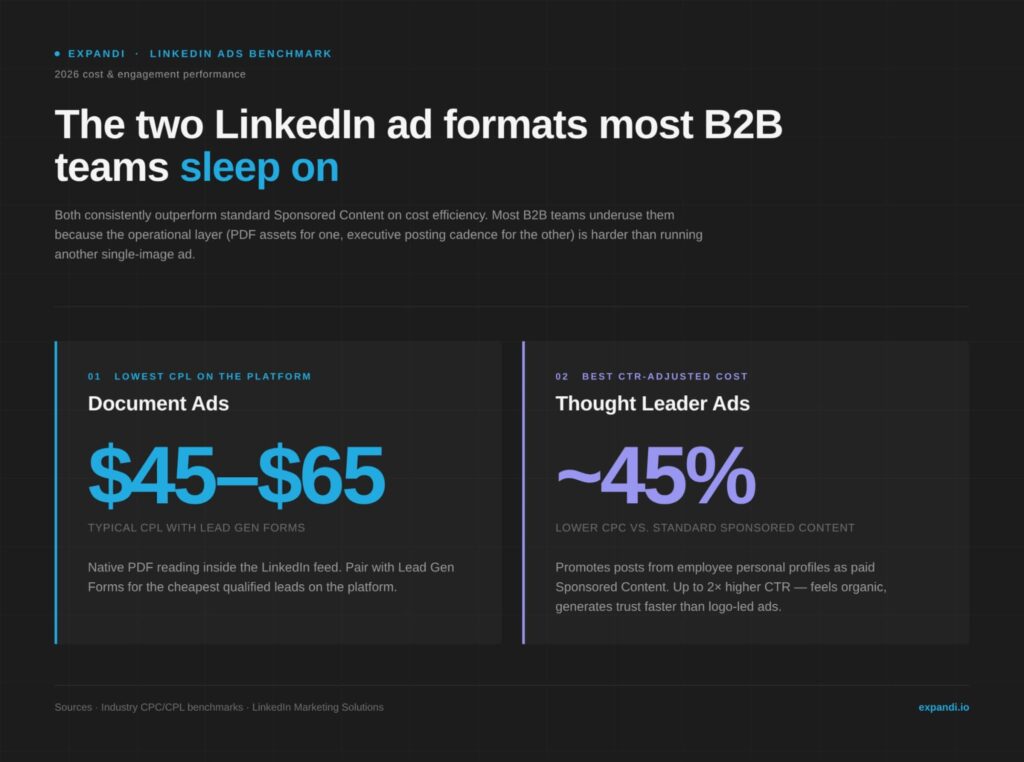
Eight matter for B2B pipeline. Two of them — Document Ads and Thought Leader Ads — consistently beat the rest on cost efficiency.
The other six each have a specific job: workhorse, awareness, sequencing, branching, inbox, niche reinforcement.
Below: what each format does well, what it costs in 2026, and when to reach for it.
Single image ads
Single Image Ads are static 1200×628 visuals that appear in the LinkedIn feed with a headline, intro text, and CTA — the default workhorse format for B2B Sponsored Content.
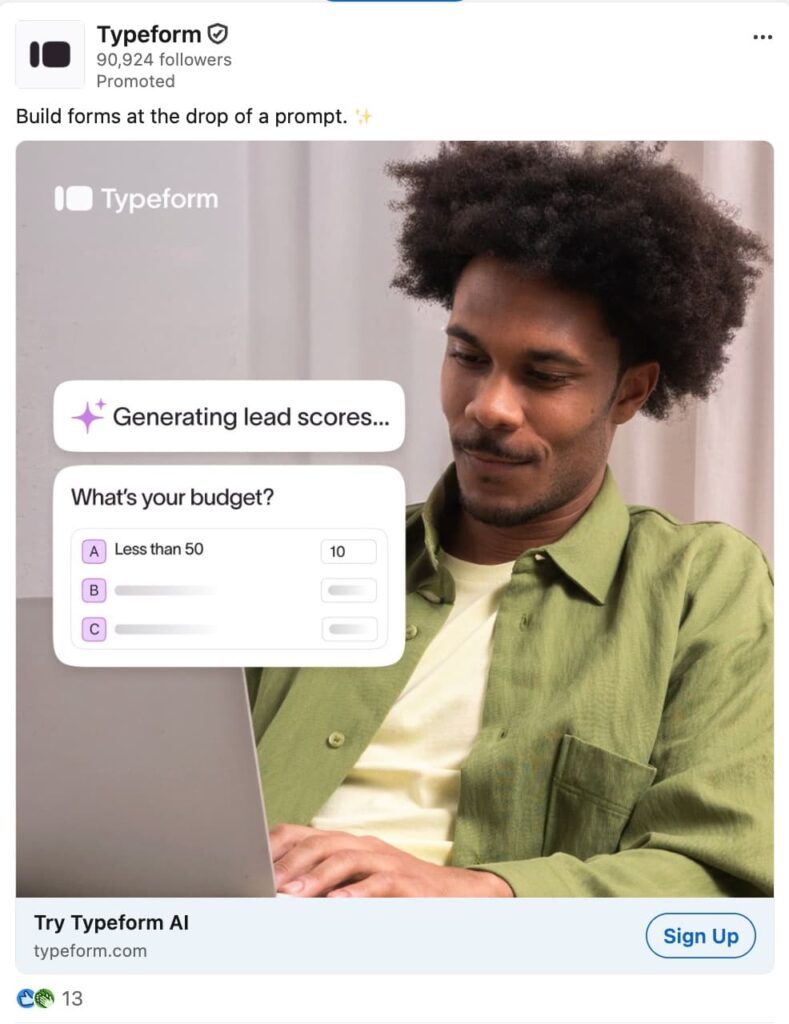
They benchmark at the platform-average CTR of 0.44%, with well-optimized campaigns hitting 0.6 to 0.8% — predictable, easy to produce, a solid baseline for retargeting and bottom-funnel conversion campaigns alike.
Video ads
Video Ads are 15 to 30-second video creatives in the LinkedIn feed, autoplayed silently with captions carrying the message. They drive higher engagement on awareness-stage campaigns — LinkedIn reports up to 5x higher interaction rates versus static formats.
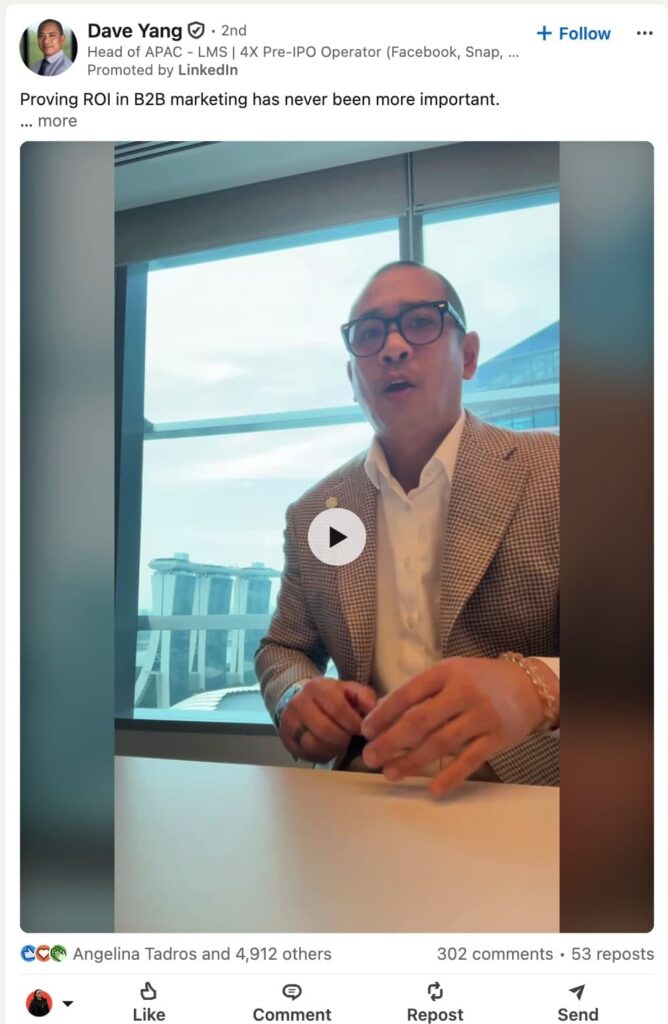
They cost more per impression but generate stronger CTR on cold audiences and tend to lift retargeting performance later in the funnel. Use video to introduce a problem you solve; save the conversion ask for the next touch.
Carousel ads
Carousel Ads are swipeable in-feed sequences of 2 to 10 cards (1080×1080 each), each with its own headline and CTA. They outperform Single Image when the story benefits from progressive reveal.
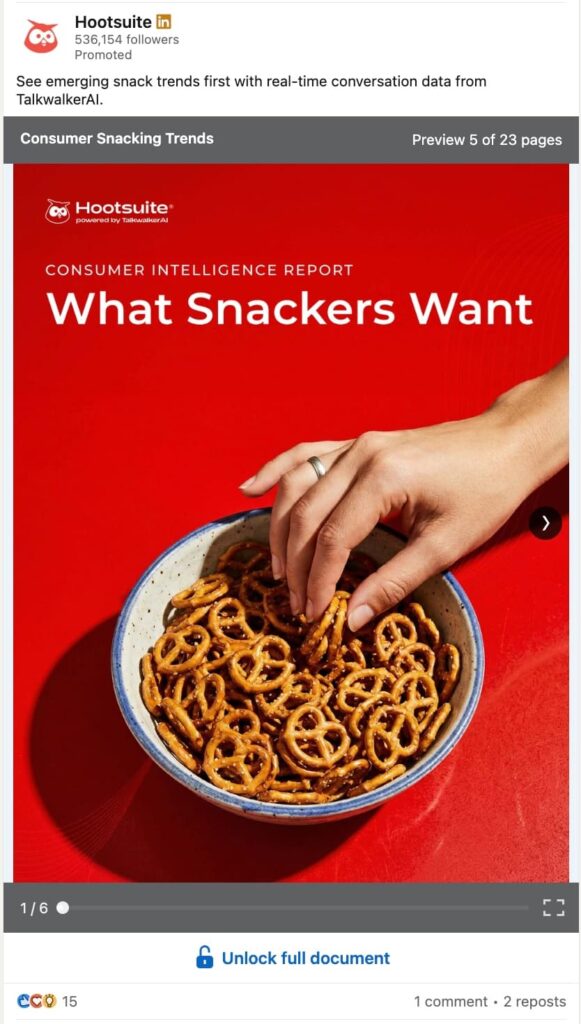
A carousel that’s just one image stretched across five cards underperforms — the format only earns its place when each card moves the narrative.
Document ads
Document Ads let prospects read or download a PDF directly inside their LinkedIn feed. Pair them with a Lead Gen Form and they consistently produce the lowest CPL of any format — typically $45 to $65.
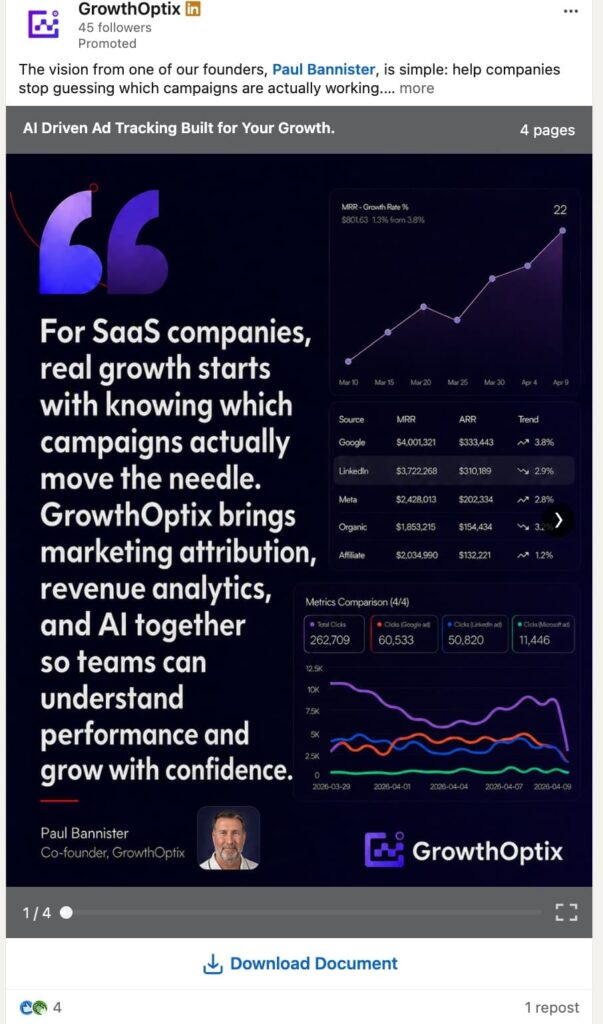
Dwell time is high (people actually read the document in-feed), which LinkedIn rewards in the auction with cheaper distribution. Use them for gated content, benchmark reports, and webinar sign-ups.
Conversation ads
Conversation Ads are a branching version of Message Ads — the recipient lands in their inbox with one opening message but multiple CTA paths (book a demo, download an asset, watch a webinar) and clicks the option that fits their stage.
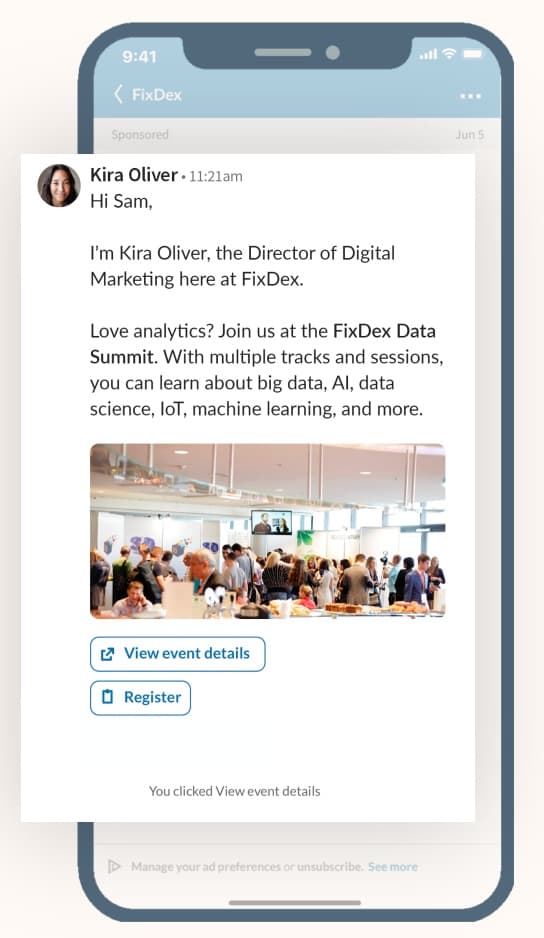
Open rates land 30 to 50% with click-through 5 to 10% across the branches.
They cost more per send than Sponsored Content, but a single ad covers multiple offers without forcing the prospect into one CTA — useful when your ICP spans mixed buying-stage contacts.
Message ads
Message Ads (formerly Sponsored InMail) deliver one message into the LinkedIn inbox without branching.
Open rates run 35 to 55% with click-through 3 to 5% of opens — strong engagement, but cost per engaged click is steep, and LinkedIn caps how many messages a member receives per month.
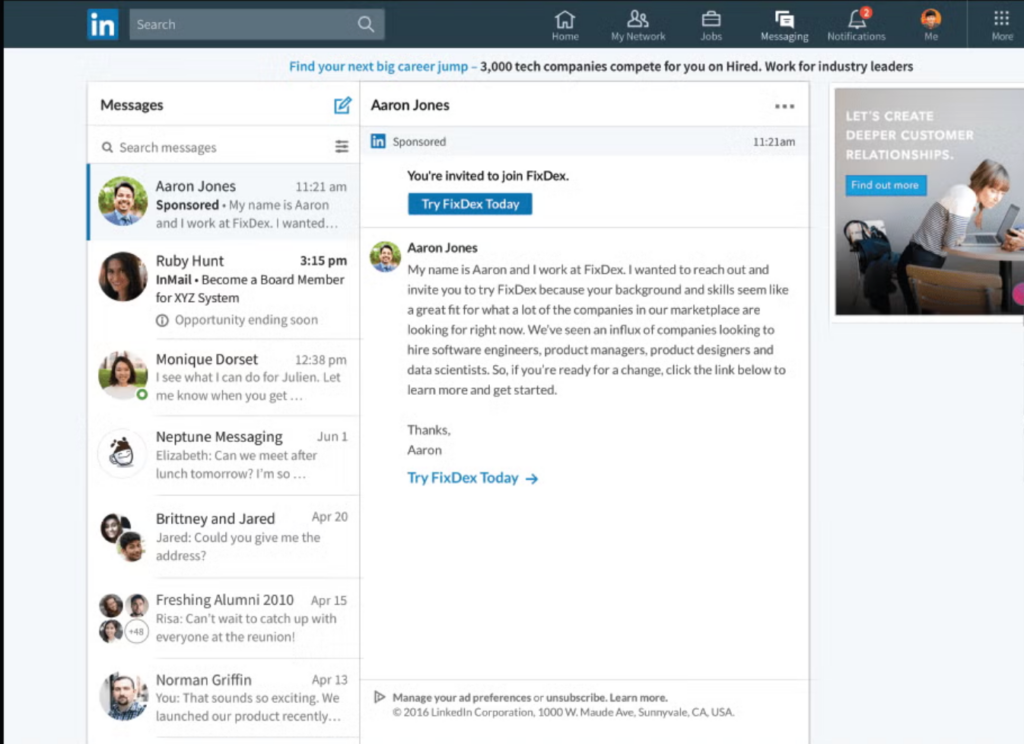
The format works for high-intent campaigns to a small, qualified list, not broad-reach plays.
Text ads
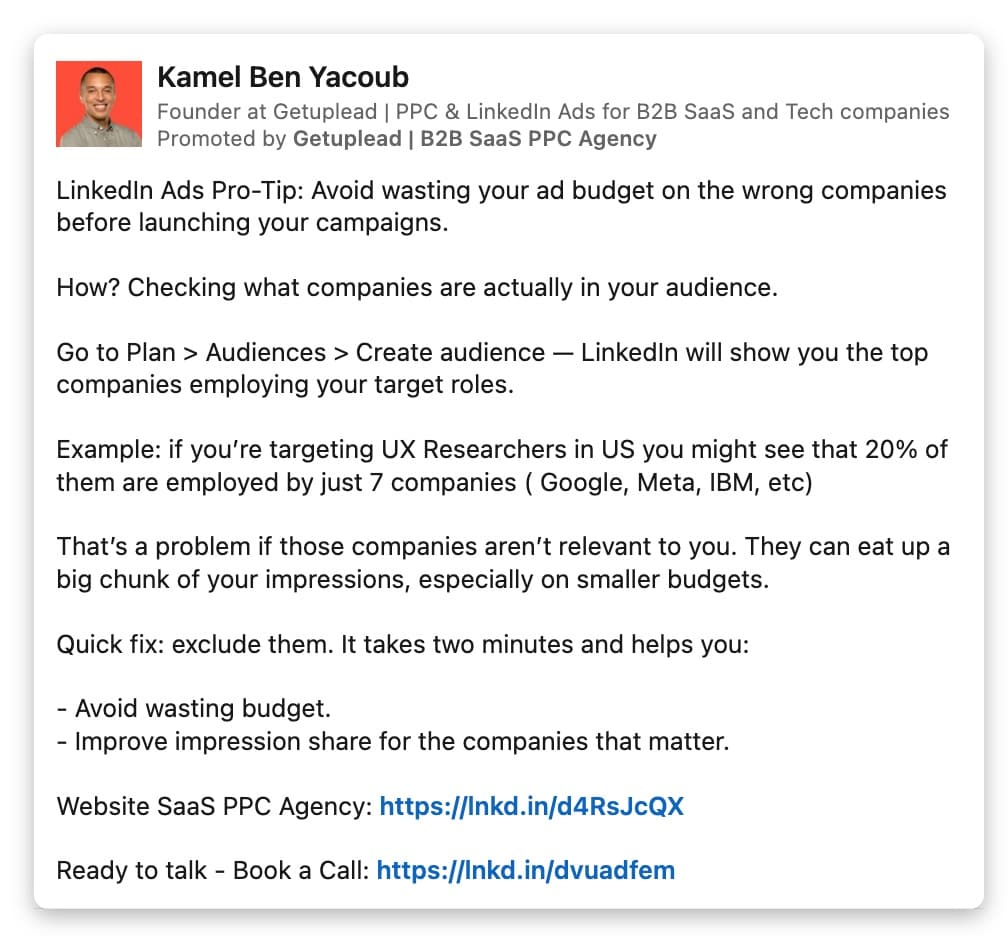
Text Ads are small text-only ads in the LinkedIn right rail and top banner. CPCs are cheap ($2 to $6), CTRs are tiny (0.02 to 0.05%) — useful for niche retargeting and brand reinforcement on a budget, rarely strong enough to drive pipeline on their own.
Across these 8 formats, one more choice matters as much as which ad type you run: where the conversion happens.
LinkedIn Lead Gen Forms are a native conversion mechanism you can attach to most Sponsored Content and Sponsored Messaging formats — instead of sending the click to your own page, the prospect submits a form pre-filled with their LinkedIn profile data right inside the feed.
Thought Leader Ads — the format you might be sleeping on
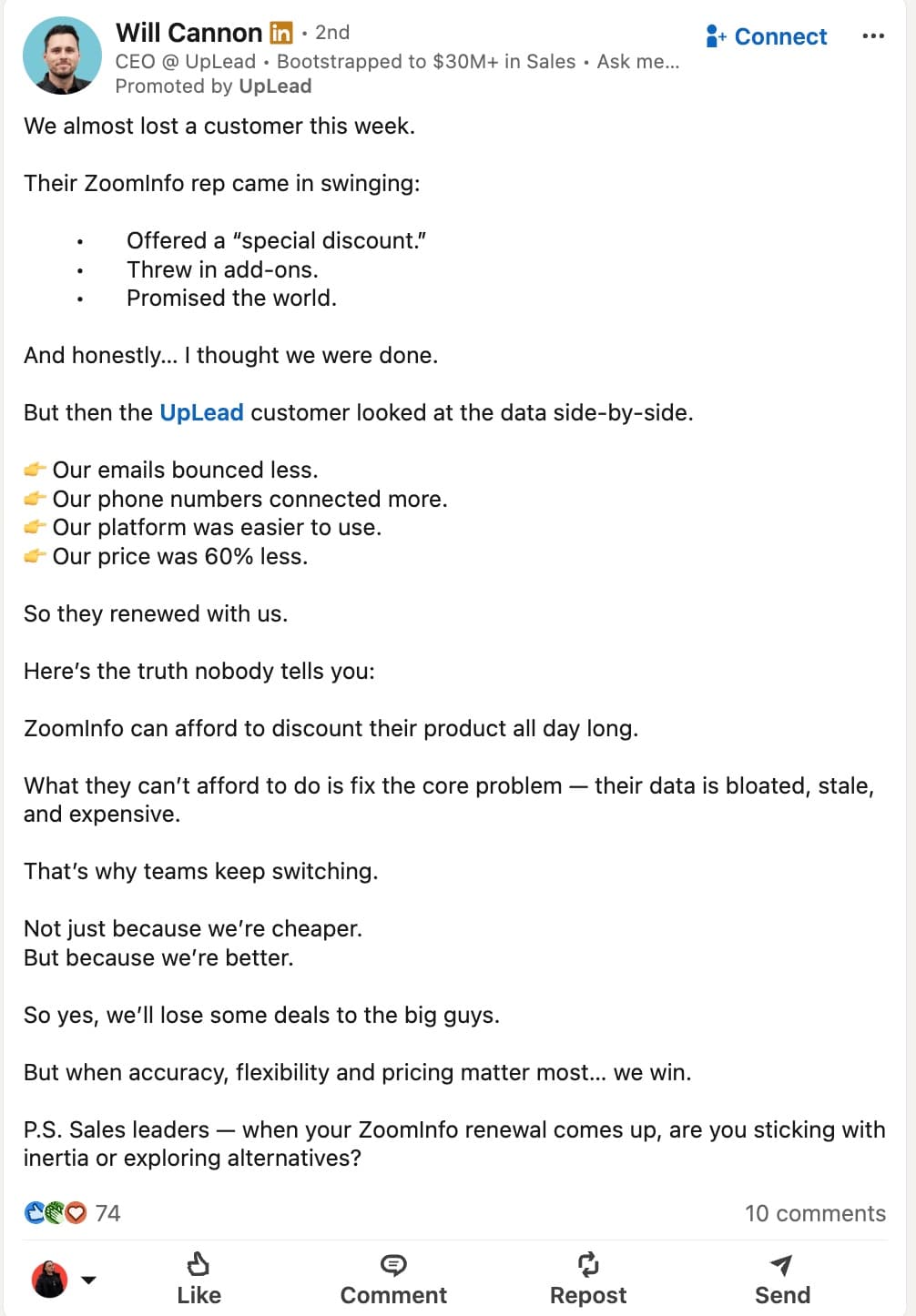
Thought Leader Ads promote posts from employee personal profiles as paid Sponsored Content.
They feel like organic posts in the feed, generate trust faster than logo-led brand ads, and produce CPC roughly 45% lower than standard Sponsored Content while delivering up to 2x higher CTR.
The mechanic is simple: a founder, CMO, or sales leader posts something useful.
Marketing puts paid budget behind that post. The ad looks identical to the organic post except for a “Promoted” label, which means it inherits the credibility a personal voice carries on LinkedIn. The auction notices the higher engagement and rewards the format with cheaper distribution.
Wes Bush of ProductLed framed it this way in his GTM Society interview:
“You can’t escape the human aspects of scaling up. People want to work with the person they know, like, and trust.”
That’s why Thought Leader Ads outperform corporate brand ads. People trust people more than logos.
Alina Vandenberghe, co-founder and co-CEO of Chili Piper, has been explicit that 50% of Chili Piper’s pipeline comes from personal social posts. Dave Gerhardt, who built marketing at Drift and Privy and now runs Exit Five, frames the broader principle this way:
“B2B marketing has shifted to digital. But digital does not mean ads. People don’t hang out on your website — they hang out on social platforms.”
The implication for paid: ads do their best work when they sit on top of organic thought leadership.
When they’re the only thing a brand does on the platform, the format doesn’t carry the same lift. Thought Leader Ads bridge that gap.
The format is underused for two reasons.
- You don’t have an executive who posts regularly,
- You are nervous about formalizing the post selection process
Both obstacles are solvable.
The simplest playbook is a monthly review where marketing and the executive pick two or three posts already performing organically, then put $1,000 to $3,000 of paid budget behind each over the following four weeks.
The cheapest, highest-converting LinkedIn ad you can run is usually a sponsored version of a post that was already working.
5 LinkedIn ads targeting layers that reduce waste in 2026 — who you exclude matters as much as who you include
The five highest-impact targeting layers are:
- Job Title.
- Seniority Level.
- Company Headcount.
- Geography.
- And Matched Audiences (CRM list upload or website retargeting).
The fastest way to reduce wasted budget is through exclusions: cut current customers, competitors, job seekers, students, and regions you don’t serve.
Job Title targeting is precise but narrow.
LinkedIn’s Job Title field uses standardized tags, so “Director of Marketing” and “Marketing Director” map to the same group.
Always combine with Seniority Level and Company Size when title is ambiguous. About 40% of “Directors” at small companies function as individual contributors with no buying authority — without a Company Headcount layer, you’ll waste a lot of budget on the wrong end of the same job title.
A VP at a 50-person company differs fundamentally from a VP at a 5,000-person company in budget and decision power.
Job Function is broader than title and useful when titles vary widely across organizations. Seniority + Function + Company Size is the workhorse combination for most B2B campaign types.
Matched Audiences is where the highest-impact targeting happens.
Upload your CRM list or your target account list and LinkedIn will match it against member profiles, typically resolving 30 to 60% of contacts on clean, recent CRM data.
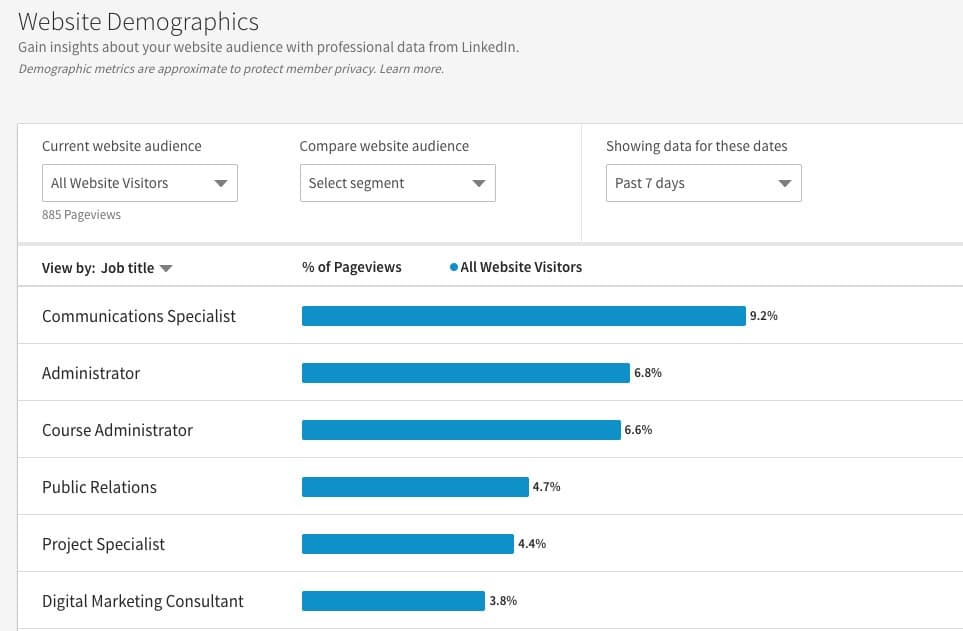
Layer on website retargeting from your LinkedIn Insight Tag and you have warm audiences who already know your brand.
Lookalike Audiences extend the same logic outward — LinkedIn builds a model from your best customer list and finds members who share their profile attributes.
ABM-active brands consistently report higher win rates, and LinkedIn’s matched and lookalike audience tools support the motion natively.
Don’t skip exclusions.
Build the lists for current customers, competitors (so you stop showing them your messaging), active job seekers, students, and any geography you don’t sell into. A clean exclusion list often saves more budget than tightening the inclusion side.
LinkedIn retargeting and Matched Audiences — where the cheaper conversions live
Retargeting website visitors and CRM contacts on LinkedIn typically delivers CPLs 40 to 60% lower than cold prospecting, with higher conversion rates because the audience already knows your brand.
Don’t spend 100% of your LinkedIn budget chasing cold audiences when you can invest in cheaper conversions.
The setup is simple:
- Install LinkedIn’s Insight Tag.
- Build segments for visitors of high-intent pages (pricing, product, demo).
- Run dedicated campaigns to those segments with offers matched to their stage.
Pricing-page visitors get a “see it in action” demo CTA. Product-page visitors get a case study or comparison piece. Newsletter readers get a webinar invite.
Pair retargeting with a CRM upload of your top target accounts and you have the foundation of any account-based motion.
Marketing runs paid against the list, sales runs personalized outbound against the same list, and both teams measure success on pipeline created from those accounts.
The same retargeting logic carries over to outbound — Expandi’s trigger-based outreach setup uses the same engagement signals (page visits, content downloads) to trigger personalized LinkedIn messages.
LinkedIn ads budget framework — work backward from pipeline
Set your LinkedIn budget by working backward from a pipeline target rather than from what your team can afford to spend per month.
Start with the pipeline number, derive cost per qualified opportunity, and size spend from there. For most B2B SaaS companies, a realistic LinkedIn cost per qualified opportunity ranges from $2,000 to $8,000 depending on ACV and sales cycle.
The framework has five steps.
- Calculate your target number of closed deals this quarter.
- Determine your average win rate from marketing-generated pipeline (most B2B teams land between 15 and 30%).
- Calculate how many qualified opportunities you need.
- Multiply by your expected LinkedIn cost per qualified opportunity.
- That’s your budget floor for the quarter.
The minimum threshold is non-negotiable.
Budget at least $50 to $100 per day per campaign to exit LinkedIn’s learning phase, which usually requires around 50 conversion events per month.
Below that threshold, you generate data too slowly to optimize and end up making decisions based on noise. LinkedIn’s $10 daily floor is a technical minimum that won’t deliver a viable starting program.
Sustainable B2B campaigns generally need $3,000 to $5,000 per month at minimum, and meaningful test budgets for new audiences usually start at $1,500 to $2,500 per month per campaign.
If those numbers feel out of reach for your stage, smaller LinkedIn campaigns usually won’t fix it.
The better move is to delay paid until your organic and outbound motion is producing repeatable results, then layer paid on top. Our breakdown of lead generation cost benchmarks walks through how cost-per-lead ranges shift across channels as a sanity check.
How to coordinate LinkedIn ads with outbound sales (5-step playbook)
When you run LinkedIn ads to the same accounts your sales team is prospecting, conversion rates lift on both sides.
The prospect sees your brand in the feed, then receives a personalized message from a rep who references the same pain the ad addressed.
If you run paid and outbound in silos, you’re splitting effort across different account lists, which costs you the compounding effect coordinated teams get on every account they touch.
The mechanics aren’t hard, but almost no one runs the play because marketing and sales rarely share the operational layer.
Five steps to do it right.
Step 1: Build a shared target account list
Marketing and sales work from the same 200 to 500 high-fit accounts. If marketing is running ads to one set and sales is prospecting another, you’re splitting effort across two half-baked motions instead of concentrating force on one.
Build the list collaboratively from your ICP definition.
Most teams find the cleanest version comes from filtering recent closed-won and high-velocity opportunities, then pulling the closest lookalikes by industry, employee count, and tech stack.
Get sales to sanity-check the list before any budget gets spent.
Step 2: Run ads as air cover for outbound
Marketing runs Sponsored Content (ideally Thought Leader Ads from a founder or sales leader) to the shared target list.
The goal is brand familiarity. By the time the sales rep sends a connection request or first message, the prospect has seen your brand and the founder’s face in their feed several times.
Response rates increase because outreach feels like a continuation of a conversation.
Step 3: Use ad engagement as a sales signal
When a contact from your target list clicks an ad, visits a high-intent page, or downloads a Document Ad, that’s a buying signal.
In the highest-performing setups, sales gets the engagement signal the same day. Pull the engagement data out of LinkedIn Campaign Manager and pipe it into your CRM or your sales engagement tool, then route the alert to whichever rep owns the account.
This turns the ad from a marketing activity into a sales trigger.
Chris Walker has been pushing signal-based selling as the right successor to MQL-driven pipeline.
His framework: adding engagement data from paid campaigns into your analytics stack tells sales where to focus, instead of cold-calling a list alphabetically.
He’s also a vocal advocate for self-reported attribution — adding a “How did you hear about us?” free-text field on high-intent forms — because what customers report about their buying journey is consistently different from what tracking pixels show.
We’ve written about signal-based outreach in more depth — the same logic applies to ad-engagement signals.
Step 4: Personalize outreach that references the ad
The outreach message should never say “I saw you clicked our ad.” It should reference the same topic, pain point, or insight the ad promoted. “Saw you’ve been digging into [topic] — we just published research on that. Worth a look.”
This is where Expandi fits the workflow naturally.
Once your shared list is set, Campaign Builder creates the outreach sequence (connection request, personalized first message, value-add follow-up).
Smart Sequences adapt based on engagement:
- If the contact downloaded the asset the ad promoted, the message references that specific resource.
- If they didn’t, the message takes a different angle.
Signals catches when ad-targeted contacts engage organically (profile visits, post likes, comments on company content) so reps know both who to reach out to and the moment to do it.
We’ve covered the broader approach to scale personalized outreach without adding headcount in a separate teardown.
Step 5: Measure both teams on shared pipeline
Stop measuring marketing on MQLs and sales on meetings booked.
Both teams should be measured on the same number: qualified pipeline created from the shared target accounts. When the metric is shared, the incentive to coordinate becomes automatic.
Walker, again, is direct on this:
“The way companies measure success of marketing and sales by design creates misalignment. This is a problem at the executive level and that’s it.”
Shared measurement is the thing that makes coordination stick. Without it, both teams default back to their own metrics. Our GTM leader’s guide to pipeline attribution walks through how to wire shared measurement up across marketing, sales, and revenue ops without losing the signal in the handoff.
When to invest in LinkedIn ads (and when organic or outreach are enough)
LinkedIn ads earn their premium when your average deal value is north of $5,000 and your sales cycle involves multiple decision-makers.
If you’re pre-revenue or selling low-ACV products, start with organic (content + outbound) and add paid once you’ve validated your messaging and audience.
Our analysis of 70,000+ campaigns in the State of LinkedIn Outreach report found that direct LinkedIn outbound averages a 10.3% reply rate against 5.1% for cold email — meaning the organic outbound layer alone often produces meaningful pipeline before paid enters the mix.
Frame the decision honestly. Not every company needs LinkedIn ads. Nick Tomic built Face2Face’s first customer base from 30 manual LinkedIn messages before adding any paid layer.
Remember that paid amplifies an existing motion. Without organic or outbound producing something, paid spend rarely produces meaningful pipeline on its own.
The companies running the cleanest LinkedIn ad programs almost always have a founder or sales leader posting consistently, a clear ICP, and at least one repeatable outbound motion. Paid joins those three things instead of replacing them.
For the organic side of the same playbook, our LinkedIn networking guide walks through the strategies that pair best with a paid program.
LinkedIn ads FAQ
Plan for 30 to 90 days before judging campaign performance. Retargeting campaigns to warm audiences usually start producing measurable conversions within 30 to 45 days, while cold prospecting and ABM plays often take 3 to 6 months to show positive ROI on the full sales cycle. Weekly performance reviews are fine for spend pacing; campaign-level decisions need at least a month of stable data.
Sponsored Content runs in the feed (Single Image, Video, Carousel, Document, Thought Leader Ads) and competes for attention while users are scrolling. Sponsored Messaging delivers Conversation Ads or Message Ads directly into a member’s LinkedIn inbox, where they’re already in work mode.
Members who see Sponsored Content first and then receive a Sponsored Message convert at roughly 2x the rate of those who only see the message — the formats are most efficient when stacked.
Yes. The Insight Tag is free and unlocks website retargeting, conversion tracking, and audience insights the moment you do start running ads. Install it now even if your first paid budget is six months away — you’ll have a warm retargeting pool ready instead of starting from zero.
The tag also picks up traffic from non-LinkedIn channels, which means you can retarget visitors driven by SEO, email, or other paid channels.
Not directly through LinkedIn. LinkedIn doesn’t share user-level click data with other platforms. The workaround is to drive ad traffic to your own landing pages, fire your own pixels (Meta Pixel, Google Tag, etc.) on those pages, and retarget from there.
CRM-based audience uploads are the second route — match the contacts who clicked into your CRM, then upload the list to Meta or Google as a custom audience.
LinkedIn runs a second-price auction weighted by relevance score, not just bid amount. The platform looks at predicted CTR, expected engagement, and historical performance of your account, then multiplies that by your bid to produce a relevance score. Higher engagement lowers your CPC over time — which is why Thought Leader Ads tend to win the auction at lower bids than corporate brand ads.
Putting it all together
LinkedIn ads work when they generate qualified pipeline rather than just leads. The companies getting the best results are coordinating paid, organic, and outbound into a single motion that hits the same accounts from every angle.Start a 7-day Expandi free trial and build the outbound side of your LinkedIn motion.

You’ve made it all the way down here, take the final step