How Much Does Lead Generation Cost?

Key Takeaways
- Lead generation costs range from $25 to $840 per lead depending on the channel, and $91 to $982 per lead depending on your industry.
- The biggest cost lever isn’t which channel you pick; it’s how precisely you target and how well your outreach converts.
- You can lower your lead generation cost by automating lead gen workflows, targeting leads who are ready to buy, optimizing your landing pages for conversions, and other tactics.
How Much Does Lead Generation Cost in 2026? Compare Your Options

How much lead generation costs depends on how you choose to buy the pipeline: an agency retainer, an in-house SDR team, paid advertising, or an automation tool your own team runs. Each option carries its own cost structure, and the gap between the cheapest and the most expensive channel runs to hundreds of dollars per lead.
Here’s what this article covers:
- What makes up your lead generation costs, from tools and salaries to purchased lists
- The five pricing models agencies charge on
- When a tool makes more sense than an agency
- Average cost per lead by channel and by industry
- Seven ways to lower your cost per lead without losing lead quality
What are lead generation costs?
Lead generation cost is the total amount you spend to acquire potential clients. You calculate it by dividing the total marketing spend by the number of leads generated.
Suppose you spend $800 on a lead generation tool and $1,000 on Twitter and LinkedIn ads to generate 50 leads, you would have spent $36 per lead.
Your lead generation costs vary by different factors, such as:
1. The technologies and tools you use
Lead generation tools speed up the process by automating repetitive tasks, allowing your sales team to focus on other demanding tasks, like closing deals.
Examples of these tools include CRMs, sales intelligence or prospecting tools, marketing automation platforms, sales engagement tools, and more.
2. Labor cost
You pay in-house experts with the necessary skills and experience to run, manage, and monitor sales campaigns across different platforms to generate leads. Although it’s a great investment, it takes time to hire and properly train the team.
According to Glassdoor, the average salary for a lead generation specialist is $76,000-$131,000 per year. You’d also need to pay for other sales automation tools and other extra costs.
3. Paid ads and promotion costs
Usually, the highest cost, this component occurs when you run paid advertising campaigns across platforms like Google (PPC) and social platforms like LinkedIn, Twitter, Facebook, and more. According to HawkSEM, the average PPC management price is $1,500 to $10,000 per month for flat-fee models. Or 10 -20% of your overall budget would be spent on ads.
4. Lead generation agencies
Hiring and training people to run campaigns can be expensive in the long run. As a result, outsource to specialists who can tap into new lead sources. However, you may receive low-quality leads in a long list. So, always prioritize services that deliver quality over quantity.
5. Incentives and rewards
Offering discounts, free trials, or physical gifts to prospects can accelerate pipeline — but it’s one of the more expensive ways to generate a lead.
Physical gifting campaigns in particular carry high per-contact costs once you factor in the gift itself, fulfilment, and the logistics of targeting the right people. They work best when reserved for high-value accounts where the deal size justifies the spend, not as a broad top-of-funnel tactic.
6. Purchased lead lists
Buying contact data shifts spend from salaries to a data provider. Prices depend on the vendor and on how much enrichment sits behind each record, and cheaper lists tend to carry more contacts who have changed roles or left the company.
The costs that don’t appear on the invoice are harder to plan for. Hitting spam traps damages sending reputation across every campaign on that domain, and a list compiled without consent creates GDPR exposure. Verify a sample of records before loading the full file into a sequence, and check what the provider’s refund policy covers for invalid contacts.
5 common lead generation pricing models
Every lead generation agency has a pricing model for its clients. As a business, the right model should align with your needs, goals, risk tolerance, and the actual impact it has on revenue growth. Note that not all pricing models mean better work or results.
That said, here are some common lead-generation pricing models to consider for your business.
1. Monthly retainers
In a monthly retainer pricing model, you pay a fixed monthly fee to cover sales prospecting services, including strategy, research, tools, SDRs, and execution. This contract runs for at least 3 months and can be extended for up to 12 months.
According to Callbox, the average retainer-based rate ranges from $3,000 to $25,000, depending on the size, complexity, and scale of your addressable market. The good part is that agencies deliver consistent results, such as driving traffic, building a sales funnel, and monitoring results.
However, without clear accountability, a high monthly retainer fee can result in wasted budget and no qualified meetings. So, before you choose an agency, set goals that align with both parties to keep you accountable to each other.
2. Commission-only
For commission-only models, you pay for qualified leads or sales, and the agency or affiliate earns a percentage for each lead converted. Although this model is tied to actual outcomes, it’s not sustainable in the long run for agencies. Why? They invest significant effort upfront (the strategy, research, messaging, testing, follow-ups, and deliverability) before generating leads in the pipeline.
Asking them to take that risk for months of revenue later means they’re gambling on their business. As a result, they may walk away once they find it unsustainable, leaving you with wasted onboarding time and no consistent output.
3. Pay-per-lead
This model is simple. You pay for each lead delivered to your business. According to Belkins, you can expect $20 to $200 per lead, depending on the complexity of the target market, the volume of leads required, and the level of customization.
But here’s the catch: you don’t just want any leads; you want the right leads. This only happens when the tactic is done right.
Without personalization or proper targeting, you risk having your inbox cluttered with low-qualified opportunities. After all, anyone who half-replies to your messages is a lead.
So, your calendar ends up getting filled with people who have little to no interest in your product or service. As a result, your sales team ends up having fruitless conversations rather than genuine ones that build meaningful relationships.
4. Pay-per-appointment
In this case, lead generation agencies charge you for every appointment they make for your business. Instead of chasing vanity metrics, you get outcomes that matter — real conversations with qualified prospects.
According to Belkins, the price ranges from $50 to $500. A more comprehensive service that includes lead generation, qualification, and appointment setting ranges from $1,000 to $10,000.
This cost depends on factors such as the sales process, industry, task complexity, and the provider’s reputation.
Note that this pricing model works if messaging and targeting are done right. Otherwise, you’d be wasting your budget on low-quality conversations that yield no results.
5. Hybrid pricing models
A hybrid pricing model combines a fixed rate with performance-based fees. They start with a fee that covers the basics, such as ICP research, list building, messaging, and campaign setup.
Then they tie the rest to performance-based metrics such as meetings booked, sales-qualified leads (SQLs) delivered, conversion rates, or any other metric you choose. This model offers flexibility to businesses that want structure without fully locking into rigid contract terms.
When to pick a lead generation tool over an agency?
The choice comes down to whether you have the people and the hours to run outreach yourself, because an agency is mostly selling you execution capacity you don’t currently have.
| An agency makes sense when | A tool makes sense when |
|---|---|
| You have nobody to run outreach and no plan to hire | You have an SDR, a founder, or a marketer with hours to spend on outreach |
| You need several channels running at once and don’t want to own the setup | LinkedIn is your main channel and you want to own the messaging |
| You want list building and copy handled for you | You already know your ICP and have messaging that earns replies |
| A $3,000–$25,000 monthly retainer fits your budget | You want your monthly software cost fixed and predictable |
The cost difference is the whole argument. Callbox puts agency retainers between $3,000 and $25,000 per month.
Expandi starts at $99 per month, which covers the software but not the person operating it, so the fair comparison is $99 plus your team’s time against the retainer. Start your 7-day free trial
What is the average cost per lead by channel?
The average cost per lead depends on different variables such as the industry, channel, lifetime value, and buying intent. According to Sopro’s 2025 report, the channel that costs the most is trade shows and in-person events, followed by PPC. And the cheapest channel is referrals and affiliate marketing. Here’s a full breakdown of the list.
Cost per lead benchmark by channel
| Channels | Cost per lead (CPL) |
|---|---|
| Trade shows and in-person events | $840 |
| PPC | $463 |
| Paid LinkedIn advertising | $408 |
| Cold calling | $300 |
| Webinars | $267 |
| Direct mails | $250 |
| Cold emails | $225 |
| SEO | $206 |
| Multi-channel prospecting | $188 |
| Paid Facebook advertising | $142 |
| Affiliate marketing | $73 |
| Referrals | $25 |
What’s the average cost per lead by industry?
FirstPageSage’s report for 2025 revealed the average cost per lead for 30 industries, differentiating the paid and organic costs for each sector.
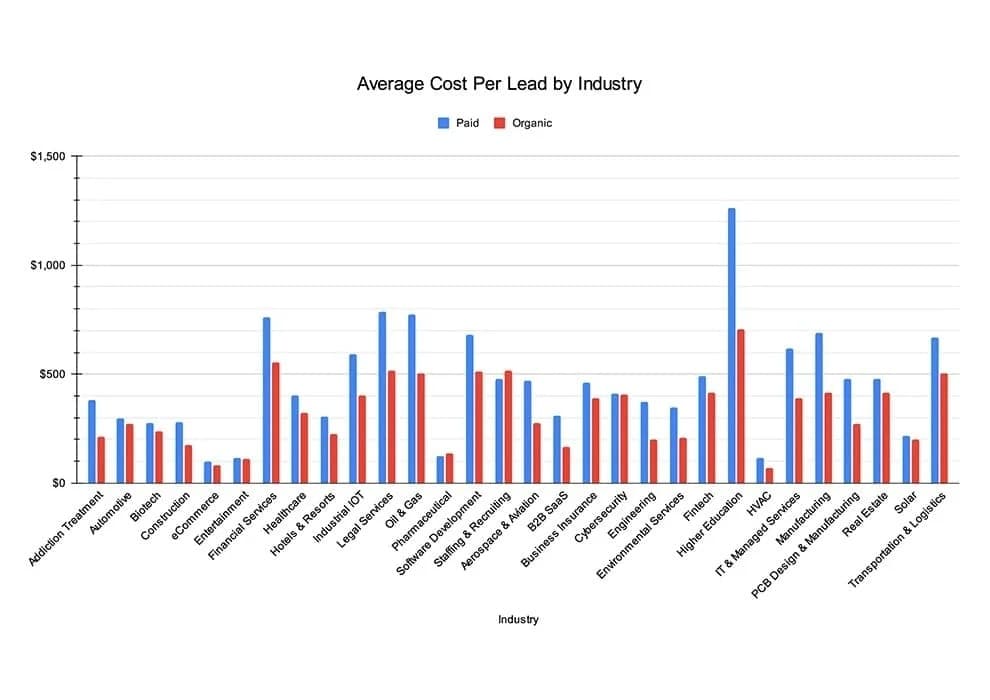
Below’s a full breakdown of the report.
| Industry | Paid CPL | Organic CPL | Blended |
|---|---|---|---|
| Addiction Treatment | $380 | $213 | $297 |
| Aerospace & Aviation | $469 | $277 | $373 |
| Automotive | $295 | $271 | $283 |
| B2B SaaS | $310 | $164 | $237 |
| Biotech | $274 | $236 | $255 |
| Business Insurance | $460 | $388 | $424 |
| Construction | $280 | $174 | $227 |
| Cybersecurity | $411 | $404 | $406 |
| eCommerce | $98 | $83 | $91 |
| Engineering | $371 | $201 | $287 |
| Entertainment | $116 | $111 | $114 |
| Environmental Services | $346 | $207 | $278 |
| Financial Services | $761 | $555 | $653 |
| Fintech | $490 | $413 | $452 |
| Healthcare | $401 | $320 | $361 |
| Higher Education | $1,261 | $705 | $982 |
| Hotels & Resorts | $308 | $224 | $266 |
| HVAC | $115 | $69 | $92 |
| Industrial IOT | $590 | $404 | $497 |
| IT & Managed Services | $617 | $385 | $503 |
| Legal Services | $784 | $516 | $649 |
| Manufacturing | $691 | $415 | $553 |
| Oil & Gas | $772 | $502 | $637 |
| PCB Design & Manufacturing | $480 | $271 | $376 |
| Pharmaceutical | $124 | $135 | $131 |
| Real Estate | $480 | $416 | $448 |
| Software Development | $680 | $510 | $591 |
| Solar | $217 | $196 | $206 |
| Staffing & Recruiting | $476 | $518 | $497 |
| Transportation & Logistics | $670 | $505 | $588 |
How Do I Lower My Lead Generation Cost?
You can lower cost per lead in one of two ways: spend less to reach the same people, or convert more of the people you already reach. These seven tested strategies work on one or both.
1. Audit your current lead generation cost drivers
Before you make any changes to your strategies, you need to identify where your money goes and what you’re getting in return. First, export your data from the past 90 days and identify the patterns embedded in it.
- Which campaign delivered quality leads at a reasonable cost?
- Which ones did you spend money on without generating real cost?
Next, rank the results in a spreadsheet to identify the highest and lowest cost-per-lead. Then, identify the channel that’s responsible for the cost. Perhaps it’s an ad with the wrong keyword that attracted the wrong audience.
Or the time you send those cold emails to prospects. The point is, you must identify the reason behind the high cost per lead to fix the problem. Otherwise, you may keep wasting your funds and efforts.
If LinkedIn outreach is part of your mix, Expandi’s campaign analytics break down reply rates, connection acceptance rates, and CPL per sequence — so you can see exactly which messages are earning their cost and which aren’t.”
2. Automate lead generation
Manual prospecting is time-consuming and exhausting. Instead, use a reputable lead generation tool to automate the sales process so you can focus on actual selling.
You don’t need many tools in your stack; you need the right one that aligns with your needs and delivers accurate data to supercharge your lead generation efforts.
Expandi is a top-rated LinkedIn automation tool that pulls live engagement signals from LinkedIn and turns them into outreach sequences.
“My favorite automation tool is Expandi. I’ve tried about a dozen different ones, and in terms of settings and stability, this is the best. You can also send emails with it.” — Andrew Bush, Founder and CEO at A17.
3. Identify your target audience
It’s hard to optimize your lead generation cost when you target a broad or wrong audience. The fix is to identify your target audience to prevent wasting time and effort on the wrong ones.
Here’s how:
- Conduct thorough market research to identify your ideal customer profile (ICP). Run surveys and conduct customer interviews to identify their needs, wants, pain points, and interests.
- Create a detailed buyer persona to deeply understand your target audience’s demographics, motivations, and goals. This will turn the abstract market research into more relatable profiles.
- Analyze competitors to gain insights into how competitors think and behave.
- Use social media insights to immerse yourself in conversations with your ideal buyers. This will let you know what they’re saying about your business and help you identify what matters to them.
- Use a B2B prospecting tool to find leads and filter them by specific criteria, such as job title, industry, revenue, and more. Expandi’s lead list filtering lets you segment by job title, industry, company size, and geography directly from LinkedIn Sales Navigator, so your outreach starts with the right 500 people, not a bloated list of 5,000.
Identifying your target audience helps you improve the cost-effectiveness of your lead generation efforts and get a quicker return on investment.
4. Target leads when they are ready to buy
Targeting leads with the right intent to buy increases the likelihood of sales when compared to generic, unsolicited outreach. To find the right leads at the right time, use intent data tools to perform signal-based outreach.
Expandi offers this feature called Signals. When a prospect reacts to your LinkedIn posts, you can extract their details with the LinkedIn automation tool and engage them in an evergreen campaign, enabling you to not miss out on potential sales opportunities.
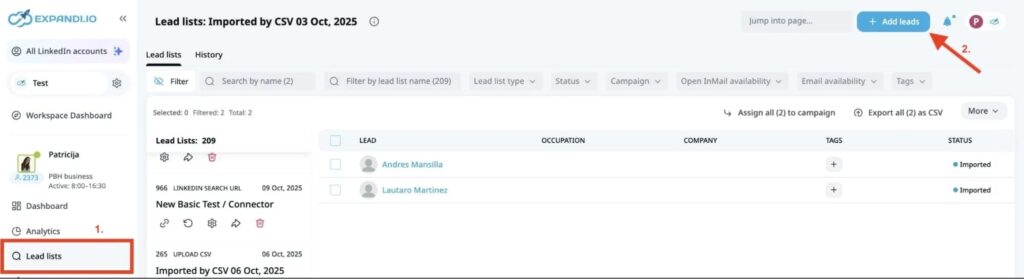
Here’s how it works. From your LinkedIn profile page, copy the link to one of your posts. Return to your Expandi’s dashboard and click “Lead list” >> “Add list.”
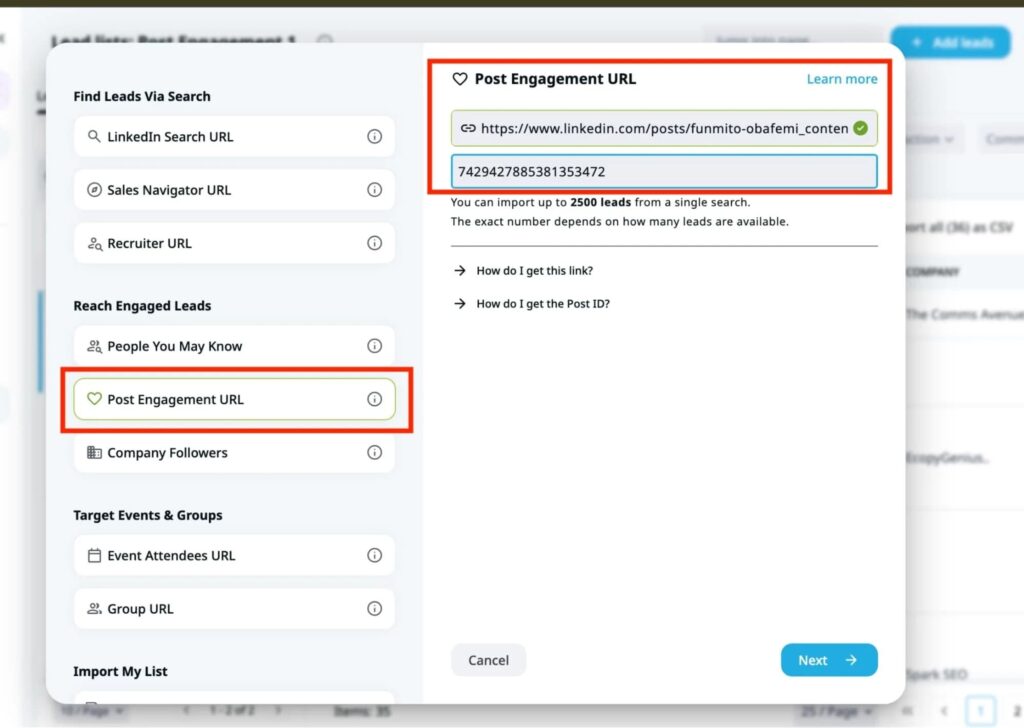
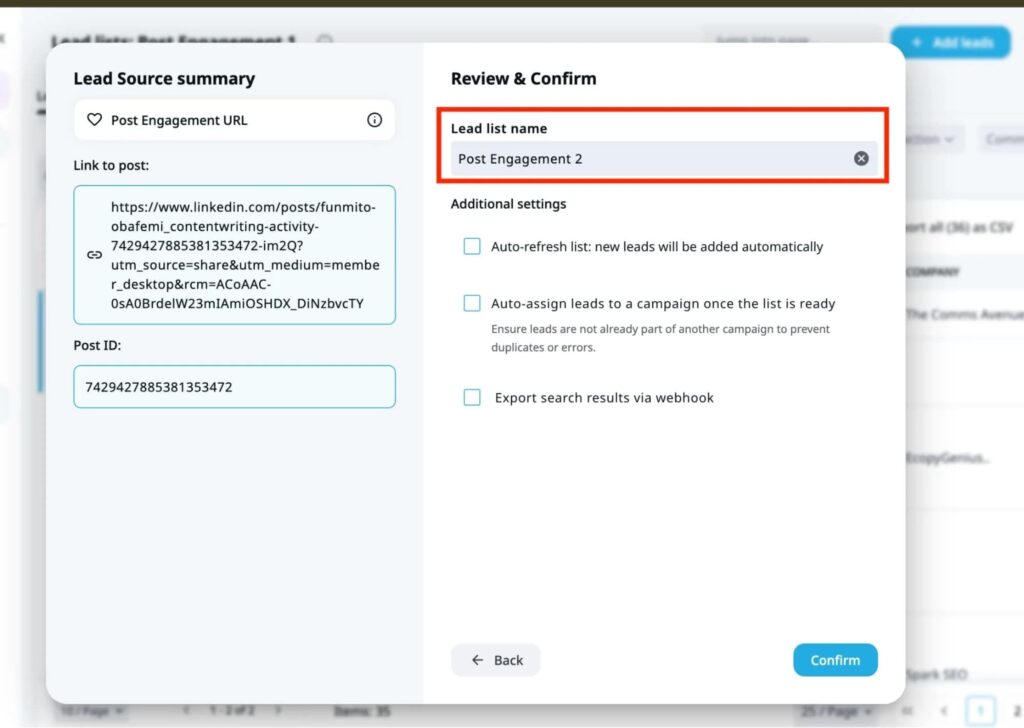
Then, choose “Post engagement URL,” paste the link you copied earlier from your LinkedIn post, and insert your post ID. The post ID is a series of figures in your post URL.
Click “Next” and name your lead list with your preferred title. Tick the box to confirm whether you want Expandi to auto-update your list and push it to an outreach sequence. Then click “Confirm.”
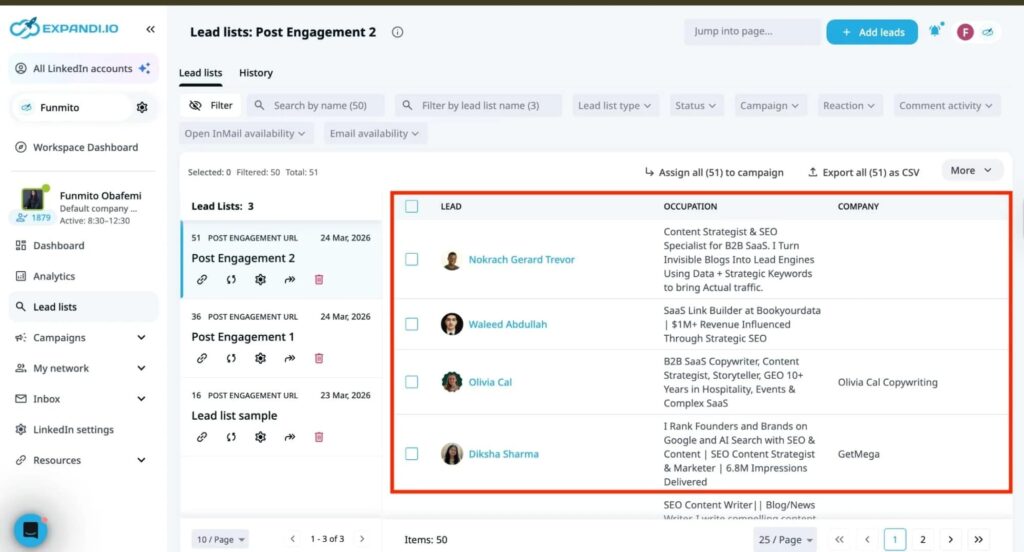
Wait for about two to three minutes, and Expandi will extract the details of those who engaged with your post in real-time. You will find their full names, job titles, company names, and status to further advance your LinkedIn outreach.
5. Use inbound marketing methods to nurture leads
Rather than investing your time, money, and efforts to chase leads, why don’t you set up a system that attracts them to you? An inbound marketing method like SEO content marketing attracts qualified leads who are most likely to convert.
With an SEO-optimized content strategy, you devise a plan to attract leads with high purchasing intent. For example, MOFU and BOFU content, like how-to guides and comparison pages, earn readers’ trust and position you as thought leaders in your industry. So when they gain your trust, they can easily come to you when they are ready for your products and services.
The overlap between inbound and outbound is where costs drop fastest. When someone engages with your LinkedIn content — a like, a comment, a share — they’ve already signaled interest. Expandi’s Signals feature captures those people automatically and moves them into an outreach sequence, so your warm leads don’t go cold while you’re focused elsewhere.”
6. Fix your landing page to convert more visitors
You can have the perfect ads and target the right people, but if your landing page fails to convert, your CPL remains high. To make your landing page work, start with the message.
For example, if your ad promises “Free lawn mowing,” your landing page should have the same headline, not “Professional mowing services.” Otherwise, it’s clickbait, which makes visitors trust you less and deters them from visiting your site.
Also, clear the path to the desired goal you want your visitors to perform. Remove navigation menus, links, and sidebars that can distract visitors from conversion. Create single-focused pages that guide visitors to your desired action: filling out a form or booking a demo.
You can also take your page speed seriously. If your page speed takes more than three seconds to load, you lose prospects before they see what you have for them. So, use Google PageSpeed Insights to identify technical issues, compress images, and improve server response time.
Finally, test your landing pages. Ask your team members or visitors if they understand your offerings at first glance. By optimizing your landing page, you provide a seamless user experience, guide visitors towards a specific action, and ultimately improve conversions.
7. Test and refine your strategies
The only way to sustainably lower CPL is to treat your campaigns as something you measure and iterate, not set and forget.
Track CPL trends over rolling four-week windows: short enough to catch problems early, long enough to filter out noise.
When CPL rises, investigate before cutting spend: is it a targeting change, a message that stopped landing, increased competition on a channel? When something works (a high-converting ad, a sequence with an above-average reply rate), document exactly what made it work:
- Was it the opening line?
- A specific offer?
- The follow-up timing?
The goal is to build a playbook of proven tactics you can replicate and scale, rather than starting from scratch every campaign.
How much should lead generation cost your business in 2026?
There is no single, universal answer to what leads to lead generation costs. But you can expect a lead generation agency to offer a pricing model that justifies the cost. So, choose one that aligns with your strategy, capacity, and conversion goals.
That said, if LinkedIn is part of your lead generation strategy, tools like Expandi can help you run scalable, compliant outreach without immediately jumping into costly retainers.
For $99/mo, you can run your own LinkedIn and email outreach campaigns, nurture your prospects with personalized messages at scale, and gain instant campaign reports.
Curious if Expandi is right for you? Claim your free, 7-day trial and learn from here!
Ready to bring down your lead generation cost?
The lowest cost per lead comes from people who have already signalled interest, which is why the seven strategies above concentrate on targeting and conversion rather than on hunting for a cheaper channel. Switching channels moves the number. Better targeting changes the economics.
If LinkedIn is where your buyers spend their time, running outreach in-house removes the retainer from your cost per lead entirely. See what’s included on the pricing page, or start the 7-day free trial and measure your own CPL before committing to anything larger.
Frequently asked questions about lead generation costs
Lead generation typically costs anywhere from $20-$200+ per lead, depending on your industry, target audience, and lead intent. Agency retainers usually range from $3,000 per month all the way up to $25,000 per month.
There is no single average CPL. The spread is between $91 – $982, depending on the industry. Industries like legal services, financial services, and higher education sit on the higher end ($649 – $982), while ecommerce, HVAC, and entertainment tend to be lower ($91 – $114).
A good CPL is one that still produces profitable customers. A good rule of thumb: if your CPL is under 10-20% of your ACV (annual contract value), it’s usually considered healthy and sustainable.
You can lower your CPL by focusing on clear ICP targeting, high-quality data, multi-channel outreach (email + LinkedIn), personalization and segmentation, and using automation tools (like Expandi) to reduce SDR and labor costs.
Paid LinkedIn advertising averaged $408 per lead in Sopro’s 2025 benchmark, making it the third most expensive channel measured. Running LinkedIn outreach yourself with an automation tool costs $99 per month for the software, plus the time of whoever operates it. Agencies running LinkedIn outreach on your behalf sit in the same $3,000 to $25,000 retainer range as other lead generation services.


You’ve made it all the way down here, take the final step