How Sales Teams Scale Personalization Without Adding SDRs

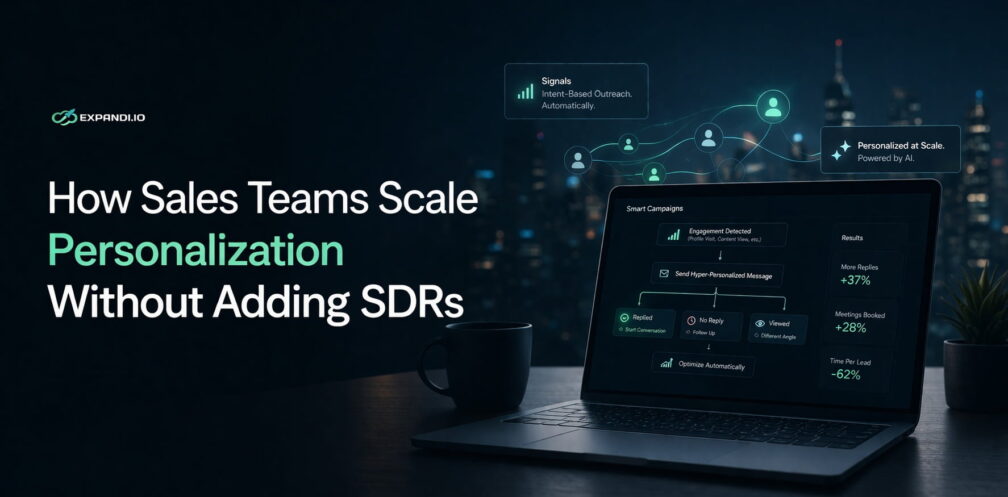
Your SDR team is at capacity. Every rep is sending as many personalized messages as they can, and pipeline targets keep climbing. And the advice you keep hearing, “just personalize more” ignores a basic constraint: there are only so many hours in a day. The instinct is to hire. But adding headcount is expensive, slow to ramp, and doesn’t solve the underlying problem: manual outreach doesn’t scale.
The teams generating the most pipeline per rep aren’t doing it by adding bodies. They’re doing it by building systems that handle the repetitive work, so their reps only spend time on conversations that matter.
This is how they do it.
The real bottleneck isn’t headcount. It’s how reps spend their time.
When personalization is manual, every part of the outreach process costs time:
- Researching a prospect
- Writing a message that doesn’t sound like a template
- Deciding when and how to follow up
- Checking if they engaged
- Choosing whether to try a different approach
- Logging the interaction
Multiply that by 50 to 80 prospects per day, per rep. The math is tight even for experienced SDRs.
Adding reps doesn’t change the underlying economics. Each new hire faces the same time constraints, needs months to ramp, and (according to Bridge Group data) will typically stay in the role for about a year and a half. You’re running to stand still.
The real question isn’t “how many more reps do we need?” It’s “how do we get dramatically better output from the team we already have?”
That question leads to three shifts.
Shift 1: Let your prospects tell you when they’re ready
Most outbound starts with a static list. You build it in Sales Navigator, upload it, and run a sequence. The problem isn’t the list itself. It’s the timing.
A prospect who was a good fit last Tuesday might be a great fit today, because this morning they visited your LinkedIn profile, read your latest post, or checked out your company page. But if they’re sitting in a drip sequence that was written two weeks ago, your outreach doesn’t reflect that shift in intent at all.
This is one of the biggest time sinks in SDR work: manually monitoring for engagement signals, re-prioritizing leads, and adjusting follow-ups based on who’s showing interest. Most teams either don’t do this (because it’s too labor-intensive) or do it inconsistently.
How the best teams handle this:
They set up systems that detect engagement signals in real time and act on them automatically. In Expandi, this is what Signals does. When someone visits your profile, views your company page, or engages with your content, Signals automatically enrolls them into a relevant campaign.
- No manual list rebuilding
- No rep checking notifications every hour
- No gap between “prospect showed interest” and “outreach sent”
The research supports this approach. Harvard Business Review found that companies responding to leads within an hour were seven times more likely to qualify them. On LinkedIn, where intent signals are fleeting, the window is even shorter. If someone checked your profile at 9am and your rep doesn’t notice until their afternoon prospecting block, that moment is gone.
Signals turns your LinkedIn presence into a continuous lead generation engine. The warm prospects surface themselves, and the system acts before the intent window closes.
The key insight: You’re not increasing outreach volume. You’re increasing outreach relevance. Every conversation starts with a built-in advantage, because the prospect already showed interest.
Shift 2: Separate the thinking from the doing
When an SDR runs outreach manually, the thinking and the doing are bundled together. They research a prospect, decide what to say, write the message, send it, decide when to follow up, check if the prospect engaged, pick a different angle for the second touch, and repeat.
The thinking (what should I say to this person?) is high-value. The doing (executing the follow-up logic, checking engagement, routing between steps) is not. But in a manual workflow, both take the same amount of time.
The shift here is to build the decision logic once, and let campaigns execute it for every prospect automatically.
How this works in practice:
Expandi’s Smart Campaigns let you map out the full outreach journey in advance:
- If a prospect accepts the connection, what’s the next step?
- If they don’t respond to the first message, what happens after 5 days?
- If they view your profile after a message but don’t reply, does that trigger a different follow-up?
Builder campaigns support up to 50 steps with 10 actions and 10 conditions. That’s enough to model complex, multi-path outreach flows that adapt to each prospect’s behavior in real time.
The system evaluates conditions at every step, not just at the beginning. So if a prospect’s behavior changes mid-sequence, the campaign responds accordingly.
This is fundamentally different from a simple drip sequence. Drip sequences treat every prospect the same. Smart Campaigns treat every prospect as an individual journey, because the logic branches based on what they actually do.
Layer in AI Hyper personalized messages
Instead of writing each message variant from scratch, you generate contextual drafts that reflect the prospect’s profile, the campaign goal, and the stage in the sequence. Your reps review and refine. But the gap between “blank page” and “ready to send” shrinks dramatically.
Combine this with A/B testing, and the system continuously learns which message variants perform best for your audience. Your campaigns get smarter over time without anyone manually analyzing results and rewriting copy.
The compound effect
- Your reps define the outreach strategy once
- The campaign executes that strategy across thousands of prospects
- AI handles the first draft of every message
- A/B testing optimizes the messaging automatically
- Your reps spend their time on strategy and live conversations, not on repetitive execution
One SDR running well-designed Smart Campaigns in Expandi can manage 3,000+ leads per month. Not because they’re working harder, but because the system handles the operational complexity that used to eat their day.
Shift 3: Make every touchpoint feel specific
The first two shifts increase your capacity. This one increases your conversion rate.
Most outreach that claims to be “personalized” is really just templated with a few merge fields. First name, company name, maybe job title. Prospects have seen this pattern so many times that it registers as automation, not personalization.
The teams getting strong reply rates on LinkedIn go significantly deeper. They reference a specific data point that the prospect recognizes as genuine research: a recent career move, a company milestone, a shared connection’s recommendation, or a detail pulled from the prospect’s own content.
Scaling this kind of specificity manually is nearly impossible. One rep can do deep research for 15 to 20 prospects per day. Beyond that, corners get cut.
How the best teams handle this:
They use structured data to make personalization systematic rather than ad-hoc.
Custom data fields at every step
Expandi supports unlimited custom fields through CSV imports. Whatever data you have on a prospect (tech stack, recent funding, conference attendance, content topics they’ve posted about) can become a personalization variable in your campaign.
Unlike basic merge fields, these custom fields work throughout multi-step sequences, not just in the first message. Your third follow-up can reference a different data point than your first touch, keeping the conversation feeling genuine across the full journey.
Visual personalization through Hyperise
This is one of the more underutilized approaches in LinkedIn outreach. Instead of a text-only message, your prospect sees a personalized image:
- Their name on a whiteboard in your message
- Their company logo featured in a custom graphic
- A personalized video thumbnail
Expandi users leveraging visual personalization have reported up to a 55% boost in reply rates compared to text-only messages. It works because it’s visually impossible to fake at scale with manual effort, so prospects register it as genuine attention.
Why this matters: Higher reply rates from the same volume of outreach means your existing team generates more pipeline without sending more messages. You’re not scaling through brute force. You’re scaling through precision.
Putting it all together: what this looks like for real teams
These three shifts don’t work in isolation. They compound.
A 5-person SDR team at a B2B SaaS company
Before: Each rep manually prospects, writes messages, manages follow-ups, and monitors for engagement.
- ~250 personalized touches per day across the team
- Quality varies rep to rep
- Follow-up timing is inconsistent
- Reps spend at least half their day on admin and research
After: Signals feeds warm prospects into Smart Campaigns automatically. AI Hyper personalized messages generate contextual first drafts. Builder campaign logic handles the follow-up branching. Reps check Global Inbox once or twice a day, respond to interested prospects, and focus the rest of their time on discovery calls and pipeline progression.
The same five reps cover significantly more ground, with higher quality outreach, because the system handles the work that used to bottleneck them.
An agency managing 15+ client accounts
Before: Each client needs a dedicated operator to run campaigns, monitor replies, and adjust targeting. Scaling means hiring.
After: Expandi Workspaces let a lean team manage multiple client accounts from a single dashboard:
- Campaign templates standardize quality across clients
- Each client still gets tailored campaigns with custom personalization fields and unique creative
- Smart Campaigns, Signals, and Global Inbox handle the operational complexity
One operator can manage what used to require three, because the system does the heavy lifting.
A founder running their own outreach
Before: 5 to 10 hours per week on manual LinkedIn prospecting. Every hour spent on outreach is an hour not spent on product, customers, or fundraising.
After: Smart Campaigns run 24/7. Signals catches interested prospects automatically. AI Hyper personalized messages keep quality high without requiring copywriting time.
The founder checks Global Inbox once a day, responds to warm leads, and reclaims the rest of that time for building the business.
The real unlock: your team’s time is the scarce resource
Every decision about how to scale outreach comes down to one question: where should your reps spend their limited time?
If they’re spending it on researching prospects who were never going to reply, writing messages from scratch for every lead, manually checking engagement signals, or running follow-up logic in their heads, then you need more reps to get more pipeline. That’s the old model.
If they’re spending it on refining AI-generated messages, having real conversations with prospects who already showed interest, and designing campaign strategies that run across thousands of leads automatically, then the same team can produce dramatically more pipeline. That’s the shift.
Expandi exists to make that shift possible. Not by replacing your reps, but by giving them infrastructure that matches the scale of your ambition:
- Smart Campaigns for intelligent outreach logic
- AI Hyper personalized messages for quality at volume
- Signals for real-time intent-based targeting
- Dynamic and visual personalization for reply rates that compound over time
- Global Inbox and Workspaces for operational efficiency as you grow
Your reps are the strategic asset. Give them the system, and let the system do the rest.
Give it a try. 14-day free trial, no credit card required.

You’ve made it all the way down here, take the final step