How Nenad Milanović Built an $85M SaaS Suite by Deliberately Entering Saturated Markets
SaaS GrowthYou don’t need a new, blue ocean market. You need a big market, a better product, and a lower price — then the patience to let compounding do its work.

Nenad Milanović runs CAKE.com: a suite of productivity tools that competes directly with Slack, Asana, Monday.com, Toggl, Jira, and ClickUp. Every product in the portfolio entered a market where well-funded incumbents had already won. And he bootstrapped all of it to $85 million in annual revenue without a single dollar of outside capital.
Founders ask him the same question every time: why build another productivity tool when the category is so saturated?
His answer never changes:
“It’s a big market. Even if you take 5% of a big market, that’s still a lot of money that can pay for 500 people. I wouldn’t discourage anyone to try something just because there’s big players there already. They’re inherently slow. People shouldn’t be afraid of big guys.” — Nenad Milanović, CAKE.com

It’s a big market. Even if you take 5% of a big market, that’s still a lot of money that can pay for 500 people. I wouldn’t discourage anyone to try something just because there’s big players there already. They’re inherently slow. People shouldn’t be afraid of big guys.
A decade of failure before the first dollar
Nenad ran a consulting company called COING for years to fund product experiments. Eight products failed before Clockify hit in 2017.
Nenad references the timeline with characteristic understatement: “The company has been around for a while, but it’s been through many transformations. In this current form, where we are a product-based company, that started in 2017.”
That word “transformations” covers a decade of false starts, products that went nowhere, and the slow realisation that the failed products were for markets Nenad didn’t personally use. Clockify was the first product built for his own team’s actual needs — and it was the first one that worked.
“We never defined a new market” — the anti-innovation playbook
Every startup blog tells you to find your blue ocean. Nenad’s strategy was the opposite. He looked at the most competitive categories in SaaS and walked in with the same product, built slightly better, sold for less money.
“Nothing that hasn’t been solved already. We just solved it in a slightly better way for less amount of money. We provided same value for less money. We never released a product that was defining a new market. We’re the company that got into existing markets and executed better,” Nenad explains.
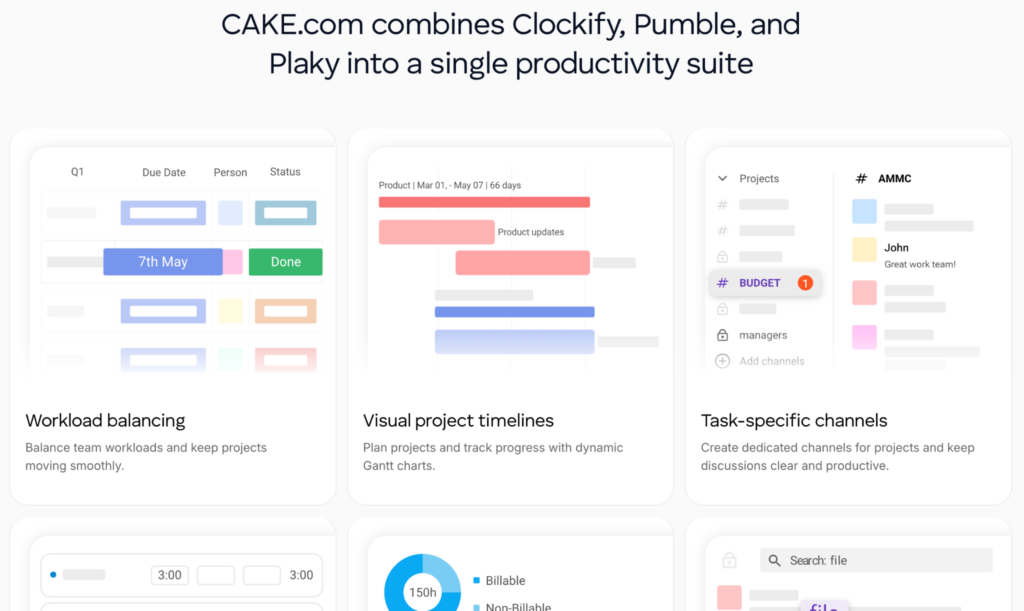
Clockify came first in 2017, taking on Toggl and Harvest — now ranked among the top time-tracking tools globally, used by HP and American Express.
A couple of years later came Pumble, a free Slack alternative in a market owned by Slack, Microsoft Teams, and Discord. Then Plaky, going up against Asana, Monday.com, Trello, Jira, and ClickUp — some of the best-funded SaaS companies in the world.
The three products unified under the CAKE.com brand, and the playbook was identical every time: existing category, better execution, lower price.
The pricing lever is what turned execution into distribution. When competitors charge $8-15 per user per month and you offer a generous free tier with paid plans that undercut them, you capture the long tail — small and medium businesses that can’t justify enterprise pricing. Then you grow with them as they grow.
“If you want to go slow, there’s no obstacle” — the most honest answer about scaling
When asked about the biggest obstacle in scaling, Nenad gave the most disarming answer a founder can give.
“If you want to go slow, there’s no obstacle, basically. If you want to be patient and live within your means, then there’s no obstacle. But if you want to do some crazy rate of growth, there’s a lot of obstacles that you would solve with cash. But then you create some other problems.” — Nenad Milanović, CAKE.com
“Inexperience was the biggest obstacle. We never did business at that scale. We never served that many customers. We had to learn how to do them from zero.”
They didn’t know how to operate at their scale — so they learned. For founders feeling overwhelmed by scaling challenges, that’s the most reassuring thing a bootstrapped CEO can say: the obstacle is temporary. You learn your way past it.
The conditional case for bootstrapping
Nenad doesn’t treat bootstrapping as a badge of honour. His view is conditional: “If you want to be innovative, try something that is highly unlikely to become a new market — I guess it’s a smarter route to take someone’s money and blow it. But if you’re going into a route where there’s an existing market…”
If you’re creating a new category, VC money buys you time to educate the market. If you’re entering an existing category with a better-execution thesis, bootstrapping lets you stay patient and keep control.
CAKE.com is the proof. Monday.com raised roughly $384M before its IPO. Asana raised about $450M. Slack raised $1.4B. CAKE.com took zero outside capital and reached $85 million in annual revenue against all of them.
What GTM leaders can steal from Nenad’s playbook
Before you dismiss a crowded market, do the math.
If 5% of the TAM would build a great business, the competition is irrelevant. All you need is execution.
The productivity SaaS market is projected at $100B+ and growing. CAKE.com’s current revenue is a fraction of that.
Nenad’s framing flips the standard competitive analysis: instead of asking “can we beat the incumbents?” ask “can we capture enough of the market to build something worth building?”
The DDoS attack that tested everything
In late 2024, Nenad publicly supported Serbian student-led protests with a $20,000 donation. Within hours, CAKE.com’s entire infrastructure was under the largest DDoS attack in the company’s history. The attack lasted days. Nenad kept the products online, kept the team coordinated, and didn’t walk back the donation.
The conviction that lets a founder walk into Slack’s or Asana’s market with a cheaper product is the same conviction that lets him absorb a targeted attack without folding a public position. Execution over innovation, in Nenad’s hands, is a temperament as much as a strategy — and it shows up in the places nobody writes playbooks for.
Here’s what that looked like in real time.
Doing more with less — scaling without headcount bloat
CAKE.com’s story is a masterclass in lean operations. No VC runway to burn through, no luxury of over-hiring. Every hire had to justify itself against the revenue it generated. The constraint forced discipline — and that discipline is what makes the whole model work.
Nenad looked at the most competitive markets in SaaS and said: “They’re inherently slow.” Then he proved it — eight failures and a decade later, with no outside money and no new category to hide behind.
If you want to speak to GTM leaders like Nenad directly, join the GTM Society — a free community where conversations like this happen every week.
Join the GTM Society. The room where GTM actually gets built. Founders, SDRs, and operators. No noise. Just systems.