How to Use LinkedIn Search to Find and Target Your Ideal Clients


LinkedIn has more than a billion members. If you don’t know how to find your ideal clients properly, you’re scrolling through an ocean of profiles hoping to bump into the right person. Most sales reps either never click past the basic search bar or pay $119.99 a month for Sales Navigator and use three of its 50+ filters.
Across the 70,000+ campaigns we analyzed in our State of LinkedIn Outreach H1 2025 report, the teams getting real pipeline from LinkedIn are the ones treating searches as a repeatable system. They layer filters, save searches, and have a workflow for what happens after the list is built.
This guide covers how to use LinkedIn’s search (free and paid) to build a list of high-fit prospects: basic search, advanced filters, Boolean operators, Sales Navigator, and the step most guides skip entirely — what to do once you’ve found the right people.
Here’s what we’ll cover:
- LinkedIn search basics and the filters most people miss.
- Boolean search operators with copy-paste strings for B2B prospecting.
- Sales Navigator filters that drive real prospecting results.
- Turning a search list into a structured outreach campaign.
- Common LinkedIn search mistakes that waste your time.
Key Takeaways
- LinkedIn’s free search covers about 80% of prospecting use cases when you combine the “All filters” panel with Boolean operators. Most reps never click “All filters” and never type AND or OR.
- Sales Navigator earns its price when you need company headcount, seniority, function, or hiring-signal filters. Five filters drive 90% of the value: Job Title, Seniority Level, Company Headcount, Geography, and “Changed jobs in past 90 days.”
- The “less than 1 year in current role” filter is the most underrated lever in Sales Navigator. People in months 4 to 10 of a new role are the sweet spot — long enough to know what’s broken, motivated to prove themselves.
- Search builds the list. Outreach turns it into pipeline. With Expandi, you can paste a Sales Navigator URL into Campaign Builder, attach a Smart Sequence, and let Signals flag which prospects already engaged with your content — so cold outreach starts warm.
How to Use LinkedIn Search to Find and Target Your Ideal Clients


LinkedIn search is the most underused prospecting tool in B2B
LinkedIn gives you access to 1.3 billion users across 200 countries. Most salespeople use the search bar the same way they’d use Google: type a job title and scroll. That isn’t prospecting.
The real power is in LinkedIn filters, Boolean operators, and saved searches that turn a vague keyword into a targeted list of exactly the people you want to talk to. Two camps tend to lose here:
- The free LinkedIn user who never opens “All filters” and burns their monthly profile views on irrelevant matches.
- And the Sales Navigator user paying $119.99 a month who runs the same title + location query they’ve been running for two years.
Both leave money and pipeline on the table.
Search is a sourcing layer that compounds when you treat it as a system: define the filter combination once, save it, and let LinkedIn alert you when new profiles match. That’s the difference between sourcing a fresh list every Monday and getting a self-refreshing pipeline.
LinkedIn search basics: what most sales teams miss
The most common mistake in free LinkedIn search is never opening the ‘All filters’ panel. That single click unlocks filtering by current company, past company, industry, connection degree, and school — criteria that turn a keyword search into an account-based prospecting list.
LinkedIn’s search bar covers eight categories:
- People.
- Companies.
- Jobs.
- Posts.
- Groups.
- Events.
- Products.
- And Services.
Type a keyword into the bar at the top of LinkedIn, hit enter, and click the relevant tab to filter to that type. Most reps stop here.
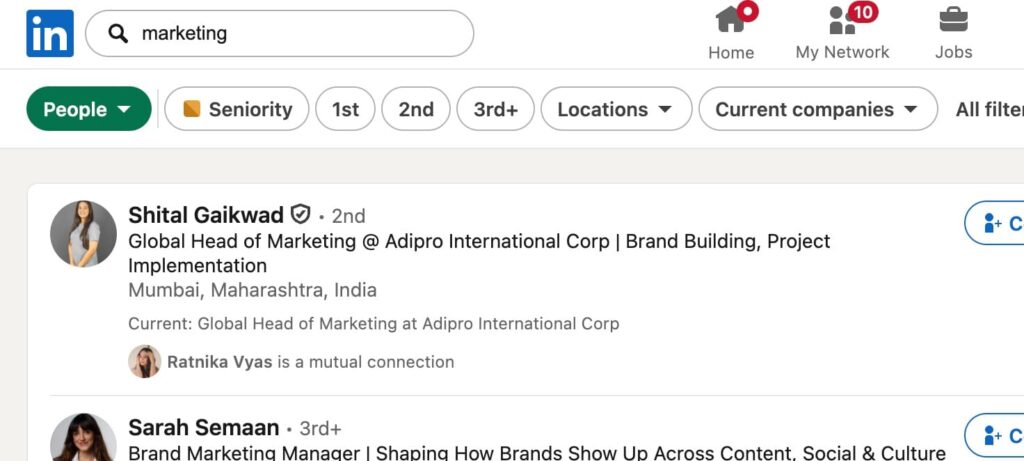
The next move is “All filters.” On the People tab, click the “All filters” button on the right side of the filter row.
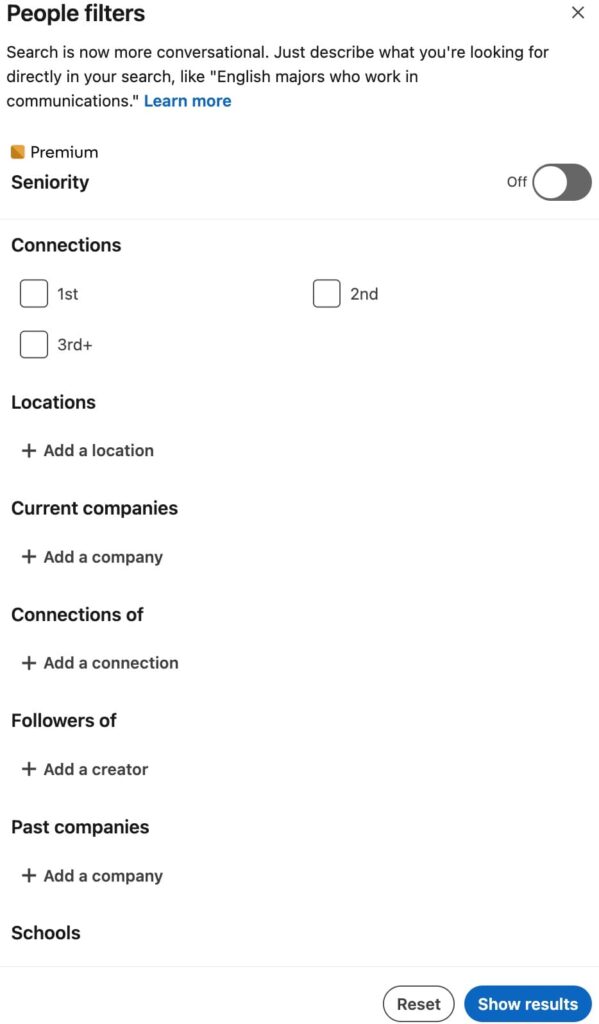
It opens a panel with criteria most users never touch:
- Location.
- Current company.
- Past company.
- Industry.
- School.
- Connection degree.
- Profile language.
- Service categories.
A few free-search filter combinations worth using:
- Connection degree. 2nd-degree connections are the prospecting sweet spot — close enough that you share connections to reference, far enough that you’re expanding your network rather than messaging the same 200 people on repeat.
- Current company. This is how you do account-based prospecting on free LinkedIn. Type a target account’s name into “Current company” and you get every employee who has it listed. Layer in a title or function and you’ve narrowed to the role you want to talk to.
- Past company. Useful when you sell to ex-employees of a competitor or to alumni of a specific firm. Reps who left a logo-account company often carry their playbook (and your prospect’s contact info) to their next role.
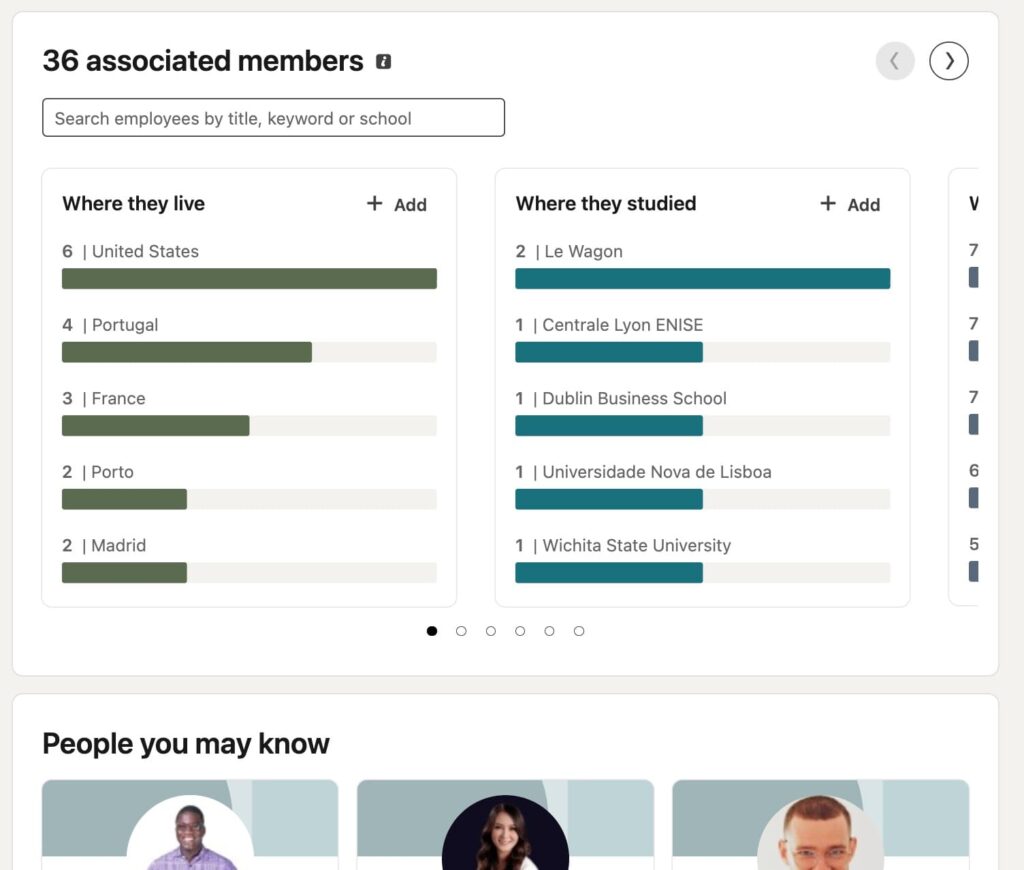
💡 Faster account-based search: Skip the search bar entirely for known target accounts. Go to the company’s LinkedIn page > click the People tab > filter by location, function, or keyword in job title. It returns every employee who matches, with no Sales Navigator required. For a 200-person company where you want every VP of Marketing, this is the cleanest method available on free LinkedIn.
When free search is enough (and when you need Sales Navigator)
Free LinkedIn works for targeted, low-volume prospecting where you already know your audience by name, title, or company. You can find decision-makers at specific accounts, browse 2nd-degree connections, and use Boolean to compensate for the limited filter set.
You need LinkedIn Sales Navigator when you want to filter by criteria that don’t exist on free LinkedIn:
- Company size.
- Seniority.
- Function.
- Technologies used.
- Or hiring signals and other filters.
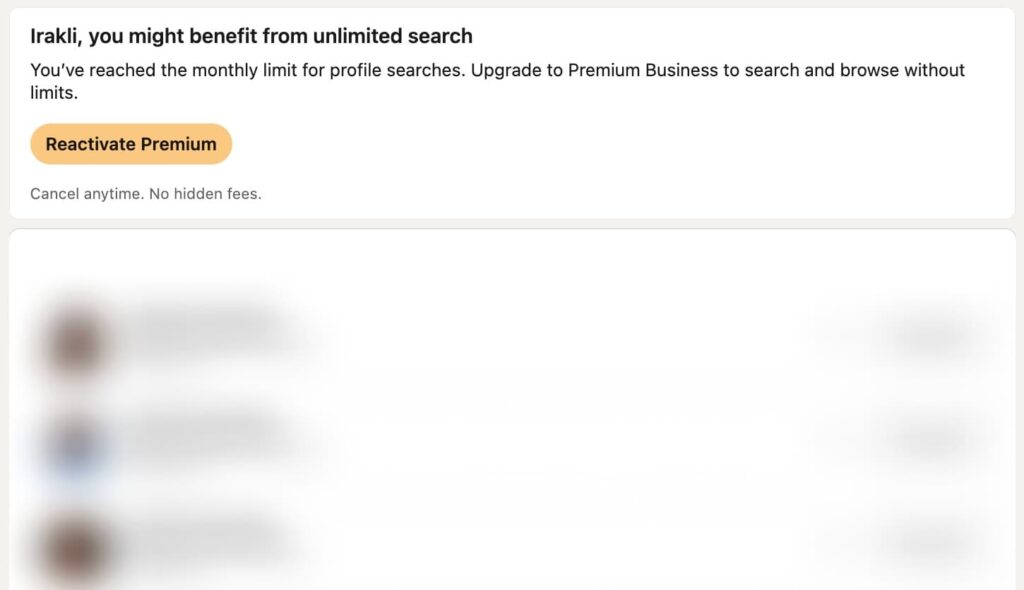
You also need it if you’re running outbound at volume — once you hit the monthly profile view cap, need saved-search alerts, or need unlimited results (free LinkedIn caps at roughly 1,000 per query).
Free LinkedIn plan is enough if you’re a solo seller or a founder running occasional outbound. But Sales Navigator pays for itself the moment outbound becomes a weekly motion.
For a side-by-side comparison of every LinkedIn tier and what’s included at each level, see our guide on LinkedIn account types.
Boolean search: the skill that separates amateurs from pros
Boolean search is a querying method that uses five operators — AND, OR, NOT, quotes, and parentheses — to control exactly which profiles LinkedIn returns.
Instead of searching ‘VP Marketing’ and getting everyone with either word in their profile, you search ‘(“VP” OR “Vice President”) AND “Marketing” NOT Recruiter’ and get a list you can actually use.
The operators must be typed in UPPERCASE. LinkedIn doesn’t support wildcard searches (the asterisk doesn’t work). Boolean works in the main search bar on free LinkedIn and in the keyword, title, and company fields in Sales Navigator.
The five operators are:
- AND — both terms must appear. Marketing AND SaaS returns profiles that mention both. LinkedIn treats spaces as implicit ANDs, so this is mostly a clarity tool.
- OR — either term works. (CTO OR “VP Engineering”) broadens your net across related titles. Useful when your target persona has multiple common job-title variants.
- NOT — excludes a term. Sales NOT Intern NOT Associate removes junior profiles. This is the operator that cleans your list of noise.
- Quotes — exact phrase match. “Head of Demand Gen” finds the precise phrase. Without quotes, LinkedIn returns profiles that mention “head,” “demand,” and “gen” in unrelated contexts.
- Parentheses — group logic. (CEO OR Founder) AND “Series A” NOT Consulting groups the title alternatives together, then layers funding stage and excludes consultants.
There’s also a Google-side trick worth knowing: typing site:linkedin.com/in/ followed by a Boolean string into Google returns matching LinkedIn profiles without burning any of your LinkedIn search quota. Then, you can use AI lead generation tools to scrape search results, whether they’re from Google or LinkedIn.
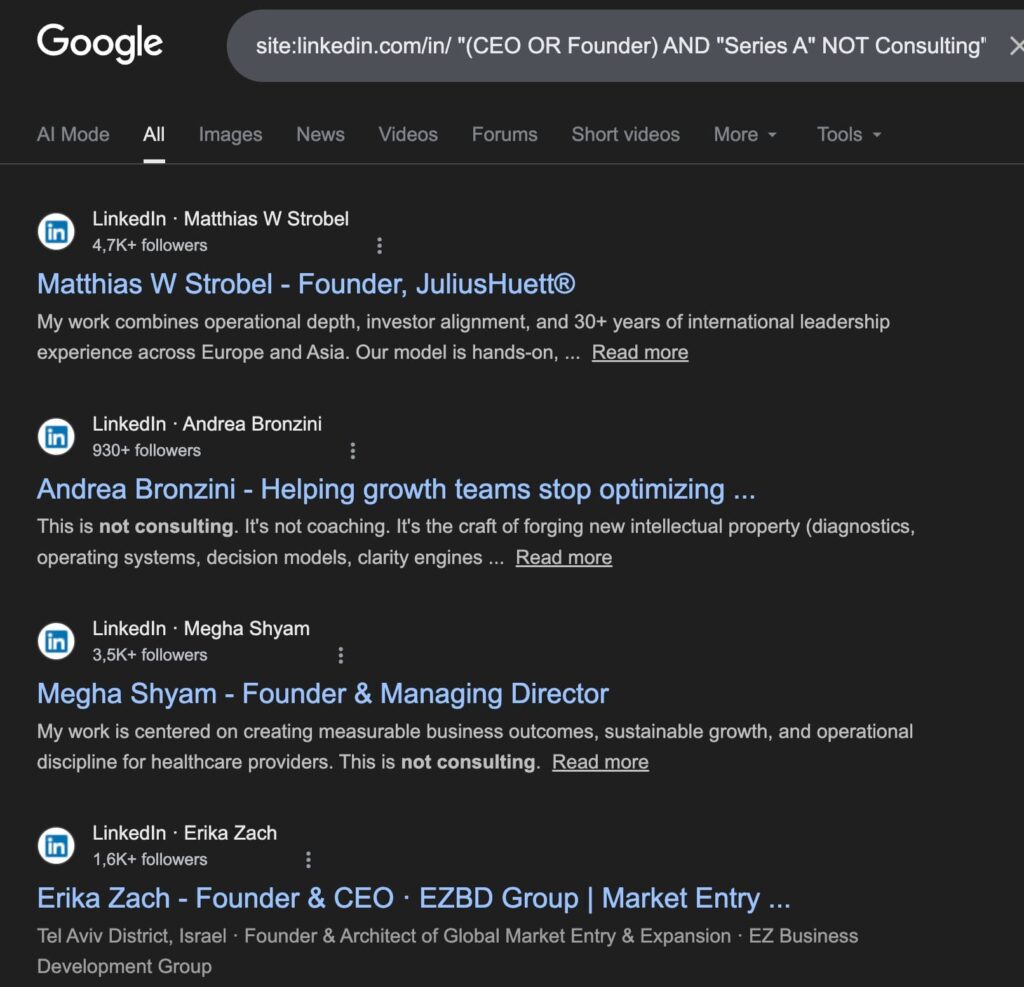
You can’t message anyone from Google, so it’s a scouting tool only — useful when you’ve hit your monthly profile view cap on a free account.
Our LinkedIn Sales Navigator filters guide goes deeper on Boolean inside Sales Navigator’s title and keyword fields.
5 copy-paste Boolean strings for common B2B use cases
Paste these into the LinkedIn search bar (free) or Sales Navigator’s keyword/title field. Adjust the tokens for your ICP.
- Find VP-level SaaS buyers: (VP OR “Vice President” OR Head) AND (“Marketing” OR “Demand Generation” OR “Growth”) AND SaaS NOT Intern NOT Coordinator
- Identify companies hiring for a role you sell into (a buying signal): (“hiring” OR “we’re growing” OR “join our team”) AND (“RevOps” OR “Sales Operations” OR “Revenue Operations”) — best paired with the Posts tab to surface recent hiring announcements.
- Target employees at a competitor’s customer or a competitor: “Acme Corp” AND (“Director” OR “VP” OR “Head”) NOT Consultant NOT Advisor — replace Acme with the company name. Layer with the “Current company” filter for tighter results.
- Find founders at recently funded startups: (Founder OR “Co-Founder” OR CEO) AND (“Series A” OR “Series B” OR “raised”) NOT Investor NOT Advisor
- Reach consultants and agency owners in a specific niche: (Consultant OR Founder OR Owner) AND (“LinkedIn outreach” OR “B2B sales” OR “demand gen”) NOT Recruiter
Justin Michael (Salesborgs.ai) recommends going beyond title-only Boolean. Stack three specific data points about each prospect — their university, an award they won, and something tied to your offering — and weave them into the opening line. The Boolean search builds the list. The personalization stack turns the list into replies.
Sales Navigator search: the filters that earn their price
Sales Navigator has 50+ filters. Based on our analysis of 70,000+ campaigns, five filters account for the majority of ICP-match improvement: Job Title, Seniority Level, Company Headcount, Geography, and ‘Changed jobs in past 90 days.’
Here’s what each one does and why the others are largely noise for most B2B motions:
- Job Title + Seniority Level — layer both. Title alone is unreliable: a “Director of Engineering” at a 5-person startup is a very different buyer than one at Google. The Seniority filter (Entry, Senior, Manager, Director, VP, CXO, Owner, Partner) anchors the title to a real org level.
- Company Headcount — the closest proxy for budget and buying authority. The 11–50, 51–200, 201–500, and 501–1,000 brackets cover most B2B SaaS deal motion. Filter to your ICP range and acceptance rates climb because you’re reaching people who can approve your product.
- Geography — filter to where your buyers sit. Anchor to your ICP’s region and you cut out the dev-outsourcing noise that shares your title keywords.
- Changed jobs in past 90 days — surfaces people in new roles. New hires are more receptive to vendor outreach because they’re building their stack and trying to make an impact.
- Posted on LinkedIn in last 30 days — found in the Spotlight section. Active users see and respond to outreach at higher rates than dormant accounts.
For a deeper walkthrough on how to set up a full Sales Navigator workflow end to end, our
using LinkedIn Sales Navigator guide covers Personas, Lead Lists, and CRM integration in more detail.
The “less than 1 year” filter hack
People who recently changed roles are more likely to respond to outreach because they’re actively building their stack. But timing within that window matters.
Morgan Ingram (4x LinkedIn Top Sales Voice, founder of AMP) showed an SDR team this filter and changed their entire approach. His breakdown:
- Months 1 to 2, the person is still onboarding and barely knows where the bathroom is.
- Months 4 to 10, they’ve been there long enough to know what’s broken and they’re looking to prove themselves. That’s the sweet spot.
- After month 10, they’ve usually committed to their current tools and your outreach lands as noise.
Set the “Years in current company” filter to “Less than 1 year” in Sales Navigator, then validate the start date on each profile before outreach.
The LinkedIn Groups filter that reveals what job titles can’t
The Groups filter in Sales Navigator surfaces what people care about beyond their job title. A VP of Sales who’s in a “Revenue Operations” group has different priorities than one in a “Cold Calling Techniques” group. That’s psychographic targeting job titles alone can’t show.
Jack Reamer (SalesBread) uses the Groups filter as a core part of his prospecting method. Instead of filtering for “startup founders” by title, he finds groups like “Remote Team Leaders” or “Bootstrapped SaaS Founders.” That reveals mindset and pain points no title filter can show.
💡 Free messaging path most reps miss: Joining the same LinkedIn group as a prospect lets you DM them directly from the group’s Members list — no InMail credit, no connection request required, even for 3rd-degree connections. Find the groups your ICP is active in, join them, and you’ve just opened a direct line to prospects who would otherwise require a paid InMail.
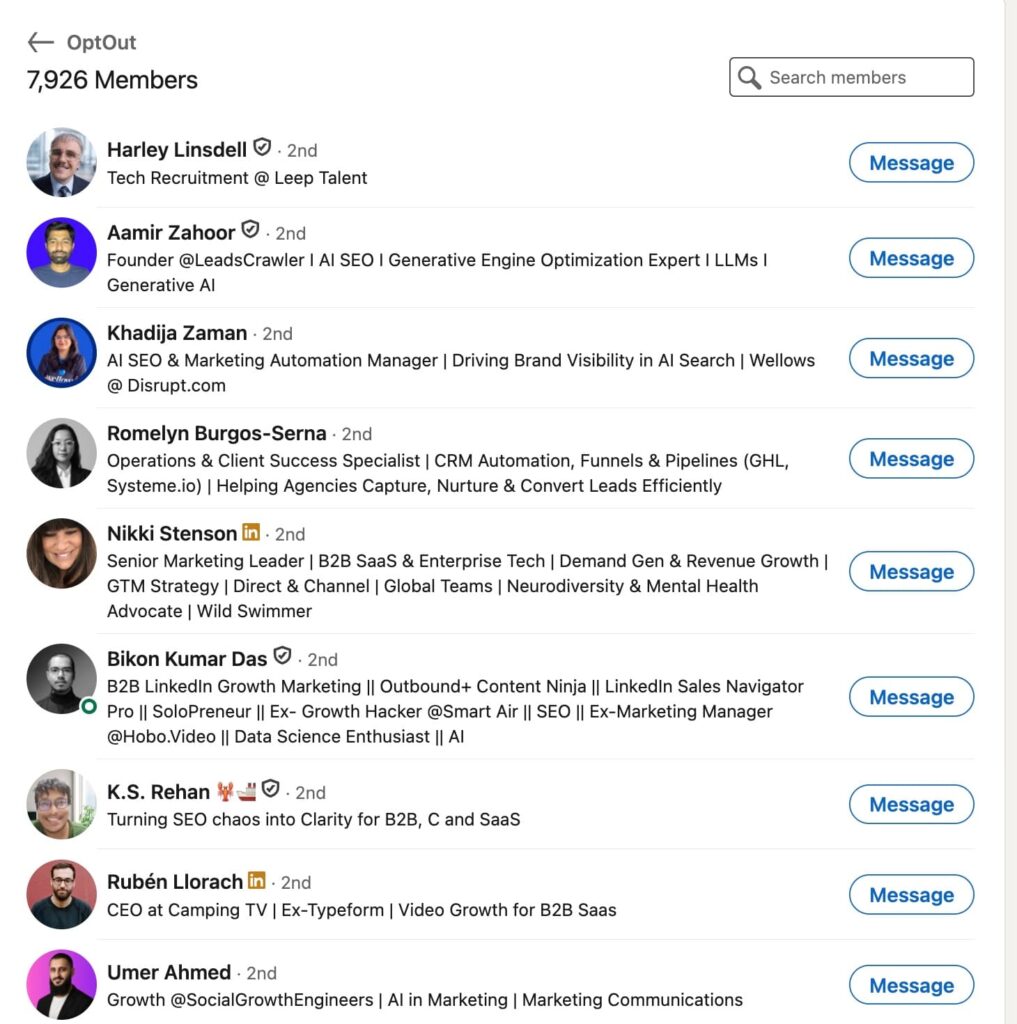
The shared-group context also gives you a credible opening line: “Saw we’re both in the Bootstrapped SaaS Founders group — wanted to swap notes on what’s working for you.”
From search to outreach: the step every guide skips
Finding the right people is half the job. The other half is reaching them in a way that opens a conversation. Most LinkedIn search guides stop at “here’s your list.” A list of perfect prospects sitting in a spreadsheet does nothing.
The 3-step workflow that turns a list into pipeline:
- Build your list using the search and filter techniques above.
- Validate that the profiles match your ICP — don’t trust LinkedIn’s inferred seniority blindly.
- Check whether each prospect has already engaged with your content before going cold.
If they have, reference the specific touchpoint when you reach out: “Saw you commented on my post about signal-based outreach last week — wanted to ask what’s working for your team.” If they haven’t, lead with something specific about them: a recent post, a job change, a shared group, a mutual connection.
Josh Braun teaches “non-persuasive selling.”
Prospects should feel heard. When you find someone through search, your message should make them feel like you saw something specific in their profile and reached out because of it. “Whenever people feel like they’re being told what to do, they enter the Zone of Resistance.”
Morgan Ingram has a 3-attempt framework for LinkedIn outreach after finding a prospect:
- Attempt 1, the fastball: lead with something specific about them.
- Attempt 2, the change-up: switch format — a voice note or short video with different messaging.
- Attempt 3, the slider: keep it light — a GIF or one-liner.
What this looks like in practice
Before his product launched, Nick Tomic (Face2Face) scraped AppSumo for leads, found their LinkedIn profiles, and messaged them manually — 30 messages, 10 meetings, 3 paying customers.
The inputs were simple: a targeted source, a specific list, a personal message. When he scaled, he used Expandi to automate outreach to people who had already engaged with his LinkedIn case study post.
The sourcing method and the outreach structure stayed the same — only the volume changed.
How to turn a search list into a repeatable outreach campaign
Once your search criteria are validated, the same query can power an ongoing outreach system instead of a one-off list.
Expandi’s Campaign Builder runs your search-generated list through a multi-step sequence:
- Connection request with a personalized note.
- Follow-up message if they accept.
- Value-add touchpoint if they engage but don’t reply.
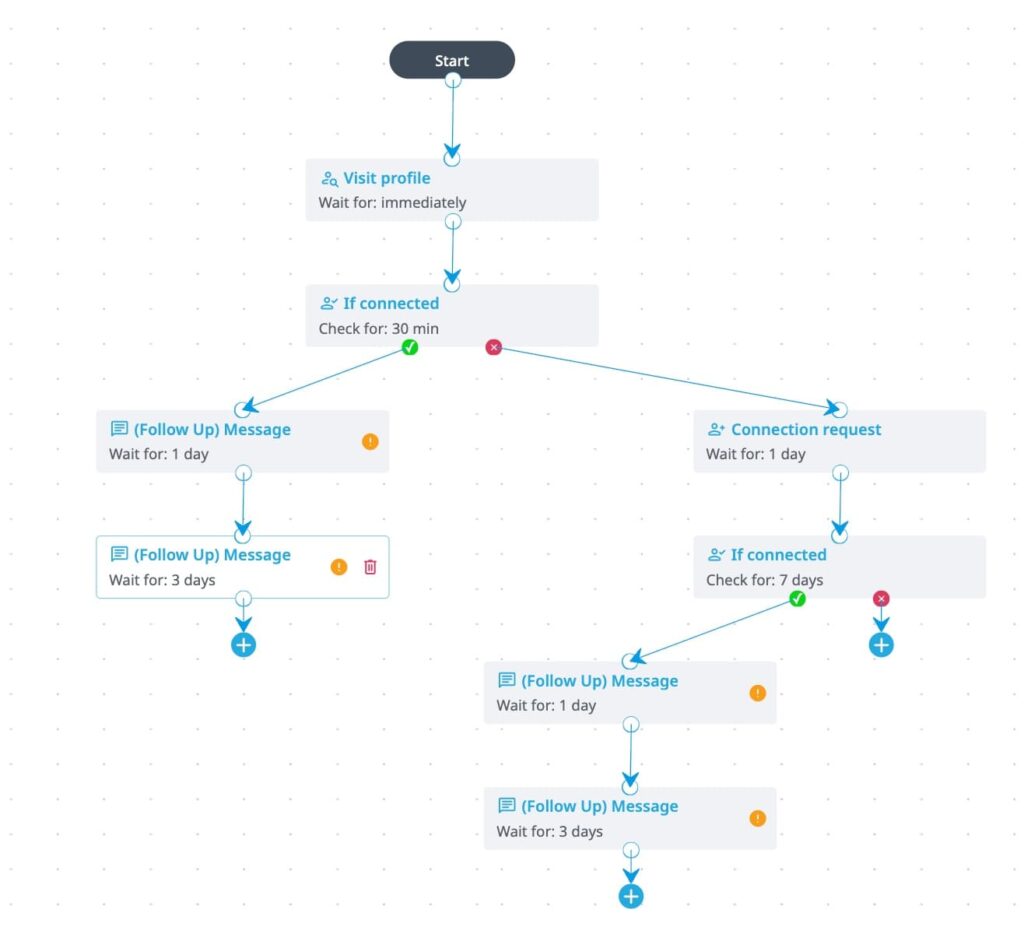
Smart Sequences add conditional logic on top. Across 19 actions and 11 conditions, you can build flows that mirror how a thoughtful rep would handle each prospect manually. Signals flags prospects from your list who’ve already engaged with your LinkedIn content (profile visits, post likes, comments) so warm leads get prioritized over cold ones.
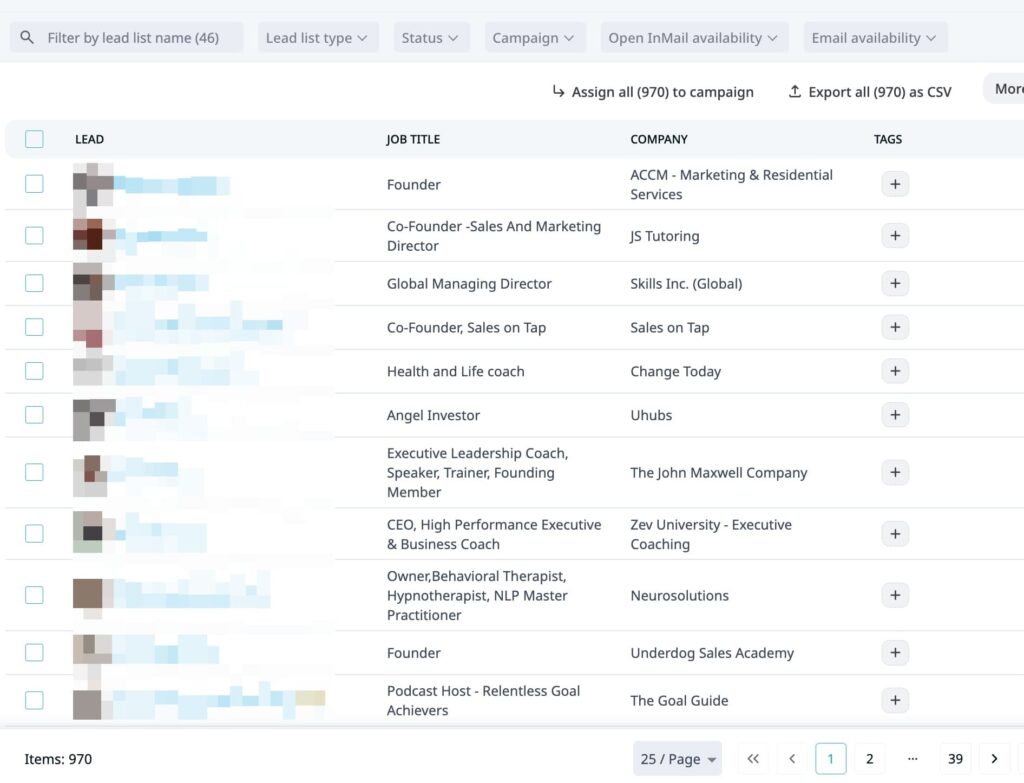
For a broader view of outreach tactics that pair with search-driven lists, the linkedin outreach tips breakdown covers what to send once your list is built.
5 common LinkedIn search mistakes that waste your time
Each mistake here breaks the LinkedIn search at a different stage — sourcing, filter precision, list management, outreach. Each mistake here breaks the search at a different stage — sourcing, filter precision, list management, outreach. Address one and ignore the others and you’ll still see mediocre results.
- Searching by job title alone. A “Director of Sales” at a 5-person startup is a different buyer than one at a 500-person company. Title without seniority or company-size context is noise.
- Ignoring Boolean. Most reps never type AND, OR, or NOT into the search bar. Every search returns broad, generic results. Five operators are all that separates a 1,200-result mess from a 60-result hit list.
- Over-filtering on the first pass. Start broad, then narrow. If your first search returns fewer than 100 results, you’ve gone too specific. Ease up on a filter and rebuild from there.
- Never saving searches. Sales Navigator lets you save up to 50 lead searches and 50 account searches with weekly alerts. Without saved searches, you’re rebuilding the same query every Monday — which is also how you turn one search into an evergreen campaign that refreshes itself.
- Finding the right people but sending the wrong message. The best search in the world is wasted if your outreach reads like a templated pitch. The 10.3% average LinkedIn DM reply rate from our State of LinkedIn Outreach H1 2026 report cracks 16% on Expandi-run campaigns because the message references a real reason for outreach.
Using LinkedIn searches: frequently asked questions
Free LinkedIn accounts are subject to a commercial use limit that LinkedIn applies dynamically based on search activity — typically hitting a soft cap within a few hundred searches per month. Sales Navigator removes this cap entirely and allows unlimited search results per query, along with up to 50 saved lead searches and 50 saved account searches with weekly alerts.
Partially. Typing site:linkedin.com/in/ followed by a Boolean string into Google returns matching public LinkedIn profiles without using any of your LinkedIn search quota. You can’t message anyone this way — it’s a scouting method only — but it’s useful when you’ve hit your monthly profile view limit on a free account.
It’s a Spotlight filter that surfaces leads who started a new role within the past 30, 60, or 90 days. To use it, open Sales Navigator’s Lead Search, scroll to the Spotlights section in the filter pane, and select your timeframe. Pair it with Job Title and Company Headcount filters to scope to recently hired ICP buyers.
After running a search, click the “Save search” button near the top of the results page. LinkedIn and Sales Navigator both send alerts when new profiles match your saved criteria. This turns a one-time search into a continuous lead feed. Sales Navigator allows up to 50 lead searches and 50 account searches saved at one time, with weekly alerts on each.
Free LinkedIn search filters by title, location, company, school, and connection degree. Sales Navigator adds company headcount, seniority level, function, years in current role, recent job changes, LinkedIn activity signals, and saved search alerts. The practical threshold: use free search for targeted, low-volume outbound where you already know your audience. Switch to Sales Navigator when you need company size filters, are running outbound at volume, or need a list that refreshes automatically.
Automatically turning your LinkedIn search results into pipeline
You now have the filters, Boolean strings, and Spotlight signals to build a list of prospects who actually match your ICP.
The harder problem is everything after the list exists: who you message first, what you say to each segment, how the follow-up shifts based on whether they accepted, viewed your profile, or ignored you entirely.
That’s the part most reps still do manually and inconsistently — which is why so much search-driven outbound stalls at the spreadsheet.Expandi runs the rest of the workflow for you. Paste your saved Sales Navigator URL, attach a sequence, and let Signals route the warm leads ahead of the cold ones. Start a 7-day free trial (no credit card required) to see what your search list looks like inside a real outreach campaign.





You’ve made it all the way down here, take the final step