How to Spot a B2B Buying Committee on LinkedIn (Before Your Competitor Does)

Today, most B2B deals are decided by more than one person. A group weighs in, and most of them never reply to your outreach. They do something quieter first: they view your profile, read your posts, and follow you.
That activity is a buying committee assembling in plain sight. Read it at the account level and you can reach the group while intent is warm. Miss it, and the deal goes to whoever read it first.Here is how to spot the committee, and how to act on it.
Why one contact never equals one deal
When you optimize for a single contact, you misread the deal. B2B purchases run through a group: a champion who wants the change, the people who will use the tool, the budget holder who signs, and at least one skeptic who can stall everything. Gartner puts the typical buying group for a complex B2B solution at six to ten people.
You rarely meet all of them. You meet the champion, build the case, then lose weeks when a stakeholder you never spoke to raises an objection in a room you were not in. The deal did not stall because your pitch was weak, but because you were selling to one person while a committee was deciding.
Read the roles by behavior, not job title
Titles flatter, but how people behave tells the truth. You will not get a name tag for each committee member, but the way someone engages is a strong tell for the job they hold in the deal.
- The champion engages early and often. They like several posts, view your profile more than once, maybe comment. They are building a case internally and pulling signal from you to do it.
- The end users react to the tactical posts: the ones about the daily grind your product removes. They rarely view your profile cold. They engage with the specific pain.
- The economic buyer shows up late, briefly, and from a senior title. One profile view, no likes, often right before a decision. Treat a quiet senior visit as a sign the deal is being weighed, not browsed.
- The skeptic lurks without engaging at all. You feel them through the champion: “legal has questions,” “our ops lead isn’t sure.” Absence around an otherwise active account is its own signal.
None of this is exact; it’s more of a working map. Read who engaged, with what, and when, and you can sketch a committee, and the message each person needs, before anyone books a call.
A committee leaks signals before it ever replies.
People research you in the open. Before a form fill, before a reply, committee members view your profile, like your posts, and follow you — each action is small, but all together, they mean something.
This is the idea behind signal-based outreach: the warmest prospects have already shown interest, and most sales teams are not watching for it. The reply-rate gap between engaged prospects and cold lists is large, and the article above breaks down the numbers.
First-party signals beat bought intent
You can buy third-party intent data. It is broad, shared with everyone who pays for it, and tells you a category is “in market,” not that anyone cares about your point of view. The engagement on your own profile and posts is different. It is specific to you, free, and current. Start there before you spend on anything else.
Read intent at the account level, not the lead level.
One like is insignificant. But three people from the same company engaging inside a week is a pattern. The shift that changes everything is grouping signals by company instead of reading them one contact at a time.
At the lead level, a profile view is a curiosity you forget by lunch. At the account level, three profile views, two post likes, and a follow from one company is a committee in motion. The signal was always there. Grouping is what makes it legible.
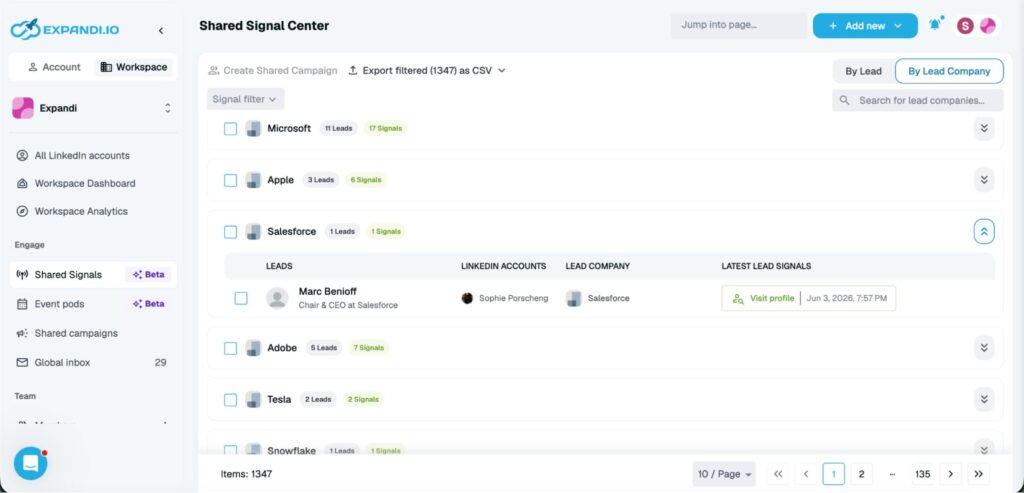
Here is the mental model. Stop asking “which lead is hot?” Start asking “which account is warming up, and who inside it is doing the warming?” The first question gives you a name. The second gives you a deal.
⚠️ Filter for fit before you act: Not every engager is a buyer. Some of your profile views are competitors, job seekers, and curious peers. If you treat every signal as pipeline, you waste the warm window on people who will never buy. Qualify for fit first — run the engaged accounts against your ICP: industry, company size, role, region. A signal from inside your ICP is intent. The same signal from outside it is noise that happens to look like intent.
The warm window is short: speed beats volume
Intent decays in days. Someone who viewed your profile this morning is a different prospect than the same person three weeks later. The gap between the signal and your first message matters more than the size of your list.
This is where most teams lose ground. The signal arrives, sits in a notification feed, and goes cold while everyone is heads-down. A bigger list does not fix that. A faster read does. The team that reaches the committee on day one beats the team that finds it on day ten, even with a worse pitch.
Coordinate, or your team competes with itself
On a team running several LinkedIn accounts, the danger is two reps messaging the same contact a day apart. That reads as disorganized to the buyer, and it burns the warm moment you worked to find.
The fix is knowing who owns each lead.
When every signal shows which of your accounts the prospect engaged with, you assign cleanly, multi-thread on purpose, and never collide. For agencies running outreach across many client accounts, that visibility is the line between a coordinated motion and chaos.
A weekly play you can run on Monday
Here is a repeatable cadence that takes about 15 minutes and works whether you run one account or twenty.
- Pull your inbound signals into one view and group them by company.
- Start with accounts showing two or more engaged contacts. Those are committees, not individuals.
- Map the likely roles. Who engaged with a tactical post (probably a user) versus who viewed your profile from a senior title (probably a buyer)?
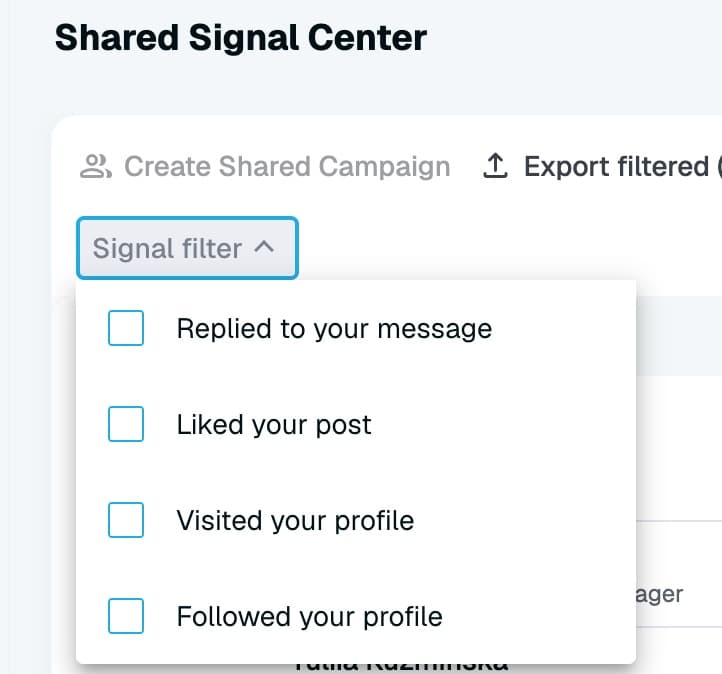
- Filter by signal type when you need focus: replies for urgent follow-up, post likes for content-led outreach, profile visits and follows for account-based plays.
- Multi-thread. Reach two or three people from the same account, each with context from what they actually engaged with.
- Move the same week. Warm windows do not wait.
Run this every Monday and you stop reacting to whoever happens to reply. You start working the accounts that are already leaning in.
What to say when you reach the committee
Context is the whole advantage, so do not waste it on a generic template.
Reference the specific post someone liked, or the angle they keep returning to. Speak to the user about the daily problem and to the buyer about the outcome.
The signal tells you which one you are talking to, so personalize the message to the role, not the role to the message.
Where teams misread the signal
Even teams that watch their signals get a few things wrong. We usually see these three mistakes show up again and again.
- Treating every signal as equal
A reply is not a follow is not a like. A reply is urgent. A profile view from a senior title is a buying sign. A single like is interest, not intent.
Picture two notifications arriving the same morning: an SDR likes your post about cold outreach, and a VP of Sales from a 200-person company views your profile without engaging further. If you work your feed top to bottom, you message the SDR first because the like is visible and the visit is quiet.
The fix is a simple hierarchy you apply before you act: replies first, senior profile views second, follows third, likes last. Weigh them, do not just count them.
- Chasing the loudest engager
The person who likes everything is often a fan, not a buyer. Every account has one: the founder of a two-person agency who comments on all your posts, shares your content, and will never have the budget or the use case.
Meanwhile a director from an ICP account viewed your profile once last Tuesday and you never noticed. The quiet senior visit matters more than the serial liker.
Before you reach out, check the engager against your ICP and check their role against the deal. Enthusiasm from outside your market is flattering. It is not pipeline. Loud is not the same as in-market.
- Waiting for a reply before you act
A reply is the last signal, not the first. By the time someone messages you, they have done most of their research, compared you to alternatives, and possibly already shortlisted a competitor. If your process only starts at the inbox, you enter every deal late.
Compare two sequences: in one, you message a prospect the day after they viewed your profile, referencing the post that brought them there. In the other, you wait three weeks for them to write first, and the conversation opens on their terms with your competitor already in the room.
Set a trigger for the early signals, a profile view or a follow from an ICP account, and treat it as the start of the conversation. The earlier, quieter signals are where the advantage lives.
Turn the committee into one coordinated conversation
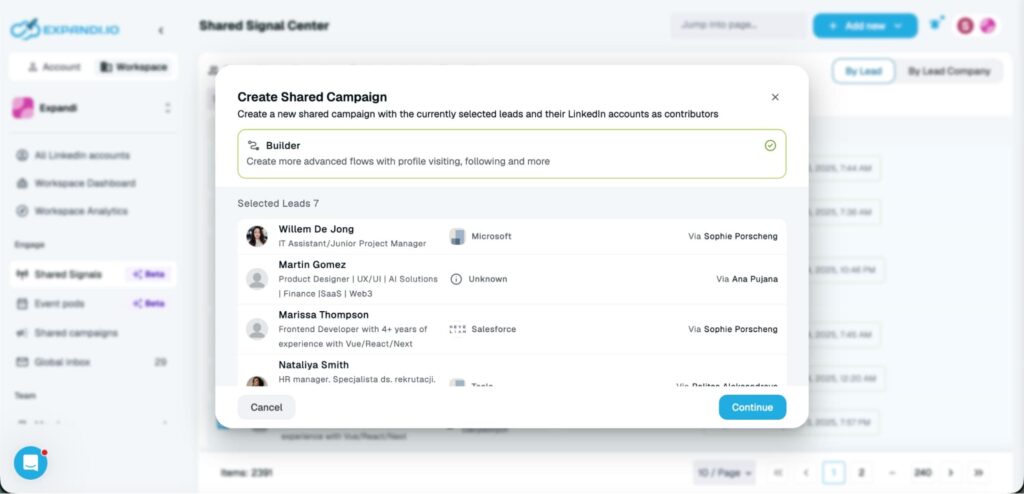
Spotting the committee is half the work. Acting on it as a group is the other half. Instead of chasing each contact separately, pull the engaged people from one account into a single sequence.
This is what Expandi’s Shared Signals Center is built for. It pools the inbound signals from every LinkedIn account in your workspace onto one page, grouped by company.
You see replies, post likes, profile visits, and follows in one place, with an “owned by” column so your team never doubles up. Select the engaged contacts from an account, create a Shared Campaign, and the relevant accounts join as contributors automatically.
It pairs with the work you already do. Sales Navigator helps you find the accounts that fit. Account-based plays tell you which accounts to prioritize. Signals tell you which of them are warming up right now, so you reach the committee at the moment it is paying attention.
The committee is already signaling. Who reads it first?
Your next deal is probably circling you right now: a few people from one account, quietly checking your profile and weighing whether to raise their hand. The advantage goes to whoever reads that room first and moves while it is warm.
Start by grouping your signals by company this week. If you want that read built into your workflow, start a free Expandi trial and open the Shared Signals Center.



You’ve made it all the way down here, take the final step