How to Write a Professional Thank You Email (30 Templates for Every Business Situation)

Key Takeaways
- Reference one specific detail from the conversation — never a generic template.
- Send within 24–48 hours; same-day for sales calls and signings.
- Cover one purpose per email: appreciation, or appreciation plus one next step.
- Match tone to the original interaction, not a fixed formality level.
- On outreach sequences, pair the email with a LinkedIn touchpoint to build familiarity.
How to Write a Professional Thank You Email (30 Templates for Every Business Situation)

At Expandi, our customers send millions of outreach messages through the platform. The difference between a professional thank you email that gets a reply and one that gets archived is visible at that scale: the replies go to messages that name one specific moment from the interaction and show up while it’s still fresh.
We work with sales teams, GTM engineers, and lead generation agencies who send thank you emails inside automated email and LinkedIn sequences, and we’ve turned what works for them into 30 templates for the business situations that come up most.
Use them as starting points for clients, partners, completed projects, internal stakeholders, and the smaller week-to-week moments, then adjust the specifics to match what really happened.
What is a professional thank you email?
A professional thank you email is a short, specific message sent after a meaningful business interaction, like a sales call, a project handoff, a referral, or a partnership milestone. It acknowledges what the other person did and, where relevant, opens the next step. The strongest ones reference one concrete detail from the interaction, go out within 24-48 hours, and stick to a single purpose: appreciation, or appreciation plus one clear next step.
Do professional thank you emails still work in 2026?
GetResponse’s email marketing benchmarks put welcome emails, the closest tracked relative of the thank you email, at an 83.63% average open rate, more than double the 39.64% average across all campaigns.
Thank you emails work the same way. The recipient knows the sender and expects the message.
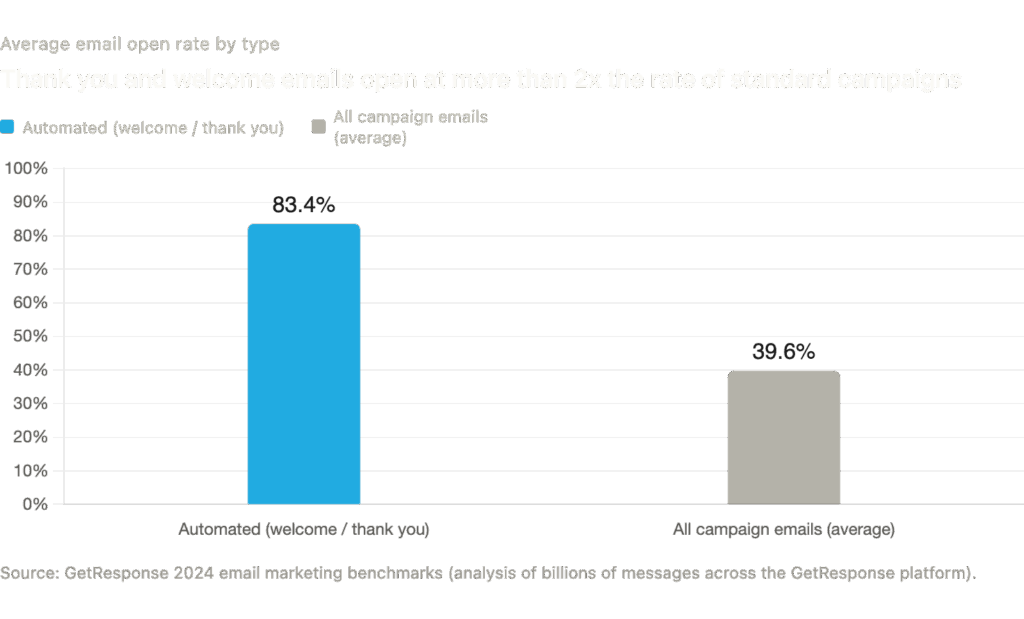
That’s the opportunity. The emails are getting opened, and almost nobody measures what happens after: a generic “thanks for your time” gets archived without a reply regardless of open rate.
Meanwhile, McKinsey’s B2B Pulse research shows buyers are now engaging across 10 or more channels regularly, which means a thank you email that lands well has a natural second touchpoint available on LinkedIn if you build for it.
But high open rates don’t matter if the email itself doesn’t earn a reply. Five things decide whether a thank you email gets one.
| Element | What it means in practice |
|---|---|
| Specificity | Reference one concrete moment from the conversation: “Thanks for walking through the Q3 forecast methodology” lands. |
| Timing | Same-day for sales calls and high-stakes meetings. Two days late is borderline — a week late is worse than not sending at all. |
| One purpose | Pure appreciation, or appreciation plus one clear next step. More than one CTA and the email reads as a sales pitch with a polite opener. |
| Tone match | Match the formality of the original interaction. The prospect’s tone on the call is your reference point. Don’t send a formal note to someone who spent 20 minutes joking around. |
| Sign-off | Closings built on “thanks” pulled 57.9–65.7% response rates, against 51.2% for “best” and 53.5% for “regards,” per a Boomerang analysis of 350,000+ email threads. |
Get the first four right and the fifth does the rest.
6 subject lines for professional thank you emails (with data)
Standard subject line advice treats thank you emails the same as cold outreach. But in this case, the recipient already knows you, which changes what earns an open.
The principle that carries over: a short subject line naming something real beats a long vague one.
Belkins’ 2025 analysis of 5.5 million B2B emails found 2-4 word subject lines pulled a 46% open rate, with engagement dropping past 7 words. Personalization added a 31% lift over non-personalized subject lines, whether that’s a name, a specific reference, or a shared moment.
Both findings hold for thank you emails, where you have more material to be specific about than a cold sender ever does.
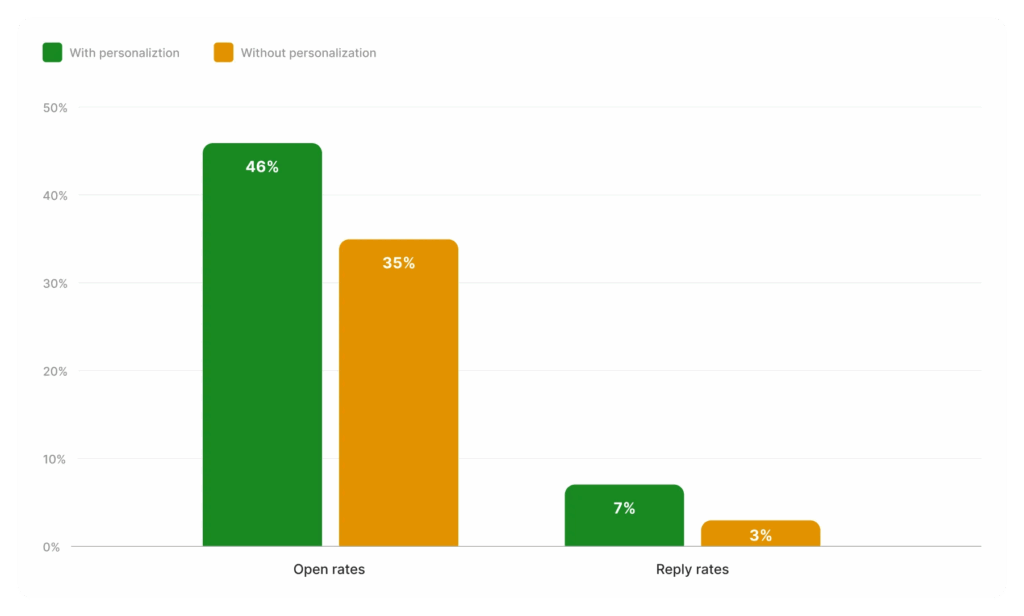
The same personalization principles that drive open rates on cold outreach apply to thank you emails: name, specific reference, and one clear reason to open.
What works:
- After a sales meeting: “Thanks for the conversation, [Name]”.
- After a referral: “[Name], thanks for the intro to [Person]”.
- After project completion: “Thanks for closing out [Project name] with us”.
- After a contract signing: “Excited for [Year] with [Company] and thank you”.
- After feedback or a testimonial: “Thank you for the [Project] testimonial”.
- After a partnership announcement: “[Company] and [Their company]: looking forward to [Year]”.
What doesn’t work:
- “Thank you” alone (no context, looks automated).
- “Following up” (transactional, reads as cold).
- All caps or excessive punctuation (deliverability hit).
- “Quick favor” or “Quick question” (bait-and-switch, reduces trust).
A note on deliverability: subject lines only get judged if the email lands. A mailbox with no sending history needs email warm-up before the first sequence goes out.
8 thank you email templates for clients
Client thank you emails do two jobs: confirm the relationship is healthy, and create a low-pressure opening for the next conversation.
The strongest ones reference something specific from the most recent interaction and leave a soft door open without pitching anything.
Once the relationship is warm, the pitch that follows is a different craft. Our sample email to approach new clients breaks down that next step.
1. After a sales meeting or discovery call
Send within the same business day. Reference one specific moment from the call. Confirm next steps if any were agreed.
This is the highest-impact thank you email for sales teams running outbound sequences, because the post-call thank you sets the next conversation up.
Subject: Thanks for the conversation today, Derek
Hi Derek,
Appreciated the time today. The piece on how your team is testing AI-assisted SDR workflows was the part I keep thinking about, that volume vs. relevance trade-off is exactly where most of our customers are right now.
I’ll send the case study we discussed by Thursday, and a 15-minute slot for the follow-up next week.
Talk soon,
[Signature]
2. After a successful purchase or onboarding
Set the tone for the relationship. Confirm the immediate next steps. Skip the “thanks for buying!” tone and lead with clarity on what happens next.
Subject: Welcome to [Company], Mary, here’s what’s next
Hi Mary,
Thanks for trusting us with [Project name]. Quick rundown of what happens next:
1. Contract signed and countersigned. PDF attached.
2. Kickoff call scheduled for Tuesday at 10am.
3. Slack channel for the project goes live tomorrow morning.
If anything’s missing or you want to adjust the timeline, reply here and I’ll handle it.
[Signature]
3. For a client referral or recommendation
If a client refers you, the thank you isn’t optional.
Send it the same day, mention the outcome if you have one, and leave the door open for them to do it again.
Subject: Thanks for the intro to John, Jack
Hi Jack,
Thanks for the intro to John at [Company]. We just wrapped a discovery call and they’re a great fit, so I owe you one.
If anyone else in your network is looking for [service], I’d appreciate the same heads up. And if I can return the favor, just say the word.
Thanks again,
[Signature]
4. After a positive review or testimonial
When a client takes time to write a testimonial or review, say what it did for you. Name the line that landed or the detail that helped.
Subject: Carol, thank you for the G2 review
Hi Carol,
Saw the review you left on G2 this morning. The line about [specific thing they mentioned] meant a lot, that’s exactly what we built [product/service] to solve.
Glad it’s working. Let me know if there’s anything we can improve, or anything I can support on your end.
Thanks,
[Signature]
5. After a client appreciation event
Personalize beyond “thanks for coming.” Reference something they specifically did or said.
Subject: Joe, great having you at the dinner last night
Hi Joe,
Thanks for making it out last night. The conversation with you and the [Company] team about [topic] was easily the highlight, and I’m still thinking about your point on [specific point].
Let me know if you want to grab coffee in the next week or two to dig into it more.
[Signature]
6. Thank you letter for project completion to client
Send within 48 hours of final delivery. A strong thank you letter for project completion to client acknowledges their role in making the work succeed. The goal is to open the renewal or follow-on conversation.
Closing the deal can wait for the next email.
Subject: [Project name] is wrapped, thank you, Jane
Hi Jane,
[Project name] is officially wrapped, on time and inside the original scope. Thank you for the trust on this one.
Two things stood out about working with you. The clarity on requirements at the start saved us about three weeks of back and forth. And your team’s response time on review cycles was the reason we hit the deadline.
We’d love to keep building on this. I’ll send a short retro doc next week with what worked, what didn’t, and a few ideas for the next phase if you’re interested.
Thanks again,
[Signature]
7. Thank you for awarding us the project email
Send within 24 hours of contract signing. A short thank you for awarding us the project email confirms the relationship and the agreed specifics in writing.
Subject: Thank you for awarding us [Project name]
Hi [Name],
Thank you for awarding us the [Project name] contract. We’re glad to be the team you chose for this, and we don’t take that lightly.
To confirm what we agreed on:
– Scope: [brief one-line scope]
– Start date: [date]
– First deliverable: [date]
– Primary point of contact on our side: [Name]
Kickoff call is on the calendar for [day/time]. If anything in the above needs to shift, reply here and I’ll update the project plan.
Looking forward to getting started,
[Signature]
8. After contract renewal or expansion
Renewals are the easiest revenue you’ll ever earn. Treat the thank you email as the moment to reset expectations for the next term.
Subject: Thanks for renewing, [Name]
Hi [Name],
Thanks for renewing for another year. We’ve grown alongside [Their company] and we’re glad you’re sticking with us.
I’ll send over a short doc next week summarizing what we hit in [previous year] and the three areas we want to push harder on in [coming year]. If there’s anything you’d want to add to that list, let me know.
[Signature]
6 thank you email templates for business collaboration and partnerships
A thank you for collaboration email carries more weight than a client thank you, because partnerships are mutual.
The strongest ones acknowledge the other side’s specific contribution and signal that the collaboration is a commitment you intend to keep past this project.
They also work better when paired with LinkedIn follow-up messages, since partner relationships live as much in DMs as in the inbox.
1. Thank you for collaboration email after a successful project
Thank you letter for collaboration — send it within 48 hours of project wrap, acknowledge the partner’s specific contribution, and mention what’s next if there’s a clear path forward.
Subject: Thank you for the collaboration on [Project name]
Hi Steve,
[Project name] just shipped, and I wanted to write before too much time passed. Thank you for the collaboration on this one. The integration work your team did in week three is what made the launch viable on this timeline.
Two things in particular: the API documentation you sent over saved us about a week, and your engineering team’s response time when we hit the auth issue was the reason we shipped on schedule.
Let’s debrief next week. I have a few ideas for what we could tackle together next.
Thanks again,
[Signature]
2. Thank you email for business collaboration (new partnership)
For a newly signed partnership. Keep the tone confident and grounded. Avoid effusive language. The point is to set the tone for everything that follows.
If the partnership is still at the pitch stage, that’s a different message — here’s how to write an email to a brand for collaboration.
Subject: Excited to get started
Hi Hanna,
Thank you for the trust in setting up this partnership. The way your team approached the conversations made the decision easy on our side.
Quick recap so we’re aligned:
– Partnership scope: [one line]
– First joint initiative: [name and target date]
– Primary contacts: [Name on our side, Name on yours]
– Cadence: monthly sync, first one on [date]
If anything looks off, flag it now. Otherwise, looking forward to building this out with you.
[Signature]
3. Partnership anniversary
Corporate thank you letter — the anniversary is the moment for one.
Mark the date, reference one concrete thing the partnership produced, and skip the “here’s to many more years” filler.
Subject: Five years of [Joint program], thank you
Hi Team [Team Name],
Today marks five years of working with [Their company]. That feels worth marking.
The thing I’m most proud of from this is how often your team has flagged things we missed before they became problems. That’s the part of partnerships you can’t write into a contract.
Looking forward to year six.
Thanks,
[Signature]
4. After a partner-driven referral
Same rules as a client referral. Send same-day. Tell them what happened. Offer to return the favor.
Subject: Thanks for connecting me with Mike, Dylan
Hi Dylan,
Just got off the call with Mike, thank you for the introduction. He’s a perfect fit for what we’re building, and he mentioned you specifically as the reason he took the meeting.
I’ll keep you posted on how it progresses. And if there’s anyone in our network you want an intro to, name them.
Thanks,
[Signature]
5. Support during a difficult period
When a partner steps up during a hard quarter, an outage, a churn spike, anything, the thank you should be specific and proportional.
Subject: Thank you for the support during [period]
Hi Mike,
Quick note while it’s fresh. Thank you for stepping in last month when [situation]. The fact that your team covered [specific thing] meant we could keep [our customers / our timeline / our team] from feeling the pressure.
We owe you. If there’s anything coming up on your side where we can return the favor, say the word.
Thanks again,
[Signature]
6. Partnership renewal or extension
Use the renewal as a moment to reset the relationship’s direction. The paperwork side is the easy part.
Subject: Renewal signed, here’s what I’m thinking for next year
Hi Carol,
Renewal’s signed. Thank you for staying with us for another term.
Three things I’d like us to push harder on in [Year]:
1. [Specific area]
2. [Specific area]
3. [Specific area]
If any of these don’t resonate, swap them out. Let’s chat in two weeks.
[Signature]
4 thank you email templates for internal stakeholders
Internal thank you emails are the easiest to phone in and the most damaging when you do.
Specificity matters even more inside the company because the recipient knows exactly when you’re being lazy.
1. Thanking your manager for mentorship
Send it while the feedback is fresh, same day or next morning. Name the specific piece of advice and what it changed in your work. Without that, it reads as flattery.
Subject: Thanks for the [Project] feedback, John
Dear John,
Thanks for the feedback on the [Project] proposal yesterday. The point about leading with the customer problem instead of the solution was the thing I needed to hear, and it changed how I’d think about the next two pitches.
I’ll send the revised version by Friday.
Thanks,
[Signature]
2. Thanking a colleague for project support
Name the exact contribution and the outcome it produced. If the win got noticed by others, say so — secondhand credit lands harder than a generic thanks. Keep it light.
Subject: Couldn’t have shipped without you, Alex
Hi Alex,
The deck you helped pull together for the [Client] pitch last week landed. They specifically called out the data visualization on slide 7, that was all you.
Owe you a coffee. Or a beer.
Thanks,
[Signature]
3. After a promotion or recognition
Send within 24 hours of the news. Acknowledge the trust behind the decision and invite direction for the new role. Skip the long gratitude speech. Short and direct is what reads as ready for the job.
Subject: Thanks for the trust on the new role, Mike
Hi Mike,
Thank you for the promotion to [role]. I know the feedback you’ve given me over the last [time period] was the main reason I was ready for it.
I’ll keep my head down for the first 30 days, but if there are specific areas you want me to focus on, send them my way.
Thanks again,
[Signature]
4. When leaving a role
Send on your last day, individually — a mass goodbye email thanks no one.
Pick one specific thing this person gave you and say where you can be reached. Doors stay open through the people who remember you.
Subject: Last day at [Company], thank you, Jill
Hi Jill,
Today’s my last day. Before I sign off, I wanted to say thank you for [specific opportunity, project, or trust they extended]. That’s the thing I’ll carry into the next role.
I’ll be on LinkedIn and at [personal email] going forward. Stay in touch.
Thanks for everything,
[Signature]
12 more thank you email scenarios with quick templates
These come up less often than the situations above, but they still deserve a real thank you. Compact templates only, swap in the specific names and details.
1. After resolving a customer support issue
Send same-day after the fix lands. Confirms the resolution and resets the relationship.
Subject: Glad we got [issue] sorted, [Name]
Hi [Name], thanks for the patience while we worked through [issue]. The fix is in place and our team flagged a few things we want to do differently to prevent a repeat. I’ll send the post-mortem doc by Friday. Reach out anytime if anything else comes up.
[Signature]
2. After a quarterly business review
Send within 24 hours. Anchor the renewal conversation by referencing the goals you both agreed on.
Subject: Thanks for the QBR, here’s what’s next
Hi [Name], thanks for making time for the QBR yesterday. Three things I’m taking back to my team: [item 1], [item 2], and [item 3]. I’ll send the updated success plan early next week with owners and dates against each.
[Signature]
3. After a customer case study or interview
Send when you ship the published asset. Customers often want to share it with their leadership.
Subject: Your [Company] story is live
Hi [Name], the case study is live: [link]. Thank you for the time on the interview and for letting us share specific numbers. Forward this to anyone on your side who’d want to see it. We’d love to do a follow-up in 6 months.
[Signature]
4. After an upsell or expansion
Send within 24 hours of the contract update. Reset expectations for the new scope.
Subject: Thank you for the expansion, [Name]
Hi [Name], thanks for the trust on the expansion to [new tier or scope]. I’ll send a kickoff plan tomorrow with what’s changing operationally on our side. If there’s anyone new on your team I should be looped in with, let me know.
[Signature]
5. After a feedback survey or NPS response
Send within 48 hours of receiving the response, especially for promoters or detractors. Both deserve a real reply.
Subject: Thank you for the [NPS/survey] feedback
Hi [Name], thanks for taking the time on the survey. The point about [specific feedback] is something we’re already discussing internally. I’ll come back to you in two weeks with what we’re changing. Appreciate the candor.
[Signature]
6. To an integration or technology partner
Send after a successful joint deployment or co-built feature. Keeps the technical relationship warm.
Subject: Thanks for the [integration name] launch
Hi [Name], the [integration] is live and the early customer reactions are good. Thanks to your team for moving fast on the auth scope. Let’s do a 30-min retro next week and line up what’s worth tackling next.
[Signature]
7. To a channel or reseller partner after a closed deal
Send within 24 hours of the close. Keeps the partner motivated to bring the next deal.
Subject: Closed [Customer], thank you for the lead
Hi [Name], we just closed [Customer] thanks to your intro. Final ARR landed at [amount]. I’ll send the partner commission breakdown by end of week. If there are similar accounts in your pipeline, I’m ready when you are.
[Signature]
8. After a co-marketing campaign or joint webinar
Send within a few days of the campaign or event. Reference one number that landed well.
Subject: Thanks for co-running [Campaign], here are the numbers
Hi [Name], the [campaign] wrapped up well. We hit [registrations / pipeline / leads], with [metric] above what we projected. Sending the full report tomorrow. Want to talk about a v2 once you’ve had a look?
[Signature]
9. Cross-functional thank you to another team
For thanking RevOps, marketing, product, or any team that covered something for you. Make the impact specific.
Subject: The [project] would not have shipped without you
Hi [Name], the [campaign / launch / deal] landed. Your team’s work on [specific thing] is what made the timeline viable. Lunch is on me if you want to do a quick debrief next week.
[Signature]
10. To a peer mentor
Different from a manager mentorship note. Peers don’t have to mentor you, so the thank you should acknowledge that.
Subject: Thanks for the time last week
Hi [Name], thanks for sitting through my [proposal / pitch / plan] last week. The feedback on [specific thing] reframed how I’m thinking about it. Coffee on me when you have 30 minutes free.
[Signature]
11. To someone who covered for you while you were out
Send your first day back. Acknowledge that they took on extra weight.
Subject: Thanks for covering [Project/Account] last week
Hi [Name], thanks for covering [project/account/inbox] while I was out. I checked in this morning and everything’s in better shape than I left it. Owe you one, and I’ll be on call if you need to take time off in the next quarter.
[Signature]
12. To a vendor or service provider after delivery
Send when a vendor finishes any meaningful piece of work, including small ones. Builds your reputation as a good client.
Subject: Thank you for the [project] delivery
Hi [Name], the work on [project] is in. The team is already getting use out of it. Thanks for hitting the deadline cleanly, that meant we could move into [next phase] without a delay. We’ll be in touch on the next round.
[Signature]
Common mistakes that kill thank you email reply rates
Five mistakes show up across nearly every underperforming thank you email we see in B2B sequences.
- Generic, copy-paste templates. If your thank you email could be sent to any prospect or partner without changes, it will be ignored by all of them. Pick one specific reference from the conversation and put it in the second sentence.
- Sending too late. Thank you emails sent more than 48 hours after the interaction read as obligatory. Same-day is the gold standard for sales calls and interviews. Project completions and contract awards get 48 hours.
- Hidden CTA. Using the thank you as a Trojan horse for a sales pitch undermines the entire premise. If you need to push for a next step, do it in a separate email after the thank you, or include it as one short sentence at the end without dressing it up.
- Tone mismatch. Sending a formal thank you letter to someone who joked through the entire call comes across as out of touch. A casual “hey, thanks!” to a CFO at an enterprise account misses just as badly. Match the original interaction.
- Skipping the follow-up entirely. If the thank you was part of an outreach sequence, skipping the follow-up trains the recipient to ignore your name. Woodpecker’s analysis of over 20 million cold emails puts sequences with no follow-ups at a 4.1% average reply rate, against 8.3% for sequences running four to seven steps, with 42% of all replies coming from a follow-up step. Vary the intervals and space the touches out, the same pattern that holds across cold email outreach best practices.
These mistakes stack — a late, generic thank you with no follow-up signals to the recipient that the relationship sits low on your list.
Automatically scaling thank you emails across email and LinkedIn
Buyers now use 10 or more channels regularly when interacting with suppliers. Single-channel outreach misses the second touchpoint that compounds familiarity.
A well-timed LinkedIn profile view or connection request after an email thank you puts your name in front of them twice without adding pressure.
The email half of that stack is increasingly AI-assisted: our comparison of AI email marketing tools covers the options.
For sales and partnership use cases, the workflow borrows its shape from classic cold email sequences:
- Trigger the thank you email within 24 hours of the meeting or interaction.
- If the recipient replies within 3 days, the sequence pauses and you’re in conversation.
- If no reply by day 4, send a LinkedIn connection request with a one-line context note.
- If accepted, follow up with a LinkedIn message after 2 days referencing the original conversation.
- If still no reply, one final email follow-up with new value (a relevant article, a quick question, an offer to share something useful).
Running this manually for every prospect or partner breaks down fast.
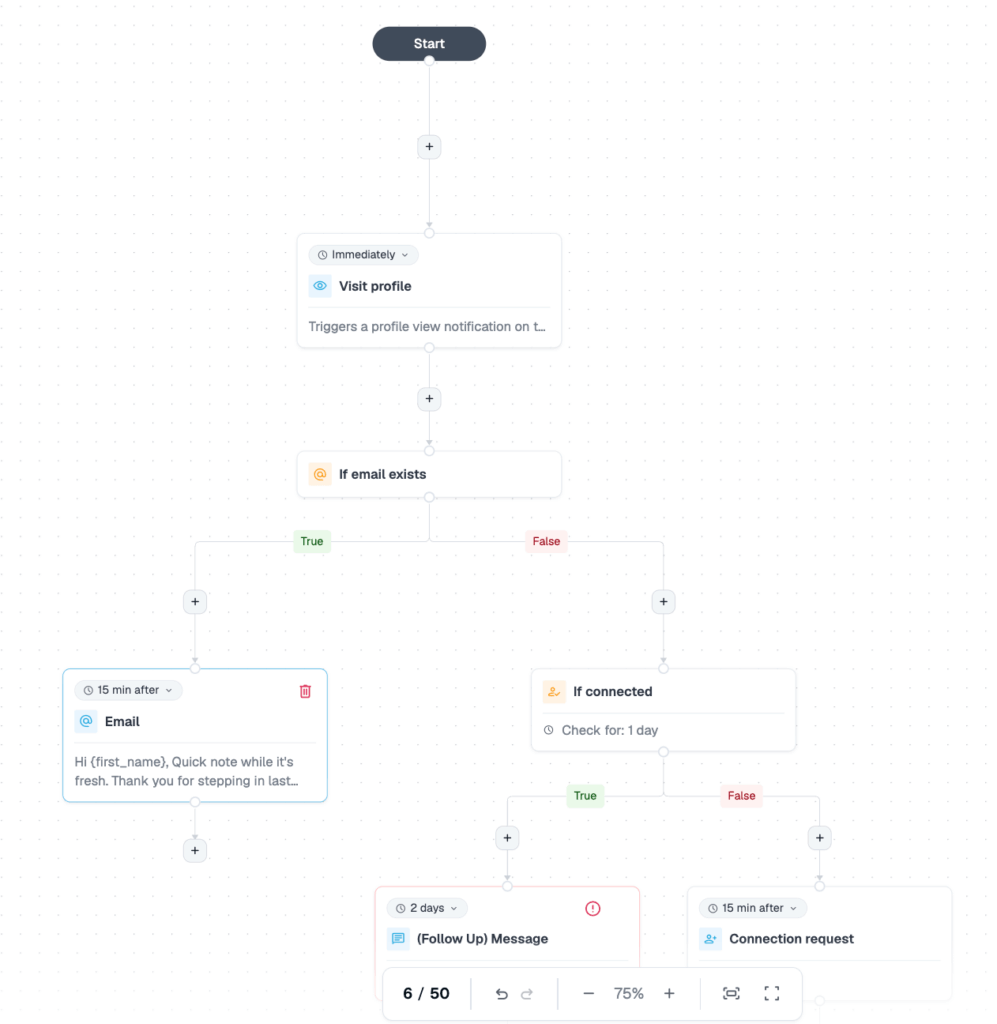
Expandi’s Smart Campaigns automate it — the post-meeting thank you sends within 24 hours, and if there’s no reply by day 4, the sequence routes to LinkedIn with a connection request that references the original conversation.
Making thank you emails part of your outreach sequence
A professional thank you email earns its reply on three things:
- One specific reference.
- A send window measured in hours.
- A single clear purpose.
The templates above cover the situations that come up most, and the specifics you swap in are what make any of them land. Where they pay off is in sequence, when the email is followed by a LinkedIn touch and a follow-up that references both.
Claim the free, 7-day trial now, no card required.
Frequently asked questions
A professional thank you email should land between 50 and 150 words. Longer than that and you’re padding. Shorter and you risk reading as automated.
The exception is project completion and partnership renewal emails, which can run to 200 words because they often include scope confirmations or next-step summaries.
Yes, when sent correctly. Welcome and thank you emails consistently rank near the top of all email types for engagement, and GetResponse’s benchmarks put welcome emails at an 83.63% average open rate, the strongest of any email type in the report.
The Boomerang study on email closings also found that variations of “thank you” as a sign-off correlated with higher reply rates than alternatives like “best” or “regards.”
No. Send thank you emails after meaningful interactions: sales meetings, project completions, contract awards, referrals, partnership milestones, and major client events.
Don’t send them after routine email exchanges, internal status updates, or low-stakes calls. Over-thanking dilutes the gesture.
A thank you note is typically handwritten or physical, sent for personal or high-touch business moments (a major client win, a senior executive introduction, a long-term partnership milestone).
A thank you email is digital, faster, and the default for most professional contexts. The two work together, and some teams send both for the highest-value interactions.
Not as a first touch. Cold thank you emails (“thanks for being a leader in [industry]!”) read as transparently fake and damage your sender reputation.
Thank you emails work in outreach sequences only after a real interaction has occurred, like a webinar attendance, a content download, a connection accept on LinkedIn, or a previous email reply.
Skip it for routine internal communications, low-stakes vendor exchanges, and any context where you’ve already thanked the person in real-time and another note would feel forced. Also skip when the email would otherwise be your third or fourth thank you to the same person in a short period. The gesture becomes meaningless when it’s over-used.



You’ve made it all the way down here, take the final step