14 Best AI Lead Generation Tools To Drive The Pipeline in 2026

Key Takeaways
There’s no single “best” AI lead gen tool in 2026. The right stack depends on your channel (LinkedIn vs email vs ABM), your sales motion (SMB vs enterprise), and where you need speed (data vs execution vs conversion). That said, pick from the list below depending on what best matches how you sell.
AI-powered prospecting, enrichment & targeting
- Clay – Best for enrichment + 1:1 personalization at scale (turn raw lists into outreach-ready lists).
- Apollo – Best all-in-one for prospecting + lists + outreach in one workflow.
- Cognism / ZoomInfo / Seamless.AI – Best when you want stronger contact data + signals (especially for SDR teams that already run outbound).
- 6sense – Best for enterprise ABM intent + account prioritization (timing + buying-stage signals).
Sales engagement & outreach automation
- Expandi – Best for safe LinkedIn automation + omnichannel sequences (LinkedIn + email in one flow).
- Instantly / Smartlead – Best for scaling cold email with multi-inbox sending + deliverability/warmup (especially for agencies).
- Outreach / Salesloft – Best when you need a serious execution system (cadences, tasks, calling, reporting) for bigger SDR/AE teams.
Conversation intelligence & deal coaching
- Gong – Best for turning sales calls into coaching + deal risk + forecast signals (helps convert meetings into pipeline).
CRM-native AI & revenue ops
- HubSpot Sales Hub – Best if you want AI prospecting/workflows inside the CRM (less context switching).
Website intent → outbound
- Dealfront (Leadfeeder) – Best for identifying companies visiting your site and turning that traffic into outreach triggers.
Lead generation in 2026 is less about “finding leads” and more about moving fast from intent signals → credible outreach → booked meetings.
AI helps you do that by compressing the work that used to take hours: research, list building, personalization, follow-ups, and routing.
But in 2026, the market is noisy. Lots of tools claim “AI” while solving totally different problems.
That’s why this list focuses on 14 tools that are actually used to generate pipeline, with a quick view of what each one does best and who it’s best for.
I’ll be breaking down what each tool does, the key features that matter for lead gen, who it’s for, and pricing. Plus I’ll be including G2 reviews for an unbiased overview, so you’re not relying on hope.
1. Expandi – Best For Safe LinkedIn + Email Outreach Automation At Scale
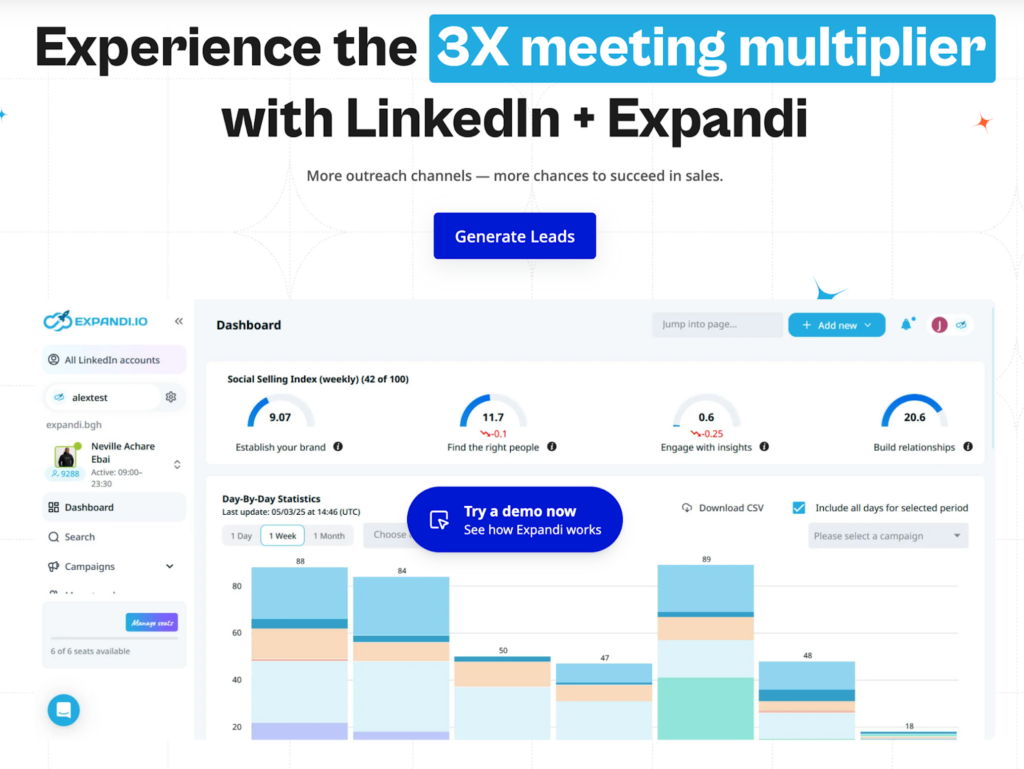
Expandi (yes, that’s us) helps founders, SDRs, and agencies generate leads through LinkedIn, email, and smart sequencing, without spending half your day doing the manual work.
Instead of hunting in Sales Navigator, sending one-off connection requests, and losing track of follow-ups, you can run structured sequences that adapt based on what prospects do (accept, ignore, reply, etc.). That matters because LinkedIn outreach usually fails from inconsistency, not lack of volume.
And it’s not LinkedIn-only: Expandi supports omnichannel outreach too (LinkedIn steps + email follow-ups). So, you can keep everything inside one workflow while pushing conversations toward booked meetings.
What makes Expandi different is that it’s built for safe, scalable, and personalized outreach at the same time.
Key features
- Campaign Builder (smart branching): Create “if-this-then-that” flows so your outreach changes based on prospect behavior.
- Omnichannel sequences: Combine LinkedIn touches with email follow-ups in the same campaign.
- AI Analyzer: Generate campaign drafts, improve messaging angles, and speed up reply writing.
- Smart Inbox: Manage conversations in one place (instead of drowning in LinkedIn’s inbox). Also ideal for people managing multiple accounts (i.e. marketing agencies)
What I like about it
- Campaign Builder is made for real outbound: you’re not locked into one linear sequence.
- Ton of different ways to scrape audience from LinkedIn to structure your outreach.
- Targeting prospects with multiple touch points is the way to go in 2026. Expandi lets you also automate profile visits, liking their latest posts, emails, InMails, and more.
Who it’s for
- Founder-led outbound teams who want a scalable LinkedIn system.
- SDRs/BDRs running daily prospecting and needing follow-up consistency.
- Agencies managing multiple outreach campaigns and wanting better control than manual ops.
Pricing
- $99/mo
Verified user review
“I love that I can rest easy at the end of the day and know that I have Expandi to be working on my behalf – Love Automation. I have increased my following and connections by the hundreds in a short period of time and because I have campaigns working for me in the background, our business is becoming more top of mind to new prospects and leads. Set up is easy and working with their technical team is easy.” – President & Head Coach
2. Clay – Best for Enrichment + 1:1 Personalization At Scale
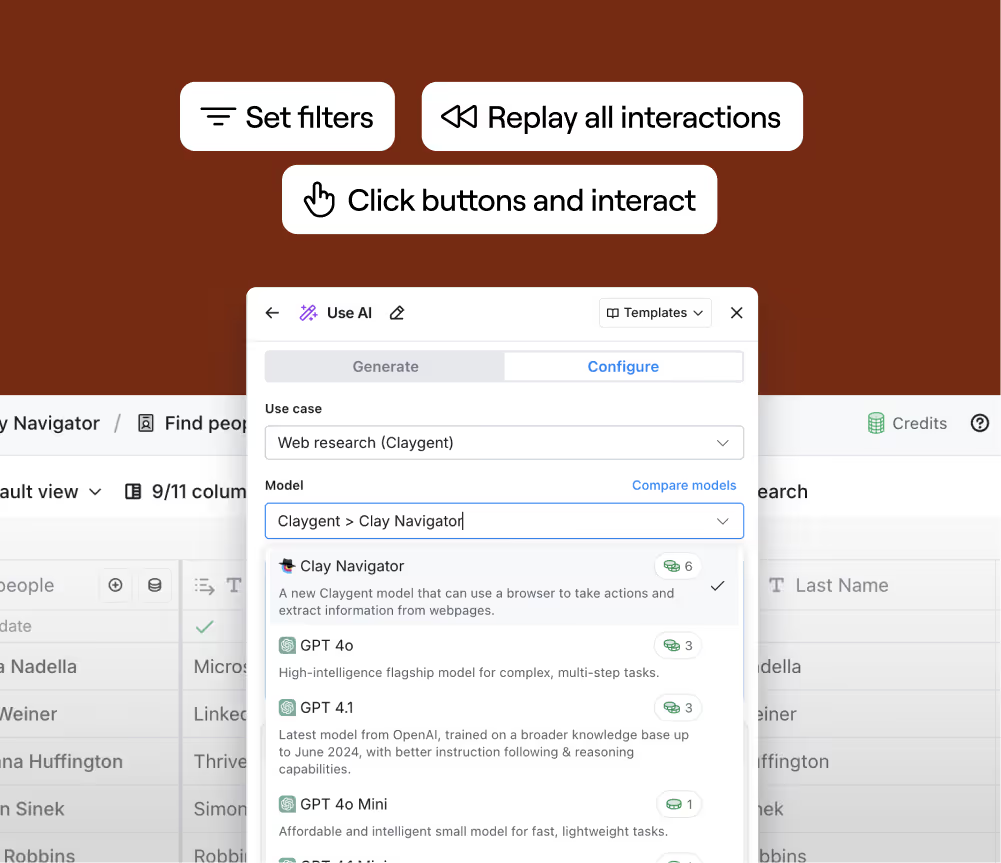
Clay is what you use when you’re tired of sending outreach that stops personalization at “hey {first_name}”.
It’s basically a GTM spreadsheet that connects to 100+ data providers, scrapes the web, and uses AI to generate the fields you actually need for outbound (decision-maker data, company context, triggers, first lines, etc.).
Then, the AI lead generation tool pushes this info into your outbound tools. Clay’s sweet spot is turning a raw list into an outreach-ready list that doesn’t feel mass-blasted.
Key features
- 100+ enrichment sources in one workflow (mix + match providers without rebuilding your process every time).
- Claygent + AI fields to research companies/leads and draft personalized snippets at scale.
- Powerful filtering/segmentation so you can build tight lists and avoid “spray and pray” outreach.
- Webhooks to plug Clay into custom ops + automations.
- Plays nice with your marketing stack.
What I like about it
- Helps you build repeatable enrichment → personalization → outbound pipeline without hiring VAs to do research.
- You can get way more specific than typical list-building (ex: enrich with firmographics + pull a trigger + generate a first line + route to the right sequence).
- It forces better outbound habits: if your list is messy, Clay makes that obvious fast.
Who it’s for
- Lead gen agencies + outbound teams that want hyper-personalized outbound at scale without manual research.
- RevOps/GTM ops teams building enrichment “systems” (routing, scoring, segmentation, triggers).
Pricing
- Free – 100 credits/mo, limited features.
- Starter – $149/mo, 2,000 credits/mo.
- Explorer – $349/mo, 10,000 credits/mo.
- Pro – $800/mo, 50,000 credits/mo.
- Enterprise – Custom credits and pricing.
Verified user review
“I really like the interactivity and ease of use of Clay. It integrates with a lot of the tools and sources that I already have, making it convenient to use. I also really appreciate the Sculptor and Sequencer, which have been powerful for experimenting with outbound campaigns, finding look-alike contacts, and generating outreach copy. Clay helps me keep my business growing, not just for my subscribers but also for my own needs.” – Senior Product Manager
3. Apollo – Best for All-in-One Prospecting + AI Lead Generation
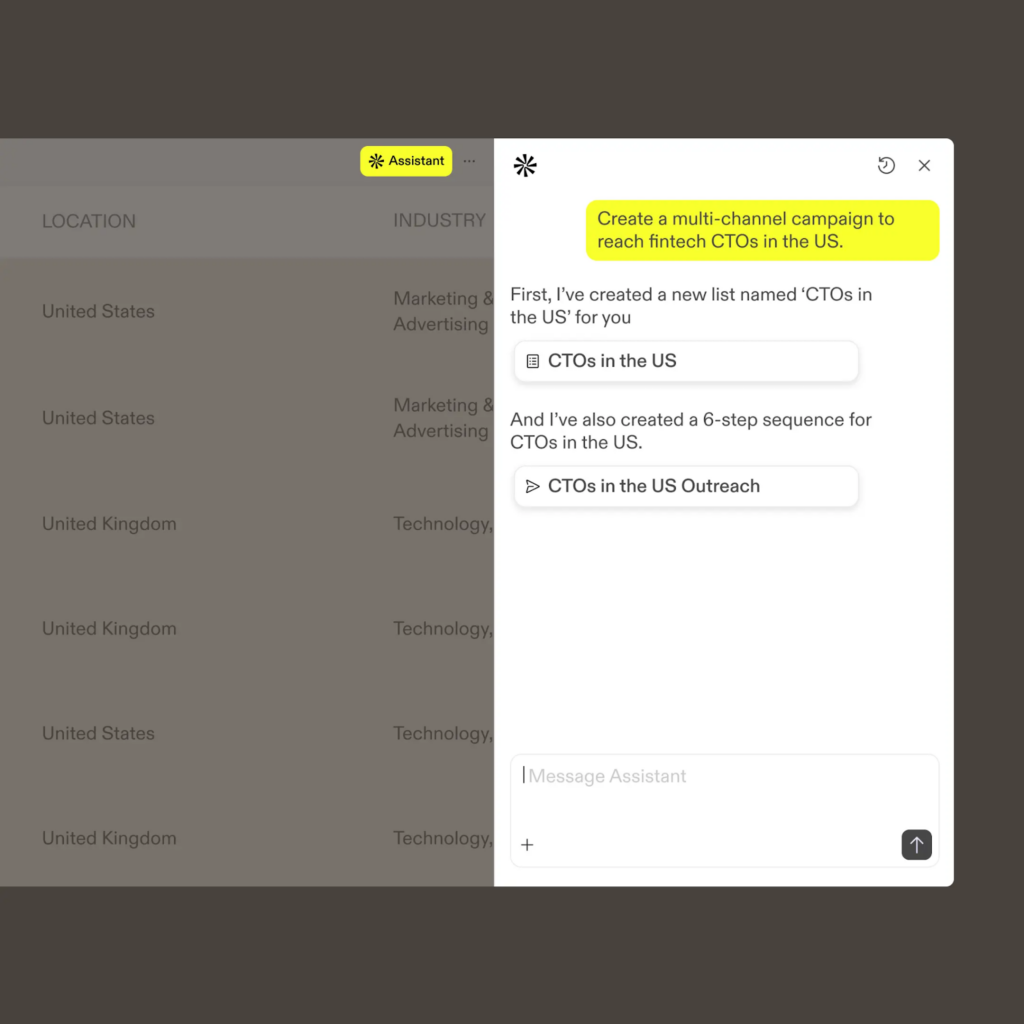
Apollo is a solid pick when you want one platform to both find leads and run the outreach, without stitching together a separate database, sequencer, dialer, and workflow tool.
It’s especially useful if your bottleneck is speed: sourcing contacts, building lists, launching sequences, and keeping reps focused on the next best action (instead of bouncing between tools). With Apollo, you can do all this and more, all in one place.
Key features
- Prospecting + list building with real-time data + signals for targeting the right buyers
- AI Assistant to help build lists and campaigns using natural-language prompts (good for getting from “ICP idea” → “campaign draft” fast)
- Built-in deliverability tools designed to help keep domains safer while sending at scale
- Workflow automation + dashboards to turn what’s working into repeatable outbound plays
What I like about it
- Great data + execution features so that you don’t use 10 different AI lead generation tools.
- AI layer positioned around shipping campaigns, not just writing copy.
- Apollo combines list, tasks, and a dialer. So, you can go from “target accounts” to “calls and follow ups” without switching tools.
Who it’s for
- Outbound teams that want an all-in-one engine (prospecting + outreach) without buying 3-5 separate tools.
- SDR teams that care about speed-to-launch and day-to-day activity efficiency (lists → sequences → calls).
Pricing
- Free – 1,200 credits per user per year.
- Basic – $49/per user/mo, 30,000 credits.
- Professional – $79 per user/mo, 48,000 credits.
- Organization – $119 per user/mo, 72,000 credits.
Verified user review
“The single best thing is the frictionless workflow between the database and the outreach engine. In other tools (like ZoomInfo), I often have to export a list to a CSV, clean it up, and then upload it to a separate tool like Outreach or Salesloft. With Apollo, I can run a search for ‘VPs of Marketing in SaaS,’ select 50 people, and click ‘Add to Sequence’ immediately. It removes the ‘admin work’ of moving data around.” – CSO.
4. Instantly – Best for High-Volume Cold Email + Deliverability
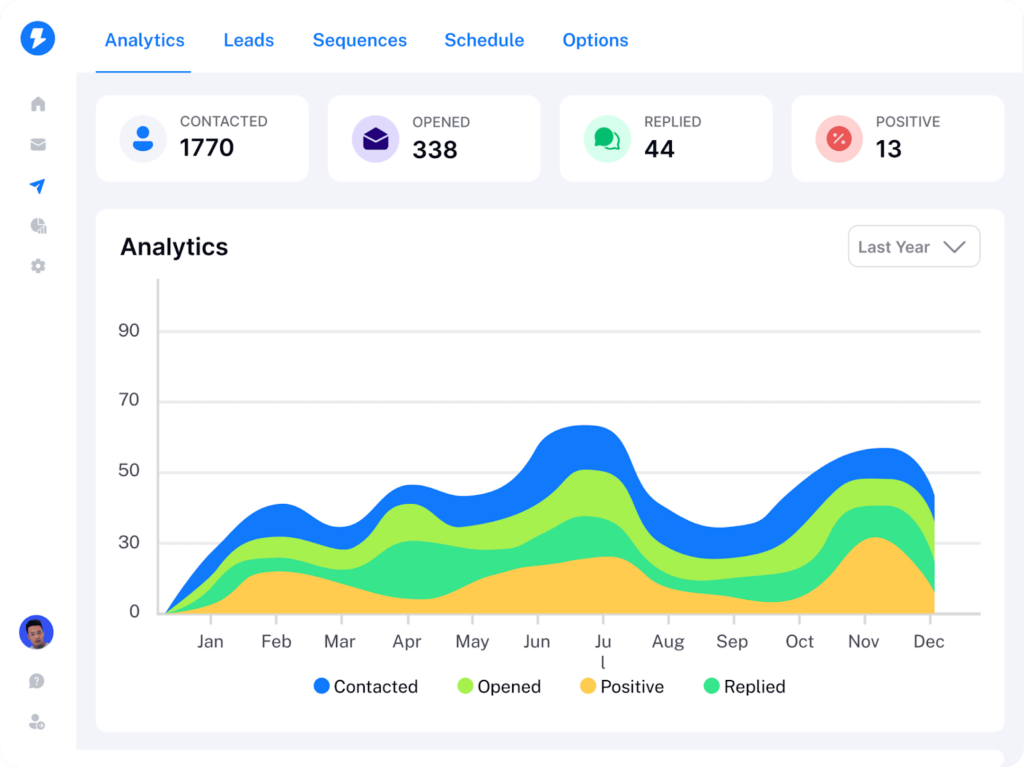
Instantly is what you reach for when your main lead gen channel is cold email, and you want to scale volume without turning deliverability into a full-time job.
The platform’s whole pitch is simple: Send more, from more inboxes, with warm-up running in the background. So you can keep landing in primary and keep replies coming in.
On top of that, the lead generation tool has grown into more of a “lead + outreach” system with an AI-powered lead finder (huge database) and Copilot-style workflows for building campaigns faster.
Key features
- Unlimited email accounts + unlimited warmup.
- Deliverability Network / automated warm-up to build and maintain sending reputation.
- AI-powered B2B Lead Finder (Instantly claims 450M leads in its database).
- AI Copilot workflows to go from ICP → targeting → campaign faster
- Deliverability-optimized email accounts (they’ll set up ready-to-go inboxes with SPF/DKIM/DMARC, etc.)
What I like about it
- The unlimited inbox model makes scaling simpler: Add mailboxes, keep the system stable, don’t renegotiate your whole stack every time you want more volume.
- Strong fit if your pipeline relies on repeatable outbound math (volume + consistency + inbox placement).
- You can pair it with tools like Clay/Expandi and use Instantly as the email “sending + deliverability engine.”
- Can buy ready-to-go inboxes with deliverability backend systems already setup, so you don’t waste time dealing with technical issues.
Who it’s for
- Agencies and outbound teams running multiple inboxes/campaigns and needing predictable scaling
- Founders + lean SDR teams who want email-led outbound without building a deliverability ops function
Pricing
- Growth – $37/mo, 1,000 uploaded contacts, 5,000 emails monthly.
- Hypergrowth – $97/mo, 25,000 uploaded contacts, 100,000 emails monthly, premium live support.
- Lightspeed – $358/mo, everything in Hypergrowth + 500,000 emails monthly, 100,000 uploaded Contacts, SISR System
- Enterprise – Custom
Verified user review
“I love how Instantly has significantly eased the process of outreach and service delivery for the past two years. The UI is particularly impressive, providing a user-friendly and aesthetically pleasing interface that made setting things up incredibly easy… By sending an impressive volume of 1 million emails monthly, Instantly facilitates efficient lead generation which we then convert through sales calls managed using Instantly’s Unibox feature.” – Co-Founder.
5. Smartlead – Best for Multi-Inbox Cold Email + Agency-Grade Control
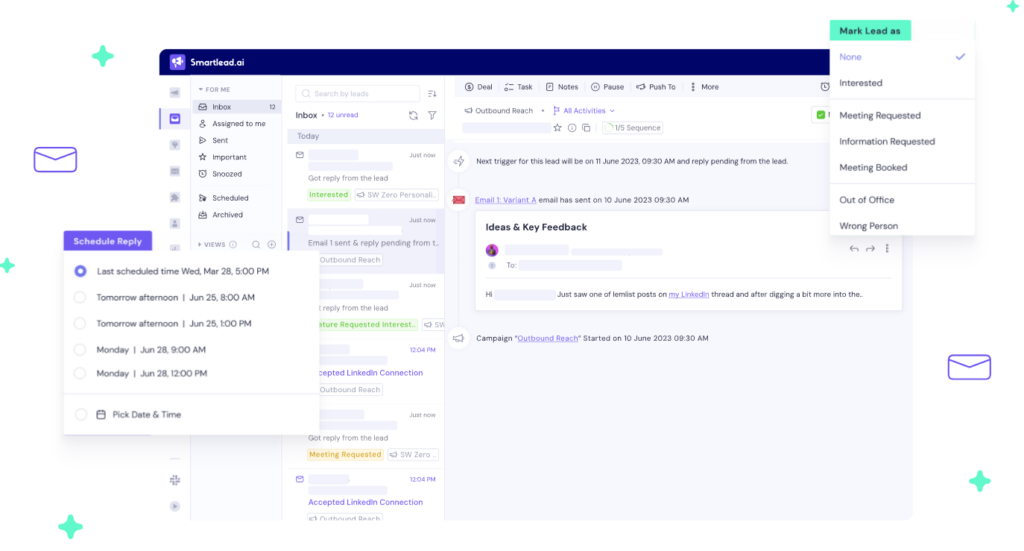
Smartlead is built for teams that want to scale cold email with lots of inboxes. But still keep everything organized (campaigns, replies, deliverability, and client work) without it turning into chaos.
Where tools like Instantly feel “scale-first,” Smartlead leans more ops-first. It’s made for managing volume and keeping workflows clean. Especially if you’re running outbound for multiple reps, brands, or clients.
Key features
- Multi-inbox sending + inbox rotation so you can scale volume without hammering a single domain/inbox.
- Warm-up + deliverability controls to protect sender reputation as you ramp.
- Unified inbox to manage replies across campaigns/inboxes in one place (big for agencies).
- Smart sequences + personalization (dynamic variables, conditional steps, AI assists depending on plan).
What I like about it
- All the essential outreach + lead generation features you’d need as an agency if managing multiple clients.
- Can set up permissions, organization management, reply handling + operational visibility.
- Works really well as the email execution layer, when you already have list building + personalization handled elsewhere (Clay/Apollo), and you want a reliable sending engine.
Who it’s for
- Lead gen agencies managing multiple clients, inboxes, and campaigns at once.
- Outbound teams scaling past a few inboxes and needing tighter operational control.
- Founders/SDRs who want multi-inbox scale, but don’t want to duct-tape processes together.
Pricing
- Basic – $39/mo, perfect for trying out Smartlead/solopreneurs.
- Pro – $94/mo, perfect for marketers / pre-scale businesses.
- Custom – $174/mo onwards, perfect for lead gen agencies/scale-up businesses.
Verified user review
“Smartlead is the single most reliable and scalable cold email platform we’ve used, hands down. It powers the entire backend of our outbound operations across dozens of client accounts and thousands of inboxes. We’ve generated over 2,000 positive replies and more than $20M in revenue using Smartlead.” – Co-Founder and CEO.
6. Seamless.AI – Best for Real-Time Contact Discovery + Direct Dials
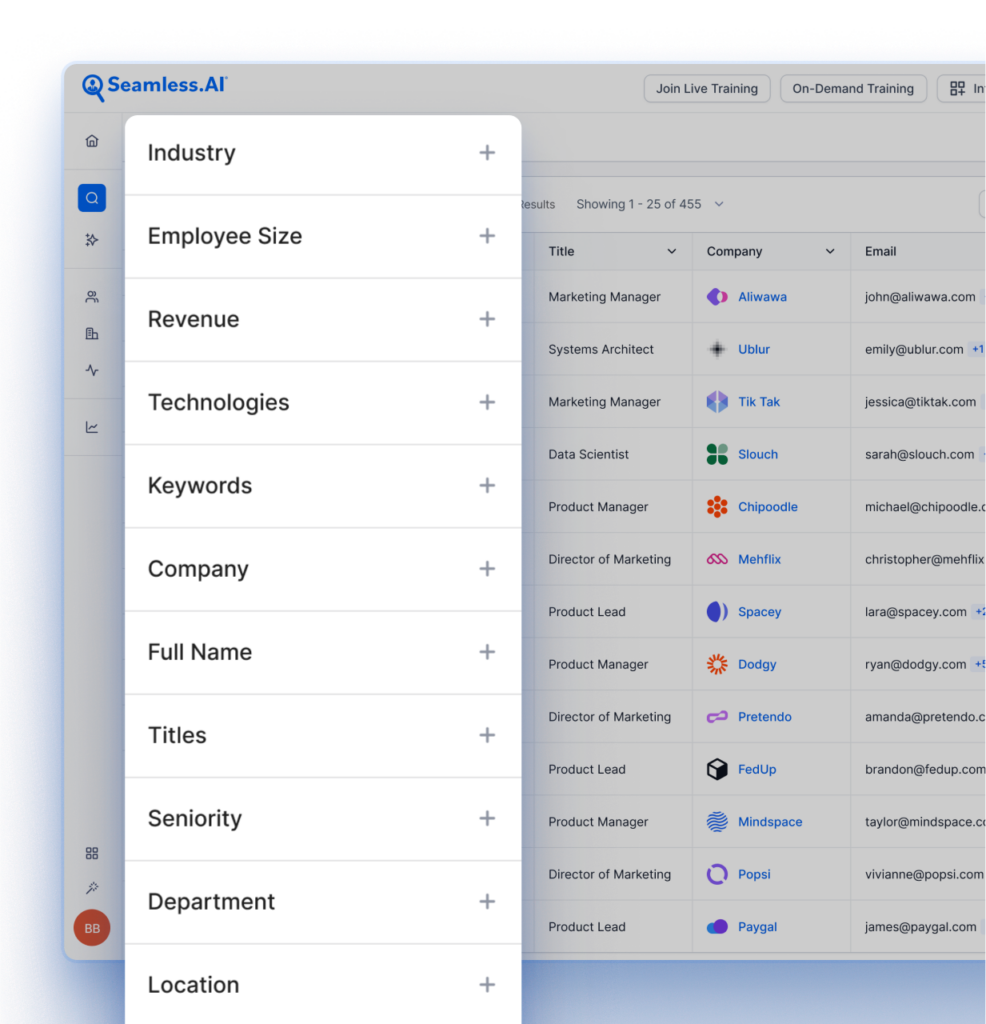
Seamless is the move when your biggest bottleneck is getting accurate contact data fast (emails and direct dials), not writing sequences.
Instead of treating your database like a static list you buy once a year, Seamless positions itself as a real-time search engine that researches and verifies contact info as you prospect.
The other big win is that it’s built for in-the-moment prospecting. You can pull contact details while you’re browsing LinkedIn/Sales Navigator (and other places), then push that data into your outbound motion.
Key features
- Prospector (AI-powered email discovery + verification) to improve deliverability and reduce bad data headaches.
- Buyer intent + job changes + enrichment modules (useful for targeting “why now” signals, not just job titles).
- Chrome Extension that works across LinkedIn + Sales Navigator (and can be used across other surfaces too).
What I like about it
- The product direction (intent + job changes + enrichment) supports a more signal-led approach.
- Strong fit if your team lives in LinkedIn and needs a quick find → enrich → export/sync loop.
- Integrates with LinkedIn + Salesforce + Gmail via the extension workflow.
- Sourcing is GDPR, CAN-SPAM, and CCPA compliant.
Who it’s for
- SDR/BDR teams that need more verified contacts + direct dials without slowing down.
- Founder-led outbound where you want real-time prospecting without buying a heavyweight enterprise database.
- Teams already happy with their sequencer (Expandi/Instantly/etc.) and just need a separate data engine.
Pricing
- Have to contact sales.
- Online research and reviews claim from $79/mo to $149/mo+.
Verified user review
“Seamless.AI offers some fantastic features for lead generation that many users appreciate. It provides valuable insights and helps streamline the process of finding potential clients. While there might be a learning curve for some, the benefits of enhanced connectivity and efficient outreach often outweigh any initial challenges.” – Founder and CEO.
7. Cognism – Best for Compliant, Phone-Verified B2B Data

Cognism is the AI lead gen tool you use when data quality and compliance matter more than just having the biggest database possible.
It’s built for outbound teams that want to find the right buyers, reach them (especially via phone), and keep teams inside guardrails (DNC checks, GDPR/CCPA posture) while doing it.
Where it really stands out though is with phone-verified mobile numbers (Diamond package) + a workflow that plugs into your daily prospecting motion (extension + web app + CRM integrations).
Key features
- Phone-Verified Mobile Numbers (Diamond) for higher call-connect rates vs “maybe” direct dials.
- Sales Companion (Chrome extension + web app) for searching, prioritizing, and enriching prospect data without bouncing between tabs.
- Lead scoring + prioritisation so reps focus on higher-value accounts first.
- Compliance support: Checked against 13 global Do-Not-Call lists + compliance-first positioning (useful if you sell into the EU/UK).
- Integrations: Works inside common stacks (CRM + sales engagement tools).
What I like about it
- If calling is part of your motion, phone-verified mobile data is one of the few advantages that actually shows up in the pipeline.
- Strong plug-in feel: prospect → enrich → push to CRM/workflows, without building a whole Frankenstein stack first.
- Strong focus on compliance and DNC list checking.
Who it’s for
- SDR/BDR teams doing phone-first or phone-heavy outbound.
- EU/UK-facing teams that need a compliance-first data vendor story for procurement/legal.
- RevOps teams that want data to flow into Salesforce/HubSpot/Sales tools instead of living in CSVs.
Pricing
- Custom pricing (have to request a demo).
- Online research and reviews claim anywhere from $15,000 to $100,000 annually
Verified user review
“What I appreciate most about Cognism is how seamlessly it works with our current tools. The integration with Salesforce is excellent, helping us maintain clean data and save valuable time… My main frustration is with the limited data coverage in the APAC region. Although the platform works well for the US and EU, finding complete contact information in Asia Pacific can be difficult.” – Enterprise Account Executive.
8. ZoomInfo – Best for Enterprise GTM Data + Intent Signals
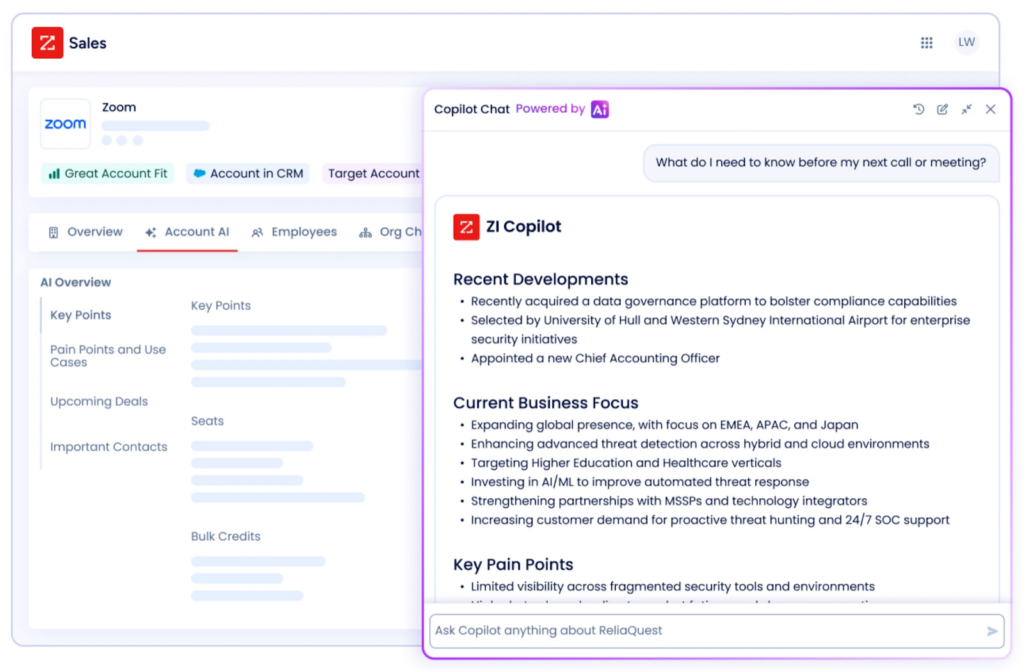
ZoomInfo positions itself as the enterprise-grade data + targeting pick when your outbound depends on finding the right accounts fast. And prioritizing who to hit now based on buying and intent signals.
At a high level, it’s a go-to-market platform built around a large business database with an intelligence layer (including intent signals). So your team can stop guessing and start focusing on accounts that are more likely to convert.
It also leans into AI with products like ZoomInfo Copilot, which helps teams move faster inside the platform so there’s less manual research and admin work.
Key features
- Sales-focused platform + data to source and target companies for prospecting.
- Intent-style intelligence layer to help prioritize accounts and reduce spray-and-pray.
- ZoomInfo Copilot to help identify, engage, and convert the right accounts at the right time.
- Designed to plug into broader GTM systems and processes.
What I like about it
- Strong fit for enterprise teams where precision targeting is important.
- Helps run tighter outbound processes when you’ve got prioritization + workflows in the same system, instead of juggling different tools.
- Position for serious GTM teams.
Who it’s for
- Mid-market + enterprise outbound teams that need reliable targeting.
- RevOps/GTM teams that want cleaner workflows and better prioritization for SDRs and AEs.
Pricing
- Have to contact sales.
- Online research shows anywhere from $15,000/year all the way up to $40,000/year.
Verified user review
“ZoomInfo provides my team with immediate clarity on where to direct our efforts. The blend of accurate company and contact data, intent signals, and workflow automation transforms prospecting from guesswork into a more focused and strategic process. It essentially serves as our shortcut to identifying who is in-market, understanding their interests, and determining the best way to connect with them” – Senior Director, Global Marketing.
9. 6sense – Best for Account-Based Intent + Buying Stage Signals (Enterprise)
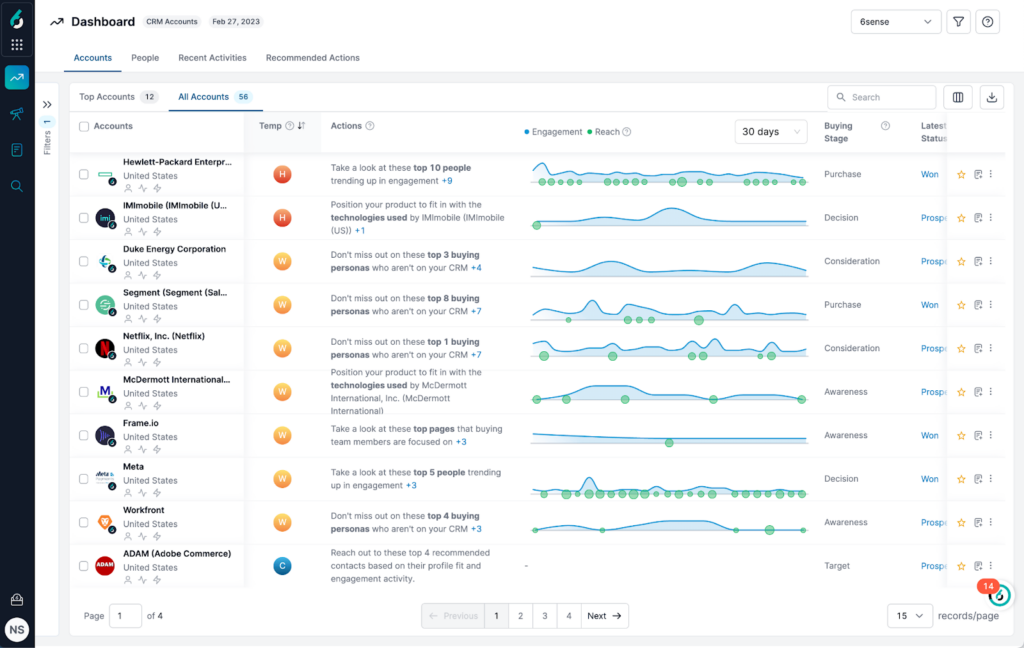
6sense is for when lead gen is more about finding which accounts are already in-market, where they are in their buying journey, and what your team should do next. Instead of finding more people to send outreach messages.
If you’re running ABM (or selling into enterprise where timing + committees matter), 6sense helps you move from anonymous signals → prioritized accounts → targeted outbound + ads.
This way, reps spend less time guessing and more time working the right opportunities.
Key features
- Intent + buying stage visibility: Spot accounts researching your category and prioritize based on likelihood to convert.
- Account scoring + segmentation: Build lists based on real signals (not just firmographics).
- Contact + committee mapping: Find the right people inside the right accounts (not just “a VP”).
- Orchestrating sales + marketing: Align outbound touches with retargeting/ads so prospects see you in more than one place.
What I like about it
- Plays best with Salesforce / HubSpot + Salesloft/Outreach + enrichment tools (Clay/Apollo).
- One of the few tools that changes who you target and when. Not just how fast you can send messages.
- Helps SDRs avoid wasted sequences on accounts that aren’t in-market yet.
Who it’s for
- Enterprise GTM teams running ABM and needing intent-driven prioritization.
- Sales + marketing teams that want a shared “source of truth” on which accounts to focus on this week.
Pricing
- Have to contact sales.
- Online content estimates anywhere from $35,000 to $130,000+ annually, depending on features and requirements.
Verified user review
“I find 6sense Revenue Marketing incredibly valuable due to its ease of use and straightforward design, making my tasks less complicated and more visual. The dashboards stand out as a key feature, offering easy access to various functions like enriching data and connecting seamlessly with platforms like Salesforce… I would like to see more industry-specific information, including the addition of a sub-sector category. Currently, only industry and sector are available, which limits the granularity of the data.” – Data Quality Specialist
10. Gong – Best for Deal Intelligence + Coaching From Sales Conversations
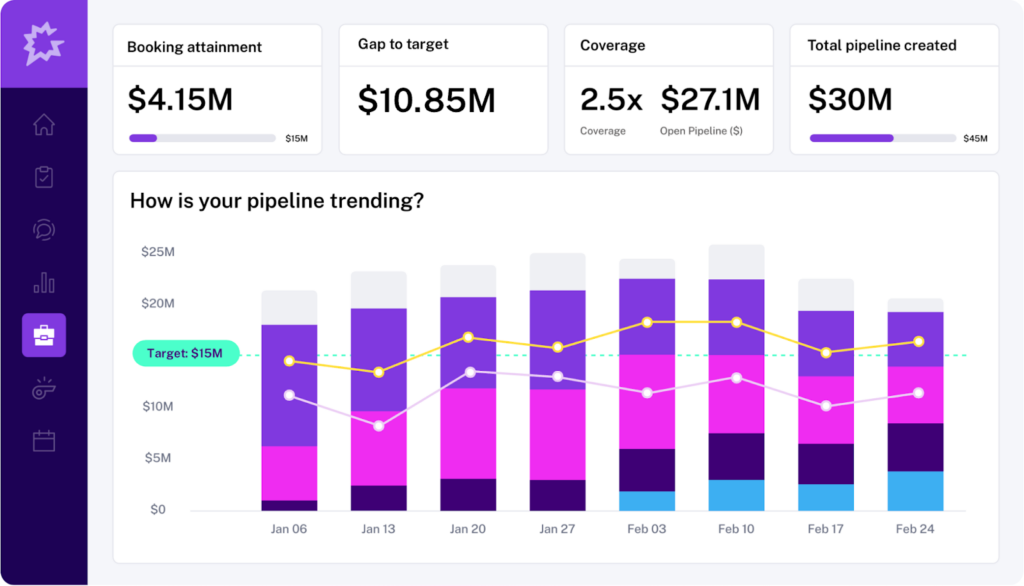
Gong is what you use after you already have leads talking to you. With it, you can convert more of them into pipeline (and stop losing deals for the same avoidable reasons).
Instead of relying on rep notes and gut-feel pipeline updates, Gong records and analyzes real sales conversations to surface what’s actually happening:
- Objections
- Competitor mentions
- Next steps
- Risk signals
- What top reps do differently
This is where the AI value shows up, less manual CRM hygiene, better coaching, and cleaner forecasting from real buyer signals.
Key features
- Conversation intelligence + AI insights: Call recording/transcription + deal and pipeline insights pulled from what was actually said.
- Coaching & enablement workflows: Spot patterns across calls, highlight what works, and use that to ramp reps faster and improve conversion rates.
- Integrations for “system of record” workflows: Strong CRM + meeting integrations so insights don’t live in a silo (ex: Salesforce, HubSpot, Zoom).
- Broad integration ecosystem: Designed to plug into wider GTM stacks (Gong publicly positions 90+ integrations).
What I like about it
- Turns sales calls into a dataset you can actually optimize (messaging, discovery, objections, win/loss patterns).
- Helps RevOps + leadership run a tighter pipeline process because the source of truth is the conversation, not the recap.
- Makes coaching way more concrete: You can point to exact moments instead of giving generic advice.
Who it’s for
- SDR/AE teams that already have meetings and want higher conversion + better follow-through from real call insights.
- Sales leaders/enablement who want scalable coaching and repeatable talk tracks based on what top performers do.
Pricing
- Have to contact sales.
- Online estimates claim from $900 to $25,000+ annually, depending on team size and requirements.
Verified user review
“I’ve used Gong in 2 different roles and organizations now over the course of the last few years as a Manager of Account Managers. Gong helps me as a leader give direct “live” feedback on calls to improves sales skills that I otherwise would only have insight on if I was on the call. I love the scorecards and AI functions and that they continue to improve from when I first started using Gong to now. The user usability is easy enough for call searching and easy to train on.” – Account Management Director
11. Outreach – Best for Sales Engagement, AI Execution, And Complex Deal Management
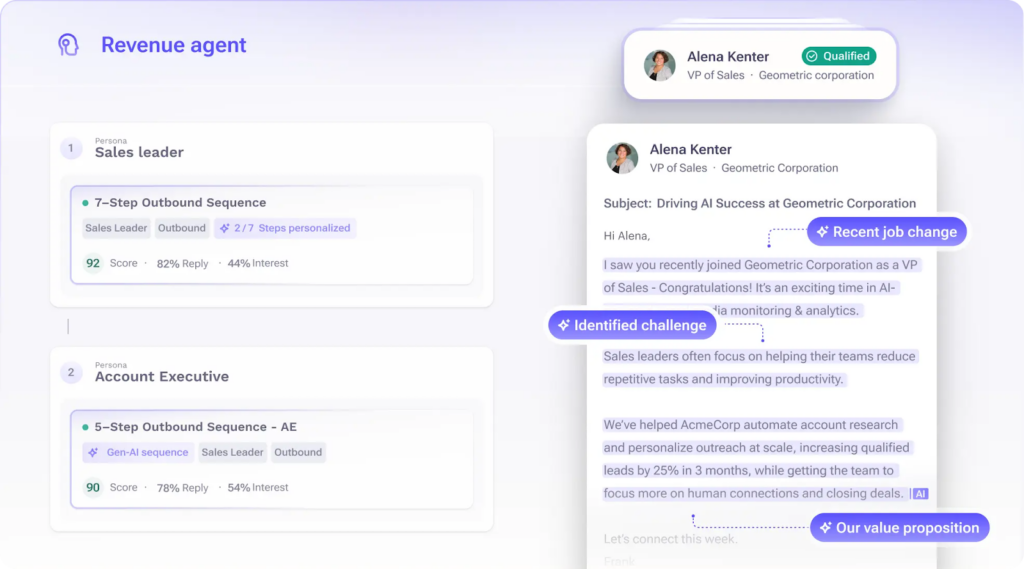
Outreach is another great pick for when you don’t just need more leads, but a system that makes reps execute consistently after the list is built.
It’s a sales engagement platform built around sequences + tasks + calling + reporting. So reps can run a tight daily outbound motion without juggling five different tools.
Key features
- Sequences (multi-touch cadences): Orchestrate emails, calls, and other touches in a repeatable playbook.
- Calling and execution layer: Built to support a rep’s day-to-day outreach + follow-up workflow in one place.
- Outreach Kaia (conversation intelligence): Auto-notes, action items, summaries, and in-meeting support.
- Integrations: Designed to sit on top of your CRM + data stack (Salesforce/HubSpot + data vendors, etc.).
What I like about it
- Built for execution discipline (sequences, tasks, reporting).
- Practical AI (Kaia) focused on capturing reality from calls and turning it into follow-through.
- Strong fit when your lead gen stack is already working and you need a serious engagement layer to convert activity into pipeline.
Who it’s for
- SDR/BDR teams who need a structured daily workflow (sequence tasks, calling blocks, follow-ups) so nothing slips.
- RevOps + sales leaders who want more consistent execution and coaching leverage from actual calls and activity data.
Pricing
- Custom pricing, have to contact sales.
- Online user reviews say between $100-$160 per user per month (or $20,000 to $50,000+ annually for larger teams).
Verified user review
“I really appreciate how Outreach streamlines the prospecting process by making it simple to create sequences within organizations…The automation capabilities are invaluable, providing consistency in reaching out to contacts, which is critical for breaking into organizations… I also think the process of building sequences could be streamlined to require fewer clicks, making it easier to construct them from scratch.” – Account Executive.
12. Salesloft – Best for Sales Engagement And Revenue Orchestration at Scale
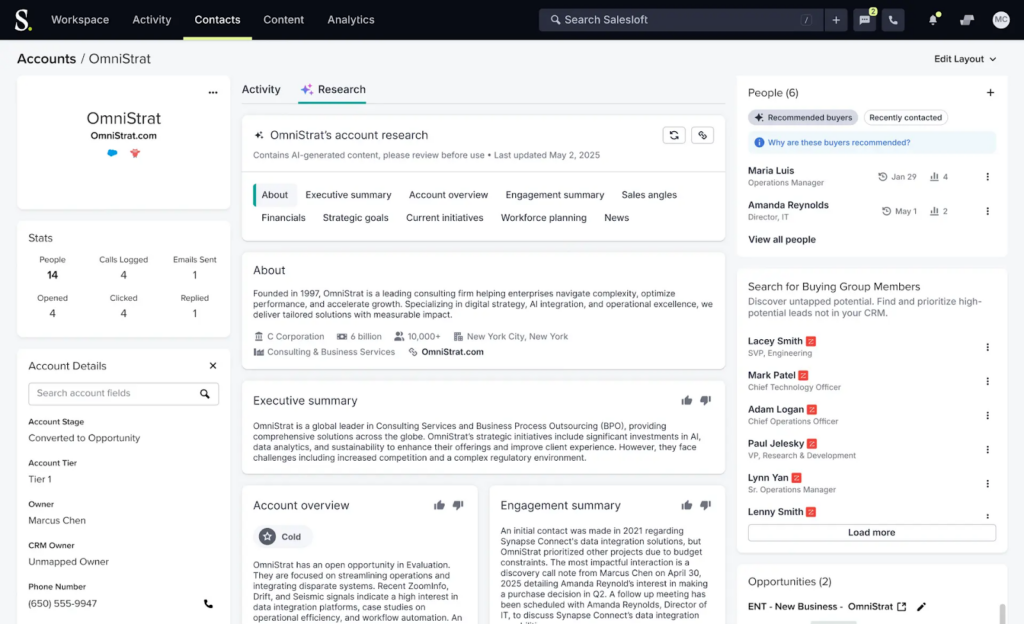
Salesloft is built to increase meeting rates by making outbound execution consistent through:
- Structured cadences.
- Prioritized tasks.
- And call + email workflows that keep momentum moving even when reps are juggling 50+ accounts.
It combines a classic sales engagement platform with an execution layer like Rhythm. Which helps sellers prioritize the next best actions across accounts/leads so your team isn’t living in spreadsheets and guesswork.
Key features
- Cadence: Build and run multi-touch outbound sequences so follow-ups don’t die when reps get busy.
- Rhythm: Prioritize accounts/leads and guide reps toward the right actions (so activity is focused, not random).
- Conversations: Capture sales calls + surface insights for coaching, deal risk, and what’s actually happening in-pipeline.
- Bi-directional CRM sync + reporting: Keep activity connected to pipeline + performance tracking.
What I like about it
- Standardizes outbound execution without forcing reps into a rigid, robotic workflow.
- Rhythm can be a big upgrade for teams that struggle with prioritization (which is usually why follow-ups slip).
- You get visibility into what’s working (and what’s not) without relying purely on rep self-reporting.
Who it’s for
- SDR/BDR + AE teams doing consistent outbound and wanting higher meeting rates through better execution.
- Sales leaders / RevOps teams who need clearer activity → pipeline attribution and more consistent process adoption.
Pricing
- Quote-based, have to talk to sales.
- Online research claims starting costs around $65-$125 per user/mo for basic tiers.
Verified user review
“I use Salesloft to create email marketing campaigns targeting our ideal customer profiles and for forecasting and data intelligence. I find Intent Data very valuable. Salesloft allows us to do outbound at scale without sacrificing the quality of outreach. I love that it allows us to input customization in our messaging, which leads to a higher response rate.” – Enterprise Account Executive.
13. HubSpot Sales Hub – Best for CRM-Native AI Prospecting And Signal-Led Execution

If you’re already using HubSpot CRM, Sales Hub is one of the cleanest ways to keep the whole flow connected: lead → outreach → pipeline → forecasting. Without exporting lists, duct-taping tools, and losing context along the way.
HubSpot positions its AI layer (Breeze) and its Prospecting Agent around identifying and engaging high-value leads with less manual research and admin.
Key features
- Breeze + Breeze Agents (Prospecting Agent): AI-driven prospecting support built into the HubSpot platform.
- Sales Hub workflow stays CRM-native: Contacts/companies, deals, activity history, and reporting live in one system (so reps aren’t prospecting blind).
What I like about it
- Built for signal-led workflows inside your CRM, not CSV lead gen. This way, there’s less context switching and faster follow-up, and better targeting.
- If your team already runs on HubSpot, it reduces the usual outbound mess: separate list builder → separate sequencer → separate task tool → separate reporting.
Who it’s for
- Teams already using HubSpot CRM that want prospecting and outreach execution to stay connected to pipeline.
- SDR/AE teams that need structured follow-up and prioritization tied to real CRM context (not spreadsheets).
Pricing
- Professional – $100/mo/seat
- Enterprise – $150/mo/seat
Verified user review
“I enjoy using Hubspot Sales Hub as opposed to other CRM tools because HubSpot is easily organized and very user-friendly. As someone who has used 3 different CRM tools in the past 3 years, Hubspot stands out as having the simplest layout to navigate and easiest learning curve… I have found that there are some emails that are only tracked on the contact level, not the company level. This makes things more difficult when I am required to search under each contact for information rather than it appearing on the company’s activity.” – Sales Executive.
14. Dealfront (Leadfeeder) – Best for Turning Website Traffic Into Intent-Led Outbound
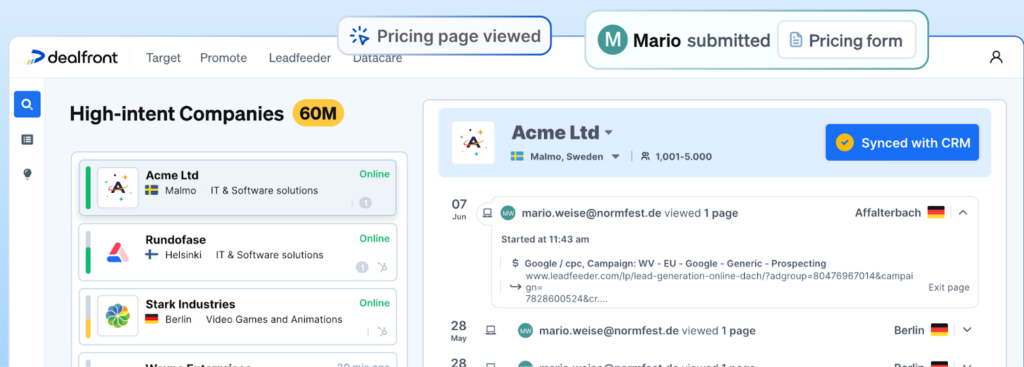
Instead of treating website traffic like a vanity metric, Dealfront lets you identify accounts that are already researching you.
It shows you which companies are visiting your site, what they’re looking at, and lets you trigger follow-up while the intent is still warm.
Dealfront focuses on tracking, machine learning, and its databases to analyze visitors and reveal companies (even when people are remote).
Key features
- Company identification from anonymous traffic, qualification via behavioral, and firmographic filters.
- Target-account alerts when specific accounts visit, plus page-level visibility to personalize the outreach.
- CRM automation and enrichment (create/enrich records based on high-intent activity) + real-time alerts (Slack/email).
- Reach decision-makers with contact details inside visiting accounts (names, titles, emails, direct dials).
What I like about it
- Contacting accounts with an obvious intent signal because they visited your website.
- Works especially well paired with your current marketing and/or outreach stack.
Who it’s for
- Teams already driving meaningful website traffic (SEO, ads, partnerships, outbound) who want to convert it into pipeline.
- SDR/AE teams that want a clean “hot accounts today” workflow, not just another static list.
Pricing
- Custom quote, have to contact sales.
- Online research claims anywhere from $115/mo to $19,000/year (depending on your website traffic and size)
Verified user review
“Dealfront has significantly improved our sales and marketing workflows. The platform provides highly detailed firmographic and behavioral data, which allows us to better target prospects and personalize our outreach. We especially appreciate the seamless integration with our CRM system and the user-friendly interface… Some features—like the workflow automation—require a bit of a learning curve, but once configured, they’re very powerful.” – Business Owner
AI Lead Generation Tools: FAQ
What are AI lead generation tools?
AI lead generation tools use AI to speed up the lead gen workflow: finding prospects, enriching data, and generating outbound messages. In practice, they help you move faster from intent signals → credible outreach → booked meetings.
Which are the best AI lead generation tools in 2026?
The best AI lead generation tools in 2026, depending on your requirements, include:
- Clay – enrichment + personalization at scale
- Apollo – prospecting + lists + outreach in one place
- Expandi – LinkedIn + email in one omnichannel sequence
- Instantly / Smartlead – cold email scale + deliverability
- Cognism / ZoomInfo / Seamless.AI – stronger contact data + signals
- 6sense – ABM intent + account prioritization for enterprise
- Gong – Deal/call intelligence to improve conversion
- HubSpot Sales Hub – CRM-native prospecting + workflows
- Dealfront/Leadfeeder – Website intent → outbound triggers
What’s the best AI tool for lead generation if you’re LinkedIn-first vs email-first?
If you’re LinkedIn-first, you want a tool that can run LinkedIn steps safely and keep follow-ups consistent → Expandi.
If you’re email-first, you want a tool built for multi-inbox sending + warmup/deliverability → Instantly or Smartlead.
The “best” tool is the one that matches your primary channel.
How do I choose the right AI lead generation tool stack?
Pick based on where you need leverage:
- Need better inputs? → Clay/Apollo (list building + enrichment)
- Need execution + follow-up consistency? → Expandi / Instantly / Smartlead
- Need enterprise targeting by timing? → 6sense
- Need higher conversion after meetings? → Gong
A good stack is the smallest one that covers data → outreach → conversion without constant exporting/importing.
Where to Go From Here
Instead of stacking 14 tools and hoping it works, you should pick a simple combo that matches how you sell.
From there, your next steps should be:
- Pick one ICP + one offer (don’t “test” 10 at once).
- Decide your primary channel (LinkedIn-first vs email-first vs ABM-first).
- Build a clean list (enrich it, filter it, add a “why now” trigger).
- Launch one sequence you can repeat (5-8 touches, multi-channel if possible).
- Track only the metrics that matter: positive replies, booked meetings, show rate.
- Iterate weekly (targeting + first line + offer).
Finally, if LinkedIn is a core channel for you, Expandi is the easiest “centerpiece” tool to build around. Because it handles safe LinkedIn automation and lets you layer in email follow-ups inside the same sequence.
Then you can plug in Clay/Apollo for enrichment and keep your whole outbound system clean.
Wondering if Expandi is right for you?
Learn more and claim your free, 7-day trial here!



You’ve made it all the way down here, take the final step