30+ LinkedIn Connection Message Templates (2026)

Key Takeaways
- A personalized note barely changes acceptance (26.42% with a note vs 26.37% without across 20M+ requests) but nearly doubles your reply rate once the request is accepted.
- LinkedIn caps connection notes at 200 characters, and free accounts can personalize only three invitations a month, so spend your notes where you want a reply.
- The highest-accepting requests name a shared context: a mutual group, a post they wrote, an event you both attended, or a clear, specific reason to connect.
- Hold the pitch in the request. Get accepted first, then earn the meeting in the follow-up.
- Triggered requests: sent right after someone engages with a post, joins an event, or views your profile — outperform cold sends, and Expandi’s signal-based campaigns automate that timing for you.
A cold LinkedIn connection request dies in the queue when it reads like every other pitch in that person’s notifications.
The data settles one debate up front: a personalized note barely changes whether you get accepted, but it nearly doubles your reply rate once you’re in. So send clean requests broadly, save your limited notes for the people you most want to talk to, and match every message to a real reason to connect.
This guide gives you 30+ LinkedIn connection message templates by persona and trigger to do exactly that.
We pulled the connection-request data across our platform and paired it with Belkins’ study of 20M+ outreach attempts run through Expandi to see what really moves acceptance and replies in 2026. The answer changes how you should spend your personalized notes.
Below:
- The note-vs-no-note data on LinkedIn connection messages.
- How to add a LinkedIn connection request note and the free-account limit to plan around.
- LinkedIn connection templates grouped by SDR, recruiter, job seeker, and founder use cases.
- A set of trigger-based requests tied to a real signal.
- Automating the follow-up message that turns a new connection into a conversation.
Should your LinkedIn connection request have a note?
A note barely changes whether someone accepts.
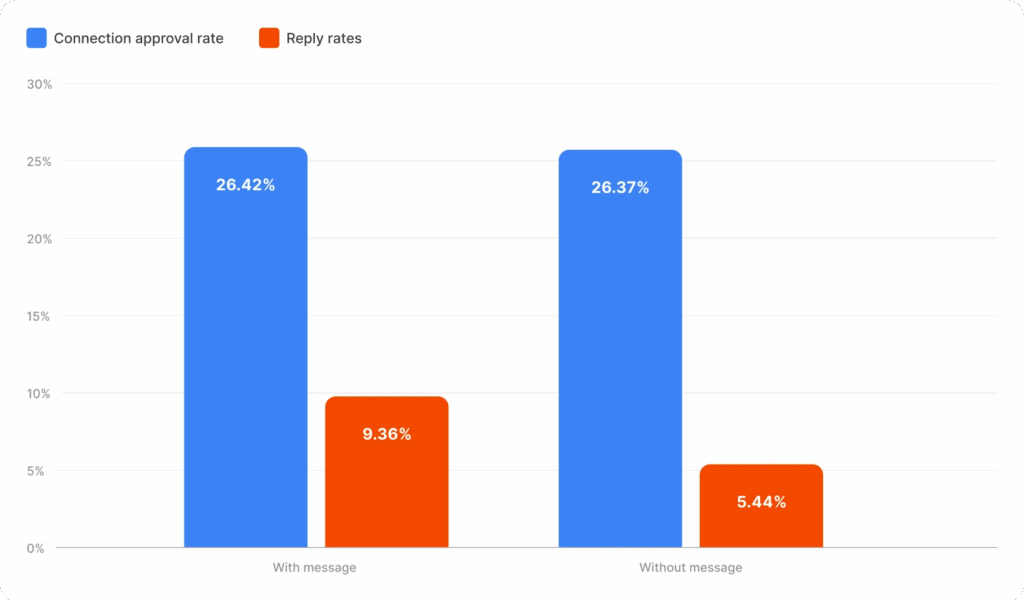
Across 20M+ outreach attempts run on our platform, Belkins’ study measured a 26.42% acceptance rate for requests sent with a personalized note against 26.37% for requests sent without one, close enough to call identical.
The note earns its place in what happens after the accept.
Requests that opened with a personalized note pulled a 9.36% reply rate against 5.44% for bare requests, a 72% lift in replies once the connection is live. So treat the note as a conversation opener: it does little for acceptance and a lot for what happens next.
“If your primary goal is to expand your network, connection requests without a message perform just as well. However, if you aim to initiate conversations or generate leads, always include a short, relevant, and personalized message to significantly boost your chances of receiving a reply. Even 2 well-crafted sentences can make a significant difference.” — Yuriy Boyko, Head of account management at Belkins.
That reframes the personalize-everything advice you’ll read everywhere else.
For a free LinkedIn account capped at three personalized invites a month, the smart move is to send clean, no-note requests broadly and save your notes for the people you most want to talk to.
For reference, our own Connector campaigns average a 29.61% approval rate in the 2026 State of LinkedIn Outreach report, so 25-30% is a healthy band to benchmark against.
How to add a note to a LinkedIn connection request (and the free-account limit)
To send a personalized connection request on LinkedIn:
- Open the person’s profile or find them in search.
- Click Connect (on mobile, you may need the three-dot menu first).
- Choose Add a note.
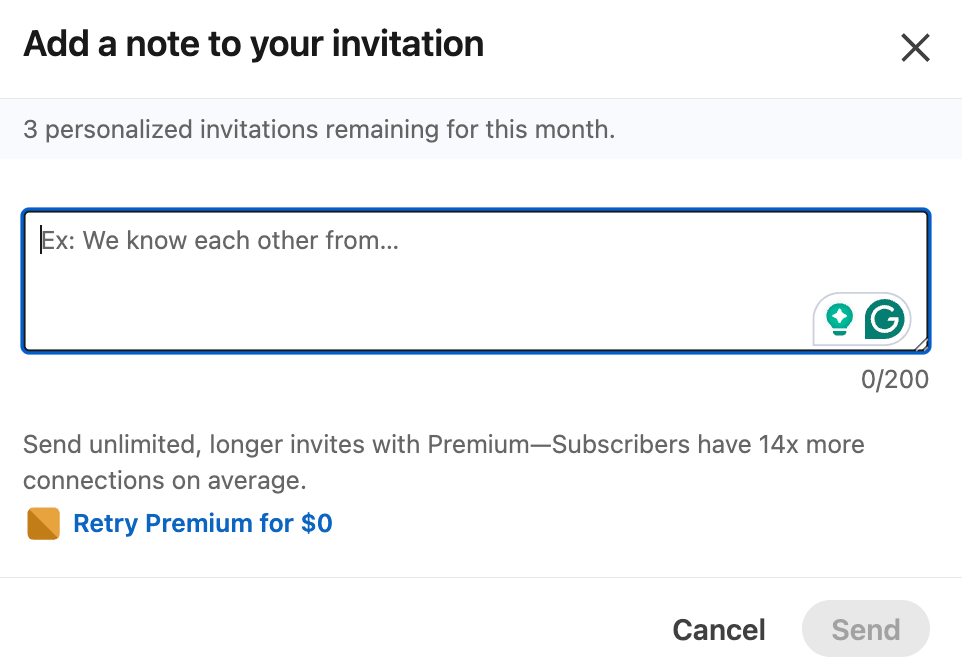
- Write your message under the 200-character limit, then send.
Two limits shape how you use this.
- LinkedIn caps the note at 200 characters, so every word has to work.
- For free or Basic LinkedIn accounts, you can send only three personalized invitations each month.
LinkedIn Premium removes that monthly invite cap. The 200-character limit is the same.
The takeaway for free accounts: you can’t personalize everything, and the data says you don’t need to. Send clean requests at volume, and spend your handful of monthly notes on high-value targets where a reply matters.
What makes a LinkedIn connection request get accepted
The requests that clear 25-30% acceptance share these traits:
- They name a shared context: a mutual group, a post, an event, or a connection.
- They personalize past the first name: a specific detail from the person’s profile, a post they wrote, or a recent company move.
- They’re timed to an intent signal: sent right after the person engages with a post, joins an event, or views your profile, while you’re already on their radar.
- They give a specific reason to connect that the other person benefits from.
- They stay short and human, well under the 200-character cap.
- They hold the pitch. A sales ask in the request is the fastest route to the Ignore button.
Match the template to that logic and you’re already ahead of the generic “I’d like to add you to my professional network” default.
“If you are just trying to sell me something… I will refuse the connection. But if you give more context, then there’s a chance I will accept.” — Alex Delivet, founder of Collect.
The flip side, the mistakes that quietly tank acceptance:
- Pitching in the request. Save the offer for after they accept.
- Generic flattery (“love your content!”) with no specific reference to back it.
- Templated text sent with the brackets unfilled or obviously mass-produced.
- Asking for time or a call before you’ve exchanged a single message.
- Filling the whole 200-character note when one specific sentence would land harder.
LinkedIn connection message templates by persona and trigger
Each template below is a connection-request note, so keep it under 200 characters. Swap the brackets for real details: a vague template performs worse than a short, specific one.
5 templates for SDRs and salespeople
For SDRs, these open peer-to-peer and avoid the pitch. A few to start with:
- Peer-to-peer: “Hi [first name]! I work with [role]s at [company type] on [problem]. Been following [their company]’s move into [area]. Would be good to connect and trade notes.”
- Research-led: “Hi [first name], I’m mapping how [industry] teams handle [specific challenge] this year. You’re clearly in the thick of it at [company], would love to connect.”
- Mutual connection: “Hi [first name], [mutual name] and I were just talking about [topic]. Saw we’re both connected to them and figured it was worth reaching out directly.”
- Content reference: “Hi [first name], I read your take on [topic] and it lined up with what I’m seeing across [industry] accounts. Keen to connect and compare notes.”
- Team admiration: “Hi [first name], your team at [company] is doing [specific thing] well. I spend my days on [related area], would value having you in my network.”
4 templates for recruiters
For recruiters, these connection message templates lead with the role or the genuine interest in their background:
- Active role: “Hi [first name], I’m hiring for a [role] at [company] and your background in [skill] stood out. Open to connecting even if the timing isn’t right today?”
- Talent pipeline: “Hi [first name], I recruit in the [field] space and like to know strong [role]s before I have a brief. Your work at [company] caught my eye, worth connecting?”
- Career-path fit: “Hi [first name], I place [role]s with [company type]. Your path from [A] to [B] is the kind of move my clients look for. Let’s connect.”
- Network-building: “Hi [first name], building a talent network in [field] and your name keeps coming up. Would value connecting and staying in touch.”
4 templates for job seekers and networking
Keep these warm and low-pressure. A clear, no-favor reason works best:
- No-favor opener: “Hi [first name], I’m exploring [field] roles and admire how [company] approaches [area]. No favor to ask, I’d value learning from people doing it well.”
- Alumni angle: “Hi [first name], fellow [school/company] alum here. I’m moving into [field] and would love connecting with someone who’s built a career in it.”
- Talk reference: “Hi [first name], I saw your talk on [topic] and it shaped how I think about [area]. Would be glad to connect and keep learning from your work.”
- Shared community: “Hi [first name], we both spend time in [community/group]. I’m growing my network in [field] and your posts are a reason to. Let’s connect.”
4 templates for founders and agency owners
Open with value or shared interest, and skip the cold pitch:
- Value-first: “Hi [first name], we help [their ICP] with [outcome]. No ask here, I publish a lot on [topic] and think we’d both get something from connecting.”
- Agency client-work: “Hi [first name], my agency runs [service] for [client type]. Saw [their company]’s recent [move] and would love to connect and follow what you’re building.”
- Peer founder: “Hi [first name], we’re both building in [space]. I share what’s working for us on [channel] each week. Would be good to have you in my network.”
- Shared lesson: “Hi [first name], your post on [topic] matched a hard lesson we learned scaling [thing]. Would value connecting with another founder in the weeds.”
7 templates for trigger-based requests (sent right after a signal)
These go out immediately after someone gives you a reason to reach out: the highest-converting moment to connect. For example:
- After they engage with your post: “Hi [first name], thanks for the [comment/reaction] on my post about [topic]. Clearly a shared interest, let’s connect.”
- After a shared event: “Hi [first name], we both sat in on [event/session]. Your question about [topic] stuck with me. Worth connecting to continue it?”
- After they join a group you’re in: “Hi [first name], saw you in the [group name] group. I spend a lot of time on [topic] there too, let’s connect.”
- After they view your profile: “Hi [first name], saw you stopped by my profile, curious what caught your eye. Happy to connect if [shared topic] is on your radar.”
- After a recent job change: “Hi [first name], congrats on the move to [company]. I work with a lot of [new role]s on [challenge], would be good to connect early.”
- After they comment on a third party’s post: “Hi [first name], your comment on [author]’s post about [topic] was spot on. Same camp here, let’s connect.”
- After they publish a newsletter or article: “Hi [first name], your piece on [topic] was the clearest take I’ve read this month. Would value connecting and reading more.”
6 templates by industry or role
With no mutual context, an industry-specific hook still beats a blank request. Tailor these:
- SaaS / tech: “Hi [first name], watching how [company] is scaling [product area]. I work with RevOps and GTM teams on [problem], would value connecting.”
- Marketing / agency: “Hi [first name], your team’s work on [campaign] caught my eye. I run in the same circles on [channel]. Let’s connect.”
- Finance / fintech: “Hi [first name], I follow how [company] approaches [compliance or growth area]. Always keen to connect with people building in fintech.”
- Healthcare / medtech: “Hi [first name], the way [company] handles [specific challenge] is rare in healthtech. Would value connecting and following your work.”
- Real estate: “Hi [first name], I work with [agents and brokers] on [outcome]. Your post on [market trend] lined up with what I’m seeing, let’s connect.”
- Operations / logistics: “Hi [first name], [company]’s move on [supply-chain topic] stood out. I spend my time on [related area]. Would be good to connect.”
What to message after your LinkedIn connection request is accepted
The accept is only the start. Because a note lifts replies far more than it lifts acceptance, your follow-up is where the conversation opens.
Wait a day, reference the reason you connected, and ask one easy question. A few openers:
- “Thanks for connecting, [first name]. You mentioned [context]. How are you handling [specific challenge] at [company] right now? Always curious how other [role]s approach it.”
- “Appreciate the connect, [first name]. I’m putting together a short view on [topic] for [audience]. What’s the biggest snag you’re hitting with it lately?”
- “Good to be connected, [first name]. Saw [company] is [recent move], is [related challenge] landing on your desk, or is that another team?”
- “Thanks for accepting, [first name]. No pitch, genuinely curious how your team measures [metric] these days. We’ve been comparing notes across [industry].”
- “Glad to connect, [first name]. I shared a teardown of [topic] last week that your post reminded me of. Want me to send it over?”
Notice the pattern: one genuine question, with the calendar link and deck held until they answer.
That first reply earns the right to go deeper. From there you can build a proper multi-step sequence: connection request, follow-up, value share, soft ask, rather than leaving it to memory.
How to automate LinkedIn connection requests at scale
Templates fix the words. What scales results is sending the right one at the right moment to the right person, every time — and following up after the accept without dropping anyone.
Doing that by hand past a handful of requests a day is where a lot of outreach falls apart.
This is where signal-based campaigns earn their keep.
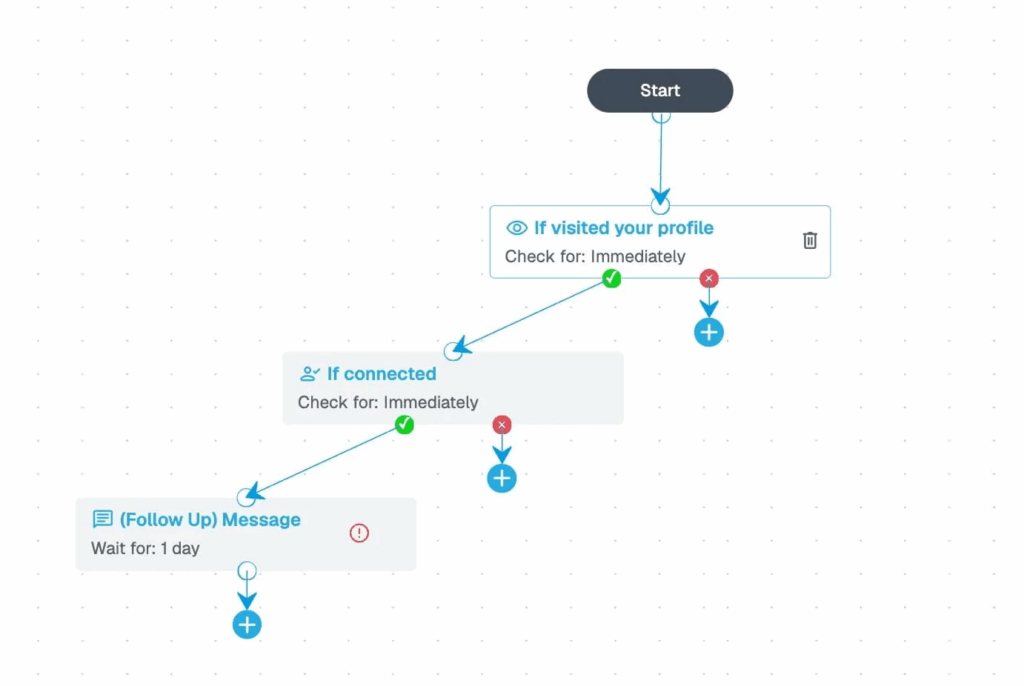
Expandi can trigger the right request automatically when someone:
- Reacts to a LinkedIn post.
- Joins an event or a webinar.
- Views your profile.
This way, the message lands while the context is still fresh.
A Builder campaign then runs the if-then follow-up sequence on a schedule, with built-in delays and smart limits that keep your account inside LinkedIn’s caps.
When you want to vary a template across hundreds of prospects, Expandi’s AI Analyzer generates and rewrites messages to your goal, then sorts replies by sentiment so hot leads get answered first.
The result is LinkedIn outreach that stays personal at a volume no manual workflow can match.
Send LinkedIn connection messages that get accepted
Strong LinkedIn connection message templates get you in the door, but the results come from:
- Matching the message to a trigger.
- Respecting LinkedIn’s limits.
- Following up after every accept.
Send clean requests at volume, spend your personalized notes where a reply matters, and let the follow-up do the selling. A LinkedIn automation tool like Expandi can do a lot of the heavy lifting for you so you can focus on closing deals instead of manually chasing prospects.
Start your free Expandi trial and build a signal-based connection sequence that times every request and runs the follow-up for you.
Frequently Asked Questions
For acceptance it barely matters. Across 20M+ requests, acceptance was 26.42% with a note and 26.37% without. A note’s value shows up after the accept, where it nearly doubles reply rates.
Send clean requests broadly and save personalized notes for people you want to start a conversation with.
LinkedIn’s help center currently lists 200 characters for a personalized connection note. Keep your message well under that: short, specific notes outperform long ones.
Free and Basic accounts can add a personalized note to only three invitations per month.
LinkedIn Premium removes the limit. The weekly cap on total requests is separate and applies to both.
A healthy range is 25-30%. Our own Connector campaigns average 29.61% approval. If you’re below 20%, the problem is usually your targeting or your reason to connect, rather than the template wording.
No. A sales ask in the request is the fastest route to being ignored. Get accepted on a shared context or a clear reason to connect, then earn the conversation in your follow-up.
One to two sentences. You have 200 characters, and shorter notes that name a specific, shared reason consistently outperform longer ones that try to say too much.


You’ve made it all the way down here, take the final step