20+ Best AI Email Marketing Tools to 10x Your Sales in 2026


Most email teams don’t struggle with ideas, they struggle with execution speed and workflows. Writing variants, segmenting lists, testing angles, and reacting to performance all take time.
AI shortens that cycle.
It can draft copy, adjust messaging based on behavior, and optimize delivery automatically. But not all AI email marketing tools do the same thing, and some of them solve very specific, narrow problems.
I dug deep into how teams use AI in email marketing today inside real workflows and features.
The problem though is that “AI email marketing” now covers a lot of very different tools. So below, I break down where AI genuinely fits, what each one does best, and who it’s for.
- How AI works in email marketing (main use cases and types of AI tools)
- 21 Best email AI tools for email marketing
Key Takeaways
The best AI email marketing tools in 2026 depend on your use case. Here’s the breakdown:
Outbound & Sales Outreach Automation
- Expandi – Safe multi-touch outreach at scale (email + LinkedIn)
- Instantly – High-volume cold email + deliverability
- Smartlead – Multi-inbox control for agencies & SDR teams
- Apollo.io – Prospecting + enrichment + outreach in one
- Lemlist – Personalization-first outreach (incl. creative elements)
- Woodpecker – Simple, reply-focused cold email automation
- Salesloft – Enterprise outbound cadences + revenue orchestration
Lifecycle Email & Marketing Automation
- Klaviyo – E-commerce lifecycle + retention automation
- ActiveCampaign – Automation-heavy lifecycle (email + optional CRM)
- Encharge – SaaS lifecycle automation (event-based)
- Customer.io – Product-led, event-driven lifecycle messaging
- Iterable – Enterprise lifecycle + omnichannel orchestration
Newsletters, Brand Campaigns & Creators
- Mailchimp – Simple newsletters + SMB email marketing
- Campaign Monitor – Design/brand-first campaigns
- ConvertKit (Kit) – Creators (bloggers, podcasters, newsletter operators)
Deliverability & Transactional Email Infrastructure
- SendGrid – Transactional email + deliverability at scale
- Mailgun – Developer-first delivery + monitoring/validation
Other AI Email Marketing Tools
- HubSpot Marketing Hub – CRM-first email marketing inside a bigger platform
- Brevo – Budget-friendly email + SMS with broad channel coverage
- GetResponse – Email + funnels + webinars in one tool
- Lavender – AI email coaching/scoring to improve outbound quality
How AI Works in Email Marketing (Overview and Main Use Cases)
When marketing teams talk about AI in email marketing, they’re usually referring to two different things that often get bundled together.
Understanding this distinction matters, because it determines what you can safely automate and where human judgment is still required.
In this context, AI for email marketing applies to lifecycle emails, newsletters, and outbound outreach or sales sequences. Anywhere teams send emails at scale and need to move faster without sacrificing relevance or deliverability.
Below are the main types of AI email marketing tools teams actually use today, and how they fit into real email workflows.
AI-powered email platforms (lifecycle & newsletters)
These are email marketing platforms with AI built directly into the product.
How teams use them:
- Welcome, onboarding, retention, and winback flows.
- Newsletter sends with AI-assisted subject lines, timing, and segmentation.
- Automatic audience grouping based on behavior instead of static lists.
How the AI works in practice:
- Learns from opens, clicks, site events, and conversions.
- Optimizes send times, targeting, and flow logic.
- Assists with testing and iteration inside the platform.
At this point, AI-assisted copy, rewriting, and A/B testing are standard features here, not unique differentiators.
AI for Outbound Outreach & Sales Sequences
These are outbound email and sales engagement tools with AI built into the workflow. Teams use them when the goal is to start conversations, book meetings, and manage replies at scale.
How teams use them:
- Cold email sequences and multi-step follow-ups.
- Personalization at scale using firmographic and enrichment data.
- Follow-ups that adapt based on opens, clicks, or replies.
- Routing replies to the right rep or pipeline stage.
How the AI works in practice:
- Uses enrichment data and context to personalize first lines and messages.
- Generates and adapts follow-ups based on engagement or reply intent.
- Adjusts sequence logic automatically (pause, stop, escalate, or reroute).
- Classifies replies to reduce manual inbox management.
Main use cases of AI in email marketing
Across these tools, teams use AI in email marketing for a few core jobs: speeding up execution, improving targeting, and automating decisions that don’t need manual oversight.
Main use cases include:
- Subject line + preview testing at scale (generate variants, predict winners, iterate faster).
- Send-time optimization to hit inboxes when each contact is most likely to engage.
- Behavior-based segmentation (group users by actions like visits, trials, purchases, inactivity).
- Lifecycle flow optimization (who enters, when to nudge, when to stop, when to escalate).
- Personalization beyond merge fields (offer + angle changes based on role, industry, intent signals).
- Outbound personalization at scale using enrichment + company context.
- Adaptive follow-ups based on opens/clicks/reply intent (pause, reroute, change angle).
- Reply classification + routing (interested / objection / OOO / not now → assign next step).
- Deliverability risk reduction (detect repetitive patterns, flag spammy phrasing, warmup guidance).
- Performance insights + recommendations (what segment/offer/message is driving results and why).
That said, not every use case or feature will matter to you and your team.
The right setup depends on your email motion (lifecycle, newsletter, outbound), volume, data quality, and how much you want to automate versus review. There’s no single “best” AI email marketing tool. Only tools that fit your workflow better than others.
With that in mind, below is a high-level overview of some of the best AI email marketing tools.
21 Best AI Marketing Tools for Email Marketing
Below is a curated list of AI email marketing tools that are actually used in production email workflows – across lifecycle, newsletters, and outbound outreach.
For each tool, I’ll cover:
- What it does at a high level
- Key features that matter in practice
- Why I included it (what it’s genuinely good at)
- Who it’s best for
- A verified user review (so you’re not relying on marketing claims)
There’s no single “best” AI email marketing tool. Each one solves a different part of the email workflow, so the goal here is to help you quickly identify which tools fit your setup.
So, let’s get into it.
1. Expandi – Best for safe LinkedIn + email outreach automation at scale
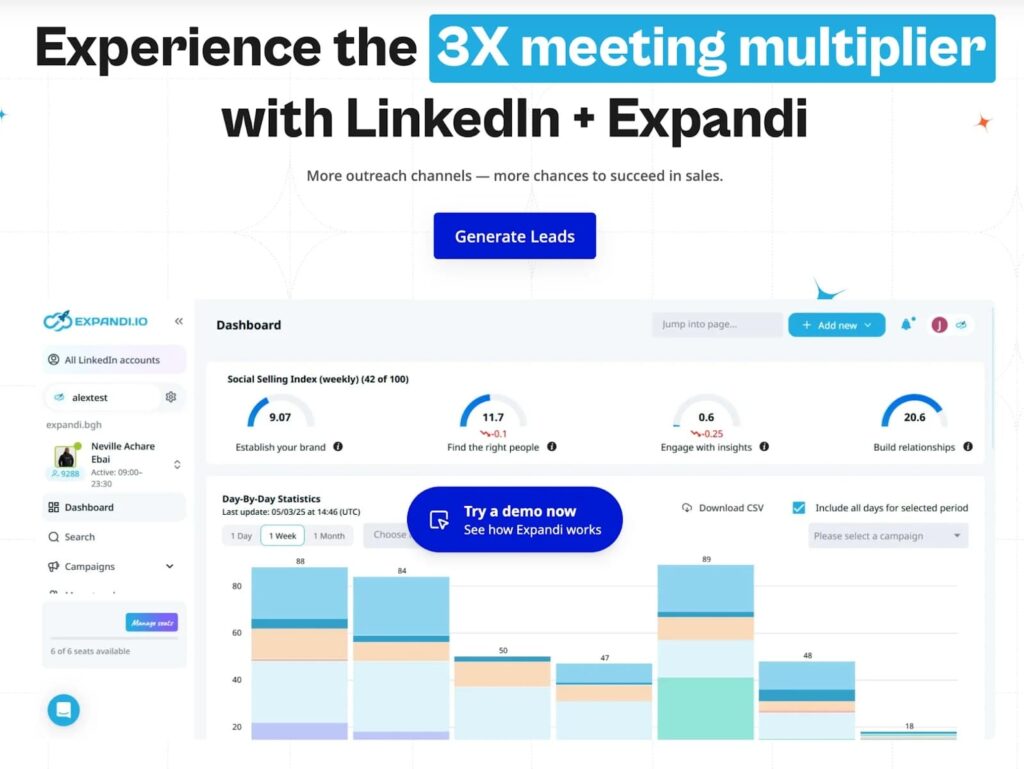
Expandi is a global, omnichannel outreach automation platform built primarily for LinkedIn and email outreach. While it’s often known for LinkedIn automation, Expandi also plays a strong role in AI-assisted email outreach and sales sequences, especially for teams running outbound at scale.
It’s especially useful for outbound teams running high-volume campaigns who need advanced sequencing logic, personalization at scale, and tight control over when messages are sent or paused.
Then, to take email outreach a step further, Expandi also lets you build multi-touch flows that combine email with LinkedIn follow-ups. This way, prospects who don’t reply in one channel can be nudged in another. Ultimately, you get to improve reply and meeting-booking rates without increasing volume.
Key Features
- Email + LinkedIn sequences: Combines email and LinkedIn touchpoints in one coordinated workflow.
- AI campaign goals: Sets target, offer, and outcome so outreach stays focused and relevant.
- AI Message & follow-up generation: Generates contextual replies directly in the inbox for faster response handling.
- Sentiment Analysis: Labels replies as Interested, Maybe, or Not Interested to prioritize leads.
- Global Inbox: Centralizes all email and LinkedIn replies in one place to manage conversations at scale. Ideal if you’re managing multiple accounts or doing outreach at scale.
- Human-safe automation: Mimics natural behavior and respects platform limits to reduce account risk.
What I Like About It
- Email and LinkedIn outreach run in one combined workflow, instead of managing separate campaigns in separate platforms.
- You can pull leads straight from LinkedIn search results and use them immediately for outreach, without bouncing between tools or CSVs.
- The global inbox keeps all replies in one place, which makes day-to-day outbound much easier to manage.
Who It’s For
- B2B SaaS teams running outbound email + LinkedIn together.
- Lead gen agencies managing outreach for multiple clients.
- Sales teams that need sequencing logic, not just email sends.
Pricing
- $99/mo
Verified User Review
“As a startup recruitment agency we were in search for tools which will allow smoother and quicker expansion of our network which is so crucial in the recruitment industry. We never wanted to automate relationships but only workflows and this is where Expandi comes in. Great tool, easy to navigate, loads of options and great support!” – Verified Director of Customer Marketing review.
2. Klaviyo – Best for eCommerce AI-powered lifecycle emails & newsletters
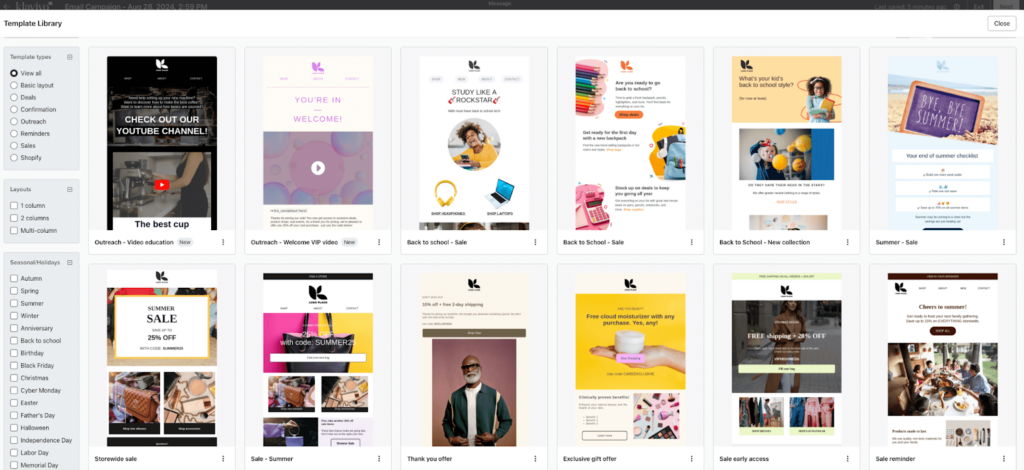
Klaviyo is an email/SMS marketing platform built for lifecycle automation and retention. It’s designed around first-party customer data and event-triggered workflows (“flows”) that let teams automate welcome, abandoned cart, post-purchase, winback, and other lifecycle programs.
Klaviyo’s AI is embedded directly into segmentation, flows, and campaign optimization, rather than positioned as a standalone feature.
Key Features
- Predictive analytics: Surfaces metrics like CLV (customer lifetime value) and churn risk so you can prioritize who to win back vs nurture.
- Smart Send Time: Finds an optimal send time using engagement data to help maximize opens/clicks.
- Flows automation: Builds event-triggered sequences (e.g., joins list, purchase, abandoned cart) across email and SMS.
- AI subject line assistant: Generates subject line options to streamline campaign setup and testing.
- Multi-channel automation: Automates email + SMS (and also mentions push + webhooks depending on setup) from one workflow system.
What I Like About It
Klaviyo’s AI is most useful when it’s tied to lifecycle decisions (timing + who to target) rather than just rewriting copy.
Predictive analytics + Smart Send Time + flows is a strong combo for retention teams that want automation driven by customer behavior. Especially powerful for eCommerce.
Who It’s For
- E-commerce and subscription businesses running lifecycle-heavy email programs.
- Teams focused on retention, repeat purchases, and LTV.
Pricing
- Depends on the number of subscribers you’ll have and how many messages you’d like to send per month.
- For 1,001-1,500 subscribers and 250 messages per month:
- Email: Starting at $45/mo at 15,000 emails per month.
- Email + mobile messages: $60/mo at 15,000+ emails and 1,250 mobile messaging credits per month.
Verified User Review
“I greatly appreciate the opportunity offered by Klaviyo to customize email marketing flows, an aspect that allows strategies to be adapted to the specific needs of customers effectively. Furthermore, Klaviyo’s ability to analyze customer behavior is extremely useful; I can segment customers based on type when the information is correctly provided by the CMS and analyze important metrics such as Life Time Value (LTV) and the average time between orders without the need to incorporate other third-party tools.” – verified Growth Marketing Manager review.
3. ActiveCampaign – Best for AI-powered marketing automation (email + CRM)
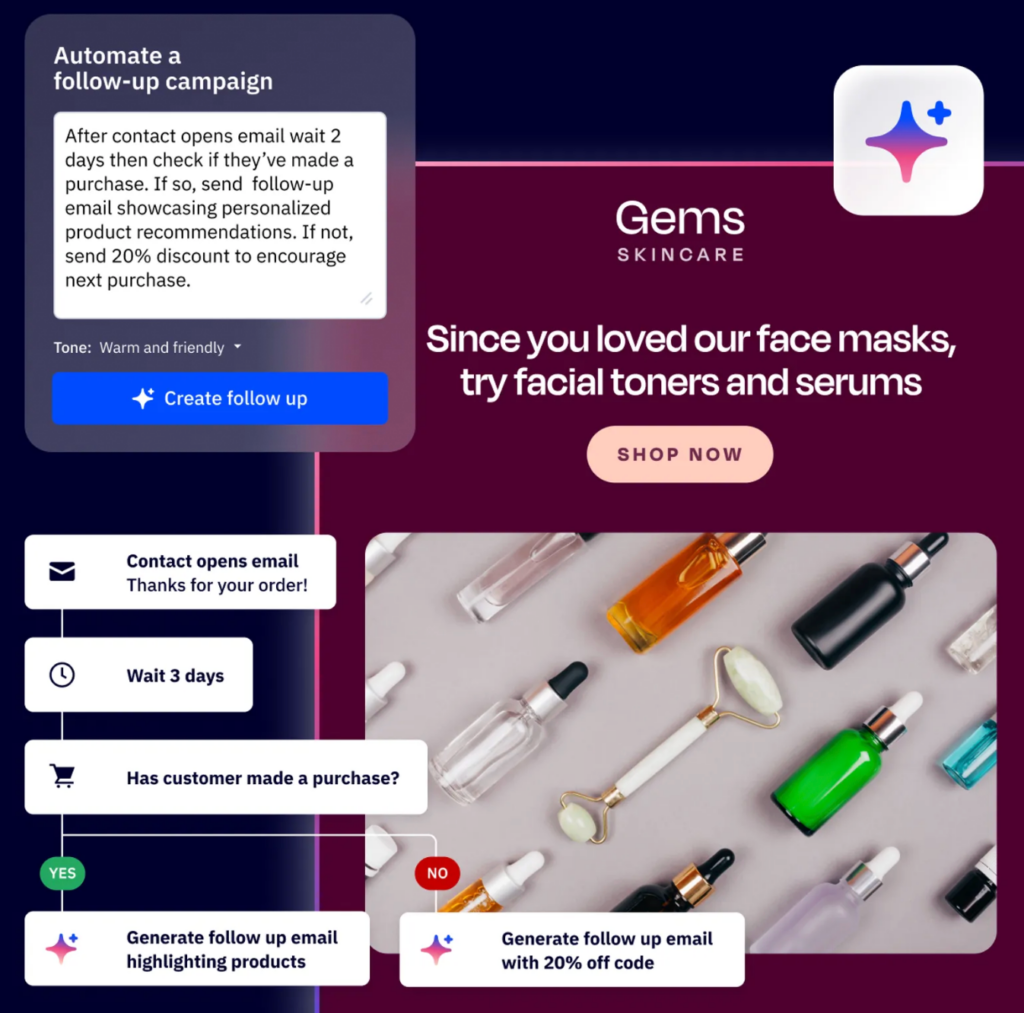
ActiveCampaign is an email marketing and automation platform that’s especially strong when you want lifecycle campaigns + deeper automation logic, with optional CRM and AI features layered in.
It’s a good fit for teams that don’t just want to “send newsletters”, but want to automate journeys end-to-end and tie email activity back to pipeline.
Key Features
- Predictive Sending: Automatically sends campaigns/automations at each contact’s most likely open time to improve engagement.
- Generative AI in the Email Designer: Generates text options inside the email editor from a prompt, so you can draft faster without leaving the builder.
- Generative AI campaign content: Supports AI-generated subject lines and other content blocks as part of its generative AI tooling.
- Win Probability: Uses AI to estimate how likely a deal is to close, helping sales teams prioritize follow-up.
What I Like About It
It’s one of the more “automation-first” tools on the list. The value is how ActiveCampaign combines send-time optimization + content generation + (optional) pipeline intelligence in one platform.
Who It’s For
- Teams running automation-heavy lifecycle journeys (beyond basic newsletters).
- SMB/mid-market teams that want email + automation + optional CRM in one system.
Pricing
- Depends on features and number of email contacts.
- For 1,000 email contacts, you can expect to pay around:
- Starter: $15/mo.
- Plus: $49/mo.
- Pro: $79/mo.
- Enterprise: $145/mo.
Verified User Review
“What I appreciate most about ActiveCampaign is how seamlessly it integrates marketing automation with CRM capabilities. It allows us to create highly personalized customer journeys without needing a large marketing ops team. The segmentation and automation features are incredibly powerful. We can trigger email sequences, in-app messages, or nurture flows based on user behavior, which helps us deliver relevant content at the right time.” – verified CMO and Co-Founder review.
4. HubSpot Marketing Hub – Best for CRM-first email marketing (especially if already using HubSpot)
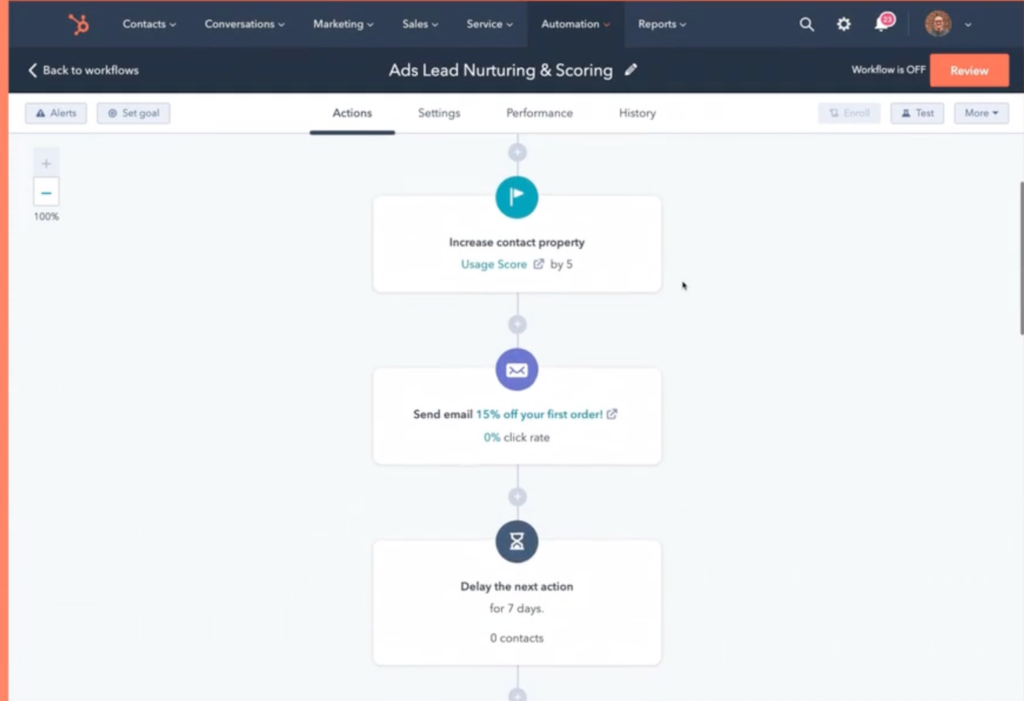
HubSpot is known for its all-in-one platform approach to marketing. It combinesCRM, marketing automation, and email marketing into a single system, with dozens of tools built around contact data, lifecycle stages, and pipeline management.
It’s a strong choice if you’re already using HubSpot or if your team thinks about email as part of a broader CRM-driven motion, rather than a standalone channel.
HubSpot also layers in AI through Breeze, which adds AI writing assistance, content suggestions, and performance insights inside marketing emails. Useful for speeding up execution without breaking existing workflows.
Key Features
- AI email writing assistance: Generates subject lines and email copy inside the email tool to speed up campaign creation.
- Email automation with workflows: Triggers follow-up actions based on engagement (opens, clicks, bounces) using workflows tied to CRM data.
- Breeze AI across the platform: Adds AI assistance across marketing/sales/service, using CRM context (helpful if email is part of a broader GTM motion).
What I Like About It
HubSpot covers all the essential email marketing features without being hard to use. It’s especially strong if you’re already using HubSpot, since email, automation, contacts, and pipeline all live in the same place.
HubSpot has a tool for almost everything, which makes it convenient and cohesive.
Who It’s For
- Teams already using HubSpot and want email marketing tightly integrated with their CRM.
- Small to mid-market teams that want all essential email features in one platform without managing multiple tools.
Pricing
For individuals and small teams:
- Free: Free marketing, sales, service, and other tools. Free for up to 2 users.
- Starter: Essential marketing, sales, service, content, and data management software. $10/mo/seat.
- Professional: For marketing teams who want to effectively run omni-channel campaigns, automation, and reporting to build a scalable demand engine. $890/mo
For businesses and enterprises:
- Professional – For marketing teams running omni-channel campaigns, automation, and reporting. $890/mo.
- Enterprise – For marketing organizations managing customer journeys at scale and accelerating revenue growth. $3,600/mo.
Verified User Review
“Quick and responsive when your portal doesn’t have much data in it. It’s fairly easy to learn, with a clean interface and a logical structure. The workflow builder is intuitive for basic automation, and a lot of the tracking is handled automatically… Everything useful seems to be locked behind another paywall. Merging records, more custom reports, etc.
If you’re experienced in marketing analytics or source tracking, HubSpot often feels restrictive.” – verified Head of Demand Generation Marketing.
5. Mailchimp – Best for simple newsletters & SMB email marketing
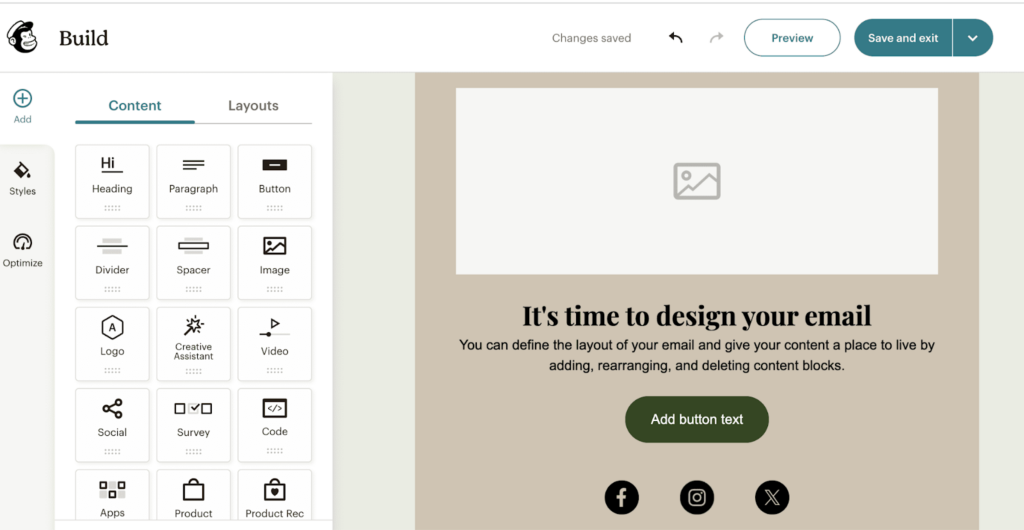
Mailchimp is one of the most widely used email marketing platforms, best known for newsletters, basic automations, and ease of use. It’s designed for teams that want to get emails out quickly without dealing with complex setup, deep lifecycle logic, or heavy CRM dependencies.
Over the years, Mailchimp has added AI features to help with copy, subject lines, and basic optimization, but it remains a simplicity-first tool rather than an advanced automation platform.
Key Features
- AI content assistant: Generates subject lines and email copy to speed up newsletter creation.
- Essential automations: Supports simple welcome emails, abandoned cart emails, and follow-ups.
- Send-time optimization: Suggests delivery times based on historical engagement.
- Audience segmentation: Allows basic segmentation using engagement and contact data.
- Templates & editor: Large library of pre-built templates with an easy drag-and-drop editor.
What I Like About It
Mailchimp is easy to pick up and hard to break. You don’t need a dedicated email specialist to run campaigns, and the editor makes it fast to launch newsletters.
It’s not built for complex lifecycle automation or advanced personalization, but that’s also why many small teams like it, there’s very little overhead.
Who It’s For
- Small businesses and creators sending regular newsletters.
- Teams that want simple email marketing without complex automation.
- Companies early in their email journey that don’t need deep lifecycle logic.
Pricing
- Depends on number of contacts.
- Free: Limited features, under 250 contacts.
- For 500-1,500 contacts, you can expect to pay:
- Essentials: $13.25/mo.
- Standard: $22.5/mo.
- Premium: $175/mo.
Verified User Review
“Mailchimp is great for small business, and the start-ups who want to keep their customer relationship management in one place, but the platform is based on how many contacts you grow, and the cost is not friendly for small business today… integrating with their API is challenging if you don’t have detailed documentation or information about the technology stack involved” – verified Digital Marketing Manager.
6. Brevo – Best for budget-friendly email + SMS with AI basics
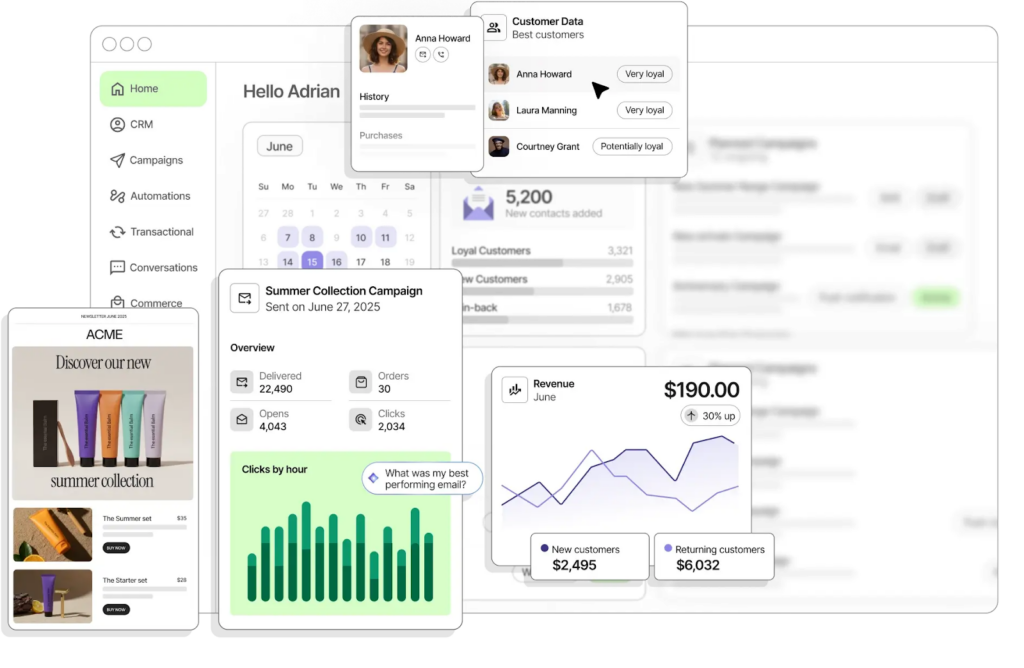
Brevo (formerly Sendinblue) is an email and SMS marketing platform positioned as a cost-effective alternative to heavier tools. It’s commonly used by small to mid-sized teams that want email, SMS, and basic automation without enterprise pricing or complexity.
Brevo includes AI-assisted features for content and optimization, but the core value is coverage + affordability, not depth.
Key Features
- AI email content assistant: Helps generate subject lines and email copy to speed up campaign setup.
- Email + SMS campaigns: Run email and SMS from the same platform using shared contact data. Channels include email, SMS, WhatsApp, web and mobile push, livechat, and others.
- Basic automation workflows: Supports welcome flows, follow-ups, and simple lifecycle emails.
- Send-time optimization: Adjusts delivery timing based on engagement patterns.
What I Like About It
Brevo gives you a lot for the price. You get email, SMS, and automation in one place without being forced into expensive tiers early.
It’s not the most advanced tool in terms of segmentation or lifecycle logic, but for teams that want broad functionality without overengineering, it’s practical and approachable.
Who It’s For
- Small to mid-sized teams with smaller budget.
- Businesses that want email + SMS without managing multiple tools.
- Teams that need basic automation, not complex lifecycle orchestration.
Pricing
- Starter: $9/mo.
- Standard: $18/mo.
- Professional: $499/mo.
- Enterprise: Talk to sales.
Verified User Review
“I appreciate how advanced and easy-to-use their automation features are. The workflows allow me to create detailed customer journeys without feeling overwhelmed, which is especially helpful when managing a growing brand… The CRM is the part I find least developed. When I compare it to platforms like HubSpot, it feels like it’s missing some important features for organizing and maintaining customer records” – verified user in education management.
7. Encharge – Best for SaaS lifecycle email automation
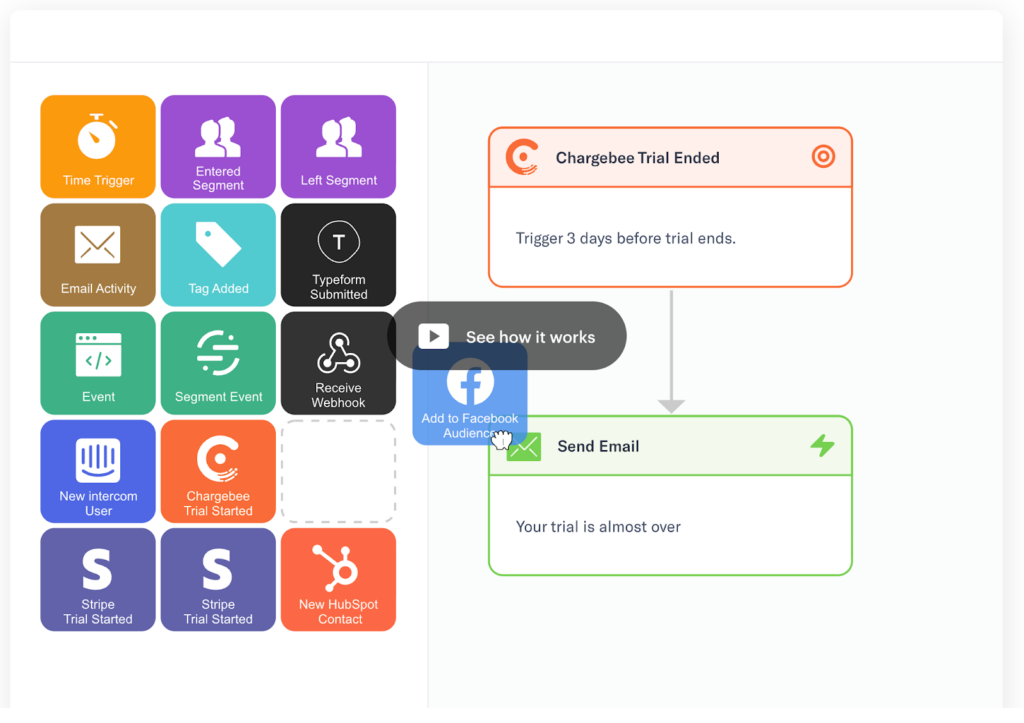
Encharge is a customer engagement platform built specifically for SaaS lifecycle email.
It’s designed around event-based automation, making it easy to trigger emails based on in-app behavior, product usage, and lifecycle stage rather than just list membership.
Compared to broader platforms, Encharge stays focused on email-first lifecycle automation instead of trying to be a full CRM or marketing suite.
Key Features
- Event-based automation: Triggers emails based on product events, page views, and user actions.
- Visual flow builder: Build multi-step lifecycle sequences (onboarding, activation, retention, churn prevention).
- Behavioral segmentation: Segment users based on real usage data, not just profile fields.
- AI-assisted email creation: Helps generate and refine email copy inside campaigns.
- SaaS-friendly integrations: Connects easily with product analytics and data tools.
What I Like About It
Encharge feels purpose-built for SaaS. Instead of forcing lifecycle logic into a general email tool, it starts with product behavior as the core signal, which makes onboarding and retention emails far more relevant.
You’re not paying for CRM features or channels you don’t need.
Who It’s For
- SaaS companies running product-led growth motions.
- Teams focused on onboarding, activation, and retention emails.
- Product and lifecycle marketers who need event-driven email, not newsletters.
Pricing
- Depends on number of subscribers.
- For 2,000, you can expect to pay:
- Growth: $79/mo.
- Premium: $129/mo.
- Enterprise: Talk to sales.
Verified User Review
“Encharge really shines in letting us build out custom automations with its visual flow builder. It’s easy to drag and drop steps, set up triggers based on actual user behavior, and personalize messages for different client segments… The flip side to all this flexibility is that there’s a bit of a learning curve. If you or your team haven’t used marketing automation before, expect to spend some time figuring out how to make everything work together” – verified Director Strategic Initiatives and Marketing Communications.
8. Instantly – Best for high-volume cold email with deliverability built in
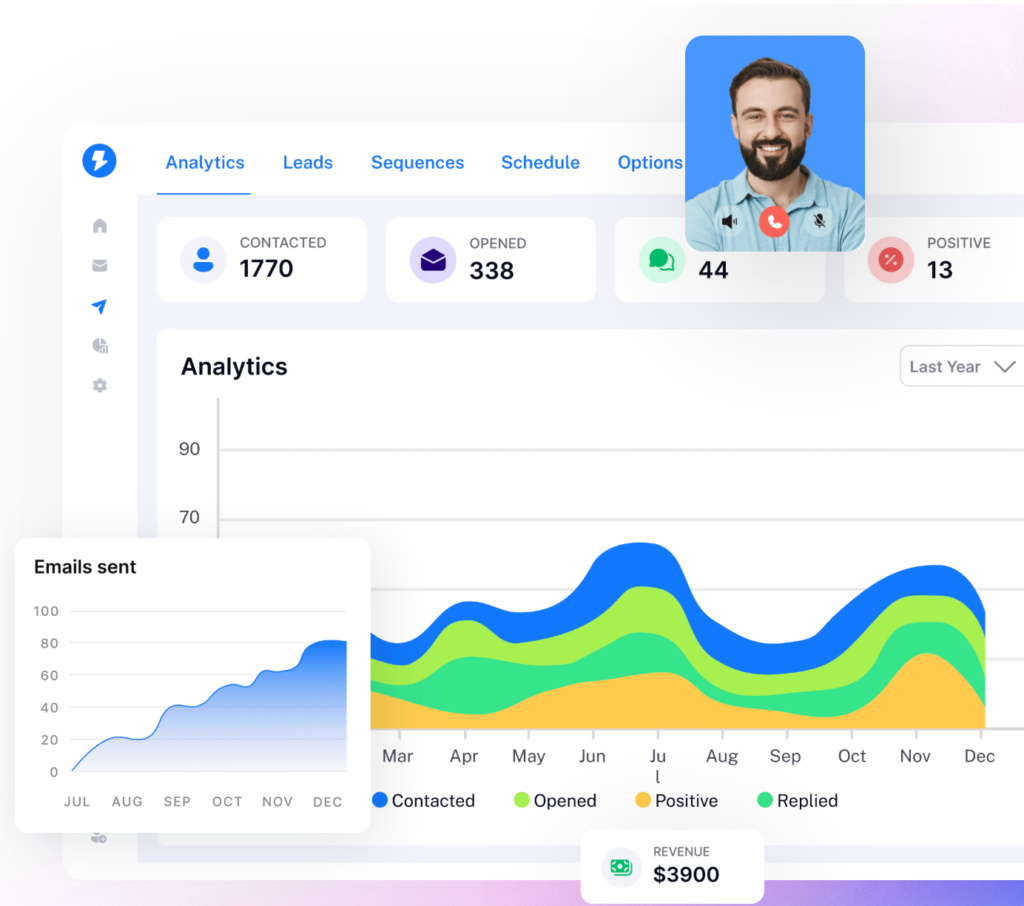
Instantly is an outbound email platform built for scaling cold email safely. It’s best known for letting teams run outreach across multiple inboxes while layering in deliverability features (like warmup + infrastructure controls) so high volume doesn’t automatically mean high spam risk.
One unique angle: Instantly also offers a Website Visitors product that uses a pixel to identify US-based website visitors and can push identified visitors into outreach campaigns automatically.
Key Features
- Unlimited email accounts + warmup: Scale sending across multiple inboxes while warming them up to protect reputation.
- Deliverability infrastructure (SISR / IP sharding & rotation): Uses server/IP sharding and rotation to help maintain deliverability at scale.
- Website Visitors pixel: Identifies US-based visitors (including business details) and can push them into outreach campaigns.
- AI/automation across outreach workflows: Positions AI across outreach + engagement workflows inside the platform.
- DFY email accounts: Buy deliverability optimized email accounts ready to go to save time.
What I Like About It
It’s built for volume + deliverability (warmup + infrastructure are core, not add-ons).
The Website Visitors feature is a strong “intent → outreach” bridge when you have meaningful US traffic and want to follow up fast.
Who It’s For
- SDR teams and agencies running high-volume cold email.
- Teams that need multiple sending accounts and deliverability controls baked in.
Pricing
- Growth: $37/mo.
- Hypergrowth: $97/mo.
- Light speed: $358/mo.
Verified User Review
“What I find most impressive about Instantly is how effortlessly it streamlines outreach management and campaign scaling. The user interface is straightforward and intuitive, making it easy to get started without facing a steep learning curve. The automation features have saved me considerable time, and the deliverability tools help ensure that my messages actually reach recipients’ inboxes. Whenever I’ve had questions, their support team has been both helpful and responsive. Overall, Instantly has made my workflow significantly more efficient.” – verified founder review.
9. SendGrid – Best for transactional email & deliverability at scale
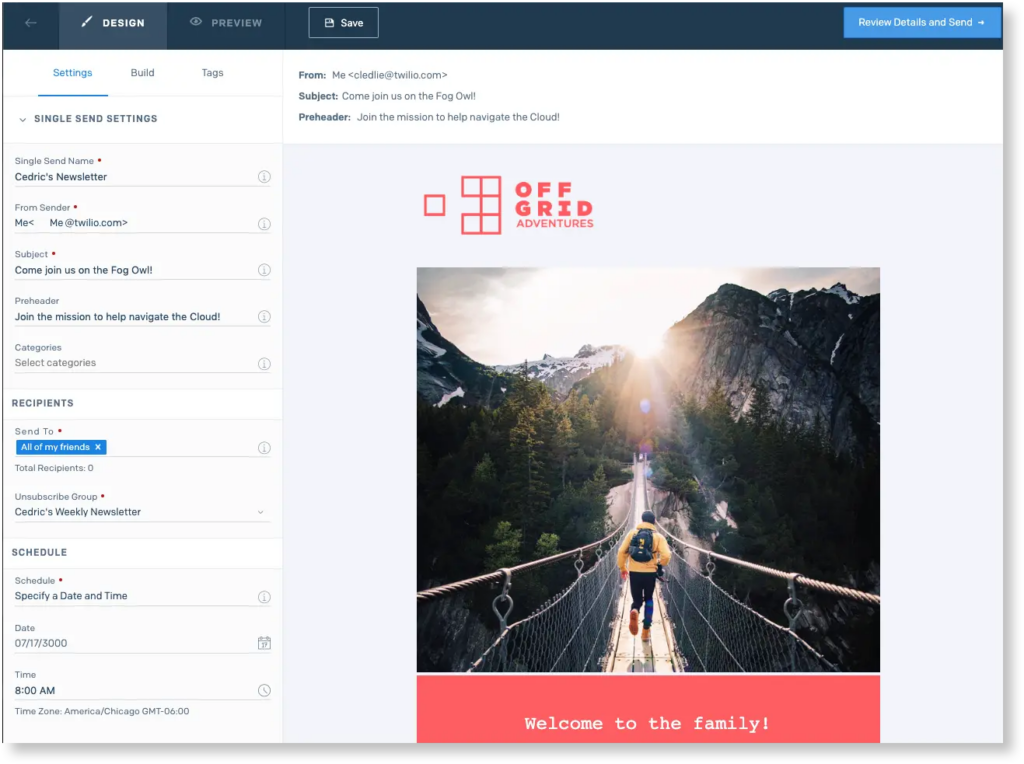
SendGrid (by Twilio) is an email delivery platform built for reliability, scale, and inbox placement. It’s not a marketing-first tool. Teams use SendGrid when email is mission-critical, transactional messages, product notifications, receipts, and high-volume sends that absolutely need to land.
AI email marketing focus here isn’t about copy. It’s about deliverability, routing, and performance monitoring under the hood
Key Features
- High-volume email delivery: Built to reliably send large volumes of transactional and programmatic emails.
- Deliverability optimization tools: Reputation monitoring, suppression management, and ISP-level insights.
- Email activity & analytics: Tracks delivery, opens, bounces, spam reports, and engagement signals.
- Dedicated IPs & IP warmup: Supports controlled scaling and reputation management for serious senders.
- API-first architecture: Designed to plug directly into apps, products, and backend workflows.
What I Like About It
SendGrid does one thing extremely well: make sure emails get delivered. There’s no fluff, no bloated UI, and no attempt to be a full marketing suite.
It’s the kind of tool you don’t think about day-to-day, which is exactly what you want when email delivery is part of your product or core infrastructure.
Who It’s For
- Product and engineering teams sending transactional or system emails.
- High-volume senders who care about deliverability and reputation control.
Pricing
- Depends on the number of emails you’d like to send per month.
- For <3,000 emails, you can expect to pay:
- Essentials: $19.95/mo.
- Pro: $89.95/mo.
- Premier: Custom pricing.
Verified User Review.
“First and foremost, the reliability of Twilio SendGrid is unmatched. The API ensures that emails are delivered promptly and consistently without the hassle of managing complex email infrastructure. With Twilio’s extensive network of servers, emails are sent efficiently, minimising the chances of them ending up in spam folders or being undelivered altogether… One aspect that could be improved is the complexity of the initial setup process” – verified associate software engineer.
10. Mailgun – Best for developer-first email delivery & monitoring
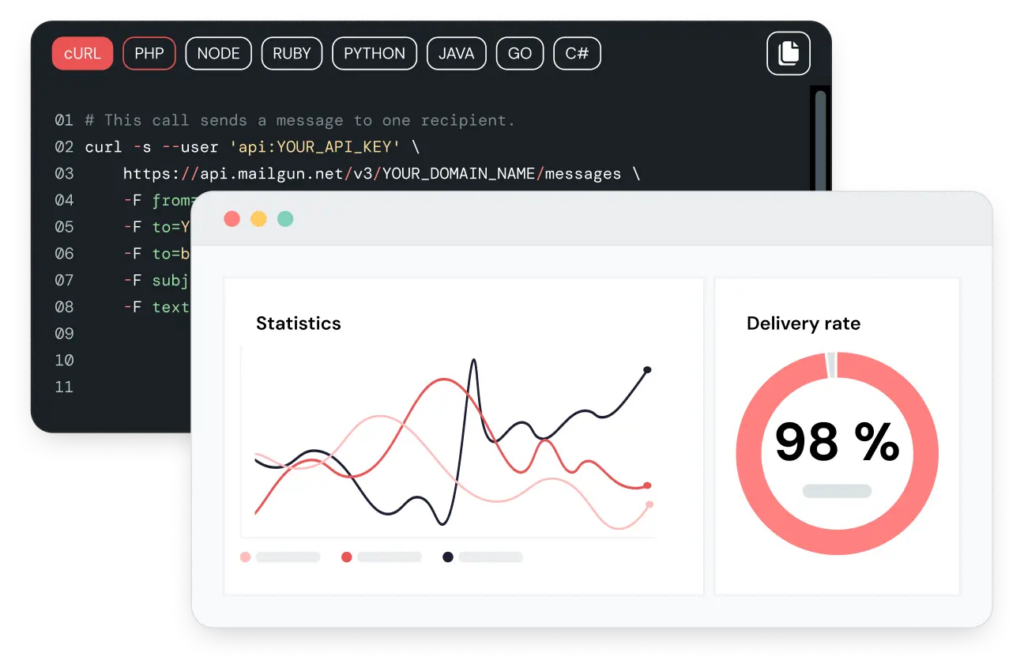
Mailgun is an email delivery platform built for developers and technical teams that want control over how emails are sent, tracked, and monitored. Like SendGrid, it’s not a marketing-first tool, it’s used for transactional emails, system notifications, and high-volume programmatic sending.
Where Mailgun stands out is its email observability and diagnostics, which make it easier to understand why emails fail or land poorly.
Key Features
- API-first email sending: Designed for programmatic and transactional email use cases.
- Deliverability monitoring: Tracks bounces, spam complaints, and reputation signals in detail.
- Email validation: Verifies email addresses before sending to reduce bounces and protect sender reputation.
- Inbound email routing: Routes replies and incoming emails back into apps or workflows.
- Dedicated IPs & IP warmup: Supports reputation control for high-volume senders.
What I Like About It
Mailgun gives you visibility that many email tools hide. If something breaks, you can usually figure out why instead of guessing.
It’s not the simplest tool on the list, but for teams that care about deliverability mechanics and want insight into what’s happening behind the scenes, that’s a big feature.
Who It’s For
- Engineering or technical teams sending transactional or system emails.
- Companies that want email validation + delivery monitoring in one place.
Pricing
- Depends on number of emails you’re sending.
- For 10,000 emails per month, that’s:
- Free: 100 emails per day.
- Basic: $15/mo.
- Foundation: $35/mo.
- Scale: $90/mo.
Verified User Review
“The best thing about Mailgun is its ability to handle high sending volumes reliably while protecting our domain’s reputation. As a commercial SME, we send a lot of electronic documentation, and before using Mailgun, our domain was constantly being blocked due to high bounce rates and invalid emails. Mailgun automatically manages and filters these issues, which is crucial for our operations… I’d say the initial setup and interface can be a little confusing.” – verified IT manager.
11. Customer.io – Best for event-driven lifecycle email (product & SaaS teams)
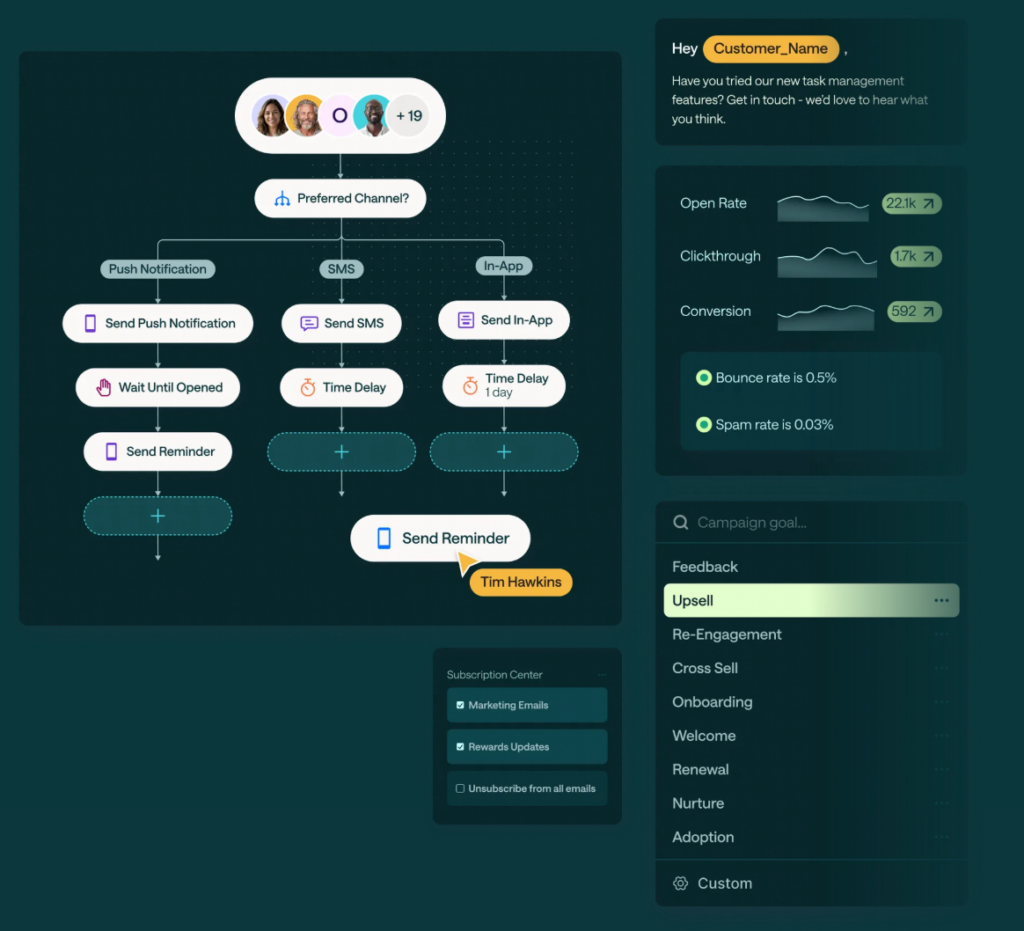
Customer.io is a customer engagement platform built around event-driven messaging. It’s designed for product-led and SaaS teams that want to trigger emails based on what users do inside a product, not just list membership or static attributes.
Email is the core channel, but everything starts with real-time events and behavioral data, which makes it a strong fit for onboarding, activation, retention, and re-engagement workflows.
Key Features
- Event-based email automation: Triggers emails from product events, API calls, and behavioral signals. Supports email, push, in-app, SMS, and more.
- Advanced segmentation: Builds dynamic segments using real-time event and attribute data.
- Visual workflow builder: Creates complex, branching lifecycle flows with conditional logic.
- AI-assisted content tools: Helps generate and refine email copy inside campaigns.
What I Like About It
Customer.io is very strong when email needs to react to product behavior. You’re not forcing lifecycle logic into a marketing tool. Events are the foundation, which makes messages feel timely and relevant.
It’s more technical than tools like Mailchimp or HubSpot, but that’s the trade-off for flexibility and control.
Who It’s For
- SaaS and product-led teams running event-driven lifecycle emails.
- Growth and product marketers who need real-time behavioral triggers.
- Teams with engineering resources to implement and maintain event tracking.
Pricing
- Customer.io pricing is usage-based and varies by message volume, channels, and features.
- For 5,000 profiles, the pricing is:
- Essentials: $100/mo.
- Premium: $1,000/mo.
- Enterprise: Custom.
Verified User Review
“I like how powerful and flexible the automation system in Customer.io is. The workflow builder makes designing customer journeys incredibly easy, whether they are simple drip sequences or complex, multi-step flows. Everything is visual, logical, and easy to adjust… The learning curve can be steep. Because the platform is so flexible, it can take time for new users to understand all the features.” – verified Sr. account executive.
12. Iterable – Best for enterprise lifecycle email & omnichannel orchestration
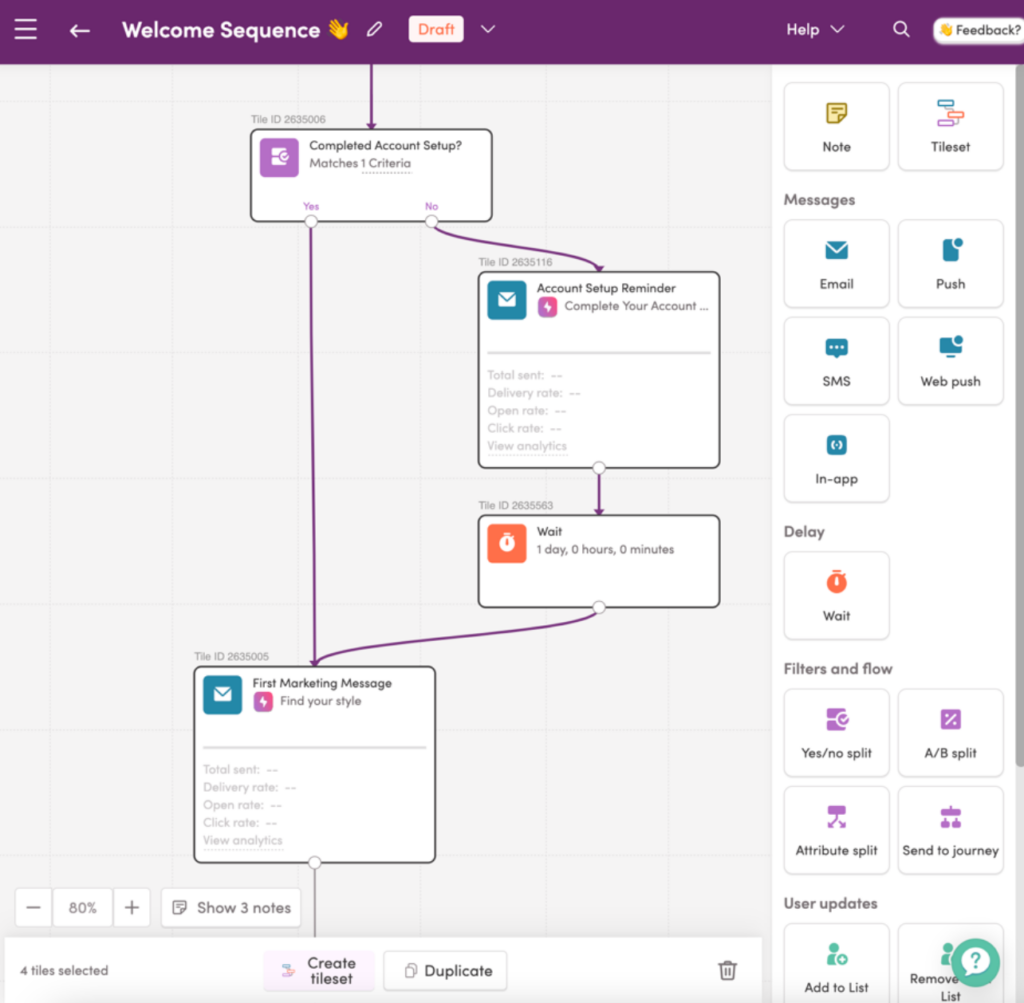
Iterable is a customer engagement platform built for large, data-heavy teams running complex lifecycle programs at scale. It’s commonly used by enterprise SaaS, fintech, and consumer tech companies that need advanced segmentation, orchestration across channels, and tight control over experimentation.
Email is a core channel, but Iterable is designed for cross-channel lifecycle orchestration, with AI used to support optimization, targeting, and decisioning rather than just copy generation.
Key Features
- Advanced segmentation: Build highly granular audiences using real-time events, attributes, and user behavior.
- Journey orchestration: Design complex, branching lifecycle flows across email, push, SMS, and in-app.
- AI-powered optimization: Supports send-time optimization, audience targeting, and performance insights.
- Experimentation & testing: Built-in A/B and multivariate testing across messages and journeys.
- Enterprise controls: Governance, permissions, and scalability features for large teams.
What I Like About It
Iterable is built for scale and complexity. If you’re running millions of messages across multiple channels and need precise control over who gets what and when, it handles that well.
It’s not lightweight and it’s not cheap. But for enterprise teams, it replaces a patchwork of tools with a single lifecycle engine.
Who It’s For
- Enterprise SaaS and consumer tech companies.
- Teams running complex, multi-channel lifecycle programs.
- Organizations with dedicated lifecycle, data, and engineering resources.
Pricing
- Custom-quote based, have to talk to sales.
- Expect to pay $10,000-$30,000/year, according to online reviews.
Verified User Review
“I really appreciate the wide range of features that help boost efficiency across various teams, including product, marketing, and data. Iterable gives our team the flexibility required for quick experimentation, the scalability to connect with audiences worldwide, and an easy-to-use interface. It also allows us to build custom journeys that we couldn’t create with our previous solution.” – Lifecycle marketing manager.
13. GetResponse – Best for email marketing with funnels & webinars
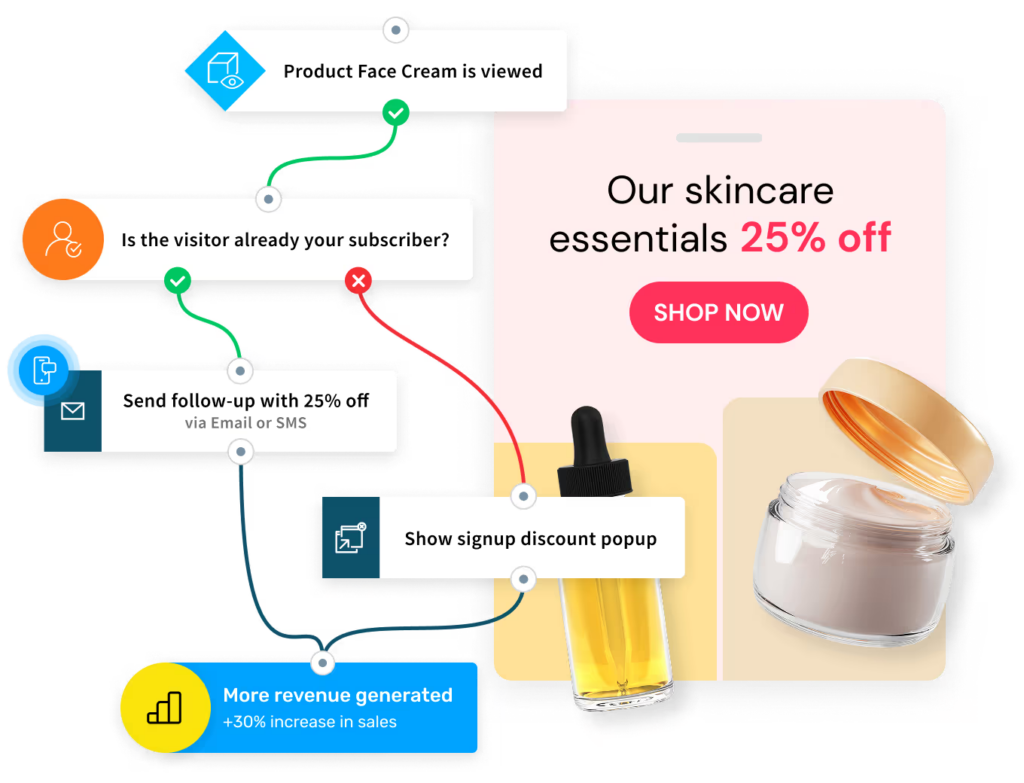
GetResponse is an email marketing platform that combines email campaigns, basic automation, landing pages, and webinars in one tool. It’s positioned for teams that want more than just newsletters, but don’t need a full CRM-first or enterprise lifecycle platform.
AI features are mostly focused on speeding up campaign creation and optimization, rather than deep behavioral decisioning.
Key Features
- AI email generator: Helps create subject lines and email copy directly inside the editor.
- Marketing automation workflows: Supports basic lifecycle flows like onboarding, lead nurturing, and follow-ups.
- Funnels & landing pages: Build lead capture funnels without relying on separate tools.
- Webinars built in: Host and promote webinars directly from the same platform.
- Send-time optimization: Adjusts delivery timing based on engagement data.
What I Like About It
GetResponse is convenient if you want email + funnels + webinars under one roof. You don’t need to stitch together multiple tools just to run lead gen campaigns.
It’s not as deep as enterprise lifecycle tools, but it offers more structure than basic newsletter platforms.
Who It’s For
- Small to mid-sized teams running lead gen and webinar-driven email campaigns.
- Marketers who want funnels and landing pages bundled with email.
- Teams that want more than newsletters without moving into enterprise tooling.
Pricing
- Depends on list size.
- For a list of 5,000 people:
- Starter: $44/mo.
- Marketer: $77/mo.
- Creator: $89/mo.
- Enterprise: Custom.
Verified User Review
“As someone who manages email marketing for several clients, I find the drag-and-drop builder to be a real lifesaver. It allows me to quickly create branded templates without needing to consult a designer each time. The workflows are also very intuitive, enabling me to set up onboarding sequences, product reminders, and nurturing campaigns within minutes. The analytics are straightforward and make it easy for me to compare performance across different clients.” – verified marketing research.
14. Campaign Monitor – Best for brand-first newsletters & campaigns
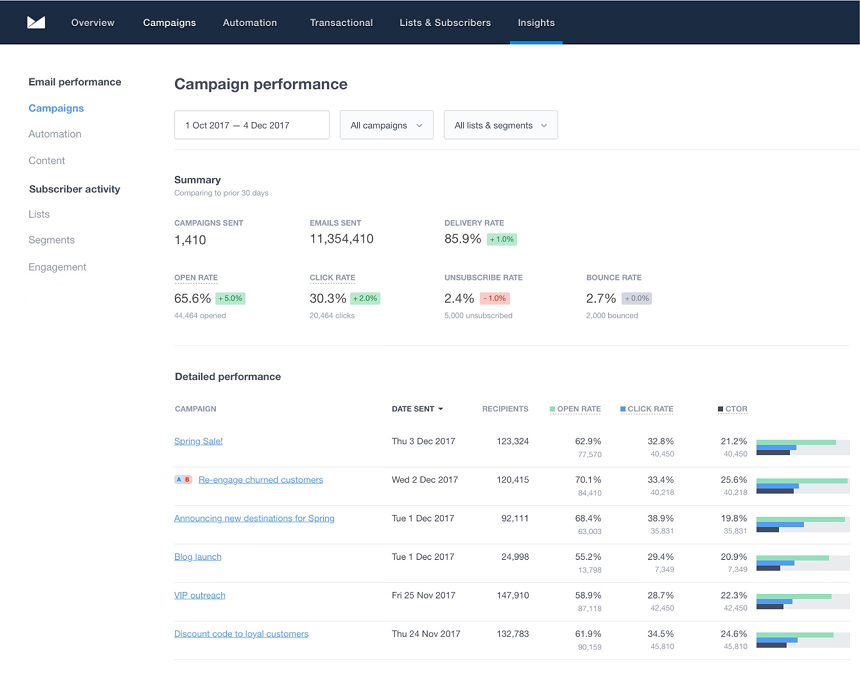
Campaign Monitor is an email marketing platform built for design-heavy, brand-sensitive email campaigns. It’s most commonly used by marketing teams that care deeply about layout, visuals, and consistent brand presentation. Especially for newsletters and promotional sends.
AI here is light and supportive, focused on helping teams move faster rather than automating complex lifecycle logic.
Key Features
- Email design & templates: Strong drag-and-drop editor with brand-friendly templates.
- Journey automation: Supports basic automated email journeys and follow-ups.
- AI copy assistance: Helps generate subject lines and email content inside campaigns.
- Audience segmentation: Segment contacts based on engagement and attributes.
What I Like About It
Campaign Monitor shines when presentation matters. Emails look polished, on-brand, and consistent without much effort.
It’s not built for complex lifecycle automation or event-driven logic. But for teams running high-quality newsletters and campaigns, it does exactly what it promises without unnecessary complexity.
Who It’s For
- Marketing teams with brand-heavy newsletters and campaigns.
- Agencies managing email for multiple brands.
- Teams that prioritize design and consistency over deep automation logic.
Pricing
- Based on list size and sending volume, with multiple tiers depending on features.
- For 500-2,500 contacts:
- Lite: $70/mo.
- Essentials: $109/mo.
- Premier: $189/mo.
- Enterprise: Contact sales.
Verified User Review
“Campaign Monitor has an easy to use interface that makes building emails quick and easy. Our emails look great and we find that we have a reasonable level of flexibility when creating our templates… The reporting isn’t as good as it could be in relation to transactional emails.” – verified head of marketing.
15. Lemlist – Best for omni-channel + personalized cold outreach
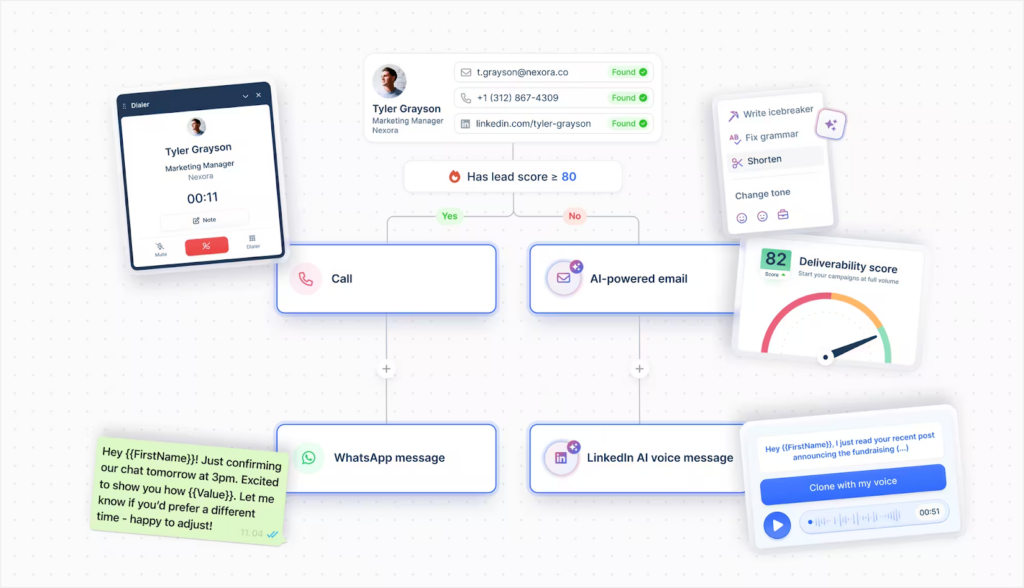
Lemlist is an outreach platform known for personalization at scale, especially dynamic variables that can adapt text, images, and landing pages per prospect. It’s built for teams that want cold emails to look and read more “handwritten,” even when they’re automated.
Key Features
- Dynamic personalization: Auto-adapts email text (and other elements) with variables so messages feel less generic.
- AI-personalized images: Supports custom variables and dynamic images for standout outreach.
- Outreach essentials: Support find qualified leads with 600m+ lead database, intent signals, verification, and all the essential outreach features (multichannel, in-app calling, unified inbox, etc.)
What I Like About It
It’s one of the better “make outbound look human” email marketing tools without turning into a manual time sink.
Strong focus on personalization (especially personalized images/videos), multichannel outreach (email, LinkedIn, calls), and integrated deliverability tools like Lemwarm.
Who It’s For
- B2B sales teams, founders, marketers, and agencies focused on automated and personalized full-stack outreach.
Pricing
- Email pro: For growing teams, $81/mo.
- Multichannel expert: For scaling businesses, $116/mo.
- Custom: For large organizations, custom.
Verified User Review
“What I enjoy about Lemlist is the way it encourages Human-first outreach. The personalization options feel practical, and the editor makes it easy to keep messages short and punchy. I also appreciate that the app doesn’t overwhelm you with 30 dashboards most of what you need is right where you’d expect… Some settings are powerful but not very forgiving small mistakes can affect a whole campaign” – verified project manager.
16. Apollo.io – Best for all-in-one outbound email + finding contact data
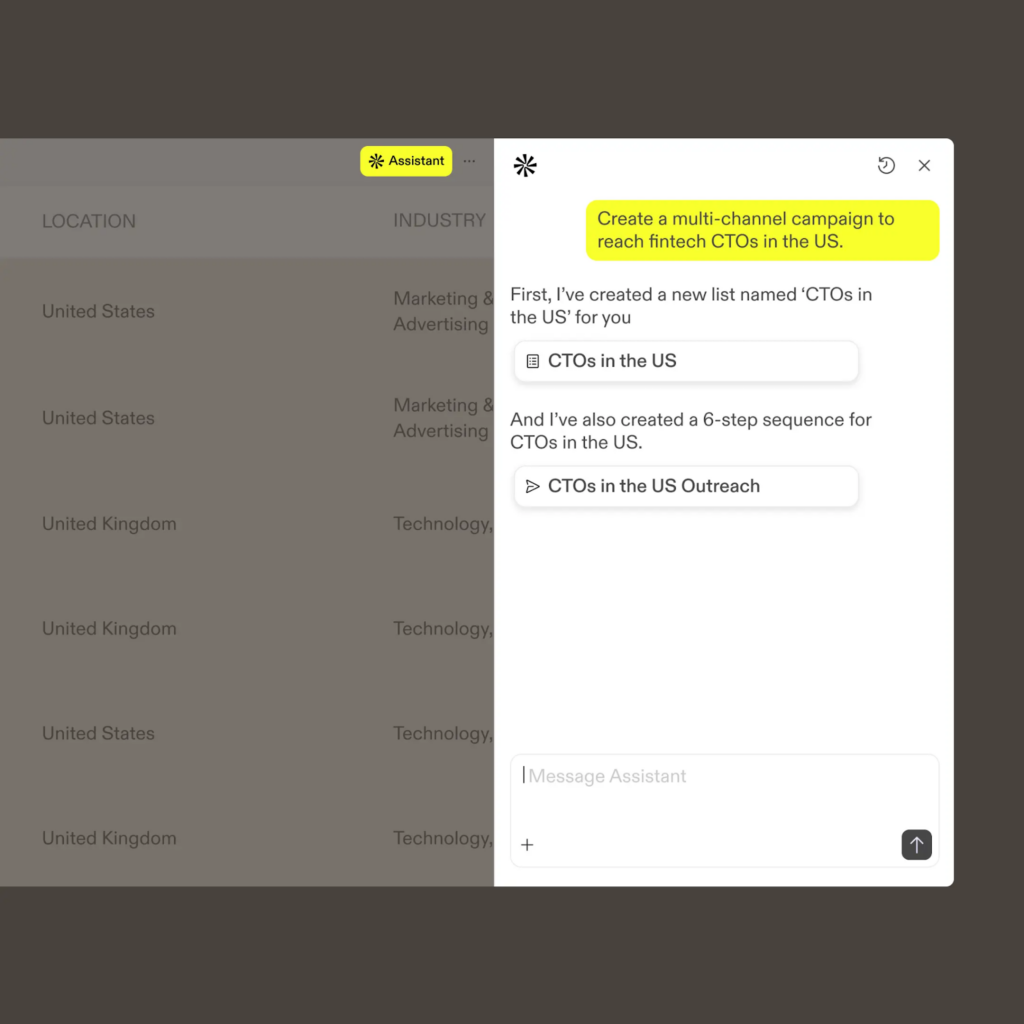
Apollo is a sales platform that combines B2B lead data (contacts + companies) with outbound sequencing. This way, teams can go from “find the right people” → “enrich” → “send sequences” without stitching together five different tools.
It’s especially useful when speed matters: building lists, filtering by ICP, launching outreach, and keeping activity tied to a single system.
Key Features
- B2B contact database: Find prospects by role, company, industry, geo, and other filters.
- Lead enrichment & data workflows: Enrich leads and accounts with firmographic data so reps aren’t sending to half-filled records (better targeting + personalization).
- Outbound sequences: Build multi-step cold email sequences with automated follow-ups so teams stay consistent without manual chasing.
- AI writing assistance: Helps draft and iterate email copy (subject lines, body variations, rewrites) so reps can move faster when launching new campaigns.
What I Like About It
Apollo’s biggest advantage is compression: data + outreach in one workflow. If you’re currently using one tool for leads and another for sequencing, Apollo often removes a big chunk of that operational friction.
Who It’s For
- SDR teams that want prospecting + sequencing in one platform.
- Startups that need to stand up outbound fast without a complex stack.
Pricing
- Free: Limited features and credits.
- Basic: $59/per user/mo.
- Professional: $99/per user/mo.
- Organization: $149/per user/mo.
Verified User Review
“One of the best modern tool with bunch of marketing features, it has replaced multiple tools for Data Mining, Email Marketing that we used to subscribe and will definitely be replacing one of the most costly CRM that we’ve been using for years… we’ve observed around 75 to 80% data accuracy so far- which could have been better” – verified Sr. manager, business development.
17. Smartlead – Best for multi-inbox cold email infrastructure & deliverability
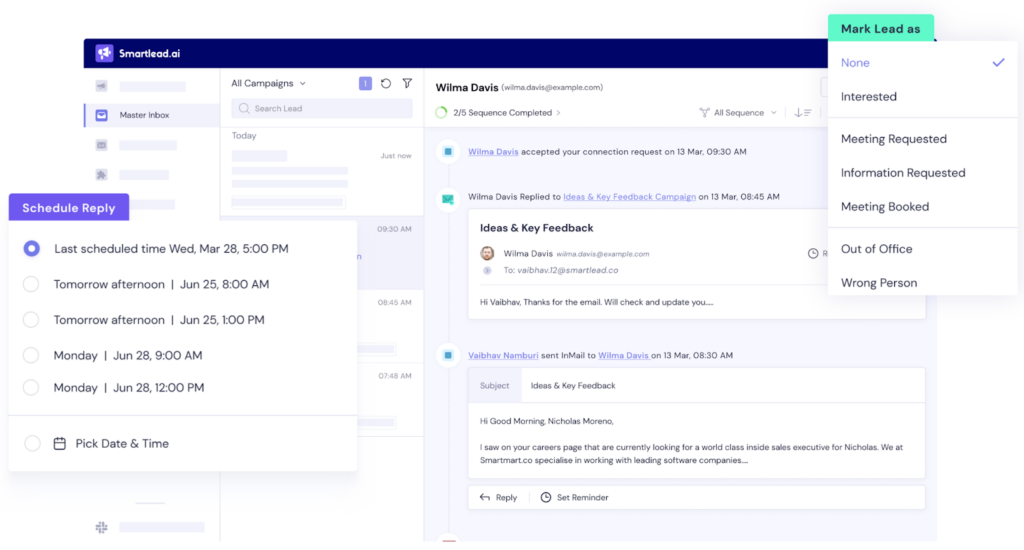
Smartlead is a cold email platform built for teams that need to scale outbound volume safely. It’s designed around sending from multiple inboxes at once, with deliverability controls baked into the core product rather than added later.
Compared to tools that focus on copy or personalization, Smartlead’s strength is infrastructure and making sure emails actually land while running high-volume campaigns.
Key Features
- Multi-inbox sending: Send campaigns across many email accounts at once, spreading volume to reduce spam risk and protect sender reputation.
- Automated inbox warmup: Gradually warms up new inboxes to establish trust with email providers.
- Centralized campaign management: Manage sequences, inboxes, and sending logic from one dashboard.
What I Like About It
Smartlead is purpose-built for teams where deliverability is the bottleneck, not copy. If you’re already confident in your messaging but keep running into inbox placement issues, Smartlead gives you the infrastructure to scale without constantly burning domains.
Who It’s For
- Agencies and SDR teams running high-volume cold email.
- If you’re managing multiple inboxes or domains.
Pricing
- Basic plan: $39/mo, perfect for solopreneurs trying out Smartlead.
- Pro plan: $94/mo, perfect for marketers and pre-scale businesses.
- Custom plan: $174+/mo, perfect for lead gen agencies and at scale businesses.
Verified User Review
“I appreciate Smartlead for its intuitive design, and the support team is always very helpful whenever I encounter any issues. I’ve built my entire cold email tech stack using both Clay and Smartlead, and I’ve never experienced any problems with deliverability.” – verified head of growth.
18. Woodpecker – Best for simple, reply-focused cold email outreach
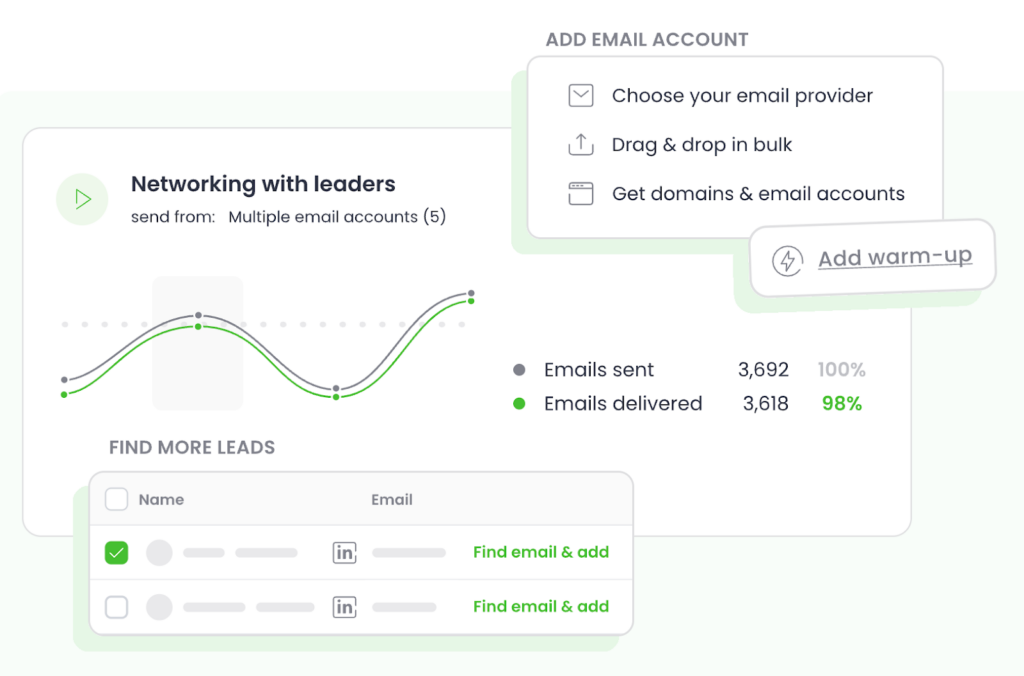
Woodpecker is a cold email tool focused on doing the basics well. It’s designed for teams that want reliable outreach and follow-ups without complex setups, advanced infrastructure, or heavy automation logic.
This email tool is mainly for small teams and agencies that care about reply management and essential outreach features. Don’t expect anything too complicated or over the top AI features, but for cold email outreach, it’s got everything you’d need.
Key Features
- Automated follow-up sequences: Runs follow-ups automatically so prospects are nudged consistently without manual chasing.
- Reply detection: Detects replies and stops sequences to avoid the classic mistake of following up after someone has already responded.
- Personalization fields: Supports basic personalization using custom fields to keep outreach relevant without overengineering.
- Extra marketing and outreach addons: Offers supporting tools to help reduce bounce rates and protect sender reputation (LinkedIn outreach automation, warm-ups, lead credits, and more).
What I Like About It
Woodpecker is straightforward and predictable. You don’t need a complicated RevOps setup or a deliverability playbook to get value out of it. It’s easy to launch campaigns and trust that follow-ups won’t go rogue.
Who It’s For
- Small teams running straightforward cold email campaigns.
- Agencies managing clients who want simplicity over advanced controls.
Pricing
Pricing can vary depending on the number of prospects you want to reach.
- Starter: $35/mo for 500 contacted prospects.
- Growth: $188/mo for 10,000 contacted prospects.
- Scale: $1,354/mo for 100,000 contacted prospects.
- Max: $9,999/mo for unlimited contacted prospects with unlimited emails per month.
Verified User Review
“Woodpecker.co solves the hassle of managing cold email outreach by providing an intuitive, centralized platform to automate and track campaigns. Instead of juggling spreadsheets or manually following up, Woodpecker makes scheduling, personalizing, and analyzing emails easy—all in one place… The user interface, while often praised as intuitive, still draws complaints for issues like awkward email sequence management” – verified sales head.
19. ConvertKit (Kit) – Best for creators (bloggers, podcasters, YouTubers, coaches)
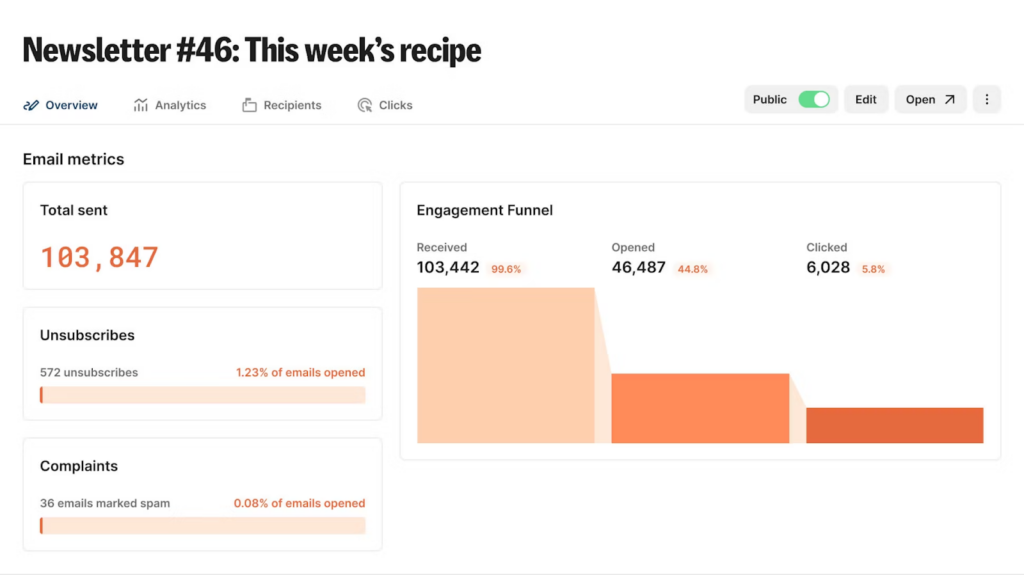
ConvertKit (now branded as Kit) is built for creators who want to grow an audience and monetize it through newsletters and automated email sequences, without needing an enterprise marketing ops setup.
It’s especially popular for content-led businesses (blogs, podcasts, YouTube channels), where email is used to nurture an audience and sell products, courses, memberships, or sponsorships.
Key Features
- Forms & landing pages: Build no-code opt-in forms and landing pages to grow your list without extra tools.
- Newsletters: Create and send newsletters designed for creator-style publishing.
- Visual automations: Drag-and-drop automation builder for welcome sequences, nurture flows, and sales sequences.
- Tags & segments: Organize subscribers by interest so the right people get the right message at the right time.
What I Like About It
You can spin up opt-ins, send newsletters, and build simple automations without turning email into a complicated ops project.
Kit is mainly for online creators like bloggers, YouTubers, podcasters, and course creators who want to build and engage with their audience, sell digital products, and run email marketing with easy-to-use automation.
Though it’s less ideal for traditional e-commerce or large corporations.
Who It’s For
- Creators: bloggers, podcasters, YouTubers, newsletter operators.
- Coaches/consultants building an audience + selling digital offers.
- Small teams that want simple automations + list growth tools without a heavy platform.
Pricing
Kit pricing depends on how many email subscribers you have.
For 10,000 subscribers, pricing is:
- Free up to 10,000 subscribers (limited features).
- Creator: $141/mo.
- Pro: $208/mo.
Verified User Review
“I liked the option of having a landing page, user subscription management and a decent delivery rate in one place. The option of having a paid newsletter exactly matched my requirements. I found their delivery rate is better in comparison to other tools… Reporting is something that can be improved for sure” – verified product & growth.
20. Salesloft – Best for enterprise outbound & revenue orchestration
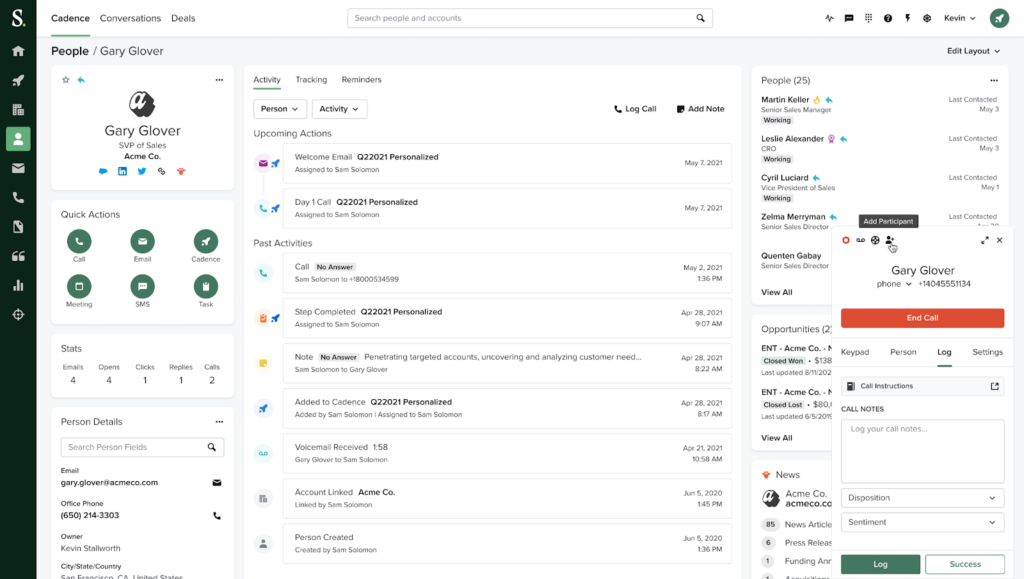
Salesloft is an enterprise-grade sales engagement platform built for large outbound teams that need structure, visibility, and control across email, calls, LinkedIn tasks, and pipeline execution.
Unlike lighter outreach tools that optimize for speed or volume, Salesloft is designed to orchestrate how reps work across long, complex sales cycles. Email is a core channel, but it’s tightly connected to CRM data, deal stages, and forecasting.
AI in Salesloft focuses more on execution quality and prioritization than pure copy generation.
Key Features
- Multichannel sequences (cadences): Coordinate email, calls, LinkedIn touches, and tasks in structured outbound cadences.
- AI-powered deal & activity insights: Surfaces signals on deal risk, engagement, and next-best actions to help reps prioritize follow-up.
- Email tracking & engagement signals: Tracks opens, replies, and engagement to inform cadence progression and rep actions.
- CRM-first architecture: Deep CRM integrations ensure outreach activity, contacts, and deals stay in sync.
What I Like About It
Salesloft shines when outbound needs process and consistency. It’s less about clever AI copy and more about making sure large teams run the same playbook and don’t drop the ball mid-cycle.
For enterprise sales orgs, that operational discipline matters more than raw personalization.
Who It’s For
- Enterprise sales teams with large SDR/BDR orgs.
- Companies with long or complex sales cycles.
- Teams that need outbound tightly aligned with CRM, pipeline, and forecasting.
Pricing
- Salesloft pricing is custom / enterprise-only and requires talking to sales.
- According to online reviews, you should expect around $1,000 per user/year (or $125-$165/user/mo).
Verified User Review
“I use Salesloft to create email marketing campaigns targeting our ideal customer profiles and for forecasting and data intelligence. I find Intent Data very valuable. Salesloft allows us to do outbound at scale without sacrificing the quality of outreach. I love that it allows us to input customization in our messaging, which leads to a higher response rate.” – verified account executive.
21. Lavender – Best for AI-powered email coaching
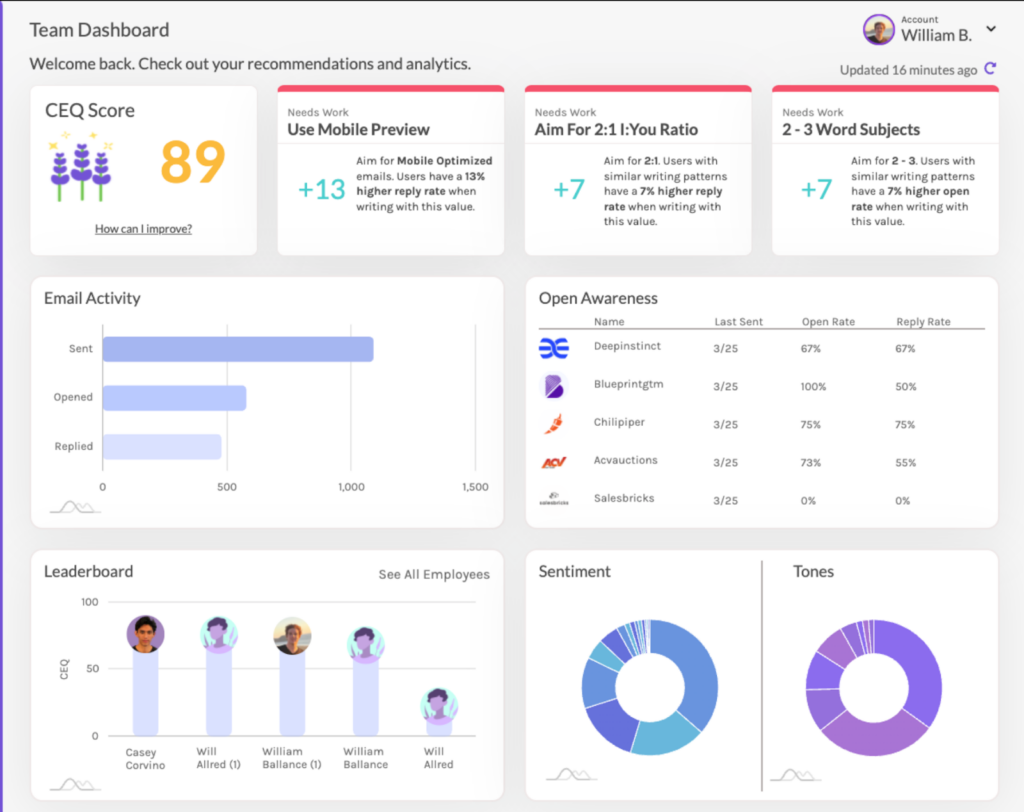
Lavender is an AI email coach designed to help sellers write more effective outbound emails.
At the same time, you can do outreach with Lavender AI. For the most part though, it’s specifically designed as an email AI coach to help you write more effective outreach messages, based on your audience.
Key Features
- Email scoring: Scores emails and templates against best practices so reps know what to fix before hitting send. Gain feedback on quick fixes, what to work on, long term trends, and custom best practices.
- Instant AI rewrite suggestions: Suggests drafts and edits to improve clarity and reply likelihood.
- Recipient context in inbox: Brings recipient research (news/insights/context) into the inbox to speed up personalization.
What I Like About It
Most AI email tools help you with copy or coming up with A/B test variations.
Lavender can be more useful when you already have reps sending daily and need a system that improves quality and consistency.
Who It’s For
- SDRs/AEs who write lots of outbound emails daily.
- Teams that want coaching and quality control without heavy enablement overhead.
Pricing
- Basic: Free but only for 5 emails/month.
- Starter: For individuals, $29/mo.
- Individual Pro: Includes integrations, $49/mo.
- Team plan: Includes integrations & Coaching Dashboard, $99/seat/mo.
Verified User Review
“The actual product is very simple but powerful when writing emails, because what Lavender realizes is that emails are not a one size fits all. From a team wide perspective, very easy for sales managers to look at the data and analytics and know exactly how to coach their reps.” – verified account executive.
FAQ: AI for Email Marketing
AI for email marketing refers to using machine learning and automation to improve how emails are written, sent, targeted, and optimized.
Practically speaking, AI helps with things like send-time optimization, behavioral segmentation, subject line testing, personalization, and workflow automation. Most modern email platforms now include some level of AI in email marketing by default.
AI in email marketing is mainly used to speed up execution and improve decision-making, not fully replace humans.
Common use cases include predicting the best send time, grouping contacts based on behavior, generating copy variations, adapting follow-ups, and optimizing lifecycle flows. In outbound, AI also helps with personalization, reply classification, and sequencing logic.
For outbound email marketing with AI: tools like Expandi, Instantly, or Smartlead
For lifecycle and newsletters: tools like Klaviyo, ActiveCampaign, or Customer.io
The best AI email marketing tools depend on your use case. Here are a few tools to consider:
For infrastructure and deliverability: SendGrid or Mailgun
Generative AI for email marketing is safe when used as a support layer, not a fully autonomous system.
It works best for drafting copy, creating variants, or speeding up ideation. Teams should still review outputs to avoid generic messaging, compliance issues, or deliverability risks. Most successful teams use AI to assist, not replace, human judgment.
Where to Go From Here
There’s no single “best AI email marketing tool.” The best setup is the one that removes the most friction from your workflow without introducing new risk.
- Your motion: lifecycle, newsletter, outbound, or a mix.
- Your scale: a few thousand sends vs millions.
- Your constraints: speed, deliverability, data quality, or team size.
- Your tolerance for complexity: all-in-one vs best-of-breed.
Here’s a simple way to decide:
- If email is tied to product behavior → lifecycle platforms win
- If email is tied to pipeline and conversations → outbound tools matter
- If email must always land → infrastructure tools are non-negotiable
Most growing marketing teams eventually run more than one category.
That said, if your focus is outbound email and sales outreach, especially alongside LinkedIn, tooling matters less than execution control.
That’s where Expandi stands out. Not as an AI rewriting tool, but as a safe way to run multi-touch email + LinkedIn workflows from one place without burning accounts or leads.
If you’re serious about scaling outbound without losing control…
See if Expandi is right for you or claim your free, 14-day trial here.

You’ve made it all the way down here, take the final step