The SDR Role Isn’t Dead — But This Version of It Is [What’s Actually Changing]
The low-judgment version of the SDR role is being eliminated, and the teams that restructure around that distinction now will outcompete the ones that find out later.
The SDR role is under pressure from every direction. AI tools are handling more of the volume work. Entry-level hiring into sales is quietly contracting. And most sales leaders are stuck between two bad options: keep building headcount the old way, or make a bet on AI tooling without knowing what actually transfers and what gets lost.
The reality is more specific than the headlines suggest. AI is replacing the parts of sales teams that were doing work AI can now do more cheaply and at higher volume. The reps doing the other work — the judgment calls, the relationship building, the signal interpretation — are becoming harder to find and more valuable.
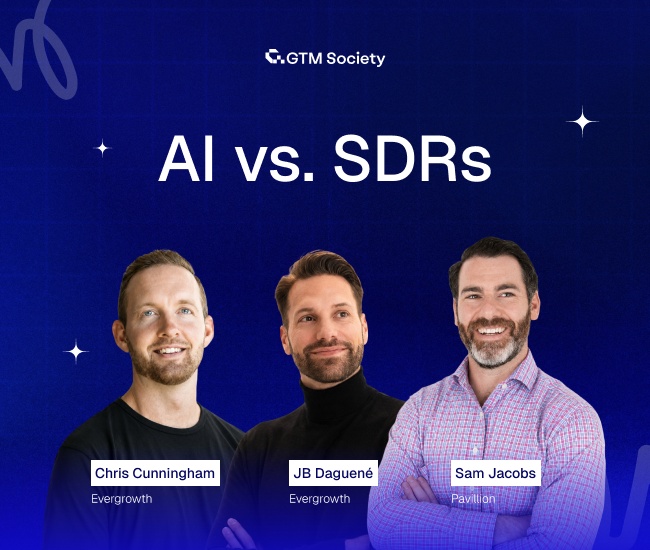
For this piece, we spoke with three GTM leaders who have been living this shift firsthand:
- JB Daguené, founder of Evergrowth.
- Sam Jacobs, founder and CEO of Pavilion.
- Chris Cunningham, co-founder of ClickUp.
Here is what they said.
One founder tried to make his team more efficient. He accidentally replaced 70 people.
Evergrowth’s original business was consulting: running workshops, building playbooks, outsourcing research for companies with complex, high-ACV products. The agent they built to speed up that research covered the function entirely. Seventy roles, gone – replaced by a system two of them put together as a side project.
What replaced the 70 is worth studying. Evergrowth now runs a 16-person team working alongside more than 40 agents. The ratio is telling: more agents than humans, but the humans are still there. They’re just doing different work.

Do I really need a colleague for this, or can I create a digital colleague?
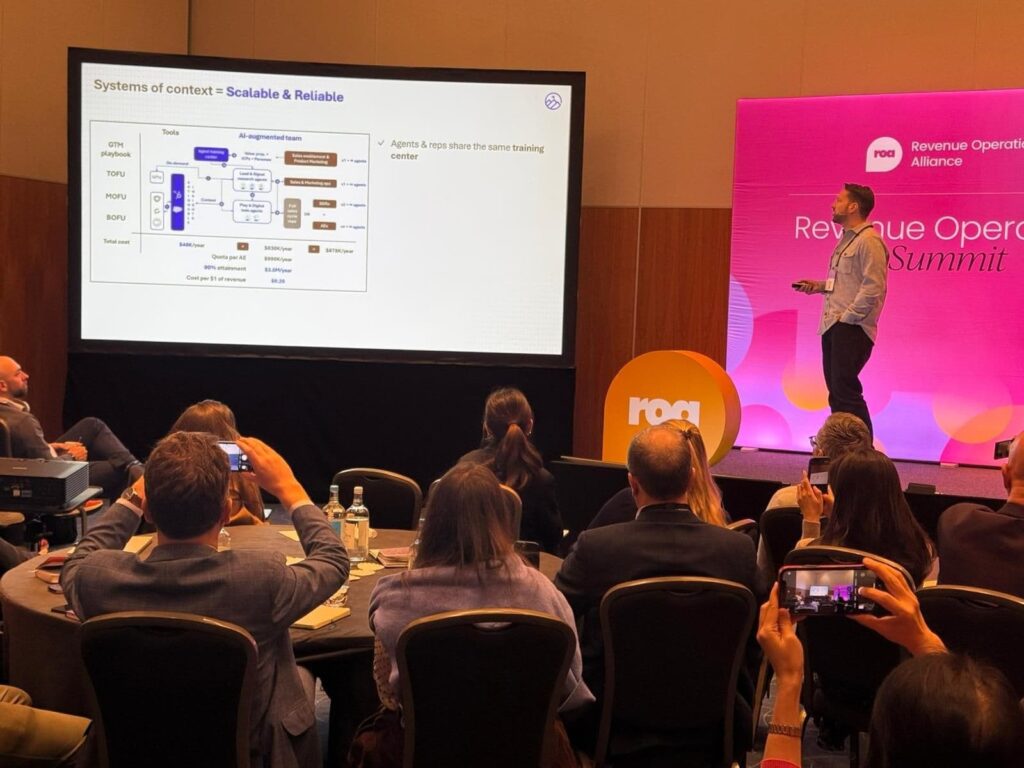
The tasks that got automated were well-defined, repeatable, and data-intensive. The tasks that stayed human were the ones that required context, judgment, and relationship. That line is not theoretical. JB lives on it every day.
So what’s actually happening across GTM teams right now?
JB’s story is extreme. Most sales leaders are not accidentally replacing 70 people at once.
But Sam Jacobs has a view across 10,000 go-to-market executives worldwide, and the pattern he sees is structural, not episodic.

SaaS is going to change a lot because of AI. It’s going to affect the size of the organization that needs to go to market. And it’s going to affect the speed at which people develop new products and new features.
The org size point is the one most people in your position are underweighting. AI does not just change what individual reps do. It changes how many reps a team needs to generate the same pipeline.
The volume layer is increasingly machine territory:
- Account research.
- List building.
- Early-stage sequencing.
- Qualification at scale.
That compresses the headcount math at the bottom of the SDR funnel.
The data point most sales leaders are missing
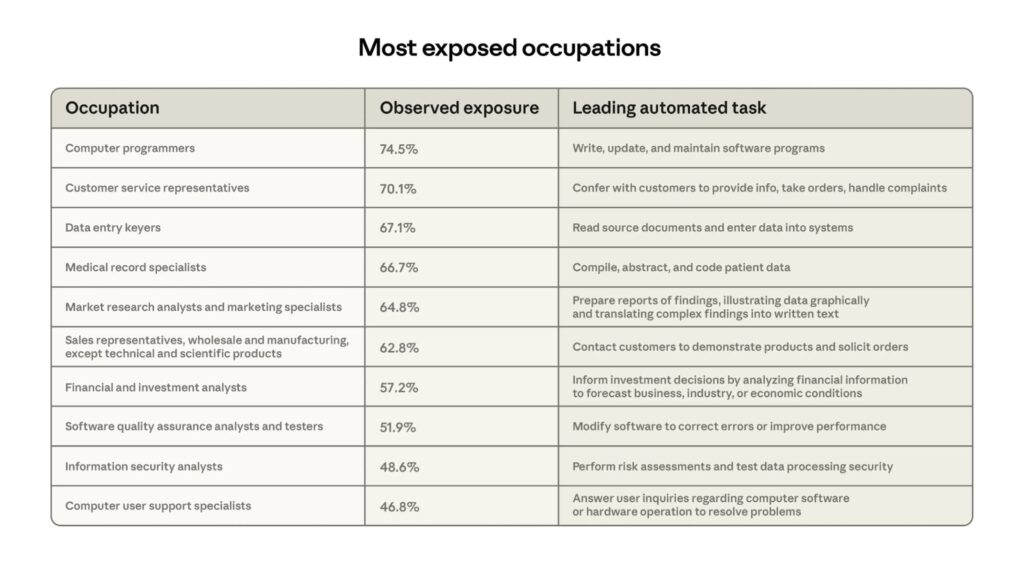
The Anthropic March 2026 labor market report puts numbers on what Sam is describing qualitatively. Sales representatives rank sixth on the list of most AI-exposed occupations in the US, with 62.8% observed task coverage. That means AI tools are already being deployed in professional settings for nearly two-thirds of the tasks that make up a sales representative’s role.
To put that in context: computer programmers top the list at 74.5%. Customer service representatives are at 70.1%. Sales sits in the same tier, not below it.
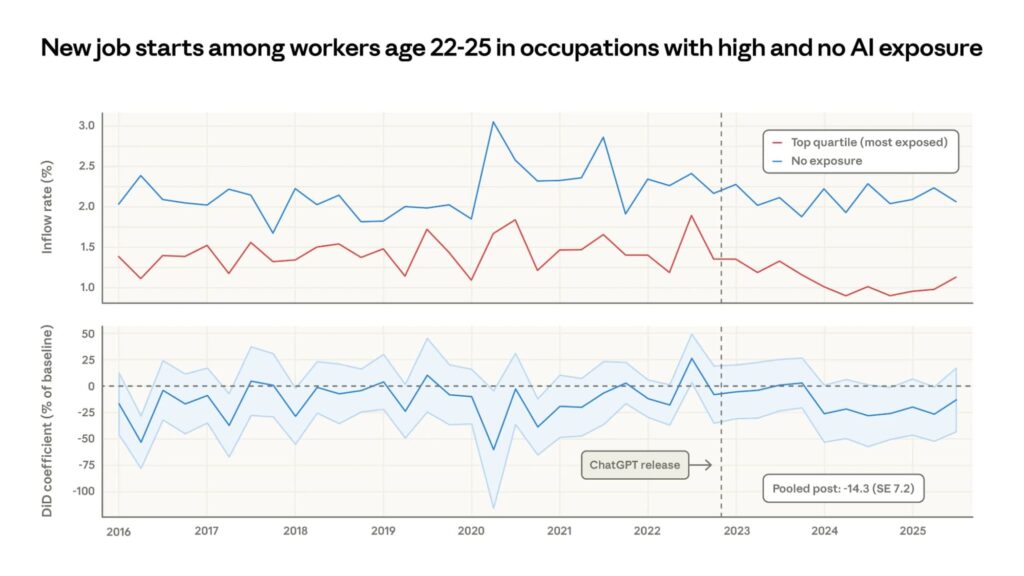
The report also finds that hiring of workers aged 22-25 into highly exposed occupations has dropped roughly 14% since ChatGPT launched. Unemployment has not moved. People are simply not being hired into the entry-level roles that used to be the starting point. The pipeline into the SDR function is narrowing, quietly, without showing up in any headline unemployment figure.
What AI is genuinely better at – and where it still falls short
The Anthropic report introduces a useful distinction between theoretical capability and observed deployment. In computer and math occupations, AI could theoretically handle 94% of tasks. In practice, it is only covering 33%. The gap exists because of model limitations, legal constraints, software integration requirements, and adoption lag.
For sales specifically, AI is already operating reliably on the tasks where you need to follow a defined pattern.
Where it still falls short:
- Multi-stakeholder deal navigation.
- Trust-building over time.
- Reading signals that are not in the CRM.
- Judgment calls on when to push and when to back off.
- And the relationship work that closes deals at enterprise level.
These are not tasks that can be reduced to a prompt.
JB’s 40 agents handle the repeatable work. His 16 humans handle everything on that list above. That division is not arbitrary. It emerged from watching what the agents could and could not do reliably over time.
Why current AI coverage is a floor, not a ceiling
The Anthropic finding that observed coverage is consistently well below theoretical capability should be read as a “not yet” rather than a “never.” For every 10 percentage point increase in observed coverage, BLS job growth projections drop by 0.6 percentage points.
The direction is clear, but the speed is not.
That gap is closing. Capabilities are improving, adoption is spreading, and the tasks AI handles reliably today are more complex than the tasks it handled 18 months ago. If you are treating current coverage as a ceiling, you are going to be caught flat-footed.
What the surviving SDR role actually looks like
Chris Cunningham co-founded ClickUp and spent years as its first sales rep. The ClickUp model is instructive.
Chris runs coordinated content and outreach across the full leadership team, with the sales team monitoring engagement on every post and jumping in when someone meaningful interacts. When a high-profile person engages with founder content, the team produces a custom video and routes them into a sales conversation.

The volume layer is automated but the judgment layer is human and fast.

When we see people comment on our post or on our founder’s post, the sales team will jump in
That model requires fewer SDRs doing spray-and-pray sequencing and more SDRs who can read a warm signal, act on it quickly, and carry a conversation that the algorithm started. The role has not disappeared. It has been filtered. The reps on your team doing work AI can now do are being displaced. The ones doing work AI cannot do are becoming more valuable.
Sam Jacobs frames the structural shift at a higher level: pricing models are changing, org sizes are contracting, and the interface between buyers and sellers is being rebuilt.
“I think the interactive layer is going to dissolve down to voice or to a chatbot,” he said. The SDR who survives that shift is the one who operates above the layer AI owns.
This is better news than the headlines suggest if you act on it
The Anthropic report’s most important finding is the one that gets buried: no systematic increase in unemployment. The displacement happening in high-exposure occupations is showing up as slower hiring and compressed entry-level pipelines, not mass layoffs. That window between where AI is today and where it is going is real, and it is not closed yet.
AI is eliminating the low-judgment version of GTM roles. The high-judgment version is not just surviving — it is becoming harder to fill, because the pool of reps who only knew how to do the automatable work is shrinking while the demand for reps who can do what AI cannot is growing.
The honest question to ask of every part of your SDR function: do I really need a colleague for this, or can I create a digital colleague? The tasks where the answer is “a digital colleague is fine” should already be automated. The tasks where the answer is “no, this needs a person” are where you invest.
What to do next Monday morning
Three actions worth taking this week:
- Audit which SDR tasks are already being automated by tools you have. List building, data enrichment, initial outreach sequences, meeting scheduling. If your reps are still doing these manually, you are paying human rates for machine work.
- Identify where your reps are adding judgment that AI cannot replicate. Where are deals moving because of a relationship, a read on a situation, or a conversation that went somewhere the script did not anticipate? That is your high-value layer. That is what you protect and develop.
- Restructure quota and KPIs around the higher-value work that remains. If you are still measuring SDR success by activity volume: calls made, emails sent, and sequences launched, you are measuring the automatable layer. The metrics need to shift to the work that actually requires a person.
The SDR role is not dead. But the version of it that looked like data entry with a phone is gone. The sooner your team is structured around that reality, the less catching up you will need to do.
The leaders navigating this shift in real time — JB among them — are in the GTM Society. Join the conversation.
Join the GTM Society. The room where GTM actually gets built. Founders, SDRs, and operators. No noise. Just systems.