From Cold Outreach to Closed Deal: Mapping the B2B Buyer Journey in 2026

B2B buying changed faster than B2B selling did.
By the time an SDR books the discovery call, the buyer has spent weeks in Slack threads with peers, asked ChatGPT to summarize the category, and pulled three competitor pricing pages into a comparison doc.
The “first touch” your CRM is logging arrives third or fourth in reality. The modern B2B buyer journey itself runs across five non-linear stages:
- Awareness — the buyer notices a recurring friction and is looking for vocabulary to describe it.
- Consideration — the buyer shops the category, asking peers and ChatGPT to map the comparison and pricing pages.
- Evaluation — finance, IT, and legal join the deal as the buyer builds the internal case.
- Decision — final approvals, procurement sign-off, contract negotiation.
- Expansion — onboarding, usage signals, renewal, and upsell.
We analyzed 70,000+ campaigns running on Expandi and found that the LinkedIn motion that closes one deal will stall another, depending on where the buyer sat in the journey when the message landed.
In this guide, you’ll learn about the five stages of the modern B2B buyer journey, what changes at each stage, and how to wire the tech stack so every touch shows up in the CRM as a deal-stage signal.
Key Takeaways
- Buying groups now sit at 6 to 10 active stakeholders, with broader buying networks averaging 22 people. Single-threaded outreach to a champion no longer survives the approval cycle.
- The metrics shift at every stage: profile views and connection acceptance measure activity. Engaged accounts, conversations started, meetings booked, and pipeline generated measure revenue.
- Expandi connects LinkedIn activity to HubSpot, Pipedrive, and Salesforce natively, so a profile view becomes a CRM event, a reply becomes a deal-stage change, and the journey stays visible end to end.
Why the linear B2B funnel broke in 2026 for modern buyers
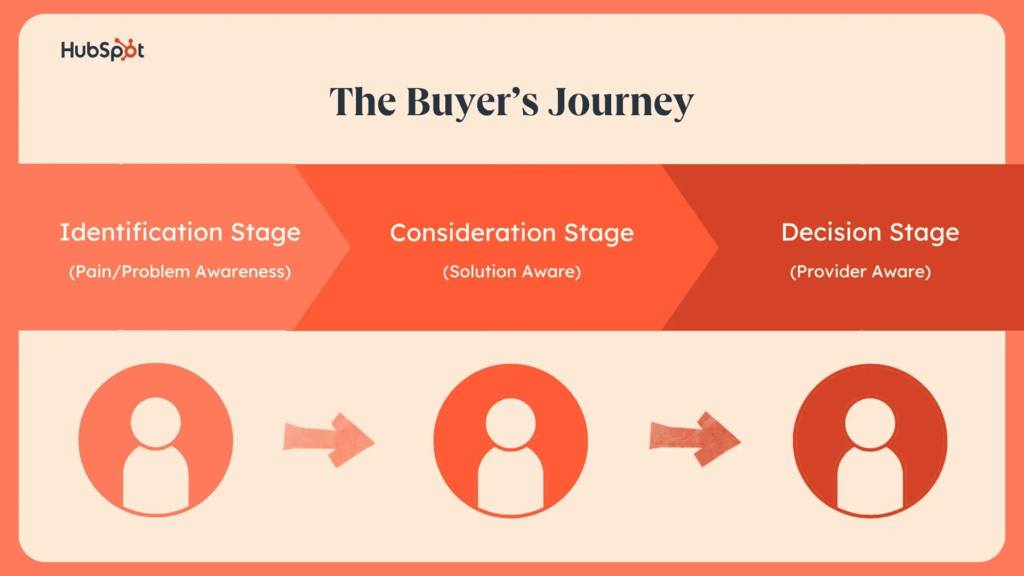
The Awareness → Consideration → Decision buyer’s journey funnel was built for a buying environment where buyers waited for sellers to define the category. That environment is gone in 2026.
Forrester found 68% of B2B buyers already have a front-runner vendor in mind at the start of the purchasing process — and 80% of the time, that front-runner wins. They enter the cycle opinionated, with the comparison structure pre-built from peer recommendations and AI-summarized research.
Three forces drove the change.
- Buying groups grew. Forrester’s State of Business Buying 2026 found that the average complex B2B deal involves 13 internal and 9 external stakeholders. Gartner’s narrower count puts the active buying group at 6 to 10. Either way, the champion you sold no longer carries the deal alone — Finance, IT, legal, and the end-user team each get their own veto.
- AI changed the research phase. A growing share of buyers use ChatGPT, Claude, and Perplexity to summarize vendor capabilities, draft RFP language, and shortlist categories before any sales conversation. By the time a rep enters the cycle, the buyer’s mental model of the category is already locked in.
- Rep-free buying preferences hardened. Gartner finds 67% of B2B buyers prefer a rep-free experience for at least part of the journey. The same buyers still want a rep involved — at the moments where the rep moves the deal forward, and only those moments.
Edmund Frey, founder of Edventure Capital and a B2B sales leader who has been closing deals since 1999, framed it cleanly in a recent GTM Society interview:
“There’s nothing more valuable than picking up the phone and calling your customer. LinkedIn is great for research, great for the first touch, but you got to talk. You got to use your sales skills to make them buy.”
The takeaway for a GTM leader:
Tools multiply, channels fragment, AI compresses the research phase — and the structure of a deal still depends on the right human conversation at the right stage. The job is mapping which conversation belongs where.
The team that gets this right understands inbound vs outbound sales as complementary motions for different stages, rather than competing channels chasing the same lead.
The 5 main stages of the modern B2B buyer journey in 2026
The five-stage frame is the planning map. Use it knowing buyers will loop between Consideration and Evaluation throughout the cycle, even as the overall arc moves forward.
1. Awareness
The buyer’s work at this stage is naming the problem clearly enough to explain it to their CFO.
They are reading comments under LinkedIn posts, listening to podcasts on the topic, and watching peer Slack channels for a sharper take on what they’re feeling. Vendor sites do not enter the picture at Awareness.
The seller who pitches a product here loses, since the buyer cannot evaluate what they cannot describe.
The seller who shows up with content that names the problem better than the buyer can name it earns consideration weeks later, when vendor evaluation begins.
The pattern that backfires at Awareness is a connection request asking “are you the right person to talk to about X?” — when X has not registered as a category on the buyer’s roadmap.
The 15-minute demo request to someone still researching the category lands in the archive the same way.
2. Consideration
The buyer has named the problem and is shopping the category.
They read comparison content, ask peers for shortlist recommendations, run vendor descriptions through ChatGPT to get the differentiators distilled, and pull pricing pages into a spreadsheet their finance partner asked for.
6sense’s 2025 Buyer Experience Report finds buyers now complete about 60% of the journey before contacting sellers — down from 70% a year earlier — and the favorite vendor identified during that selection phase still wins the deal about 80% of the time
The buyer needs help structuring the comparison they are already running.
- The vendor who maps the category honestly, including the use cases where their own product is the wrong choice, gets borrowed as the framework the buyer uses to evaluate every competitor.
- The vendor who gates the comparison behind a demo gets cut from the shortlist meeting.
What backfires at this part of the B2B buyer journey is a connection request asking for 15 minutes to walk through the platform, sent to a buyer two weeks into a vendor shortlist that did not include the seller.
Cold-DMing the named champion when the influencer is the engineering lead nobody has reached out to fails the same way.
3. Evaluation
The buyer is building the internal case at this part of the buyer journey.
- Pricing scenarios for Finance.
- ROI math for the CFO.
- Security and procurement requirements.
- Integration audits with IT.
- Deployment timelines with the operations lead.
The original champion has become a coordinator running five people who each want something different from the deal. The conversation has moved out of one inbox into Slack threads, Notion docs, and a procurement ticket nobody told the seller about.
Specificity sells at the Evaluation stage. For example:
- Customer references from companies that look like the buyer’s.
- A direct contact for legal questions who responds within a day.
- Honest answers about total cost of ownership, including line items competitors leave off the quote.
- A slide the CFO can drop into the board deck.
Generic content gets cut from the comparison spreadsheet, regardless of product quality.
The mistake at Evaluation is sending the same case study to every stakeholder when Finance, IT, and the end-user team each need a different proof point. Or forcing every conversation through the original champion when the deal needs three parallel tracks:
- Finance talking to the seller’s CFO.
- IT talking to the CTO.
- The end-user team talking to a peer customer.
Discounting before consensus exists is the third common pattern. It signals desperation and resets the procurement clock.
4. Decision
The buyer is locking the approver chain, negotiating contract terms, and getting procurement sign-off. Often re-litigating decisions the champion thought were settled three weeks ago.
The seller’s job at Decision is consensus support:
- Templates for the procurement conversation.
- Reference calls timed to the specific objection blocking the deal — security signoff, integration risk, change management for the end-user team.
- Patience with re-litigation driven by internal politics the seller was not briefed on.
The deal-killers at Decision start with the assumption that the champion can carry the deal alone.
- Heavy discounting to the champion when the real blocker is a different stakeholder’s risk profile.
- Disappearing when negotiations stall, exactly the moment when multi-threading new voices would unblock the deal.
- Treating the deal as won because the champion said yes, without checking whether the champion ever had the authority they implied.
5. Expansion
The deal closed. The customer is onboarding, hitting first value, and quietly deciding whether the tool earns its renewal. The expansion buyer behaves like a new buyer with familiarity. The same five stages compress into weeks.
The same stakeholder politics replay at a smaller scale.
What earns the renewal is:
- Real onboarding.
- Usage signals that surface expansion-ready accounts before the customer asks.
- A named contact who stays in the room as the original AE rotates off to chase new clients.
Relationship loss inside the customer org is a leading churn precursor. CSMs who inherit accounts without the LinkedIn relationship history start the renewal cold, and the renewal conversation arrives with the buyer already comparison-shopping.
Three patterns kill expansion.
- First: handing the customer to a CSM and disappearing.
- Second: treating renewal as paperwork. Renewal is a re-purchase decision driven by the same buying group dynamics that closed the original deal.
- Third: missing the expansion signal because product usage data lives in one system and the CRM lives in another, and nobody is tagging them together until the customer mentions it on a QBR.
Now that you’ve learned what doesn’t work and reduces your chances of success, we’ll show you how to tailor LinkedIn outreach the right way.
How LinkedIn outreach fits at each stage of the B2B buyer journey
LinkedIn behaves differently at every stage. The automation that builds familiarity at Awareness will backfire at Decision. Match the motion to the stage.
Awareness — earn recognition before pitching
LinkedIn outreach at Awareness is presence work.
- Founder-led content that names problems before pitching solutions.
- Thoughtful comments on the posts your target buyers are reading.
- Profile views into target accounts so your name appears in their “who viewed your profile” feed before any connection request lands.
- Inbound campaigns that auto-engage prospects who view your profile or engage with your team’s posts — the prospect who looked at your founder’s profile is signaling earlier intent than the prospect cold-imported from Sales Navigator.
Sam Jacobs, founder of Pavilion, tracks where his community signups originate:
“80% of people that sign up for Pavilion say they’ve interacted with my LinkedIn in some way.”
Sam shows up in the feed of the people whose problems his community solves. They find him there.
Wynter founder Peep Laja sees the same pattern — 70 to 80% of app signups credit his LinkedIn content as their first touch with the brand.
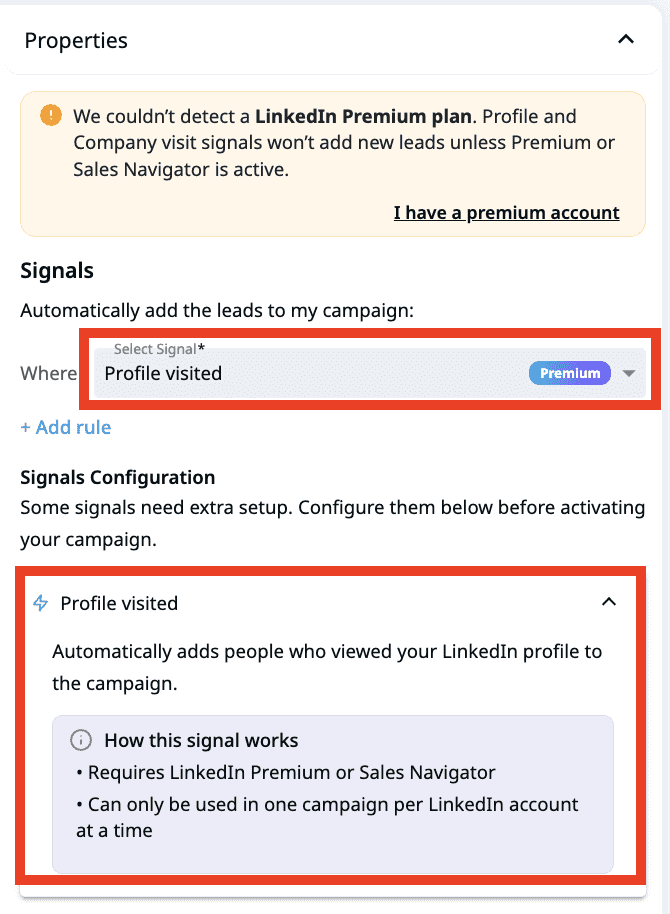
Here, you can set up Expandi’s Profile visited signal in a campaign and anyone who views your LinkedIn profile auto-imports as a lead. The opening message can reference the visit directly:
“Hey {first_name}, saw you stopped by my profile — let me know if I can help with X.”
Consideration — turn engagement into a real conversation
By Consideration the buyer has identified the category and is shortlisting vendors.
LinkedIn outreach now needs context:
- A mutual connection in common.
- A comment on a post they wrote last week.
- A reference to a problem you know they have because their job title and recent activity say so.
Smart sequences with conditional logic match the stage’s complexity.
- If the prospect accepts the connection request, the next touch is a category-mapping resource.
- If they engage with one of your posts before that, they branch into a warmer sequence than the one running against cold profile views.
Expandi’s Builder campaigns support 19 actions and 11 conditions — enough to wire a sequence that reads how the prospect behaves and adapts the next step on the fly.
Morgan Edmondson, CEO at Nesti, runs LinkedIn as the primary outbound channel, saying:
“We have an AE at the moment who probably contacts around 5,000 people a month through LinkedIn alone. When prospects see your posts, they recognize you when you reach out.”
That recognition is what gets a Consideration-stage prospect to open the message rather than archive it on sight.
Evaluation — meet the buyer where their committee meets
By this stage, the buyer is everywhere at once:
- They skim your one-pager on LinkedIn.
- Ping the CFO on Slack.
- Fire a procurement question into email.
- Then circle back to LinkedIn with a follow-up for the champion.
Camp on one channel and you miss the rest of that motion.
McKinsey’s B2B Pulse research finds B2B buyers regularly use ten or more channels to reach suppliers, up from five in 2016 — so the sequence that wins here moves the way the buyer moves.
- LinkedIn carries the relationship and the quick back-and-forth in the feed.
- Email handles the procurement thread and the one-pager that has to survive inside a board deck.
- A personalized video does the work neither can — the handmade message that answers the CFO’s three objections by name.
A workable Expandi flow here, based on custom actions and conditions:
- A LinkedIn message, a delay if there’s no reply.
- A move to email with the CFO-ready one-pager.
- Then a follow-up LinkedIn touch aimed at a second stakeholder in the same buying group.
- The video is the manual touch you drop on the one objection blocking the cycle.
Message personalization matters more here than anywhere earlier.
The moment a stakeholder reads a touch that ignores what the committee is weighing, you read as a seller who never understood the deal — and that read is what drops you from the shortlist.
Decision — multi-thread without overwhelming the room
Decision is where deals stall.
Forrester found 86% of B2B purchases stall during the buying process, and it happens right here — procurement runs its process while the champion tries to hold the room together alone.
The fix is multi-threading: real relationships with 3 to 5 people in the buying group, so the deal stops resting on one person.
LinkedIn is the multi-threading channel. Starting a connection with the Finance partner on LinkedIn is easier than cold-emailing them after the champion CCs them once.
The trick is pacing: when a deal hits this stage of the buyer journey, time the touches so your CEO, head of CS, and a customer reference each show up in the prospect’s feed across the same week — spaced a few days apart so it reads as steady presence.
Stefan Smulders, founder of Expandi, on what separates the top teams in our State of LinkedIn Outreach report
“The top-performing teams treat LinkedIn like a primary outbound channel. They track conversations in their CRM, automate follow-ups, and send thousands of messages monthly without compromising personalization.”
The “track in CRM” half is the Decision-stage requirement. A multi-thread nobody is logging breaks the moment a rep leaves or rotates off the account.
Expansion — stay-in-touch sequences for customers
Expansion is the easiest LinkedIn motion to set up, and the one teams leave half-built.
The customer already knows the brand, so the work is staying visible: a quarterly check-in to the original champion, a connection request to the new VP who just joined the account, a congratulations message when a champion gets promoted — which often opens the door to a second use case.
The tech requirement is product usage signals flowing into the CRM, so what the customer does triggers the right LinkedIn or email touch.
- A customer using a feature at higher volume than peers is an expansion signal.
- A customer whose champion just changed jobs is both a churn risk and a relationship-rebuild signal
That rebuild often starts on LinkedIn before anywhere else.
The tech stack that connects the buyer journey from first touch to closed-won
A journey-aware outreach motion needs the journey visible in one place.
LinkedIn activity in one tool, email in another, CRM stages in a third, product usage in a different prospecting tool — the seller spends half the day reconstructing the deal from four dashboards while the buyer moves between four channels in 15 minutes.
The non-negotiables:
- CRM as the system of record. HubSpot, Salesforce, or Pipedrive — pick one and route everything into it. The CRM is where the deal stage lives, where forecasting happens, and where revenue gets credited.
- Native LinkedIn outreach integrations that write activity into the CRM in real time. CSV exports go stale by the next sync and turn into a manual reconciliation job.
- Email tools running in the same sequence engine as LinkedIn. A separate email tool means a separate cadence, a separate report, and a broken handoff every time a sequence switches channels.
- Product usage signals flowing into the CRM for the Expansion stage. Otherwise the renewal conversation starts blind.
Joliene van Grieken at The Growth Syndicate, who consults with B2B companies on GTM setup, sees the same gap on every engagement:
“When we enter companies, a lot of things fundamentally are just not right. The ICP is not set up correctly, the data is not tracked correctly, and they focus on the wrong things.”
Before automating against the journey, audit whether the journey is even visible in your CRM.
A buyer who shows up as an MQL in HubSpot with zero LinkedIn activity logged is invisible to the seller running the LinkedIn motion — which means the seller is going to mis-time the first message.
Expandi connects to HubSpot, Pipedrive, and Salesforce natively. Connection accepts, profile views, replies, and email opens push into the contact record as the activity happens. Webhooks and Zapier cover anything else.
A practical end-to-end workflow for the modern buyer journey here:
- A target prospect views your founder’s LinkedIn profile after a post goes up.
- Expandi’s Inbound campaign auto-imports the profile viewer as a lead.
- A connection request goes out with a contextual line referencing the post topic.
- Connection accept triggers a CRM activity in HubSpot and moves the contact to “engaged.”
- A smart sequence runs three educational touches over two weeks.
- A reply triggers a Slack notification to the AE and a CRM stage change to “conversation started.”
- The AE takes over with a personalized video addressing the prospect’s role and use case.
- A meeting books. The CRM stage moves to “discovery booked.”
Each touchpoint maps to a buyer stage, each handoff is clean, and the seller stops reconstructing the deal from memory.
Metrics that matter at each stage of the B2B buyer journey
Stage-by-stage measurement is the difference between an activity dashboard and a revenue dashboard. The wrong metrics make a busy team look productive while pipeline shrinks.
Three rules for setting this up.
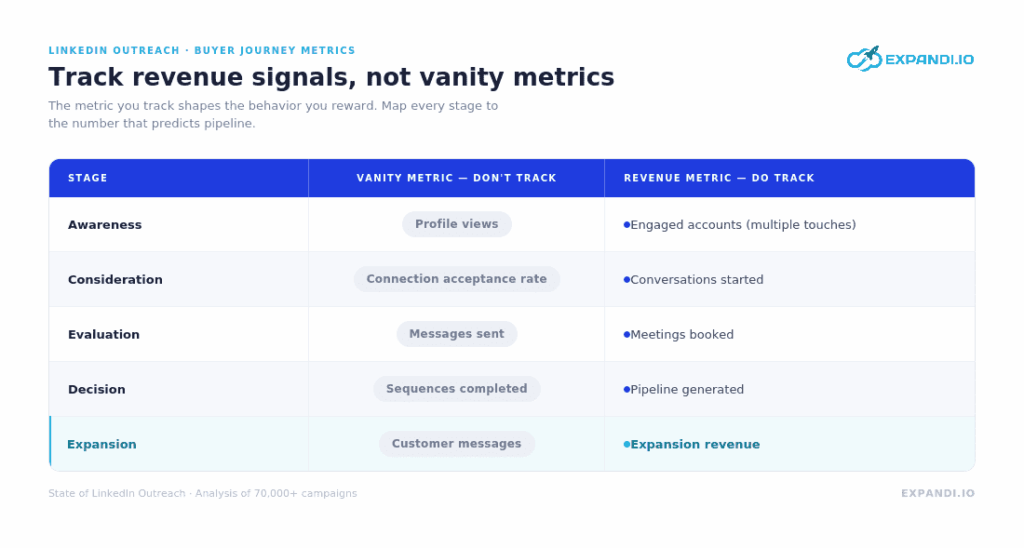
Track leading alongside lagging
Pipeline generated is a lagging indicator — by the time it moves, the cause already happened weeks ago. Engaged accounts and conversations started are leading indicators that predict pipeline two to four weeks out.
Put both on the dashboard next to each other so the team sees cause and effect.
Wire up attribution before the deal closes
If LinkedIn touches do not write to the CRM in real time, attribution becomes guesswork when the cycle runs 90 days.
See the full breakdown on what to track and how to wire it sits in our GTM leader’s guide to pipeline attribution.
Anchor each metric to a stage
“LinkedIn reply rate” is a channel metric — useful, but it does not tell you whether the channel is moving deals. “Conversations started by stage” tells you whether the LinkedIn motion is working at the moment in the cycle where it is supposed to work.
You can easily track all relevant performance metrics for all your LinkedIn accounts through Expandi’s Workspace analytics:
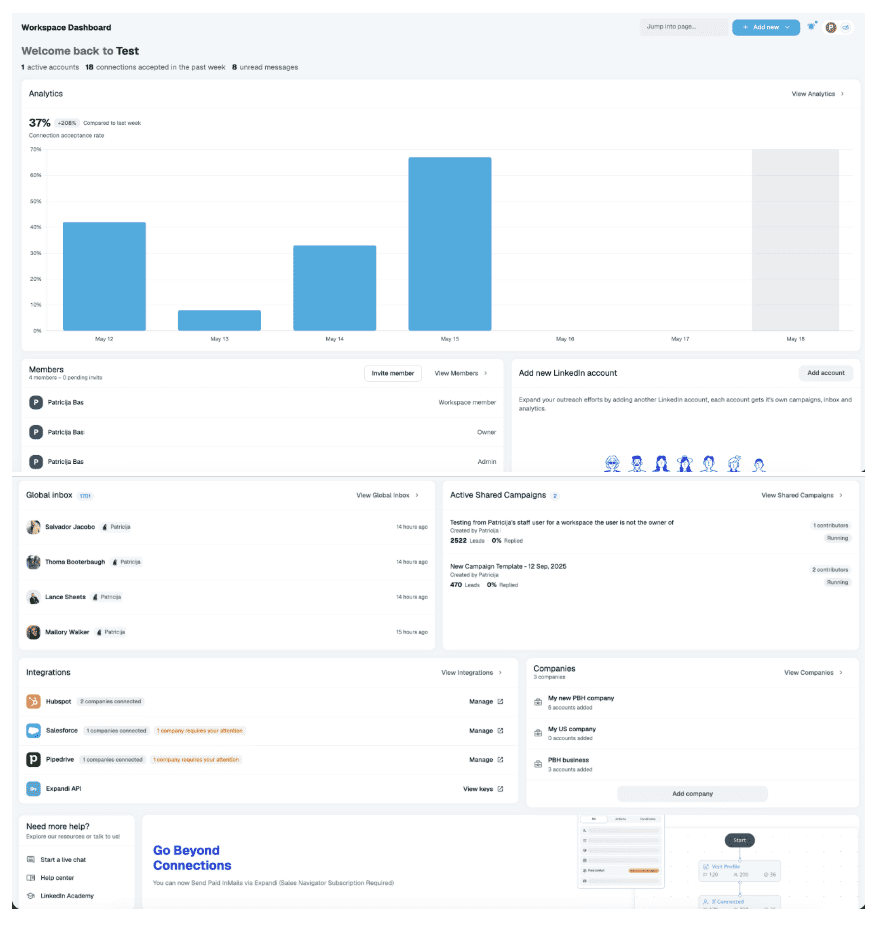
For example, you can easily access and monitor:
- Important notifications that require your attention
- Performance data (KPI) like connection and reply rates
- Daily activity stats such as messages sent, requests made, and campaign results
- Active campaigns with key metrics at a glance
You can use available filters to view data by company, LinkedIn account, campaign, or time range.
From journey map to repeatable pipeline
The B2B buyer journey in 2026 is non-linear, multi-stakeholder, AI-assisted, and stalled at Decision more than at any other stage. Teams winning pipeline match the LinkedIn motion to the buyer’s stage, and they write every touch back to the CRM so the deal stays visible end to end.
That alignment is the work.
Start a free, 7-day Expandi trial to run signal-based LinkedIn campaigns that match the buyer’s stage, write activity into HubSpot, Pipedrive, or Salesforce in real time, and connect first touch to closed-won inside one workflow.
Frequently asked questions about 2026 buyer journey stages
The B2B buyer journey runs across five stages:
• Awareness — the buyer recognizes a problem.
• Consideration — the buyer researches possible solutions.
• Evaluation — the buyer compares vendors and builds the business case.
• Decision — final stakeholder alignment and negotiation.
• Expansion — post-purchase usage, upsell, and renewal.
The stages rarely run in a clean line. Buyers loop back to earlier ones whenever new information or a new stakeholder enters the deal.
A B2B journey is longer, involves more people, and carries far higher commercial risk. Where a B2C purchase is often one person deciding in minutes, a B2B deal runs months and needs consensus across finance, IT, legal, and end users. That group dynamic is what drives stalled deals and multi-threaded outreach.
B2B sales cycles run from a few months for mid-market deals to a year or more for enterprise. Across the deals we tracked in the State of LinkedIn Outreach Report, cycles stretched past the six-month mark before closing. The bigger the buying group, the longer the cycle — every extra approver adds time.
A typical complex B2B purchase involves six to ten decision-makers, according to Gartner — each arriving with four or five pieces of research they gathered on their own. Forrester’s State of Business Buying 2026 counts the wider network, including informal influencers, at 22 people. Outreach built around a single champion rarely clears that approval group.
Gartner replaces the linear funnel with six “buying jobs” buyers work through in parallel:
• Problem identification.
• Solution exploration.
• Requirements building.
• Supplier selection.
• Validation.
• Consensus creation.
The model is non-linear — buyers revisit each job at least once as new information surfaces. Gartner also finds 77% of buyers call their latest purchase “very complex or difficult.”
LinkedIn works at every stage when the play matches the stage. Early on it builds familiarity through founder content and profile engagement; mid-journey it carries contextual connection requests and educational sequences; late in the deal it powers multi-threading across the buying group. Run the wrong play — a demo invite to an Awareness-stage prospect — and it burns trust faster than it builds pipeline.

You’ve made it all the way down here, take the final step