The 5 Stages of the B2B Buyer Journey in 2026 & How They Map to Your Sales Pipeline

B2B buying changed faster than B2B selling did. The B2B buyer journey now moves through Awareness, Consideration, Evaluation, Decision, and Expansion, where buyers often return to an earlier stage when someone new joins the deal. This guide maps those 5 stages to your seller-side pipeline, then tells you which LinkedIn play fits each one.
Key Takeaways
- The B2B buying journey has 5 stages, but buyers rarely move through them in a straight line.
- A CRM pipeline records the seller’s progress. The buyer journey records the buyer’s work. Deals stall when those two views disagree.
- Buying groups extend well beyond the original champion, so Decision-stage deals need relationships with more than one stakeholder.
- Use acceptance and reply rates early. Later stages need buying-group coverage and opportunity movement.
The 5 Stages of the B2B Buyer Journey in 2026 & How They Map to Your Sales Pipeline


What is the B2B buyer journey?
The B2B buyer journey is the work a company carries out, from recognizing a problem through choosing a supplier and expanding the relationship after purchase. It follows the buyer’s questions and internal decisions, whereas your CRM follows the actions taken by your sales team.
Companies rarely move through the journey in a straight line. A new approver can reopen questions that seemed settled and send the deal back to Evaluation. After the contract is signed, the customer begins a shorter cycle in which it assesses value and decides whether to renew or expand.
Forrester’s 2025 Buyers’ Journey Survey found that 68% of B2B buyers entered the purchase process with a preferred vendor already in mind. That vendor won 80% of the time, which suggests that much of the competition happens before a formal evaluation begins.
The contact in your CRM is only one person in a much larger buying network. Forrester’s State of Business Buying 2026 report counted an average of 13 internal stakeholders and 9 external participants. A separate Forrester report published in 2024 found that 86% of B2B purchases stalled, which means the process paused or lost momentum before completion.
Gartner’s March 2026 survey found that 67% of B2B buyers preferred a buying experience without a sales representative. Sellers still have a role when they can clarify how the product would improve outcomes in the buyer’s specific business context.
Edmund Frey, founder of Edventure Capital and a B2B sales leader who’s been closing deals since 1999, described the value of a direct conversation in a GTM Society interview:
“There’s nothing more valuable than picking up the phone and calling your customer. LinkedIn is great for research, great for the first touch, but you got to talk. You got to use your sales skills to make them buy.”
Use inbound and outbound sales for different moments. LinkedIn can build recognition early and help a rep reach the wider buying group once a deal is active.
The 5 stages of the B2B buyer journey
The 5-stage frame is the planning map. Use it with the knowledge that buyers will loop between Consideration and Evaluation throughout the cycle, even as the overall arc moves forward.
1. Awareness (pipeline: prospecting)
The buyer is trying to name a recurring problem clearly enough to discuss it internally. They may read industry posts or listen to peers before they ever visit a vendor site.
The seller’s job is to become recognizable by explaining the problem well. Useful content and thoughtful comments give the buyer language they can reuse inside the company. This is where organic B2B lead generation supports later outreach.
What backfires: asking for a meeting before the buyer has decided the problem deserves attention. A connection request that asks, “Are you the right person to discuss X?” also fails when X isn’t yet on the roadmap.
2. Consideration (pipeline: qualification)
The buyer has named the problem and is comparing approaches. They ask peers for recommendations and test vendor claims against their own context.
6sense’s 2025 Buyer Experience Report found that buyers first contacted sellers at 61% of the way through the journey, earlier than the 69% reported in 2024. Buyers still did most of the work before that first conversation.
The seller can help by giving the buyer a comparison framework that covers fit alongside limitations. Qualification begins here as well: does the problem justify action, and is someone responsible for solving it?
What backfires: requiring a demo before the buyer can access a useful comparison. Focusing every message on the named champion (the person in the buyer’s company advocating for the purchase) can also leave an important technical influencer out of the conversation.
3. Evaluation (pipeline: discovery and proposal)
The buyer is building the internal case. Finance wants credible cost assumptions, and IT checks how the product fits the existing stack. Procurement and end users have their own concerns.
What works here is specific evidence. One stakeholder may need a reference from a similar company, and another may want a clear explanation of implementation. At this stage, tailor the evidence to the account and to the question each person is trying to answer.
General lead generation tactics have to give way to account-level evidence.
What backfires: sending the same case study to everyone on the buying committee. The original champion shouldn’t have to explain why a generic example is relevant to colleagues with different concerns.
4. Decision (pipeline: negotiation and closed won)
By the Decision stage, the buyer is trying to secure final approval. Procurement or an executive may join late and reopen questions the champion thought were settled.
Help the champion answer those questions and confirm who still needs to approve the purchase. Where appropriate, build direct relationships with other members of the buying group.
What backfires: offering a discount when trust or implementation risk is the blocker. Disappearing during a procurement pause leaves the champion without support at the point they need it most.
5. Expansion (pipeline: onboarding and renewal)
After the purchase, the customer starts judging whether the product delivers the promised outcome. That decision shapes both renewal and expansion.
Keep the relationship history attached to the account, since a new executive or a champion’s job change can reopen questions the team thought it had settled.
What backfires: treating renewal as paperwork. If the original salesperson hands the account over without its relationship history, the customer success or account management rep has to rebuild the context from scratch. By then, the customer may already be reviewing alternatives.
B2B buyer journey vs B2B sales pipeline vs sales cycle
The B2B buyer journey follows what the buyer is doing, whereas the B2B sales pipeline records the seller’s progress. The B2B sales cycle measures the elapsed time between the start and finish points your team has defined.
| Concept | What it represents | Question it answers | Common mistake |
|---|---|---|---|
| B2B buyer journey | The buyer’s research, internal alignment, and decision work | What must the buying group resolve next? | Assuming the CRM stage proves buyer readiness |
| B2B sales pipeline | The opportunities and seller actions tracked in the CRM | Which deals are active, and what should the team do next? | Advancing a deal because a task was completed |
| B2B sales cycle | The time from a defined starting event to a defined outcome | How long does a deal take under the same measurement rule? | Comparing cycle figures that start at different events |
A B2B sales funnel summarizes how a larger group narrows toward purchase. A pipeline tracks individual deals and the work attached to them. A funnel combines those deals into stage-by-stage conversion totals. A clear B2B sales strategy defines both, and sales forecasting methods use evidence from the buyer to estimate what may close.
How the buyer journey maps to your sales pipeline stages
The mapping below gives each CRM stage a buyer-side test. Completing a seller task is insufficient if the buyer has not done the corresponding work.
| Buyer stage | Typical pipeline stages | What the buyer is doing | What the seller should do | Metric to watch |
|---|---|---|---|---|
| Awareness | Prospecting | Naming the problem and noticing credible voices | Build familiarity around the problem; respond when a useful signal appears | Relevant profile visits; target-account engagement |
| Consideration | Qualification | Comparing approaches and forming a shortlist | Confirm fit; offer a useful frame; start a short follow-up sequence | Acceptance rate; reply rate; qualified conversations |
| Evaluation | Discovery and proposal | Building the business case across the buying committee | Give each stakeholder evidence that answers their concern; record any open requirements | Stakeholders engaged; discovery-to-proposal conversion |
| Decision | Negotiation and closed won | Resolving risk and securing final approval | Build relationships with other members of the buying group (multi-thread); help the champion answer procurement questions | Buying-group coverage; stage age; win rate |
| Expansion | Onboarding and renewal | Checking whether the product delivers enough value to renew or expand | Keep the account’s relationship history; follow up when a key contact changes jobs or product usage changes | Time to value; renewal rate; expansion pipeline |
Pipeline check: A CRM stage tells you what your team has completed. Before advancing the deal, confirm what the buyer has completed too. If a proposal exists but the buying group is still debating requirements, the deal remains in Evaluation from the buyer’s point of view.
The clearest mismatch often appears at Decision. Your CRM may show “negotiation” because a proposal has been sent, even though someone who joined the buying group late is still comparing options. Tracking which stakeholders have been involved helps you see why the deal has slowed.
Qualifying by stage
BANT is a qualification framework that stands for Budget, Authority, Need, and Timeline. It can help a rep ask early qualification questions, but the answers can change as more people join the buying group, so they shouldn’t be treated as final after one call.
MEDDIC is another sales qualification framework. It covers Metrics, the Economic Buyer, Decision Criteria, the Decision Process, Identify Pain, and the Champion. For a complex opportunity, the Decision Process and Champion fields can reveal whether the approval route is clear and whether your internal supporter has enough influence. Record those answers before moving the opportunity to Proposal.
How long is the B2B sales cycle?
There’s no universal B2B sales cycle length because studies use different starting events and deal populations. Use a benchmark whose deal size and measurement rule resemble your own, then compare like with like inside the CRM.
The 6sense 2025 Buyer Experience Report found an average buying cycle of 10.1 months, down from 11.3 months in 2024. Its nearly 4,000 buyers reported relatively large purchases, with a median cost between $200,000 and $300,000. This figure is most relevant to complex purchases.
Meanwhile, a different population produces a different result. In TrustRadius’s 2024 B2B Buying Disconnect survey, 87% of technology buyers completed purchases within 6 months. Among enterprise buyers, 65% finished within 6 months and 87% within a year. The report surveyed 2,164 verified technology buyers.
Buying-group size helps explain why some sales cycles take much longer than others. In the 6sense study, it was the strongest predictor of cycle length and accounted for nearly one-quarter of the variation. Each additional participant can introduce a new requirement or reopen an earlier decision.
Start building relationships with several members of the buying group before the deal reaches Decision (multi-threading). Record each relationship in the CRM, along with the person’s main concern. If an approver joins late, the team can see what has already been discussed and respond with the right context.
Set the clock explicitly in reporting. A cycle measured from first anonymous visit will be longer than one measured from opportunity creation. Write the start event beside every benchmark and use the same rule from one quarter to the next.
How LinkedIn outreach fits each stage of the B2B buyer journey
LinkedIn can support a different job at each stage. Early activity builds recognition, and later outreach can help a rep reach more members of the buying group.
The benchmarks below come from Expandi’s State of LinkedIn Outreach H2 2026. The report analyzes 13.2 million connection requests and 6.7 million messages sent from May 2025 through April 2026. These figures describe acceptance and reply behavior at the top of the pipeline. They show associations, so they can’t prove that one tactic caused a result.
Awareness: earn recognition before pitching
At the Awareness stage, the goal is to become familiar before you ask for a meeting. Publish content that helps buyers describe the problem they’re facing, then make sure your profile supports the same expertise when they look you up.
In the report’s small group of 38 accounts with at least 1,000 followers and 3 or more consistently engaged posts, the connection acceptance rate was 30.5%. The rate for the wider sample ranged from 27% to 29%, so the result remains preliminary.
Connection notes that mentioned an existing LinkedIn connection point were accepted at 1.8x to 2.7x the 30.2% baseline. Examples included thanking the prospect for a follow or referring to a shared group. Use the reference only when the connection point exists.
Sam Jacobs, founder of Pavilion, described how LinkedIn contributes to recognition:
“80% of people that sign up for Pavilion say they’ve interacted with my LinkedIn in some way.”
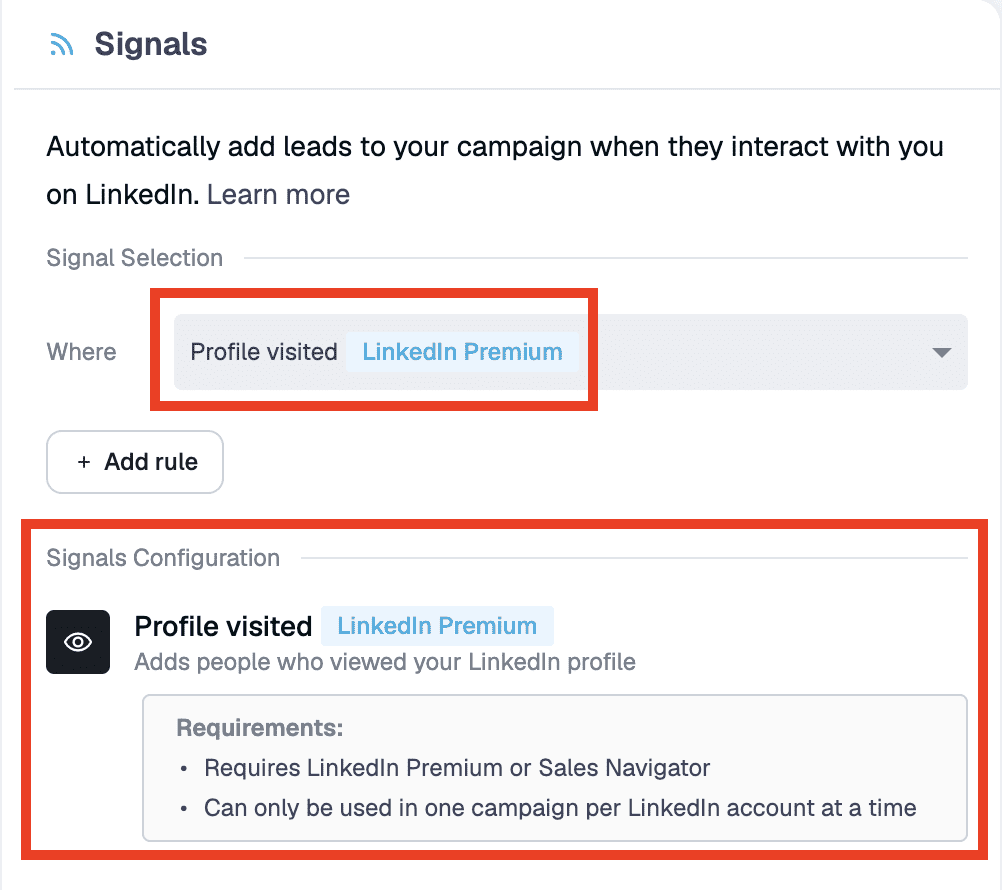
Expandi Signals can add profile visitors or post engagers to a campaign. A profile visit gives you a reason to start a conversation, though it doesn’t reveal what prompted the visit. An open question gives the person room to explain.
“Hey {first_name}, noticed you stopped by my profile this week. Was there something around [topic] you were looking into?”
Consideration: turn engagement into a real conversation
At the Consideration stage, outreach should supply useful context and give the buyer a simple way to continue.
The H2 2026 report found that campaigns with 3 messages reached a 9.8% reply rate, compared with 5.0% for campaigns containing 5 or more. Message #2 produces the strongest per-send result at 8.8%, so save your best follow-up for it.
Expandi benchmark: Three-message campaigns reached a 9.8% reply rate, compared with 5.0% for campaigns with 5 or more messages. Message #2 produced the strongest per-send result at 8.8%, so save your best follow-up for it.
A shorter follow-up sequence still depends on the right audience. Use these B2B prospecting methods to choose the segment before writing the messages.
The connection note is also becoming less likely to start the conversation. Replies to connection-note messages fell from 3.5% to 2.2% during the report’s 12-month window. Plan the more substantial message for after acceptance.
Copy quality remains important. Within the same accounts, human-written messages achieved an acceptance rate about 12% higher than AI-generated messages, and the 2 groups had similar reply rates. AI can draft the first version, but a salesperson should add context from the account before sending it.
In a Builder campaign, Smart Sequences can branch after a connection acceptance or engagement signal. A post commenter can receive a message tied to that topic, and a cold prospect can remain on the original path.
Morgan Edmondson, CEO at Nesti, linked familiarity to response:
“When prospects see your posts, they recognize you when you reach out.”
Evaluation: support the committee with specific proof
Evaluation outreach should answer the issue each stakeholder owns. Finance may need the assumptions behind the business case, whereas operations may care about implementation.
Use LinkedIn to establish the relationship and ask short, specific questions. Record the evidence each stakeholder requested in the CRM so another rep can understand what brought that person into the conversation.
Personalize the message around the live deal: the stakeholder’s role or the proof they asked to see. A first-name field adds no deal context.
McKinsey’s 2026 Global B2B Pulse discovered that buyers used an average of 10 channels during the purchasing journey. Keep the account history in the CRM so each conversation starts with the same facts, even when the buyer changes channel.
Decision: multi-thread without crowding the buyer
At the Decision stage, the CRM may show that the deal is close even though the buying group is still working through approval. Multi-threading, or building relationships with several B2B buying committee members, gives the sales team a clearer picture of the remaining concerns.
Do it with the champion’s knowledge. Connect the people who can answer one another’s questions, then give each relationship room. Several reps contacting the same company without coordination will feel like a pile-on.
Expandi’s Global Inbox brings active campaign conversations from multiple LinkedIn accounts into one view. A manager can see when several reps are speaking with the same account and coordinate the next response.
Stefan Smulders, founder of Expandi, described the CRM discipline behind the approach:
“They track conversations in their CRM, automate follow-ups…”
That shared record prevents repeated questions and keeps the deal from depending on one rep’s memory.
Expansion: keep the relationship through handoffs
At the Expansion stage, you’ll need to stay visible after signature and watch for a champion’s job change, which can alter renewal risk.
A former champion who moves to another company already understands the category and may become a prospect again. At the customer company, a new executive may reconsider the original purchase. Record either change in the CRM, so the next salesperson or account manager has the history.
The tech stack that connects your buyer journey to your pipeline
The CRM should hold the shared account history. LinkedIn outreach and buyer signals become useful to forecasting once the relevant activity reaches that record.
Expandi offers native CRM integrations for HubSpot and Pipedrive, with Salesforce available as well. Leads can be synced automatically when they reach the corresponding integration step in a Builder campaign, or sent manually from the inbox. Configure that step around the event your team uses to qualify a lead.
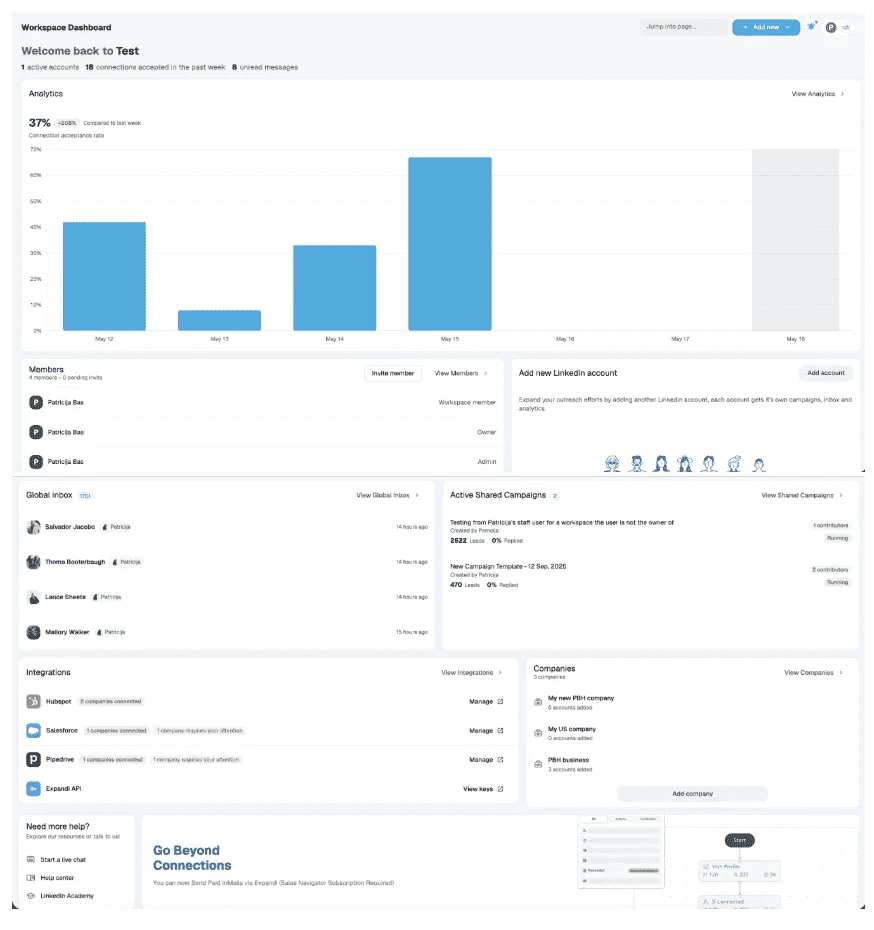
Workspaces keep multiple LinkedIn accounts under shared team access. Global Inbox shows active campaign threads in one view. Workspace Analytics filters performance by company or LinkedIn account, with further controls for campaign and time range.
Expandi MCP can review campaign data and draft a new campaign from a brief inside a compatible AI assistant. You still approve the copy and launch the campaign.
Joliene van Grieken at The Growth Syndicate sees the underlying data problem in client work:
“When we enter companies, a lot of things fundamentally are just not right. The ICP is not set up correctly, the data is not tracked correctly, and they focus on the wrong things.”
To address this potential problem, audit the CRM before adding more automation. If a contact has no campaign history, the salesperson has to guess what prompted the buyer to enter the pipeline.
One end-to-end workflow could look like this:
- A target prospect visits the founder’s profile after reading a post.
- Expandi Signals adds the visitor to a Builder campaign on its next sync.
- The sequence checks the ICP criteria before sending a contextual request.
- After acceptance, a short sequence continues until the prospect replies.
- The CRM integration sends the qualified contact and supported activity to the contact timeline.
- Once the prospect replies, an account executive (AE) takes over the conversation and identifies the other people involved in the purchase.
- At Decision, the team uses the CRM record and Global Inbox to keep threads visible.
- After close, the relationship history stays with the account.
Adapt the workflow to your team’s stage definitions. Each trigger should have a clear qualification rule and CRM outcome.
Metrics to track at each stage
Measure the evidence that belongs to the buyer stage. Acceptance and reply rates can diagnose top-of-pipeline outreach, but they can’t prove that an opportunity is ready to advance.
Track early and late evidence together
At the Awareness stage, watch relevant engagement from target accounts. Consideration adds qualified conversations. From Evaluation onward, watch buying-group coverage and stage movement.
Expandi’s H2 2026 platform baseline was 28.5% connection acceptance and 10.4% message reply. Those figures can help identify an outreach problem, provided you compare similar audiences and count each rate the same way. For the formulas and commercial measures that follow, use this guide to lead generation KPIs.
Set attribution before the deal closes
Decide which CRM event marks a sourced conversation and which one marks an influenced opportunity. Document the rule before reviewing wins, then apply it consistently.
Expandi’s pipeline attribution guide explains the full setup. Some attribution decisions will still require judgment, so write down the rule and apply it consistently. That gives the team a clear basis for reviewing the result.
Read the metric in its stage
A low acceptance rate may point to targeting or profile credibility. A long Decision stage points elsewhere, often to approval work or missing relationships in the buying group.
Workspaces can show connection and reply performance across accounts, with filters for campaign and time range. Compare those figures with CRM stage movement. If replies improve but qualified opportunities don’t, inspect the handoff and qualification criteria before increasing activity.
From journey map to repeatable pipeline
Map your CRM stages to the 5 buyer stages this week. For every sales pipeline stage, write down the buyer evidence required to enter it and the condition that moves a deal back.
Then choose one stage where LinkedIn can help. A signal-led Awareness campaign can start from profile visits. A short Consideration sequence can begin after the prospect accepts your request. At the Decision stage, the priority may simply be making every buying-group conversation visible to the team.
If you want to build that stage-matched workflow in Expandi, start a free 7-day trial. Keep the CRM as the record and let the buyer’s behavior guide the next step. Use automation only where the rule is clear.
Frequently asked questions about the B2B buyer journey
The 5 stages are Awareness, Consideration, Evaluation, Decision, and Expansion. They cover the path from recognizing a problem to comparing suppliers and securing approval. Expansion begins after the sale, when the customer decides whether to renew or increase its use of the product.
B2B purchases usually require company-wide agreement and create operational risk. Internal approval and a shared business case therefore carry more weight than in most consumer purchases.
It depends on what is being bought and when the clock starts. 6sense reported a 10.1-month average in its 2025 study of relatively large B2B purchases, whereas TrustRadius found that 87% of technology purchases in its 2024 buyer survey finished within 6 months; enterprise purchases took longer.
The number depends on how the research defines the group. Gartner’s 2025 guidance says a typical buying group contains 5 to 10 people. Forrester’s State of Business Buying 2026 report measures the wider network and found an average of 13 internal stakeholders plus 9 external influencers.
A common set of sales pipeline stages is prospecting, qualification, discovery, proposal, negotiation, closed won, onboarding, and renewal. Your CRM may use different labels. Before moving a deal forward, require evidence that the buyer has completed the work associated with the next stage.
A sales pipeline tracks individual opportunities and the next action on each one. A sales funnel groups prospects by stage and shows how many advance. Sales leaders use the pipeline to manage specific deals and the funnel to assess conversion across the full group.
Gartner describes the B2B buying journey as 6 “buying jobs” that buyers may revisit: problem identification, solution exploration, requirements building, supplier selection, validation, and consensus creation. Because the model is non-linear, a buying group can return to an earlier job when new information or another stakeholder enters the decision.


You’ve made it all the way down here, take the final step