How to Add a Portfolio to LinkedIn in 2026: 5 Methods That Work

Key Takeaways
- The Featured section is the highest-impact place to add a portfolio. Use it for links to external sites (Behance, Dribbble, GitHub), uploaded files (PDFs, images), or pinned posts that include video.
- Creator Mode was retired in early 2024. The features it gated (newsletters, follow-instead-of-connect, basic analytics) are now default for every profile.
- A LinkedIn Services page works as a dedicated portfolio surface for freelancers and consultants, surfacing in LinkedIn search filters that the Featured section does not.
- Once your profile is portfolio-ready, Expandi turns it into pipeline by sending signal-based LinkedIn outreach to the people most likely to act on it.
Recruiters, prospects, and hiring managers skim LinkedIn profiles in seconds. If yours reads like a resume, with job titles, bullet points, and no proof of work above the fold, the people deciding whether to message you have nothing to look at.
The fix: add a portfolio to LinkedIn. Proof of work distributed across 5 surfaces (Featured, Experience media, Projects, Services, Contact info), leading with visible outcomes, respecting LinkedIn’s file caps.
We pulled apart LinkedIn profiles of creators, service providers, agency owners, and sales leaders, and mapped how they distribute portfolio content across the five surfaces LinkedIn gives you.
This guide covers what each surface does, the best way to upload and optimize each tile, and what you need to know about LinkedIn’s portfolio features in 2026.
What is a LinkedIn portfolio?
A LinkedIn portfolio is the combination of media, links, and project entries spread across LinkedIn’s five portfolio surfaces (Featured tiles, Experience media, Projects, Services, and Contact info) that prove the work you say you do.
Each surface suits a different content type:
- Uploaded files
- External links
- Role-specific media
- Project entries
- Service offerings
It also has a different audience: recruiters, prospects, hiring managers, and peers. For broader profile optimization beyond portfolio surfaces, see our guide on improving your LinkedIn profile.
Now, let’s clarify how LinkedIn portfolio and a LinkedIn resume do different jobs.
LinkedIn portfolio vs LinkedIn resume
Your Experience section, About summary, and Skills list all behave like a resume; they’re words describing past roles. The Featured section, Projects entries, Services page, and media inside Experience entries all behave like a portfolio — these are artifacts that show the actual work.
Readers use both differently. They skim the resume sections to confirm relevance, then click portfolio items to verify quality.
The Ladders’ eye-tracking study clocked the average recruiter’s initial profile scan at 7.4 seconds. In this context, we can say that the resume sections absorb most of that budget, and portfolio sections are what earn a second look.
Where to add a portfolio on LinkedIn: 5 surfaces, ranked by impact
LinkedIn offers five surfaces for portfolio content: the Featured section (highest impact), Experience entry media, the Projects section, the Services page, and the Contact info website field. Each surface suits a different work type and audience.
For a wider view of what LinkedIn surfaces drive profile reach, see our breakdown of LinkedIn hacks.
These five surfaces differ in visibility, supported file types, and how easy they are for a recruiter or prospect to find. Use this section as the decision matrix.
- Featured section: Highest visibility. Sits near the top of every profile, between About and Activity. Accepts links, uploaded files, and pinned posts. Best for the 3-5 strongest pieces you want every visitor to see.
- Experience entry media: Medium visibility. Each role can hold its own media block, so you can attach work directly to the company it was for. Best for showing role-specific outputs that wouldn’t make sense out of context.
- Projects section: Medium visibility. A dedicated profile section for things you led or built. Each project can include collaborators, dates, descriptions, and one link. Best for project-based work where the team and timeline matter.
- Services page: Variable visibility, but high intent. Surfaces you in LinkedIn’s Service search filters and triggers a Provides Services badge. Best for freelancers, consultants, and agencies who want to be found by people specifically hiring for what you do.
- Contact info website field: Lowest visibility but lowest friction. A simple link to your portfolio site, visible only when someone clicks Contact info. Use it as a backup destination, since one of the four surfaces above should carry the primary load.
The first three are blog-and-portfolio surfaces. The Services page is for income work. The Contact info field is the safety net.
How to add a portfolio to your LinkedIn Featured section
The Featured section, living near the top of every LinkedIn profile, is the main place to upload a portfolio on LinkedIn. It accepts five input types:
- Pinned posts
- LinkedIn articles
- External links
- Image uploads
- Document upload
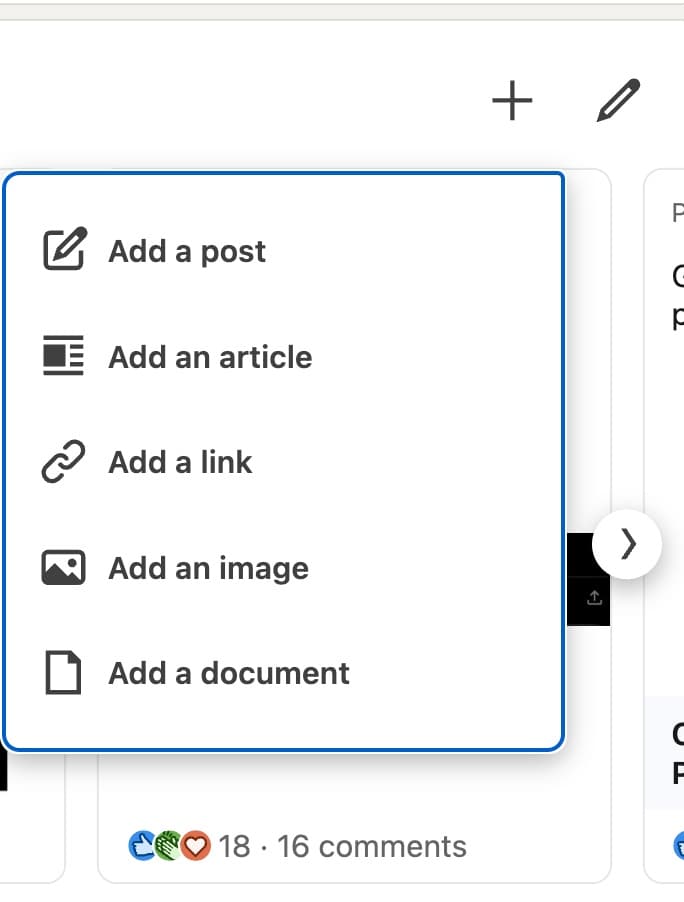
Setup runs through the plus icon (+) at the top right of the Featured section, or the pencil edit icon if Featured already has items. About a minute per item. Here’s where to click to add:

The Featured section is where portfolio work goes if you only set up one of LinkedIn’s five portfolio surfaces. The setup process is the same across all five input types; what changes is what you’re showing.
Open your LinkedIn profile, scroll to the Featured section, and click the plus icon (+) or, if Featured already has items, the pencil edit icon. The dropdown that appears gives you five options:
- Add a post.
- Add an article.
- Add a link.
- Add an image.
- Add a document.
Method 1: Pin a video, carousel, or thought leadership post
Use this when you want to feature a post you’ve already published, including video posts, image carousels, document carousels, or text-only thought leadership.
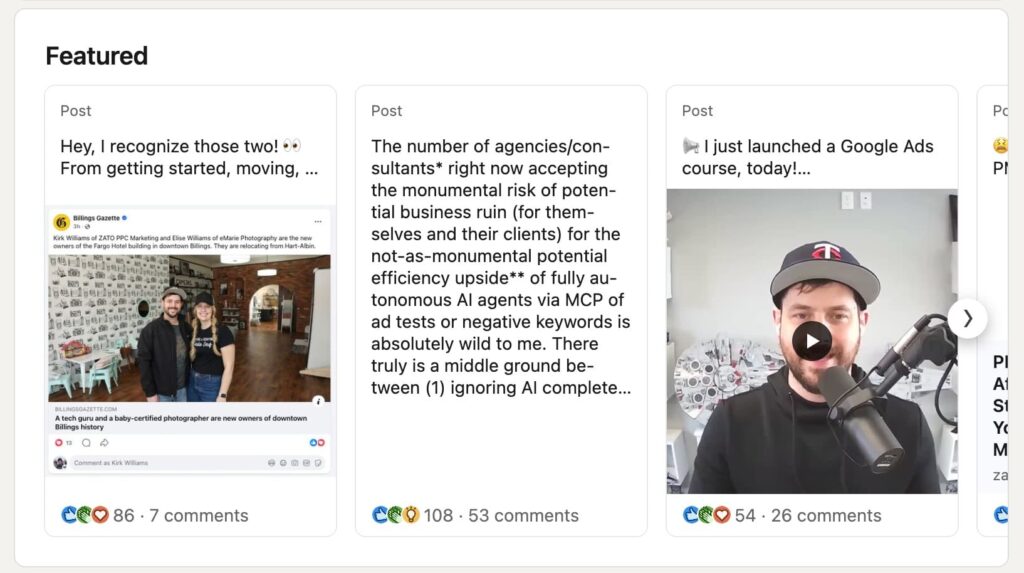
This is also the only way to put video into Featured: LinkedIn does not accept direct MP4 or MOV uploads in this section, so you publish the video as a post first and then feature the post.
To pin an existing post to your Featured section:
- If the post doesn’t exist yet, publish it normally on LinkedIn.
- Open your profile, scroll to Featured, and click the plus icon (+).
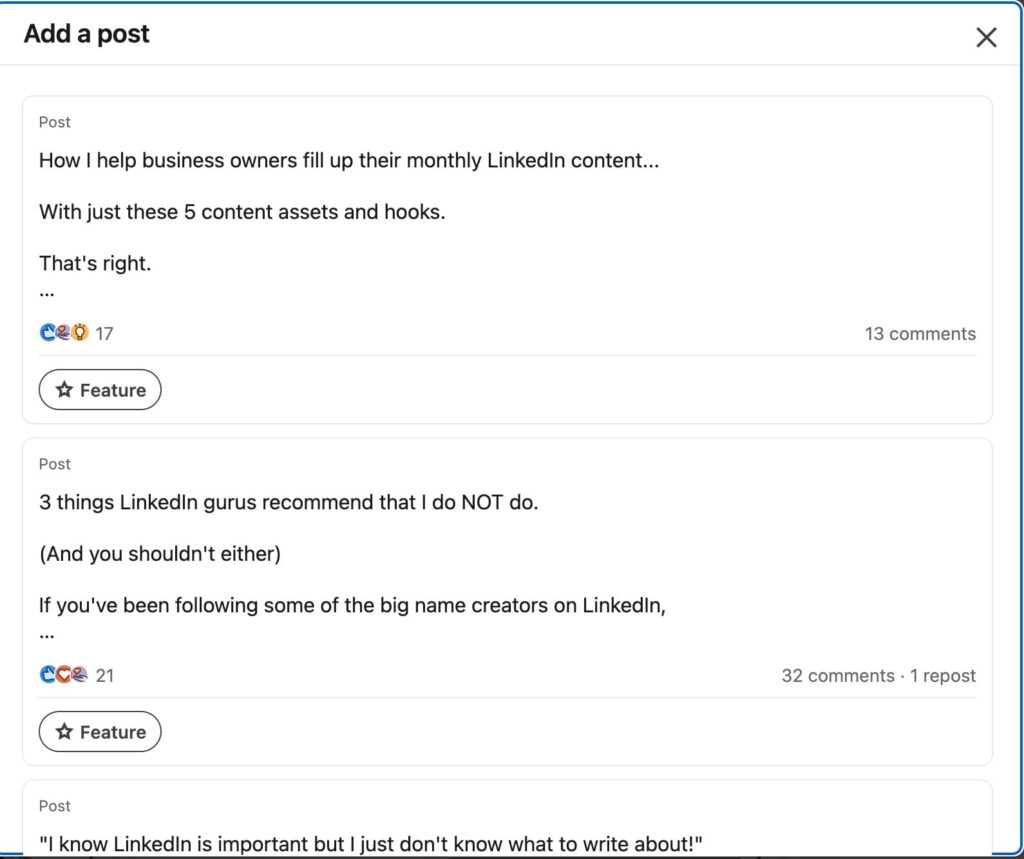
- Select Add a post from the dropdown.
- Pick the post from your recent-posts list, or paste its URL.
- Save.
The featured post appears as a tile with the original post’s media playable inline. Featuring a post and pinning a post are different actions: featuring puts it in the dedicated Featured section, while pinning leaves it on top of your activity feed.
Method 2: Feature a long-form LinkedIn article
Use this when you’ve published a LinkedIn-native article (the dedicated long-form publishing format, distinct from regular posts). Like Method 1, you can only feature articles you’ve already published.
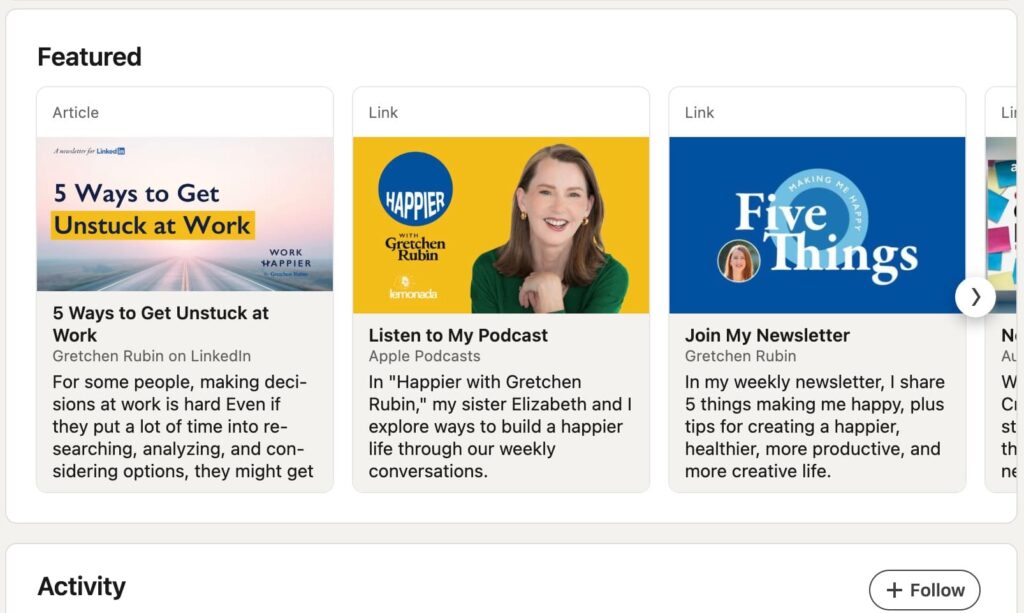
The Featured menu does not let you compose a new article inline.
To feature a published LinkedIn article:
- If the article isn’t published yet, write and publish it through LinkedIn’s article publishing flow (the Write article entry on your home feed or post composer).
- Open your profile, click the plus icon in the Featured section.
- Select Add an article from the dropdown.
- Pick the article from the list of articles you’ve published.
- Save.
Articles render with a larger card preview than regular posts inside Featured. Worth featuring if you have one or two strong long-form pieces; less critical if your content mainly lives in short-form posts.
Method 3: Link to Behance, GitHub, or your personal portfolio site
Use this to connect your LinkedIn profile to a portfolio website. Your portfolio might live on Behance, Dribbble, GitHub, Notion, Read.cv, or your own personal domain — all of these render clean previews inside the Featured tile.
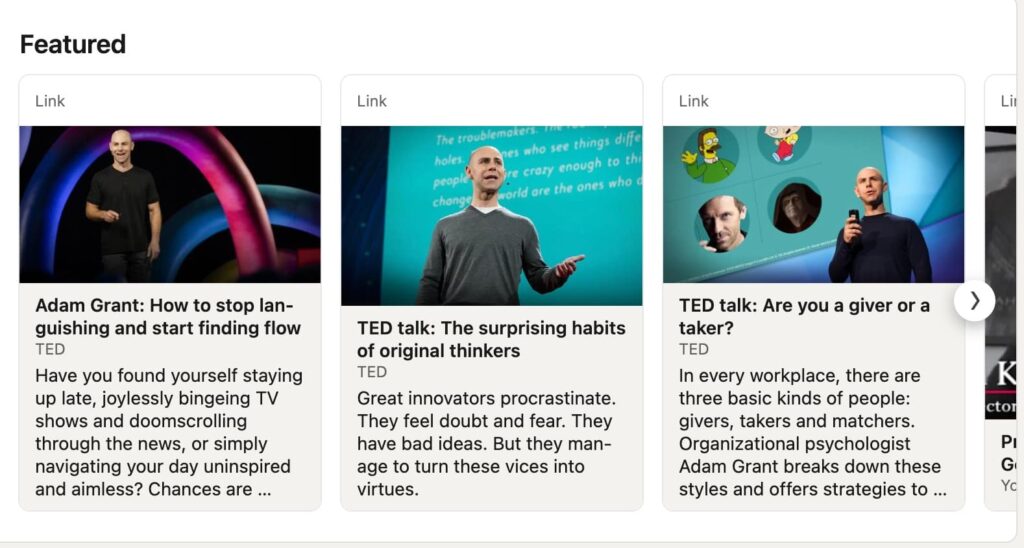
To add a portfolio link to your Featured section:
- Click the plus icon in the Featured section.
- Select Add a link.
- Paste the full URL of your portfolio page.
- LinkedIn fetches a preview thumbnail. If the preview looks generic, the destination site doesn’t include strong Open Graph image tags. Replace the auto-generated title with something specific, and add a short description so the tile reads as a portfolio entry rather than a generic webpage.
- Save.
Most portfolio platforms (Behance, Dribbble, GitHub, Notion) render clean previews because they include the right meta tags by default.
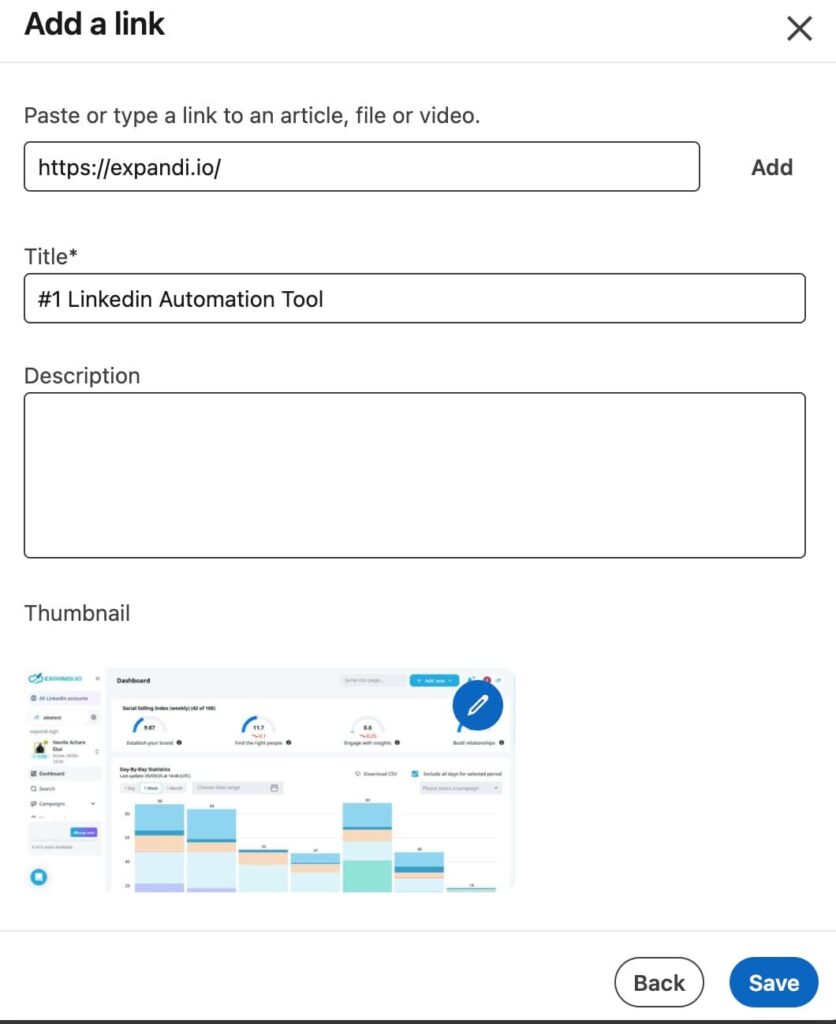
Older personal sites or certain CMS templates render flat defaults; if you control the destination, add Open Graph and Twitter Card meta tags so the preview is visual.
Method 4: Upload a case study screenshot or infographic
Use this when the portfolio piece is a single image: a case study screenshot, an infographic, a designed quote tile, a hero shot, or a metric dashboard screenshot.
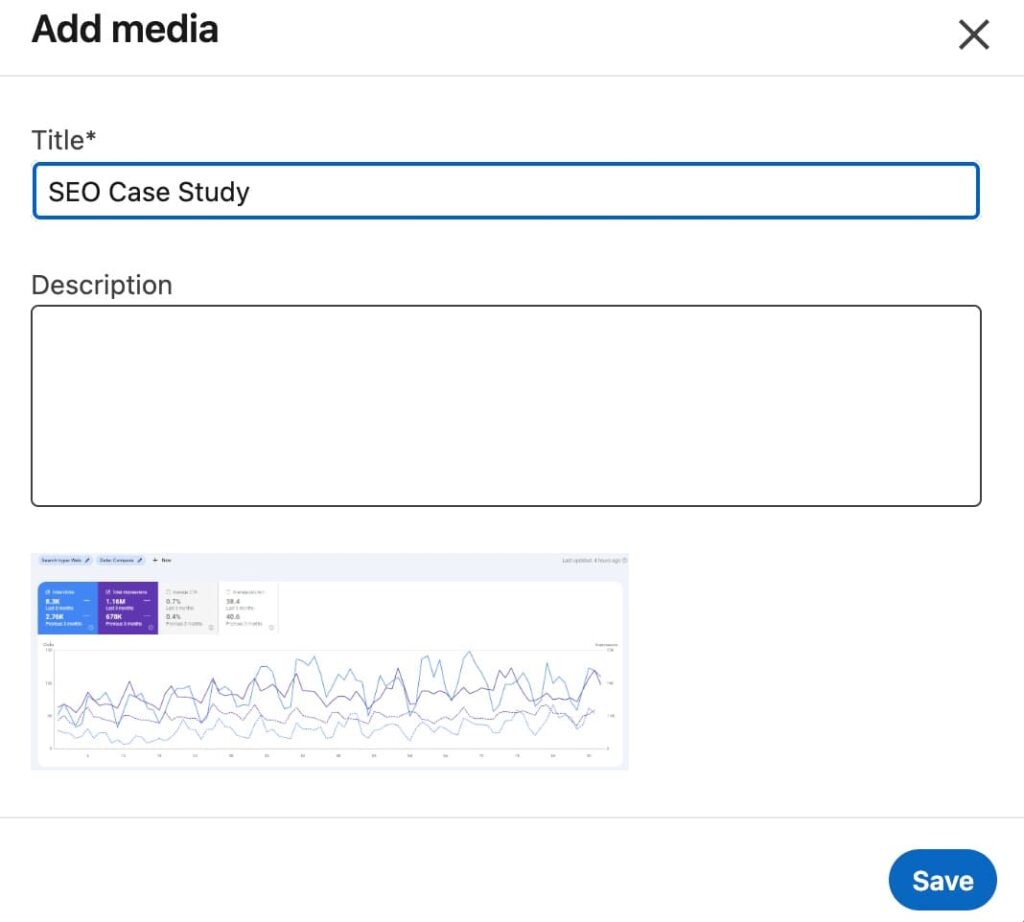
To upload an image to your Featured section:
- Click the plus icon in the Featured section.
- Select Add an image.
- Upload the image file.
- Add a title and a one-sentence description.
- Save.
Image specs LinkedIn enforces on profile uploads (per LinkedIn’s profile media spec):
- Maximum resolution: 120 megapixels.
- Maximum file size: 100 MB.
- Supported formats: .jpg, .jpeg, .png, .gif (note: GIFs do not animate in profile uploads, since LinkedIn extracts the first frame).
Method 5: Upload a PDF case study, deck, or portfolio book
Use this when the portfolio piece is a document: a PDF case study, a slide deck, a multi-page portfolio book, or a Word document with embedded work samples.
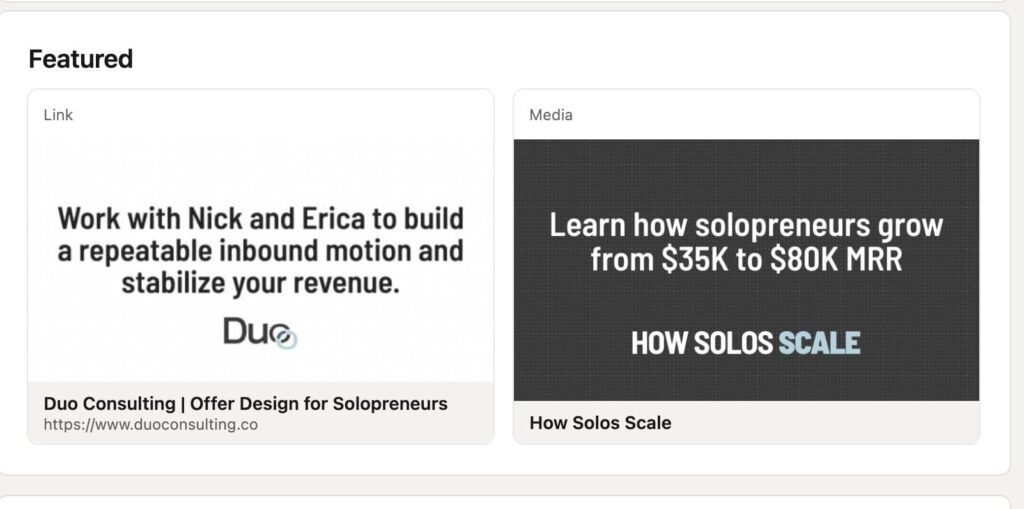
Documents render as a scrollable in-line preview right inside the Featured tile, so a viewer can flip through pages without leaving the profile.
To upload a document to your Featured section:
- Click the plus icon in the Featured section.
- Select Add a document.
- Upload the file.
- Add a title and a one-sentence description.
- Save.
Document specs LinkedIn enforces (per LinkedIn’s profile media spec):
- Maximum pages: 300.
- Maximum word count: 1 million.
- Maximum file size: 100 MB.
- Supported formats: .pdf, .ppt, .pptx, .doc, .docx.
- All pages in a PDF must be the same page size; mixed-size PDFs get rejected.
You can start with whichever format represents your strongest piece of work and build from there.
How to add portfolio media to a LinkedIn Experience entry
Each role in the LinkedIn Experience section has its own Media subsection inside the entry edit dialog, accepting the same file types and size caps as the Featured section.
Experience media is the right surface for portfolio work specifically tied to a job. The media block sits below the role description and gives prospects context about which company the work was for.
For richer copy patterns inside Experience entries, see our LinkedIn headline examples.
Example: if you ran a campaign that generated 4x the average pipeline at a specific company, the case study deck belongs inside that Experience entry rather than the Featured section. It gives context (you did this in this role) that a top-of-profile feature loses.
To add portfolio media to a LinkedIn Experience entry:
- Scroll to the Experience section in your LinkedIn profile.
- Click the pencil icon, then click the pencil icon again next to the role you want to add media to.
- Scroll to the Media subsection at the bottom of the edit dialog.
- Click Upload to add a file or Add link to add a URL.
- Add a title, description, and click save.
Same file type and size limits apply as the Featured section.
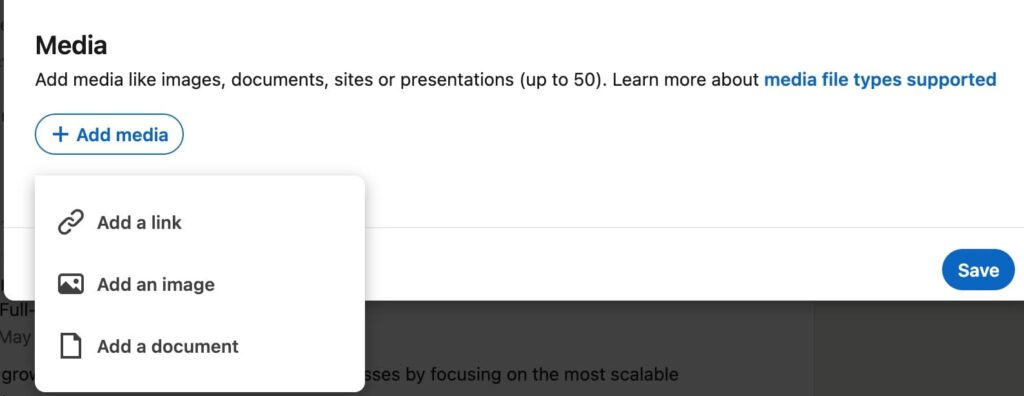
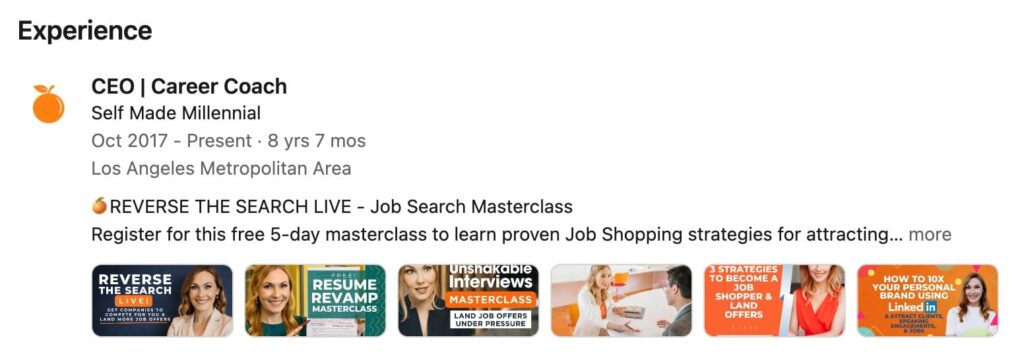
Media added to an Experience entry shows as a thumbnail strip below the role description and expands inline when clicked.
How to add a Projects section to your LinkedIn profile
The LinkedIn Projects section is a dedicated profile module for case studies, freelance engagements, side projects, and open-source contributions that don’t map to a single job title. Enable Projects through Add profile section > Additional > Projects.
Each project entry holds collaborators, dates, a description, and one project link. Entries stack in reverse chronological order and surface as a discrete profile section.
To add a Projects section to your LinkedIn profile:
- Click Add section in your LinkedIn profile.
- Choose Recommended, then Add projects.
- Click the plus icon to add your first project.
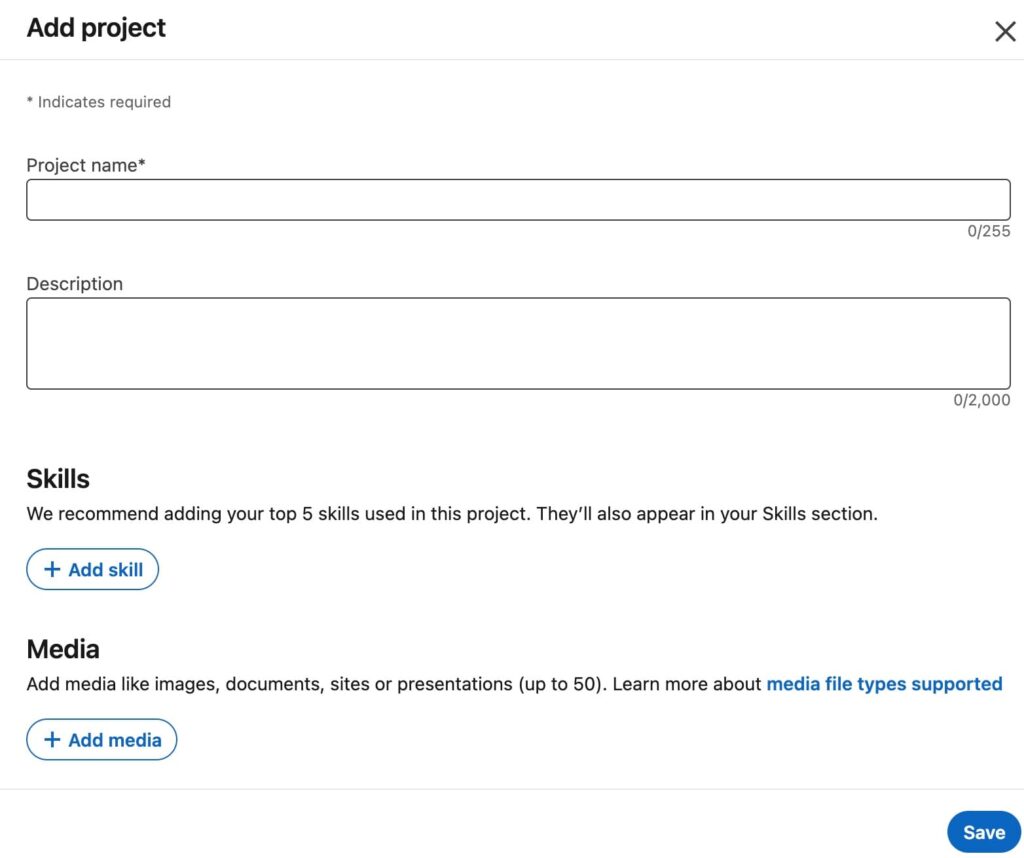
- Enter the project name, dates, a description, and a single project link.
- Tag any LinkedIn members who collaborated on the project and click Save.
The Projects description field gives you space to write a short narrative for each project: the problem, the approach, the outcome.
Most profiles either leave the description blank or stuff it with bullet fragments. A clean two-paragraph case study reads better and converts better.
How to set up a LinkedIn Services page
The LinkedIn Services page surfaces freelancers, consultants, and agencies in LinkedIn’s service-provider search filters and adds a Provides Services badge to the profile.
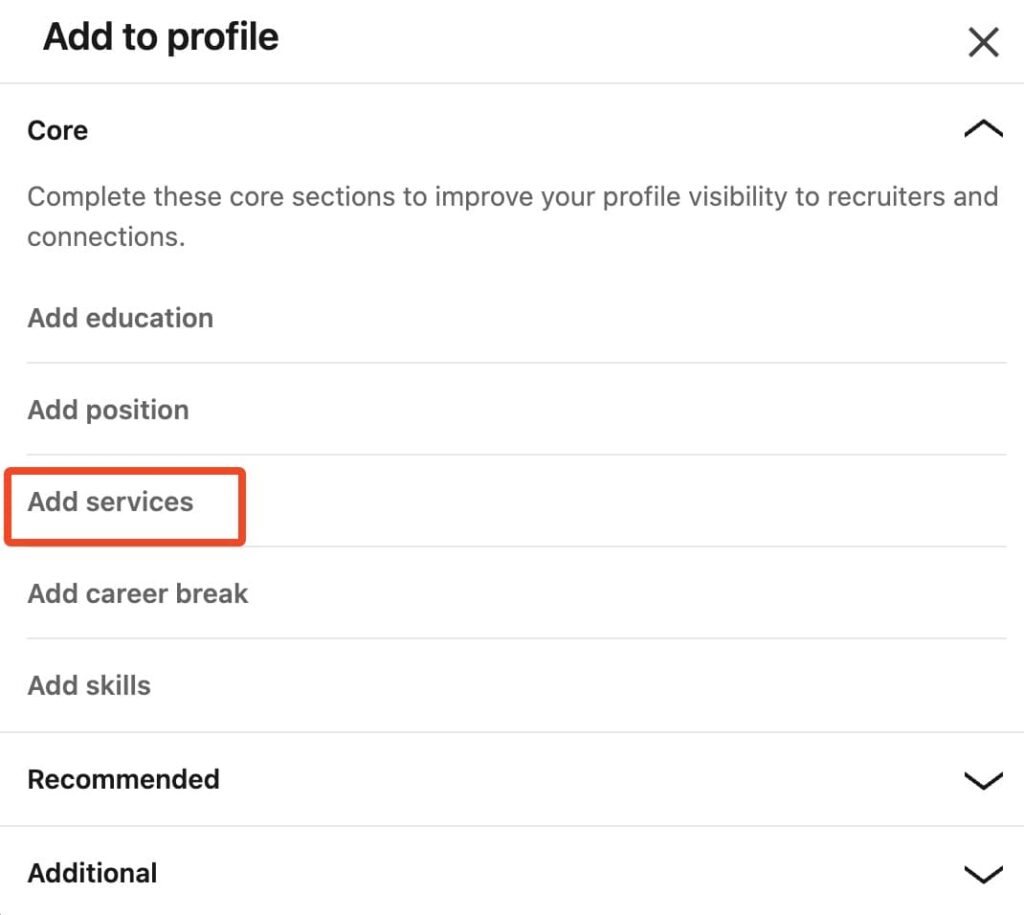
If you sell services (freelance, consulting, agency work), the Services page is the surface most worth setting up.
The page is underused in most portfolio guides, which is part of why it converts: prospects searching for service providers find a much shorter list of candidates than the typical LinkedIn search returns.
To set up a LinkedIn Services page:
- Click your Me icon at the top of LinkedIn, then View Profile.
- Click Add profile section below your profile picture.
- Click Add services. Review the How it works overview and click Continue.
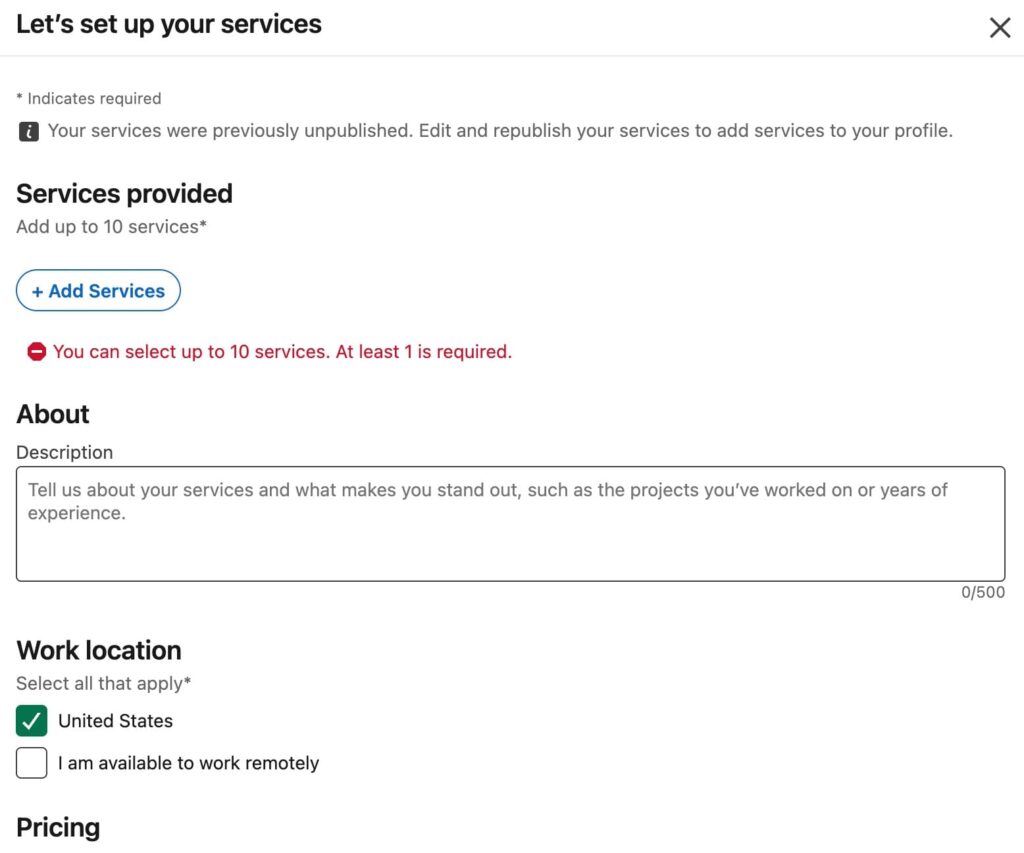
- Pick the services you offer from LinkedIn’s predefined list (Consulting, Web Design, Copywriting, etc.).
- Write an About description for your services. Set your work location and check the remote-work box if applicable.
Once published, your Services page appears as a dedicated section on your profile and you become discoverable in LinkedIn’s Service Pages filters.
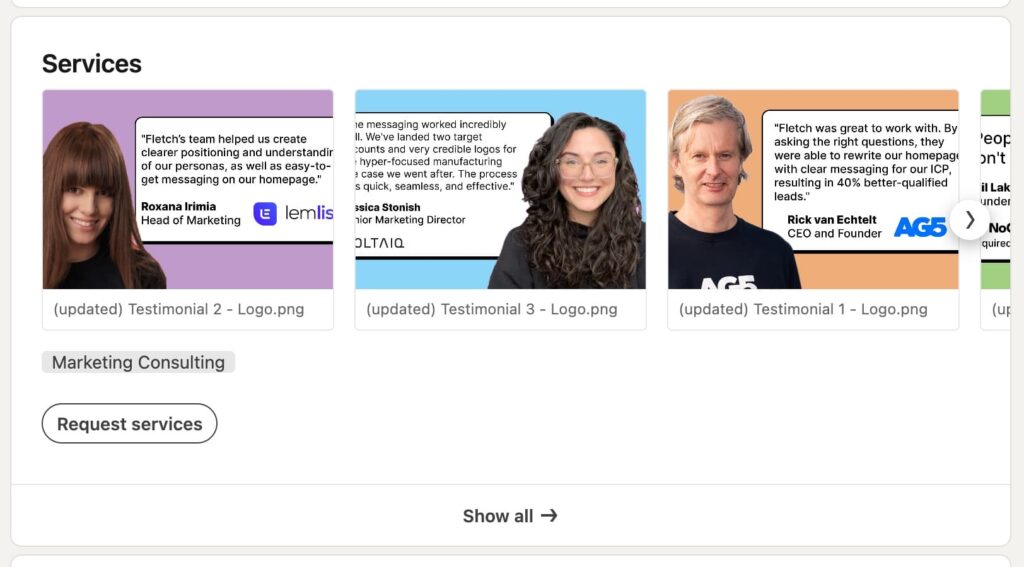
A Premium Business, Sales Navigator, or Recruiter Lite subscription unlocks the Services Showcase carousel, media uploads (documents, photos, videos, websites), ratings, recent reviews, and a prominent Request services button at the top of your profile.
Without one of those LinkedIn account types, the Services section still publishes; it just shows a preview of your service description rather than the full carousel.
Services and Featured do different jobs:
- Services puts you in front of search-intent prospects.
- Featured controls what every profile visitor sees first.
Set up both if possible — Services brings prospects to your profile; Featured gives them a reason to stay.
How to add your portfolio link to LinkedIn Contact info
Contact info is the lowest-friction surface in your portfolio. It’s a website slot on your profile that links wherever you want: your portfolio site, Behance, a Notion case study collection.
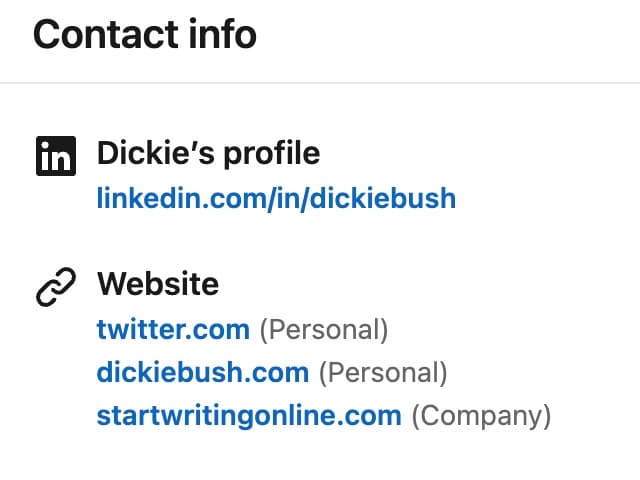
Visible only when someone clicks Contact info, so it works as a backup destination rather than the headline.
To add a portfolio link to your Contact info:
- Click your Me icon at the top of LinkedIn, then View Profile.
- Click Contact info in your introduction section.
- In the Contact Info pop-up, click the Edit icon (pencil).
- Click Add website. Paste your portfolio URL into the Website URL field and pick a Website type from the dropdown.
- Click Save.
LinkedIn lets you add up to 3 website slots. Use them deliberately:
- One for your primary portfolio.
- One for a case study collection or company site.
- One for a lead magnet or scheduling link.
Bonus: The Custom button (Premium only)
If you have Premium Business, Sales Navigator, or Recruiter Lite, LinkedIn adds a clickable Custom button at the top of your profile.
The button text is editable (Visit Website, Book a Call, See Portfolio) and the link goes wherever you point it.
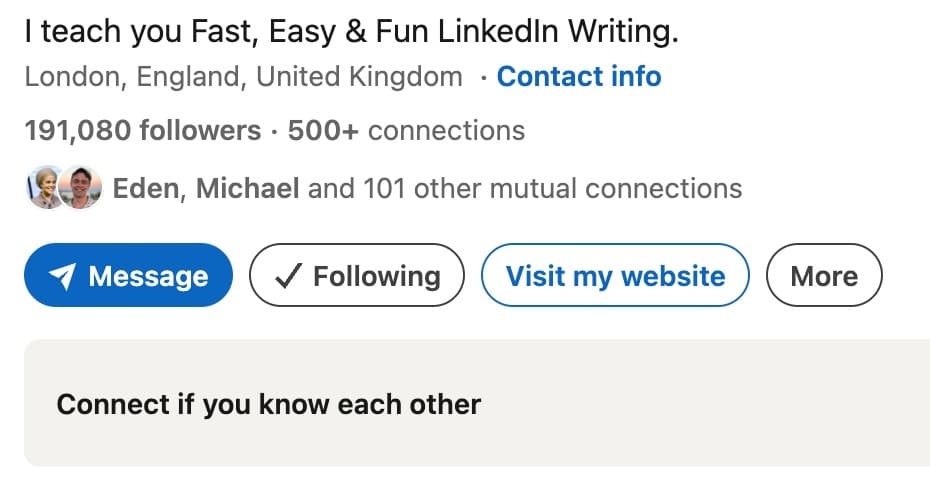
This is visible in profile previews, search results, and your messages, so people don’t have to click into Contact info to find it.
If you have Premium and you’re going to set up only one portfolio link, this is the single highest-visibility slot LinkedIn gives you. Free users skip this and rely on Contact info plus Featured tiles.
What to put on your LinkedIn portfolio: 4 content types that earn views
Four content types do the heaviest lifting on a LinkedIn portfolio: rich visuals and case study screenshots, lead magnets and downloadables, evergreen and viral posts, and testimonials with social proof.
Adding any one of these to a Featured tile beats a generic portfolio link. Using all four types signals breadth that any single category misses.
Rich visuals and case study screenshots
Tile thumbnails are small. A wall of text-only PDFs blends into the feed — most visitors won’t click to find out what’s inside. A designed cover image or a dashboard screenshot tells them what the work is before they’ve made any decision.
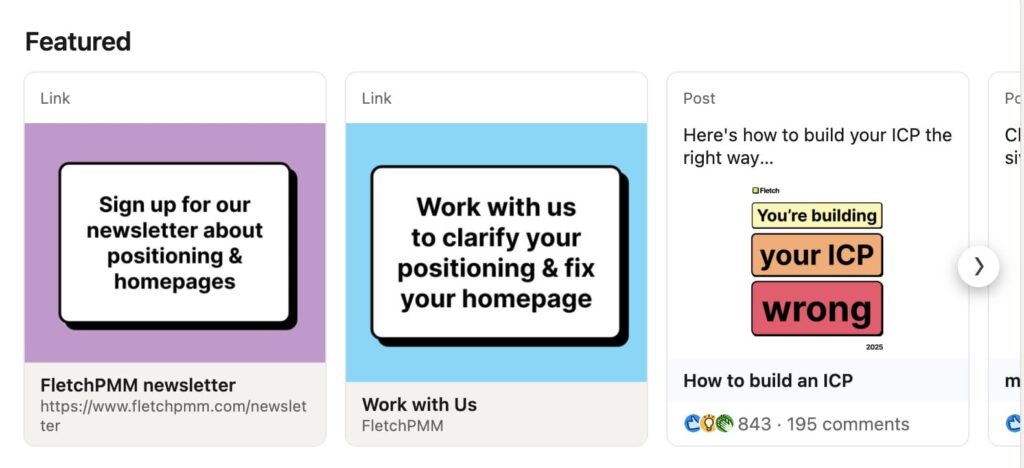
For designers, the rule is obvious: include hero images, mockups, before/afters. For non-designers, the same rule applies in disguise:
- Sales leaders should screenshot a dashboard showing pipeline impact
- Marketers should include the ad or landing page that drove the result
- Founders should screenshot the product or the metric
A description alone reads like the resume part of the profile.
A 90-second test: open your Featured section thumbnails on a phone. If you can’t tell what the work is from the thumbnail alone, the visual layer is doing nothing.
Lead magnets and downloadables
If you produce gated content (templates, frameworks, checklists, white papers), feature one of them.
A featured downloadable does double duty: it proves you ship useful content, and it captures the email of every profile visitor curious enough to download.
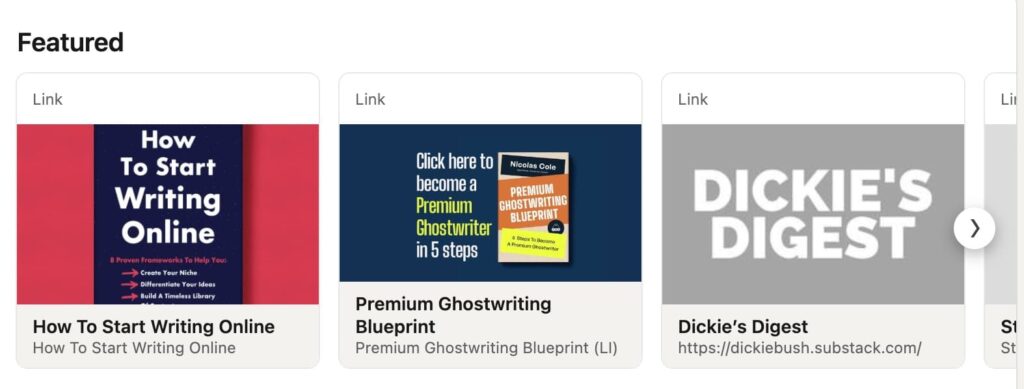
Use a Featured upload for the asset itself or a Featured link to a landing page. Landing page links pass the lead through your tracking; direct uploads pull a wider audience but skip the email capture step. Pick based on what you optimize for.
Evergreen and viral posts
Pin the LinkedIn post that pulled the most engagement, then add the post that explains your point of view best.
The first earns curiosity (people want to see what worked); the second earns trust (it shows how you think). For a deeper view of what drives engagement on the platform right now, see our guide on LinkedIn impressions.
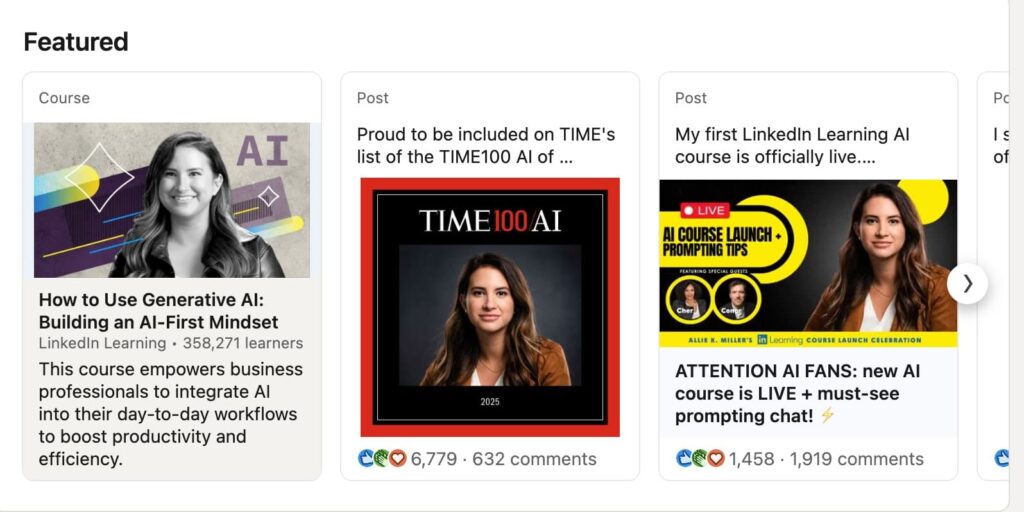
Featuring posts also keeps your top-of-profile fresh without manual updates. A post that’s still pulling comments six months later signals that you say things people care about.
Testimonials and social proof
The fourth tile should be social proof. The most visible options:
- A LinkedIn recommendation, screenshotted and posted as an image to Featured.
- A short customer quote with the customer’s photo, formatted as a designed tile.
- A case study one-pager (PDF) with the outcome in the title.
- A screenshot of a positive G2, Capterra, or TrustRadius review.
- A pinned LinkedIn post that captured public customer praise (comments and reshares included).
Featured testimonials work because they’re the first thing prospects look for and the last thing job applicants think to add. Adding even one puts you ahead of most profiles in your category.
Common LinkedIn portfolio mistakes that kill clicks
Most portfolios fail because of presentation. Five mistakes show up over and over when adding portfolios on LinkedIn:
- Outdated work that doesn’t match what you do now: Replace the oldest tile every quarter; recency signals momentum.
- Vague titles and descriptions with no outcome: “Marketing Project” tells the visitor nothing. “Q3 ABM campaign, 47% reply rate, $250k pipeline” tells them everything. Lead with the outcome.
- Generic thumbnails that blend into the feed: Wall-of-text PDFs are unreadable on mobile. Use a designed cover (Canva, Figma) as the PDF’s first page, or upload a hero image.
- Broken links or dead-end destinations: A 404 or permission-locked Google Doc kills credibility instantly. Audit your portfolio links once a quarter.
- More than 5 tiles in Featured: Visitors look at the first 3 on desktop, fewer on mobile; past 5, dilution kills the signal. Distribute extra work across Experience media and Projects.
None of these take more than 20 minutes to fix, but most profiles never bother to do it.
What you need to know about LinkedIn Creator Mode in 2026
LinkedIn retired Creator Mode in early 2024. Profile hashtags were removed in February 2024 and the Creator Mode on/off toggle was removed in March 2024.
The features Creator Mode used to gate (newsletters, follow-instead-of-connect on your profile, basic creator analytics, profile hashtags) are now either default for everyone or were removed entirely:
- Follow button as the primary CTA on your profile is now an option for any account.
- Newsletter publishing is available to all members in good standing.
- Basic content analytics (post views, follower growth) appear in everyone’s analytics dashboard.
- Profile hashtags (the “Topics I post about” tags Creator Mode added below your headline) were removed entirely.
For a portfolio, the practical implication is that nothing you used to need Creator Mode for is locked away.
The Featured section, Services page, and Experience media all work the same on every account.
How to turn your portfolio into LinkedIn pipeline
A polished portfolio doesn’t get seen if you’re not posting LinkedIn content or doing social outreach. Inbound shows up for accounts already running both, and for everyone else, the profile sits idle.
Expandi runs the outreach for you with automated connection requests, follow-ups, and profile-view campaigns aimed at the people you want to reach. More on the underlying logic in our breakdown of signal-based outreach.
Expandi helps two ways:
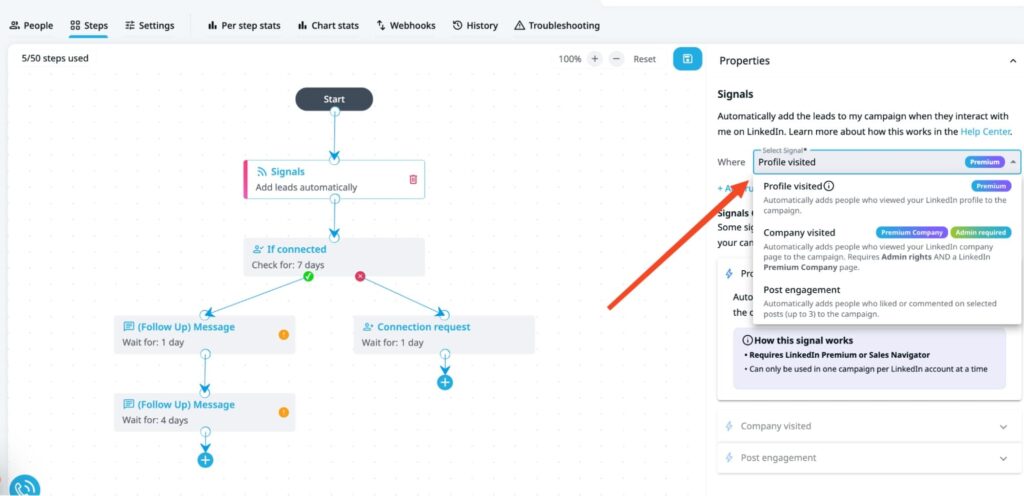
- Outreach triggered by signals
When someone views your profile, likes one of your posts, comments on something you wrote, joins a group you target, or starts following an account on your radar, Expandi can send them a connection request and a follow-up.
The message lands while you’re still top-of-mind.
- Network growth through reciprocal views
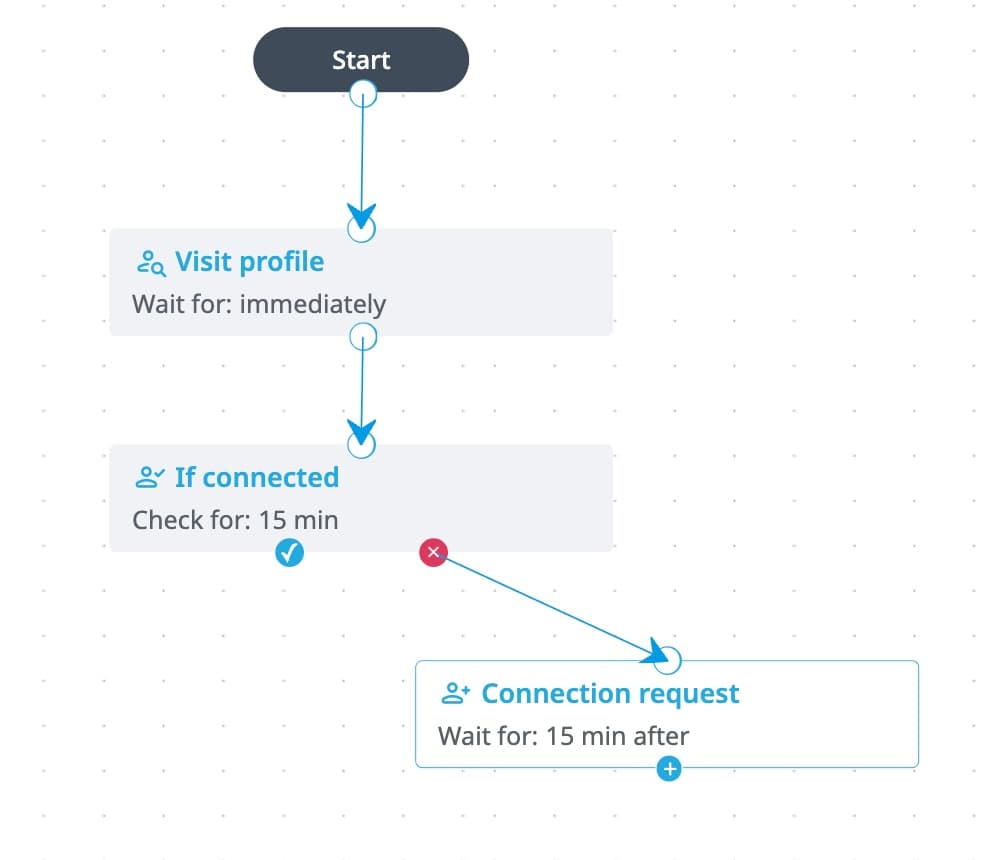
Expandi visits thousands of target profiles on your behalf. LinkedIn notifies the people you’ve viewed, a chunk of them click back to see who you are, and they land on the polished profile you spent an hour building.
No connection request needed; your profile does the talking.
Make your LinkedIn portfolio earn its keep
Adding a portfolio to LinkedIn is a one-hour job. The Featured section, Experience media, Projects, Services page, and Contact info field cover every type of work, and the file specs are simple once you know them.
The harder work is what comes after: putting the polished profile in front of the people who can hire you, refer you, or buy from you.
That’s where automated LinkedIn outreach pays off. A portfolio gives prospects a reason to take the meeting. Using a LinkedIn automation tool to run signal-based campaigns make sure those prospects see the portfolio in the first place.
See how Expandi automates signal-based LinkedIn outreach. Start your 7-day free trial.
Frequently Asked Questions
Mostly yes, but with one limit. The Featured section accepts post-pinning, link tiles, and image uploads from the LinkedIn mobile app. Document uploads (PDFs, decks, Word files) are easiest from a desktop. If you’re publishing a PDF case study, do it from desktop and the mobile app will display it correctly after.
An empty Featured section stays hidden until you add the first item. To enable it, click Add profile section, choose Recommended, then Add featured. Once your first item is added, Featured stays visible by default and sits between your About section and Activity, near the top of your profile.
Featured. The About section can hold clickable URLs, but they render as plain text inside the paragraph, which buries them. Featured renders portfolio items as visual tiles near the top of your profile, with thumbnail previews and a click-through link. About is for the narrative; Featured is for the proof. If you only set up one, set up Featured.
Yes. Open your profile, scroll to Featured, and click the pencil edit icon at the top right of the section. From there you can edit the title and description of any item, reorder items (you need at least two featured to reorder), remove items from Featured without deleting the underlying post or file, or delete items entirely. Removed items can’t be restored, but the original post or file stays in your account.
Yes, by default. The Featured section is part of the public-facing profile and shows to anyone who views your profile, including 2nd-degree, 3rd-degree, and out-of-network viewers. The exception is if you’ve manually limited public profile visibility in your settings. To check what non-connections see, open your profile in an incognito window logged out of LinkedIn — that’s your public view.
Partially. LinkedIn’s free analytics show profile views, post impressions, and follower changes. They don’t break out item-level view counts inside Featured. To see who clicked through to a featured link or downloaded a featured document, add UTM parameters to the link or route through a landing page with its own analytics (Google Analytics, Plausible). LinkedIn Premium adds the names, titles, and companies of recent profile viewers; the free tier shows the same data only in aggregate.

You’ve made it all the way down here, take the final step