How Nick Tomic Sold a Napkin Sketch For $100 And Built It Into a Bootstrapped SaaS Company
SaaS GrowthYou don’t need a product to get paying customers. You need a problem worth solving and the nerve to ask someone to pay for the solution before it exists.

Three people paid Nick Tomic $100 before he had a product, an MVP, or even a single line of code. All he had was a three-page Google Slides deck and a list of 30 people he’d found by scraping AppSumo.
Nick is the founder of Face2Face.io: a tool that lets SaaS companies have live video conversations with users directly inside their product. Ten months in, he has 60 paying customers, a pricing model that’s evolved from $100 lifetime to $10,000 a year, and a LinkedIn content engine that turns case studies into demo bookings. All this started with a napkin.

Before we even had a product, I started doing something which I call selling the napkin. We outreached about 30 people, got 10 meetings pretty much the same day. And out of the 10 meetings, three people paid me a hundred dollars to have lifetime access to this idea, which I basically showed them on this napkin.
He found his leads by scraping AppSumo and then tracking down their LinkedIn profiles and messaging them manually.
The $100 was not the point here, he says. “That was the very first validation I needed to say, okay, I’m not crazy. I’m not an idiot. There’s someone who just transferred me a hundred bucks to access this idea I have. Cool. Let’s continue.”
The 5-step napkin playbook – exactly how he did it
The whole process took three days and cost nothing. Thirty outreach messages, ten meetings, three paying customers. Here is how each step worked.
Step 1 – Sketch it on three slides, not thirty
“I drew the idea on a three-page slide, Google Slides.” Not a wireframe. Not a Figma prototype. Three slides. If you can’t explain it in three pages, you don’t understand it well enough to sell it.
Step 2 – Find your buyers where they already spend money
Nick scraped AppSumo: a marketplace where his target users were already buying SaaS tools. Then he found their LinkedIn profiles. He did not use Sales Navigator or fancy sales tools. He went where his target audience already was.
Step 3 – Message them manually. Skip automation at first
“I messaged them manually. I didn’t know about Expandi back then.” Thirty personal messages. The 33% meeting rate came from the human touch. He would later discover how to do this at scale, more on that below.
Step 4 – Book calls and show the idea live
Ten meetings in essentially the same day. No waiting for a polished demo. Just a conversation and three slides.
Step 5 – Ask for money. Right now
$100 for lifetime access. Not “would you hypothetically pay?” but “transfer me a hundred bucks.” Three people did it immediately.
95% of SaaS products fail, and Nick interviewed 350 founders to find out why
Before Face2Face, Nick spent three years running ProductMarketFit.io, interviewing over 350 SaaS founders on what separates the companies that make it from the ones that don’t.
His conclusion was simple and uncomfortable: most founders build before they talk. The fix, in his words, is getting super high quality insights from the market — talking to the people whose problems you want to solve, not building in isolation and hoping they show up.
That research led directly to the product. The question that kept coming up across those 350 conversations: what if you could show up exactly when the customer was stuck — not in a follow-up email, not in a scheduled call, but in the moment they’re sitting inside your product, confused about pricing, unsure whether to upgrade?
Going from $100 lifetime to $10,000 a year
The napkin got him three customers at $100 lifetime. Then he built the MVP and shifted to a new model.
Instead of selling it for a hundred bucks lifetime, I started selling it for $365 per year. Which is a dollar a day, which sounds really cheap when you tell someone it’s a dollar a day. And we sold that 60 times. Currently we’re shifting away from the dollar a day model. Right now we’re pricing people based on the value they’re going to get. So we’re looking at $1,000 a year, $5,000 a year, $10,000 a year.
The confidence to raise prices 100x came from repetitions. “We’re not getting that many objections because I know what I’m selling now. I’ve sold it 60 times. We’ve perfected sort of the formula.”
The reframe worked because it maps the cost to something the buyer already does without thinking.
The $62K ARR case study: what “showing up in the moment” actually means
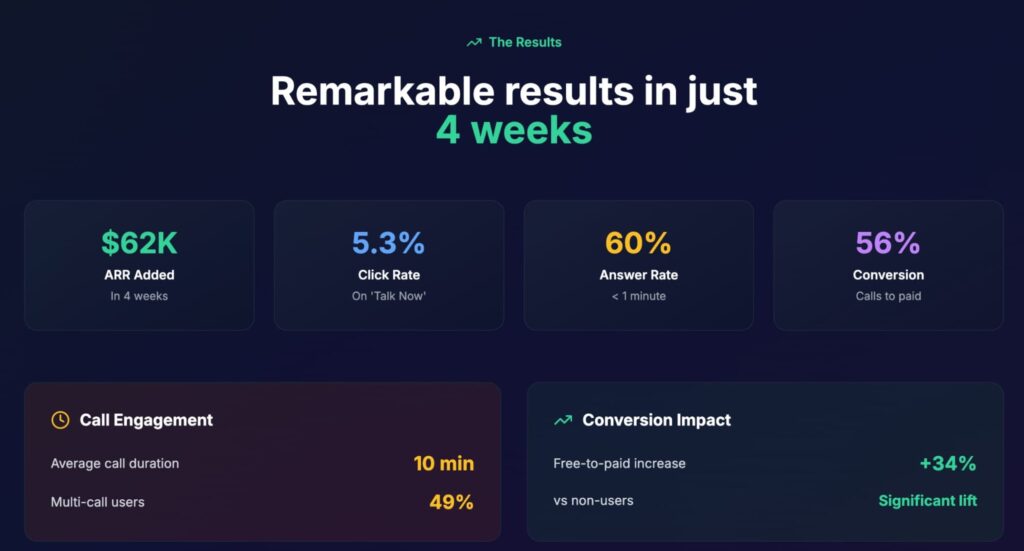
A B2B SaaS company used Face2Face for live video consultations with high-value trial users on their enterprise tier. In four weeks, they added $62K ARR by closing five to ten enterprise deals that had been stalling in the trial phase. The pattern was identical to the napkin: show up at the moment the customer has the question, speak to them directly, remove the friction blocking the conversion
“When you have that beautiful formula of understanding who your customer is, what their problem is, how you can solve it with your tool and what’s required for that to work, I think the sale just becomes almost automatic.”
How Nick uses LinkedIn to turn case studies into demos
The growth strategy follows the same principle as the napkin. Post a case study. Let it gather engagement. Use that engagement as the entry point for a conversation.
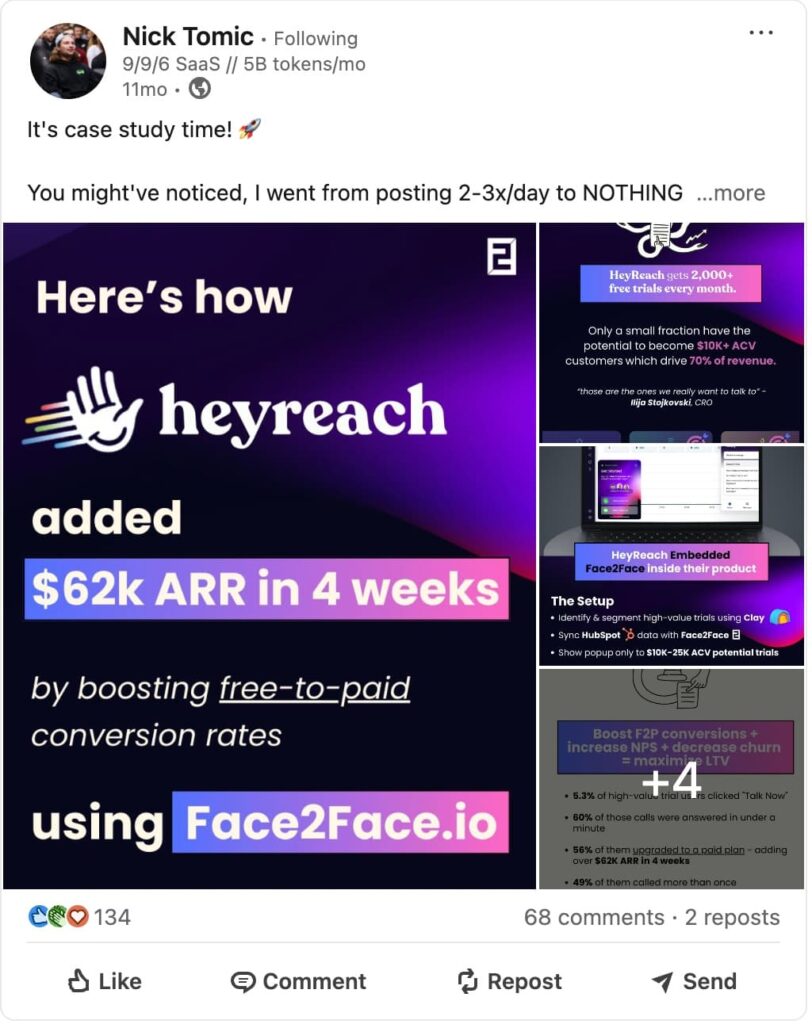
I had a post on LinkedIn which did really well, one of my case studies. That post got 50 comments. And what I did is I used Expandi. I put an automation so that it would go through the whole list of everybody that liked and commented that post. Then I added them on LinkedIn with a message saying, hey, I saw you engage with my case study, I was wondering if you wanted to learn more. And so I booked a couple of demos from that.
The trophy loop – a repeatable content-to-pipeline flywheel
The mechanic is simple but most founders miss it. Every time you close a customer and get a result worth posting about, that post becomes your next top-of-funnel. People who engage with it — likes, comments, shares — are self-selecting as interested in exactly what you just solved. They are warmer than any cold list you could buy.
Nick’s version: post the case study, let it gather engagement, then reach out to everyone who interacted with a single message: “I saw you engage with my case study, I was wondering if you wanted to learn more.” He booked demos. Not because the outreach was clever, but because the audience had already raised their hand.
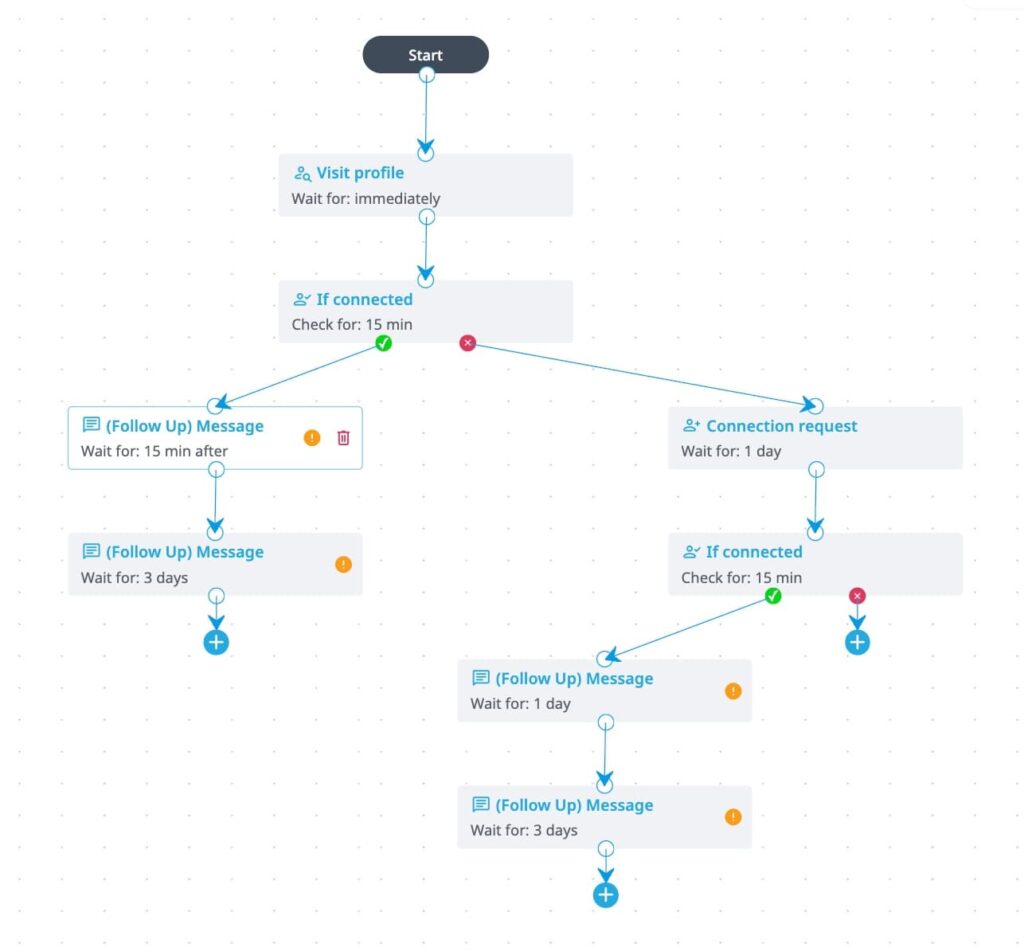
Each closed customer funds the next cycle. The result is a flywheel where winning creates the conditions for more winning.
“As you keep posting more content, as you keep winning, you can now use those posts, which are your trophies, and ask people: hey, how about my next trophy is about us.”
It is the napkin method at scale. The only thing that changed is the volume.
What’s still missing and what Nick would tell his 10-months-ago self
Nick is honest about where he still is. “The main one may be the case studies. If I had more case studies, if I knew in which conditions the product would thrive for who, then I think selling would be a lot easier because I would know what I’m selling and to who.”
Ten months in, 60 customers, pricing evolving, team unpaid for months, girlfriend covering rent, developer without a phone, and he is still running. He calls it enjoying the brokenness — the pressure is what creates the diamonds, and you have to be willing to put yourself through it.
“I aim to encourage the right ones and basically put a warning sign in front of everybody else.”
Nick drew three slides, messaged 30 people, and let the market tell him if he was crazy. It told him he wasn’t.
If you want to speak to GTM leaders like Nick directly, join the GTM Society where founders share their proven playbooks and processes.
Join the GTM Society. The room where GTM actually gets built. Founders, SDRs, and operators. No noise. Just systems.