How Peep Laja Turned His Own Blind Spot Into Wynter — And Hit $2M ARR in Two Years
SaaS GrowthThe most valuable founder insight is often an honest admission that you do not know something. If you build from that, the answer becomes the product.
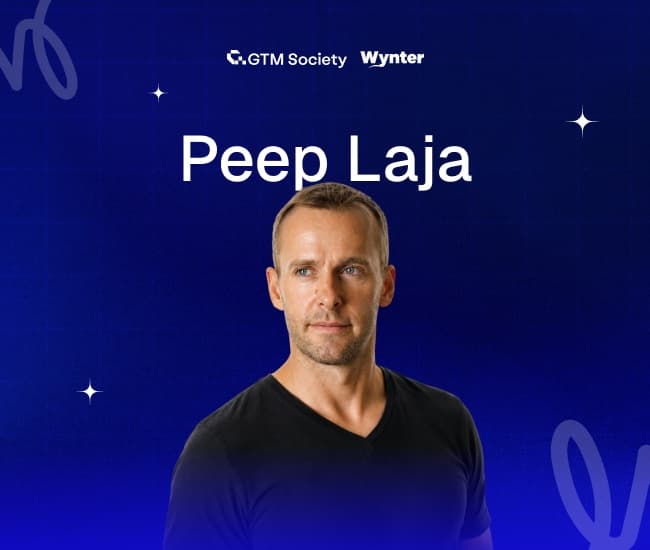
It is 2019. Peep Laja is writing sales copy for a new CXL course. He has a decade of conversion rate optimisation behind him, 100+ landing pages already live, and a business most people in the industry look up to. He also has a gnawing problem. He has no way to know if the copy he is writing is any good.
He goes looking for a tool. He finds nothing. He asks the smartest operators he knows. Nobody has a solution and everybody has the same problem.

I started to look for a tool to help me. I asked everyone. Nobody knew about such a tool, but I did learn that almost everyone had the same issue.
That line is where Wynter starts. A founder couldn’t answer his own question and decided to build the answer, not from competitive maps or market analysis.
The backstory — one of the most respected bootstrappers in B2B
To understand why this moment mattered, it helps to know who was asking the question. Peep grew up in Estonia, moved to the US, and built three bootstrapped companies to seven figures: CXL (conversion rate optimisation education, 100+ courses), Speero (a CRO agency serving enterprise clients), and Wynter.
He also has a large LinkedIn following — in his words: ‘Don’t know by heart. Maybe 75,000, something like this.’ (81,000+ as of writing).
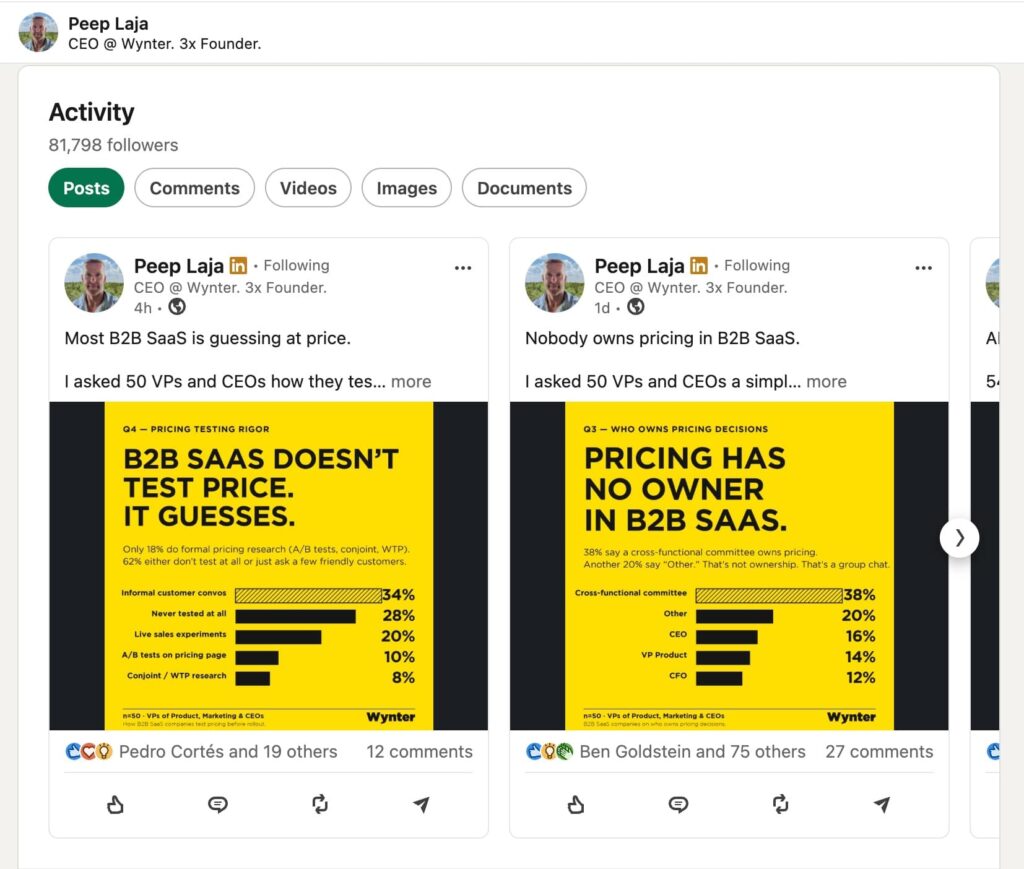
He runs the “How to Win” podcast on competitive strategy, Spryng by Wynter (a boutique B2B marketing conference), and has spent more than a decade writing about the one thing his career has always been about: why people buy, and what makes them buy now rather than later.
This is a founder whose problem found him, in the middle of doing the work he had built his whole career around.
The build — “it didn’t take too much work to build a prototype”
Peep is blunt about the early days. Wynter was a scratch-your-own-itch product, built quickly, tested on himself. No moonshot thinking involved.
I think it took me four months from thinking that we needed a product like this to having an MVP. This is me being on my own, basically learning how to build on Bubble, which is a no-code tool.
That is the first important detail. Peep is not a developer. He built the original version of Wynter on Bubble, the no-code tool, in four months, alongside running CXL and Speero. The constraint made the product sharper. The Bubble constraint kept him to the narrowest possible version of the thing he needed for his own copywriting work. Feature creep wasn’t available to him.
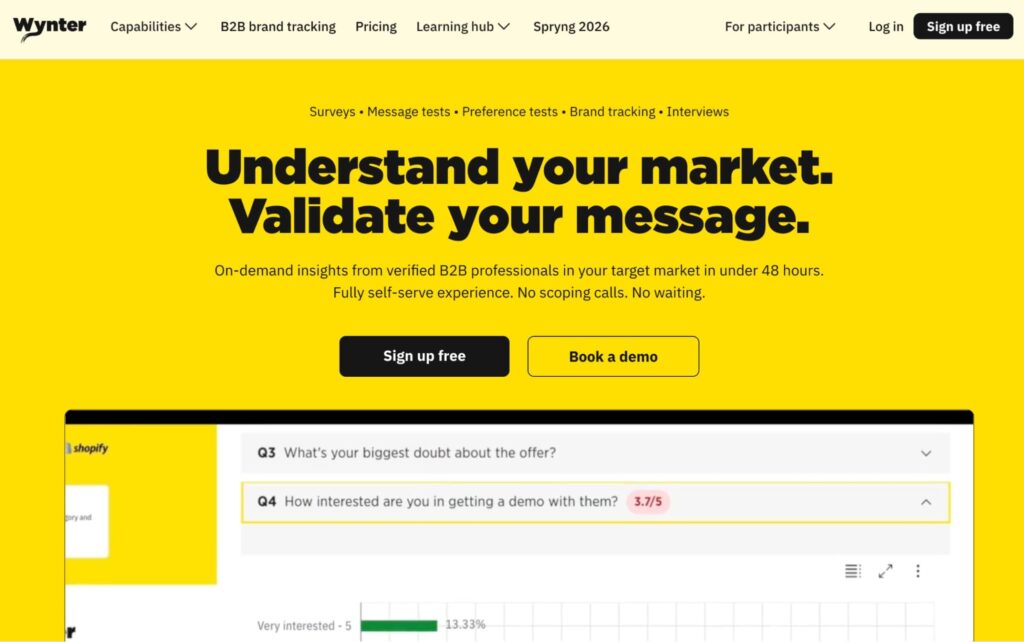
That narrowest possible version was message testing for B2B. Put your landing page copy in front of actual ICP buyers, get structured feedback on what they understood, what they did not, what made them want to buy, what made them skeptical. Nothing fancy. The operator need was already there, years before the category had a name.
The distribution — why LinkedIn became 70 to 80% of Wynter’s signups
Most early-stage B2B founders fight the distribution question for years. Peep had already solved that years earlier — he had built an audience in public for a decade before Wynter existed. His LinkedIn distribution started when he started writing about CRO on the internet, long before Wynter launched.
LinkedIn is a huge deal for us and we have been doing well with it. Today, organic LinkedIn, including the ads that we run on LinkedIn, is 70 to 80% of all our signups.
There are two pieces to that number. The first is the organic audience — 81,000+ followers who have been reading him write sharply about B2B buying behaviour for years. The second is the paid layer on top. Wynter runs LinkedIn ads against the same warm audience, with the organic content doing the job of softening the ground before the ad hits.
The point is that Peep built a distribution asset before the product existed, so when Wynter launched it had a warm channel rather than a cold start.
The lesson here isn’t the follower count. What you should remember is the sequencing. Building distribution after the product ships is a harder problem, not an impossible one, but it means your launch has to do two jobs at once.
The growth — $2M ARR in two years, bootstrapped
Wynter hit $2M ARR in roughly two years, bootstrapped. That is a meaningful number in a category that did not exist when Peep started.
The shape of that growth is worth paying attention to. Wynter grew on the back of operators telling other operators that the tool solved a real, specific problem.
In B2B SaaS, operator-to-operator referrals tend to produce stickier customers than paid acquisition, especially for tools solving a specific workflow problem, where the person doing the referring has already validated the fit.
It’s not always the fastest path to growth, but it’s often the most durable one.

The bootstrapped part also matters. Peep had the option to raise. He chose not to. The result is a business that can pick its customers, set its pricing, and say no to deals that are not a fit — which is exactly the posture that a buyer intelligence tool needs to have with enterprise buyers.
The category creation — “B2B buyer intelligence” before it had a name
When Wynter launched in January 2021 as Copytesting, the category was unclear. Was it market research? Was it copy testing? Was it survey software? The real answer was something new — structured access to ICP buyers for the purpose of making better go-to-market decisions.
Peep’s bet was that the right name for that was “B2B buyer intelligence.” The rebrand to Wynter formalised the category positioning. That move — renaming from a feature (“copytesting”) to a category (“buyer intelligence”) — is one of the most important decisions Wynter made. It gave buyers a way to think about the tool that was not constrained to one use case, and it gave Wynter room to grow into messaging research, positioning research, win/loss research, and ICP research.
Category creation is a strategic commitment. You are saying: I am defining a new category, and everything from my pricing to my content to my customer language has to align with that. Peep made that commitment early and has run every part of Wynter accordingly.
What to steal from Peep’s playbook
There are three specific things worth pulling out of how Wynter got built.
The first is founder-market fit as a starting signal.
The idea picked Peep because he was doing the work that generated the problem. For him, the starting signal was that simple: he needed the tool himself and couldn’t find it anywhere. That’s one of the cleaner founding conditions — the problem is real, the ICP is known, and the founder’s own frustration does the work that market research usually can’t.
The second is building distribution before product.
Peep’s situation was unusual: he had written publicly about B2B buying behaviour for a decade before Wynter existed. By the time the product launched, the audience had already formed and the trust was already there.
That’s a years-long investment that most early-stage founders don’t have, but the underlying principle holds even at a smaller scale. Writing publicly about the domain before you have a product to sell means the launch doesn’t have to introduce you and pitch you at the same time.
The third is category positioning as strategy, not marketing.
The rebrand from Copytesting to Wynter was a commitment to a category that didn’t exist yet, and it shaped every downstream decision.
The rebrand from Copytesting to Wynter wasn’t a copy change, but a category commitment. It determined what Wynter could charge, who the right customers were, and which use cases to build toward. Positioning at that level shapes every downstream decision; treating it as a messaging exercise misses most of what it actually does.GTM leaders working through these problems — distribution, positioning, category creation — are in the GTM Society. It’s a free community. Join the conversation.
Join the GTM Society. The room where GTM actually gets built. Founders, SDRs, and operators. No noise. Just systems.