How To Start a Lead Generation Business in 2026: Lessons From Lead Gen Agencies Doing $200m in Revenue

Key Takeaways
- A lead generation business finds and qualifies prospects for client companies. Pick your pricing model (per-lead, retainer, or hybrid) before you sign anyone.
- A specialized niche is the difference between competing on price and charging a premium per lead.
- Budget $1,000-$2,000 for a lean solo launch, plus $50-$200 a month for core software.
- The agencies profiled here agree on the fundamentals: invest in SEO and CRO, make decisions with data, and treat cold calls and email as complements to LinkedIn.
- Expandi is the LinkedIn automation tool used throughout this guide to execute outreach, scrape leads, and manage follow-ups at scale. Start a 7-day free trial to try it yourself.
Figuring out how to start a lead generation business comes down to sequencing: lock the niche and the pricing model before you spend a cent on tools, then build an outreach engine that delivers leads on a schedule.
To ground the advice, we broke down how eight lead generation agencies with a combined $200M+ in revenue win clients and deliver results, and pulled out the moves a new founder can copy.
Here’s what this guide covers:
- The 7 steps, from choosing a niche and pricing your services to building your tech stack.
- What a lean launch costs, and what to budget monthly for software.
- A LinkedIn scraping walkthrough that turns post engagement into a warm lead list.
- How eight leading agencies apply the fundamentals, and where LinkedIn automation fits at each stage.
Why do most lead generation businesses fail?
Lead generation companies fail when they sell a generic service into a crowded market with no repeatable system behind it.
The demand side is real: generating leads is still a top challenge for 30% of marketers, per HubSpot’s 2026 State of Marketing survey of 1,500+ marketers. The hard part is the business model: you’re promising a client results in a discipline their own team struggles with.
The failure patterns repeat:
- Vague positioning that forces the agency to compete on price
- Pricing that ignores ad spend and tool costs, so margins vanish
- No repeatable way to generate leads for their own pipeline, let alone a client’s
- No tracking, so there’s no ROI story when a client asks what they paid for
- One-off wins with no system behind them, so clients churn after a quarter
Every step below exists to close one of those gaps.
How to start a lead generation business step-by-step
This guide covers 7 steps: from choosing your niche to scaling your outreach.
Throughout, we’ll also show you how Expandi, a LinkedIn automation tool built for B2B lead generation, handles the outreach and follow-up work at each stage.
Step 1. Choose a profitable niche, industry, or category
Founders who start a lead generation agency and survive year one all specialize.
A clear niche shapes your pricing, your outreach lists, and the case studies you build, and it keeps you out of the over-saturated generalist market.
Judge a niche on economics before you commit:
- What clients in the niche pay per qualified lead.
- How large the addressable market is.
- How easy the decision-makers are to reach.
- The lifetime value of a closed customer, which caps what clients will pay you.
Then set the scope of your services: one vertical or several, one geography or global, and whether you deliver leads only or run the full outreach motion for your client.
Economics tells you which niche can pay. Durability decides whether you’ll still enjoy the work in year three. Nick Tomic, founder of Face2Face.io, who has consulted over a hundred startups, put it this way in a GTM Society interview:
“Make sure you pick a niche that resonates with you. And that is going to be the bedrock of what’s gonna drive you for the next… five, 10 years. If you don’t love what you’re doing, if you don’t love your niche, it’s gonna be such a pain in the ass for you.” — Nick Tomic, Face2Face.io
Step 2. Determine fees and costs
Lead generation businesses charge in three main ways:
- Pay-per-lead: a flat fee for every qualified lead you deliver. Simple to sell, but revenue swings with volume.
- Monthly retainer: a fixed fee to act as an extension of your client’s sales team. Predictable, but you carry the performance risk.
- Hybrid: your client funds the campaign spend, then pays a predetermined fee per lead plus a percentage on each lead that converts.
For a new business, the hybrid approach is the low-risk starting point: your client selects how much to spend on advertising and campaigns, you run that budget, and you get paid on delivery.
The thing to watch is margin. Hybrid commission rates run lower than pure per-lead deals, so price the work with your own costs in view.
Budget for your own startup costs
Before you take on clients, budget for your own setup.
Plan on at least $1,000-$2,000 to launch a lean, solo lead generation business — your first month of tools, hiring or outsourcing, trial and error.
For ongoing lead generation software (a LinkedIn automation tool, a CRM, and an email finder), budget $50-$200+ a month combined. Once you’re pricing client campaigns, our breakdown of how much lead generation costs covers what to charge on the other side of the table.
Step 3. Identify your target audience and build client relationships
You have two audiences to define: the clients who pay you, and the leads you deliver to them.
Build an Ideal Customer Profile (ICP) for each, with pain points, goals, and the triggers that make them buy.
Map how a prospect moves through your client’s funnel before you send a single message. A documented journey map makes your B2B lead generation motion repeatable, which is what lets you take on more clients later on.
Tomic’s shorthand for the same discipline, from the same GTM Society interview:
“When you have that beautiful formula of understanding who your customer is, what their problem is, how you can solve it with your tool and what’s required for that to work, I think the sale just becomes almost automatic.” — Nick Tomic, Face2Face.io
Step 4. Use lead generation strategies
One effective lead generation strategy is scraping LinkedIn engagement data for potential customers — people who already liked or commented on a relevant post are warmer leads than a cold list.
Here’s how to do this in Expandi:
- Log into Expandi (or grab the free trial if you’re new).
- Go to “search” and select “add new search.”
- Choose “post engagement.”
- Name your search.
- Add the URL of the post you want to scrape.
- Press “search” and Expandi scrapes the post for you.
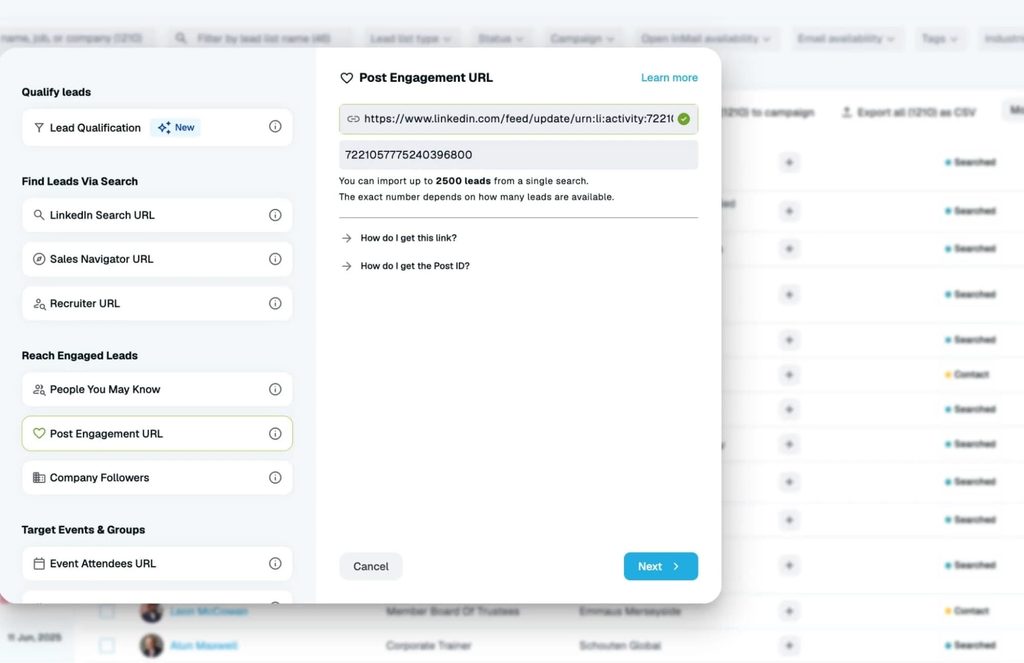
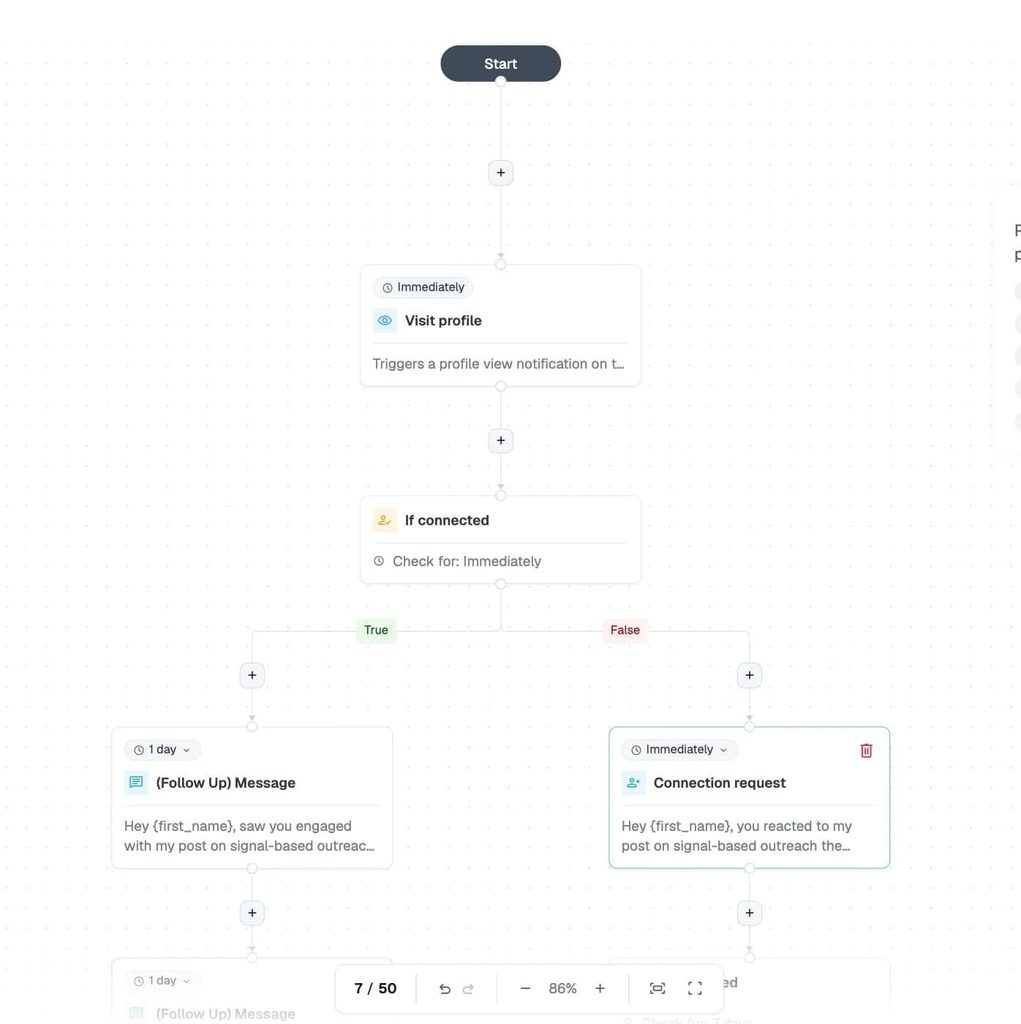
One post can hand you up to 2,500-3,000 engaged leads. From there, launch a smart campaign that sequences connection requests, messages, and follow-ups to the list automatically.
Step 5. Use outreach marketing strategies
Outreach marketing is how a new lead generation business builds brand awareness and lands its first clients: you offer a solution directly to the people who need it.
The core channels are LinkedIn outreach, cold email, cold calling, and face-to-face at industry events — and the guardrails in our ethical LinkedIn outreach best practices keep the LinkedIn side effective without burning your own reputation.
Support the outbound motion with assets that convert the attention it creates:
- A website that details your services, expertise, fees, and client testimonials.
- Targeted landing pages plus SEO, so prospects searching for lead gen help find you.
- Lead capture forms to collect contact information from visitors.
- A LinkedIn CRM connected to your outreach, so every conversation gets tracked and followed up.
Your own LinkedIn profile is a landing page too. These LinkedIn profile tips cover how to make it convert the profile views your outreach generates.
Step 6. Measure and analyze your lead generation efforts
Measurement is what turns a lead generation service into a business. Track performance per client and per channel:
- Cost per lead, against what the client pays you.
- Connection acceptance and reply rates on LinkedIn outreach.
- Lead-to-opportunity conversion, so lead quality stays visible.
- Meetings booked, the number that maps to your client’s pipeline.
- Client ROI, the retention number.
Benchmarks give the numbers meaning: across 13.2 million connection requests in our State of LinkedIn Outreach H2 2026 report, the average connection acceptance rate is 28.5% and the average message reply rate is 10.4%.

If your client campaigns sit under those lines, fix targeting and messaging before you scale volume.
Step 7. Build a lead generation tech stack
A lead generation stack covers five jobs:
- Find prospects.
- Enrich the data.
- Run outreach.
- Convert visitors.
- Manage the pipeline.
One tool per job is enough at the start:
| Job | Tool | What it covers |
|---|---|---|
| LinkedIn outreach | Expandi | Automated connection requests, messages, smart sequences, scraping |
| CRM and pipeline | HubSpot or Pipedrive | Contact records, deal stages, client reporting |
| Data and enrichment | Clay or ZoomInfo | Contact data, signals, list building |
| Forms and landing pages | Typeform or Unbounce | Lead capture for your own site and client campaigns |
| Email finding | An email finder tool | Verified addresses for multichannel sequences |
Expandi is the outreach layer of the stack: a cloud-based LinkedIn lead generation platform with a dedicated IP per account, auto warm-up, smart daily limits, and if-then sequences built from 20 actions and 11 conditions.
The AI Analyzer drafts campaign messages and follow-ups, then sorts replies by sentiment so hot leads get routed fast. It also integrates natively with HubSpot, Pipedrive, and Salesforce, so every conversation lands in your client’s CRM.
For a wider sweep of options across all five jobs, see our breakdown of AI for lead generation tools.
How to make your lead generation company successful: insights from leading agencies
Now that you know the fundamentals, here’s how leading agencies apply them in practice — and where Expandi fits into executing each one on LinkedIn:
Lean on LinkedIn for B2B lead generation — Pearl Lemon Leads
Pearl Lemon Leads built its practice around LinkedIn outreach, and the channel earns that focus: in our State of LinkedIn Outreach report, LinkedIn DMs average a 10.3% reply rate against 5.1% for cold email.
LinkedIn caps standard connection requests at roughly 100 per week, which forces precision over volume: tight targeting, personalized notes, and automation that works within the limits.
Expandi runs that motion safely: a dedicated IP per account, profile warm-up, and smart daily limits keep the account inside LinkedIn’s rules while your sequences do the nurturing.
Invest in SEO and TOFU content — Belkins
Belkins builds a predictable B2B pipeline for clients, and a large part of that engine is SEO paired with top-of-the-funnel (TOFU) content. TOFU content attracts leads and gets them interested. SEO is what makes that content rank, so the two only work as a pair.
Belkins’ playbook for content that generates leads:
- Target decision-makers with every piece.
- Structure content around the product, so reading it sells it.
- Nurture leads inside the article with testimonials and social proof.
- Add lead capture forms where they fit the reader’s intent.
Belkins also runs LinkedIn outreach with Expandi for its own pipeline: here’s how Belkins generates leads with automated LinkedIn outreach. While SEO drives the traffic, Expandi helps you convert LinkedIn engagement on that content into direct outreach conversations.
Invest in conversion rate optimization (CRO) — Single Grain
Single Grain specializes in CRO campaigns that lower the cost of acquiring each lead, which raises the value your client gets from every visitor their site already has.
CRO moves you can apply inside a lead generation business:
- Test CTA copy, phrasing, and placement.
- Run A/B tests on landing pages before scaling ad spend to them.
- Fix mobile experience and page speed, the silent conversion killers.
- Add trust signals: testimonials, client logos, review scores — near every form.
On LinkedIn specifically, Expandi’s A/B testing feature lets you test connection messages and follow-ups the same way you’d test a landing page.
Make your lead generation strategies data-driven — Cience
Cience builds hard-to-find target audiences for B2B clients by putting data at the center of every campaign: algorithms and software surface leads that manual research misses, and custom signals specific to each client’s industry decide who gets contacted and when.
Expandi’s campaign analytics give you the same kind of data — reply rates, connection acceptance rates, and conversion by message variant — without needing a separate data team.
Develop an ICP to truly understand customers — Martal Group
Martal Group targets leads that fit a tightly defined ICP. A narrow, well-researched profile shrinks the prospect list to the people genuinely worth contacting, which concentrates your resources where conversion is likeliest.
Their standard for a working ICP: very detailed, research-backed, and built together with your client. That takes a real discovery process, and a client relationship strong enough to get honest answers.
Don’t neglect cold calls and emails — Callbox
Callbox runs a multi-touch, multi-channel account-based approach, and the phone still earns its place in it.
The channel is recovering: the average cold call success rate climbed from 2.3% to 2.7% this year, and reaching a prospect now takes an average of 1.55 call attempts, down from 2.9, per Cognism’s State of Cold Calling 2026 report, built on 200K+ analyzed calls.
Callbox’s rules for making cold outreach work:
- Listen more than you talk, and let the lead feel heard.
- Work from scripts, so every call hits the points that matter.
- Research the prospect before engaging.
- Time the outreach: emails early in the morning, calls outside the industry’s peak hours.
- Leave voicemails that give a real reason to call back.
Expandi supports multi-channel smart sequences that combine LinkedIn touchpoints with email, so you’re not limited to a single channel.
Use audience search data — Terakeet
Terakeet builds customer acquisition strategies on audience search data, and the logic holds for a new lead generation business: buyers research long before they talk to sales. Gartner’s research finds that 75% of B2B buyers prefer a rep-free sales experience, which means search behavior shows you demand while it’s still invisible to your client’s pipeline.
Search data tells you which problems a market is actively trying to solve, where a prospect sits in the funnel, and what your client’s competitors rank for. Expandi’s LinkedIn search and scraping tools let you build a similarly targeted list before you ever send a message.
Understand your clients’ lead generation funnels — LeadGen
LeadGen, a B2B lead generation company, builds a unique strategy per client by studying each client’s funnel in detail.
Their qualification standard: every prospect in the funnel gets assigned a potential revenue figure and a probability of closing.
That discipline pays off at handoff. When you know the funnel well, you pass your client the leads most likely to close, their sales team spends time where it converts, and your retention numbers reflect it.
Putting your lead generation business plan to work
Starting a lead generation business rewards sequence over speed: pick a niche you can price confidently, choose a low-risk fee model, and build one repeatable outreach system before you scale anything.
The agencies doing this at $200M+ combined agree on the rest: invest in SEO and CRO, decide with data, and run LinkedIn, email, and phone as one motion rather than three.
Expandi handles the LinkedIn side of that motion end to end: scraping engaged leads, sequencing the outreach, and tracking the numbers your clients pay you to improve.
Claim your 7-day free trial and launch your first lead generation campaign this week.
Frequently asked questions about starting a lead generation business
Plan on $1,000-$2,000 to start a lean, solo lead generation business, mostly your first month of tools, hiring or outsourcing, and trial and error.
Ongoing software — a LinkedIn automation tool, a CRM, and an email finder — runs another $50-$200 a month combined.
A lead generation business is profitable even at small scale: a new agency with four retainer clients can realistically reach six figures in year-one revenue. Established agencies with a proven niche scale well beyond that.
Start with your existing network: former colleagues, LinkedIn connections, and referrals convert faster than cold outbound when you have no case studies yet. Deliver fast results for that first client, even at a discounted rate, and the referrals that follow fuel the next stage of growth.
They work best together rather than as a choice between the two. LinkedIn brings higher response rates on warm, engagement-based outreach, while cold email scales further on volume. Tools like Expandi combine both channels in a single sequence.



You’ve made it all the way down here, take the final step