White Label Lead Generation: How Agencies Run LinkedIn Outreach for Clients in 2026


White label lead generation lets your agency sell LinkedIn outreach to clients under its own brand. Buying the white label is the easy part. Keeping a client past the second retainer depends on proving the campaign works before you scale it.
Our data from 13.2 million connection requests shows which targeting, sequence and timing choices earn replies.
Here’s what this guide covers:
- The two white-label models, and what a LinkedIn platform handles for your agency.
- A 100-message test that tells you whether a client is worth a retainer.
- How to rebuild a client’s ICP from replies and filter the list before launch.
- The sequence and offer to run once the motion is proven, with the numbers behind them.
- How two agencies built white-label delivery, and how to run it across client accounts.
TL;DR:
Choose a white-label platform for branding and account structure, then prove each client’s motion by hand before you automate anything. Send 100 manual messages from your client’s profile and sign the retainer once that test earns five positive replies. Rebuild the ICP from the conversations that worked, filter every list before launch, and run a three-message sequence with the strongest message second. Expandi’s white label then puts your agency’s logo, colors, and domain on the platform. Workspaces keep each client’s LinkedIn accounts and campaigns behind permissions scoped to that client.
Fulfillment partner or white-label platform: which white label lead generation model fits your agency?
Pick a fulfillment partner if you want to resell white label lead generation services while headcount stays flat, and pick a white-label platform if your own team will run the campaigns on rebranded software.
White label lead generation is outreach your agency sells under its own brand, with a partner or a rebranded platform doing the work behind it.
The model you pick decides who owns the result:
| Fulfillment partner | White-label platform | |
|---|---|---|
| Who does the work | The partner’s team builds lists, writes copy, and runs campaigns | Your team runs targeting, copy and campaigns on rebranded software |
| Margin | You mark up the partner’s fee, so their price sets your ceiling | You pay for software seats and keep the rest of the retainer |
| Control | The partner decides how campaigns run | You control every list, message and sequence |
| Risk to your brand | A partner mistake lands on your client relationship, and you hear about it late | Mistakes are yours to catch, and so is the fix |
| Best for | Agencies testing demand before hiring delivery staff | Agencies building delivery into a core, repeatable service |
From here, the focus is the platform model, where your team runs delivery on LinkedIn.
If you’re still choosing a niche and a pricing model, our guide to starting a lead generation agency covers those decisions first.
What are the advantages of white label lead generation?
White label lead generation for agencies gives you a sellable outreach product without building software, and it keeps the client relationship under your name. The advantages an agency owner feels first:
- Your brand on everything the client sees: the dashboard, the login domain, and the reports.
- Pricing freedom, because the client never sees the vendor’s price list.
- No development budget or engineering hires to own a branded outreach tool.
- One delivery stack for every client, so the setup and process you prove on one account carry over to the next.
- Retention tied to your agency, since the relationship and the reporting carry your name.
- A new service line to sell next to SEO, paid or content retainers as part of a wider B2B lead generation offer.
What does a white label LinkedIn lead generation tool cover, and what doesn’t it?
A white label LinkedIn lead generation tool covers branding and account structure: your logo, colors, and domain, client accounts grouped under one login, permissions, and client-facing reports. Results come from targeting, messaging and the sender’s standing on LinkedIn, and the software supplies none of those three.
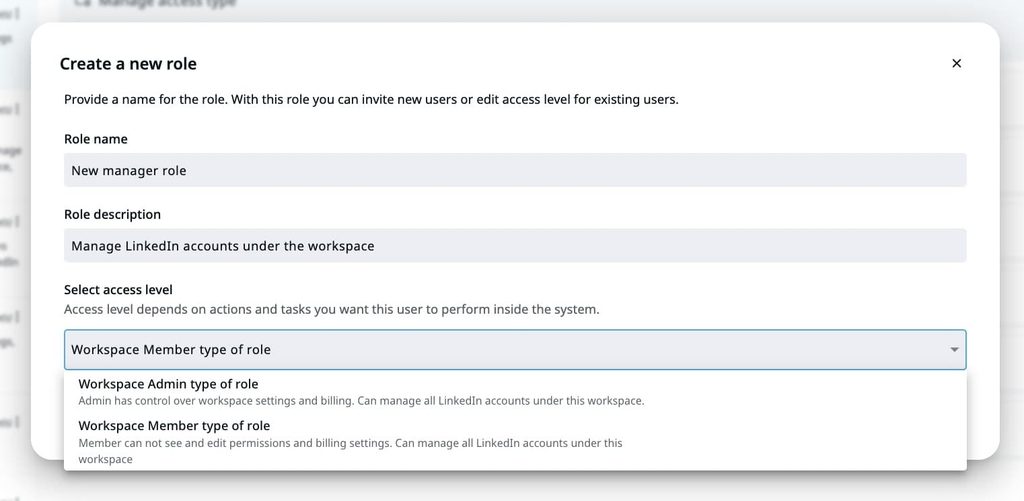
With Expandi’s white label, you send your color scheme and logo and get your own version of the platform, with your domain, menus, and SMTP settings. You can plug in your own chat widget (Intercom, Zendesk, or Crisp) and use custom roles to decide what your team and each client can see.
Everything a client judges you on still sits outside the software: who you target, what you say, and whether the person sending the request is someone the prospect wants to hear from.
Those three decide whether a client renews.
What to check before you pick a white-label platform
Run any white label lead generation software through the same short checklist before you move client accounts onto it:
- Client-facing reporting: can each client see their own results under your brand, and only theirs?
- Per-account permissions: can you scope a client or contractor to one account or one client group?
- Pricing per connected account: is the cost per LinkedIn seat clear, with agency terms in writing?
- Data ownership on offboarding: can you export a client’s leads and campaign history when they leave? Our compliance checklist for enterprise buyers covers the data questions in depth.
- Account safety: does it run from the cloud with a dedicated IP per account, warm-up, and daily limits? These are the safety checks we run on LinkedIn tools.
Why did LinkedIn connection limits change white label lead generation?
LinkedIn caps weekly connection requests, so every request a client account sends has to count. LinkedIn doesn’t publish the number, and our guidance of about 100 a week is explained in our breakdown of LinkedIn’s weekly connection limit.
An agency can no longer make up for weak targeting with volume.
Across the 13.2 million connection requests and 6.7 million outbound messages in our State of LinkedIn Outreach H2 2026 report, 28.5% of requests were accepted and 10.4% of messages got a reply. Every figure from this dataset is observational, so treat the numbers as patterns to test on every client.

For client accounts, our answer is to engage before you ask.
A profile view and a like on a recent post before the connection request make your client’s name familiar by the time the request lands, which is the logic behind a LinkedIn warm-up sequence.
Glenn Miseroy, co-founder and CEO of Expandi, made the same point in a GTM Society fireside chat:
“I don’t think it’s a matter of sending the connection request at the right time to that person. It’s more a matter of nurturing.”
Glenn Miseroy, Expandi
In Expandi, Smart Sequences run those touches as steps ahead of the connection request, with flexible time delays between actions.
Our data backs the value of an existing tie.
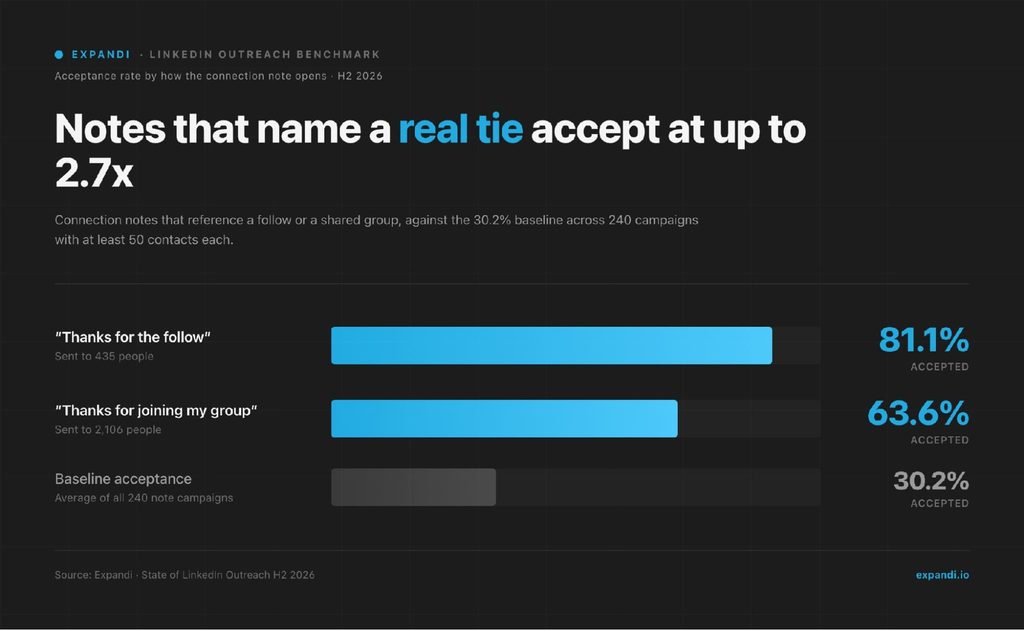
Connection notes that referenced one (a follow, a shared group, a mutual network) were accepted at 1.8 to 2.7 times the 30.2% baseline for campaigns that sent only a connection request.
The tie has to be real: “thanks for the follow” only works if the prospect followed your client.
The note itself has stopped starting conversations. Replies to connection notes fell from 3.5% in May 2025 to 2.2% in April 2026, so the message after acceptance does the work.
Why good copy can’t fix a client nobody has heard of
Prospects check who’s asking before they accept, and a thin, silent profile gives them little reason to say yes. Copy has no way to supply the credibility the profile lacks.
In our H2 2026 data, the 38 accounts with 1,000+ followers and consistently engaged posts accepted connection requests at 30.5%, against a 27 to 29% platform average.
Alex Vacca, founder and CEO of Frontal, a go-to-market AI company, and previously co-founder of the outbound agency ColdIQ, named the problem in a GTM Society webinar:
“Humans are craving trust, and I think we are going through a bit of a trust crisis.”
Alex Vacca, Frontal
That makes qualification an agency decision at the sales stage.
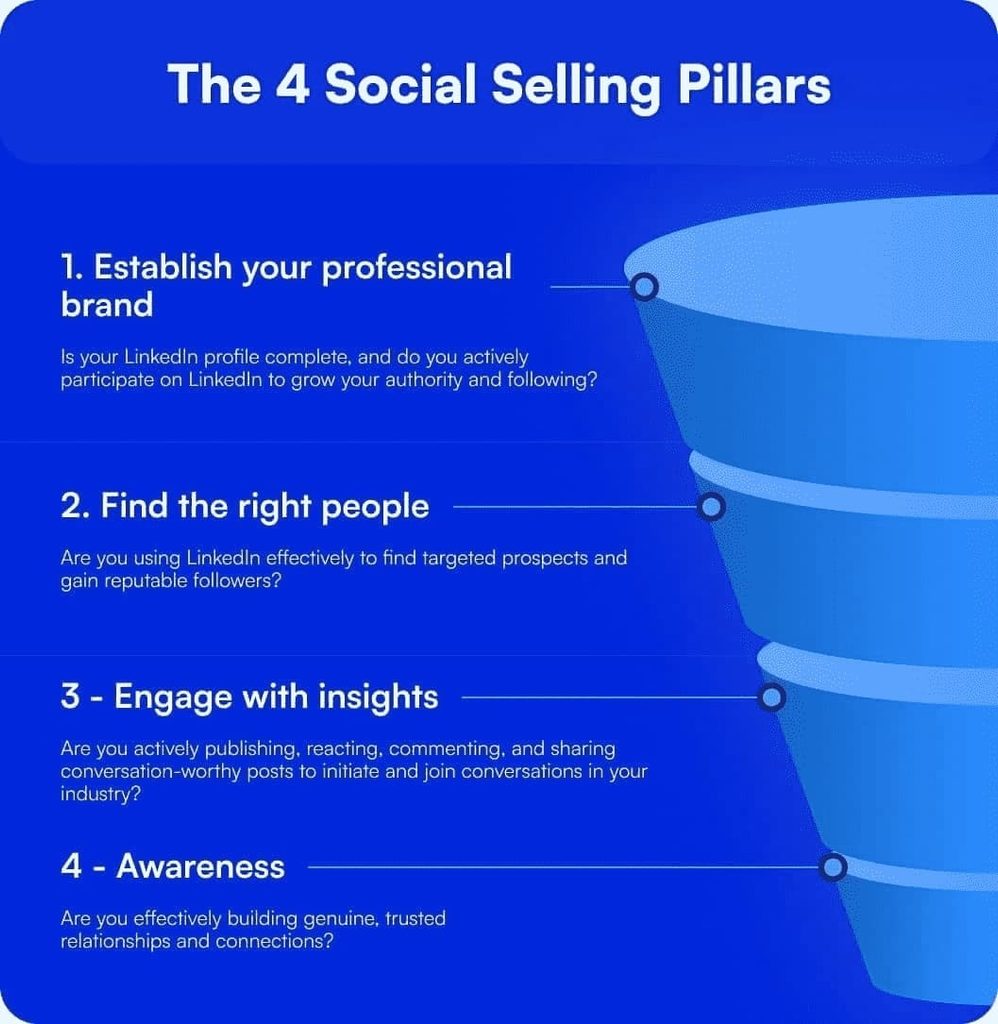
Before you sign, check your client’s profile: a clear headline, recent posts, a network in the target market, and a healthy Social Selling Index. If the profile is weak, fix it before the pilot, or pass on the client.
How do you validate a new client before signing the retainer?
Validate a new client with a short pilot: agree access to their LinkedIn profile, then send 100 messages by hand before you sign the retainer or switch on automation.
The manual 100 is the cheapest pilot an agency can run: a few hours of work tells you whether the market answers.
To run the manual 100 for a new client:
- Pick one narrow segment: one industry, one role, one region.
- Build 100 prospects by hand, checking each against the brief.
- Engage first with a profile view and a post like.
- Write and send each request and follow-up yourself.
- Count positive replies, then judge the motion.
Five positive replies from 100 is the bar. Below it, change one variable (the segment or the offer) and run another 100 before you automate anything.
Automation multiplies whatever the manual test produced.
- A motion that earns five conversations in 100 sends earns more at full volume.
- A motion that earns none burns through your client’s market faster.
Ilija Cosic, Head of Sales at Expandi, reviews customer campaigns on the platform and has watched automation amplify a weak list. He put it this way:
“I’ve looked at around 200 underperforming campaigns in the past quarter. The pattern’s always the same. The list is way too big, the copy’s generic, and there’s no signal in the message about why this person, today. By the time the sequence runs, the automation is just delivering bad outreach faster. The list has been and always will be the strategy.”
Ilija Cosic, Expandi
How do you build a client’s ICP from conversations that worked?
Build your client’s ICP from the people who replied positively in the pilot, because those replies show who wants the offer. The original brief is a guess, and the reply list is evidence.
To rebuild the ICP from your pilot conversations:
- Export every positive reply from the manual test.
- Tag each by company size, seniority and sub-niche.
- Note which line in the message each person answered.
- Find the traits that repeat across positive repliers.
- Rewrite the ICP around them and cut dead segments.
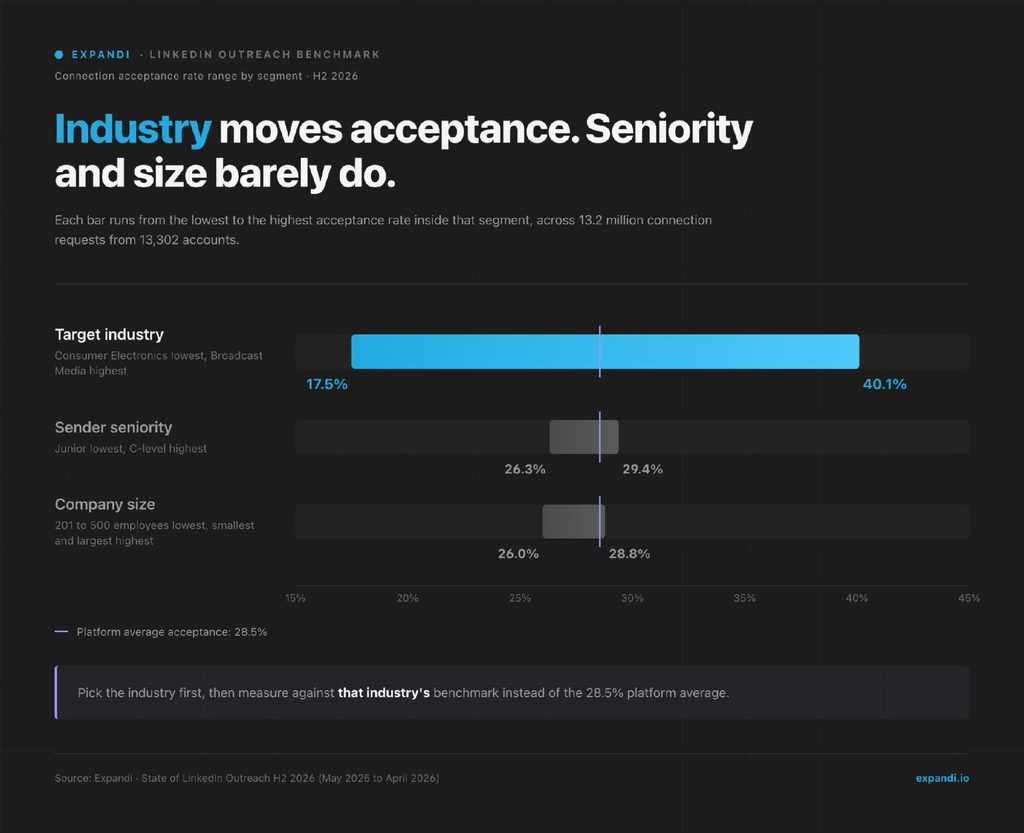
Pick the pilot industry with care, since it’s the one targeting choice with real spread.
In our H2 2026 data, acceptance ranges from 17.5% in Consumer Electronics to 40.1% in Broadcast Media, while sender seniority moves it within about 3 points.
List source matters less than the filters you apply. Sales Navigator leads accepted at 19.8% against 18.5% for CSV imports, with identical reply rates, so pick the source that fits your client’s budget and workflow.
How should you filter a lead list before launch?
Filter every lead list before launch, because a wrong lead in a live campaign has already used one of your client’s capped requests.
Filtering is the highest-margin habit in white-label delivery: each lead you cut costs nothing, and each wrong lead costs a request and a little of the client’s reputation. Make it a sign-off step for your head of delivery.
Raw searches carry a lot of waste. Ilija estimates that 40 to 70% of the 1,500 people a Sales Navigator search returns are poor fits, a figure from our guide to prospecting with AI.
Ilija is blunt about where the effort belongs:
“You cannot fix bad targeting with good messaging. It has to go downstream.”
Ilija Cosic, Expandi
To score a list in batches before it goes live:
- Split the export into batches of about 100 leads.
- Rate every lead 1 to 5 against the rebuilt ICP.
- Let AI take the first pass, then check borderline scores.
- Launch only the 4s and 5s, and log why the rest were cut.
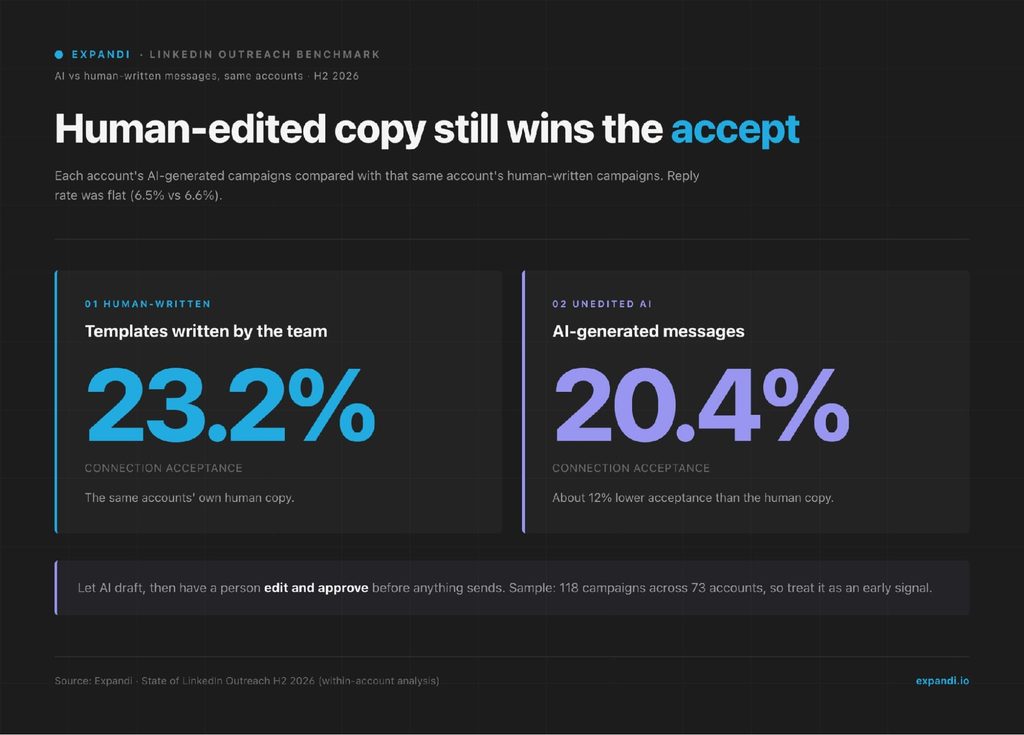
Use AI for the filtering and the first draft, and keep a person on the final copy. Within the same accounts, human-written messages beat AI-generated ones on acceptance by about 12%, with reply rates flat.
Our guide to AI for lead generation covers where AI earns its place in the rest of the workflow.
What sequence should you run once the motion is proven?
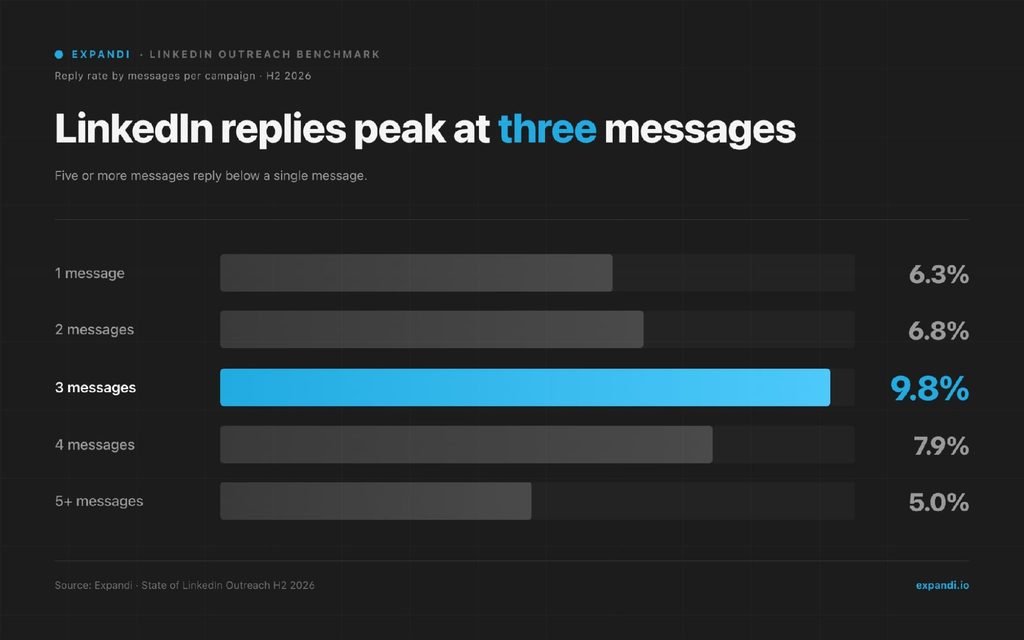
Once a client passes the manual test, run three messages after the connection, put the strongest one second, keep each to about 151 to 200 characters, and send in the morning.
Treat these four points from our H2 2026 data as defaults to test against each client’s results:
- Three messages: 3-message campaigns replied at 9.8%, against 5.0% for campaigns with 5 or more.
- Strongest message second: message 2 replied at 8.8% per send, the highest of any position.
- 151 to 200 characters: that length bracket peaked at 8.5% reply.
- Morning sends: requests sent from 7 to 11 a.m. were accepted at about 32%, against about 24% in the evening.
Write message 2 first, since it carries the pitch the connection note can’t. Our guide to LinkedIn follow-up messages has examples for each step.
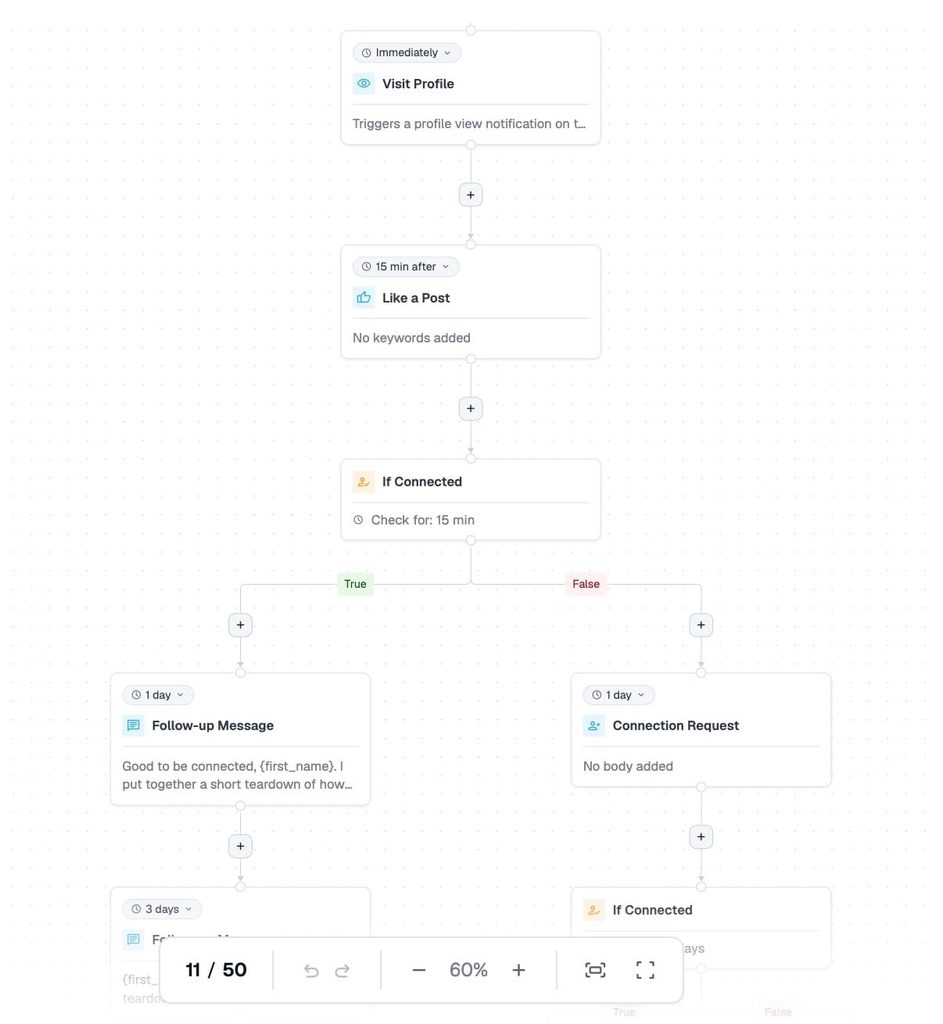
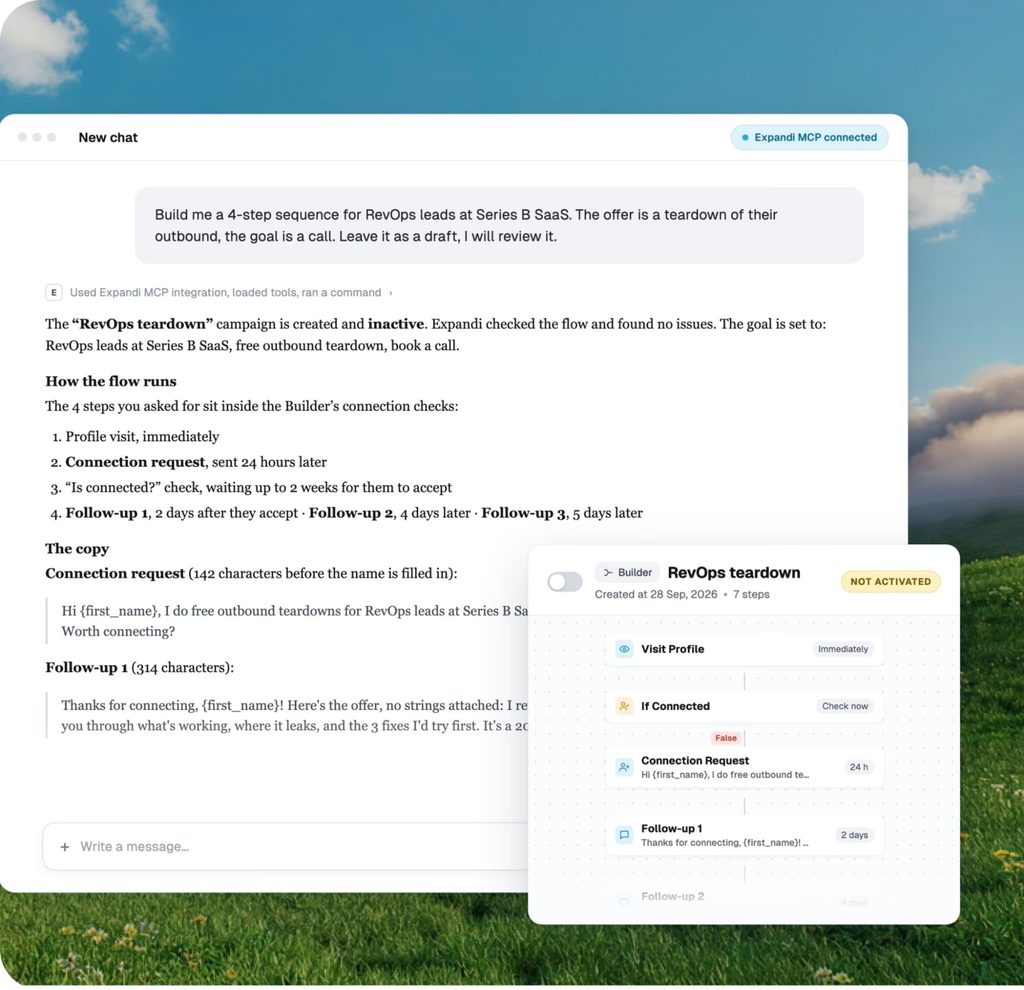
In Expandi’s Campaign Builder, the profile view, post like, connection request, and three messages sit in one visual sequence, with conditions between steps.
Which offer should you lead with when nobody knows the client?
Lead with a split offer: a small piece of free, specific work for the cold prospect, with the paid offer saved for the people who engage.
A stranger has no reason to commit to a trial or a discount from a company they’ve never heard of, and useful free work gives them one.
Alex Vacca drew the same line in our GTM Society webinar: inbound leads already trust you and can buy the big package, while cold prospects get quality free work with no meeting or budget ask.
The split looks like this in practice:
| Cold offer | Warm offer | |
|---|---|---|
| Who gets it | Prospects with no prior contact | Prospects who replied, engaged or viewed the profile |
| What it is | A free audit, teardown or short analysis of their situation | A trial, discount, demo or paid pilot |
| What it asks for | A reply | A meeting or a commitment |
| What it costs your team | Real work for each prospect | A sales conversation |
For an agency, the cold offer can be the first step of your own onboarding. Ilija described it in a GTM Society fireside chat with Glenn Miseroy:
“What I suggest for everyone to do is to provide something of tangible value upfront before the prospect even asks for it. … Let’s say you’re an outreach agency, you could give them a list of 500 to 2,000 contacts that are enriched with phone numbers, email addresses, and also the recent signals.”
Ilija Cosic, Expandi
The honest cost: free work persuades because producing it costs your team something, like an hour of analysis per prospect. That caps how many cold offers you can make, which is one more reason to filter hard.
Our roundup of lead generation tactics covers other ways to open the conversation.
How two agencies build white-label delivery on Expandi
Both agencies ran white label LinkedIn outreach for their clients from a rebranded Expandi platform: Provoke Agency from day one, and Salescout after another vendor’s white-label rollout stalled.
Provoke Agency: close to $2 million in recurring revenue
Provoke Agency, a Montreal LinkedIn prospecting agency founded in 2019, presents Expandi to its clients as its own platform, with its brand colors, its name and its own pricing.
One client campaign on the white-labeled platform passed 40% on both acceptance and response within a week. At the time of the case study, the agency served more than 50 recurring clients a month and was close to $2 million in annual recurring revenue.
“The problem is that there’s a ton of Linkedin automation software. And an early agency owner simply has no idea which one to choose. But when you understand what you’re getting with Expandi — which is reliability and safety first and foremost — combined with the personal approach the owner himself took with me, the final decision was easy to make” — Richard Mechaly, Provoke.Agency
Salescout: 6+ demos and $250,000+ in pipeline in three weeks
Salescout, a Melbourne sales development agency that runs B2B lead generation on LinkedIn, first tried white-labeling a different LinkedIn tool.
That rollout ran more than six months late and brought hidden costs. After switching, Salescout had its branded Expandi platform set up quickly, connected a sentiment-recognition AI through webhooks, and booked 6+ demos with $250,000+ in pipeline within three weeks.
“With Expandi, I basically have a team of sales development reps working for me 24/7, 365 days a year. They never sleep and are extremely good at getting the outcomes we seek to achieve, such as engagement bookings for demonstration meetings, among others.” — Ryan O’Connor, Salescout
In both cases, the numbers came from the campaigns each agency’s team ran on the platform.
How do you answer the three objections agency clients raise?
Each objection has an answer in the data:
- Replies drop once a sequence runs past three messages.
- Templates lose the shared context that earns acceptance.
- A single vertical gives you a readable result sooner.
Here’s how to handle each objection.
Why not just send more connection requests and messages?
Weekly limits cap the connection requests each account can send, and replies drop once a sequence runs past three messages: campaigns with 5 or more messages replied at 5.0%, below a single message.
Pushing request volume also raises the risk of a restriction, and dealing with a restricted LinkedIn account takes a client’s sender out of the campaign entirely.
Can you give us templates that work everywhere?
No opening line works for every audience.
The top connection notes in our data worked because they referenced something real between sender and recipient, and a template copied into another client’s market loses exactly that.
As Ilija puts it:
“If a message applies to everyone, it doesn’t apply to anyone.”
Ilija Cosic, Expandi
Won’t one vertical shrink our pipeline?
One vertical makes the pipeline measurable.
Industry is the only demographic dimension with real spread in acceptance in our data, so a narrow test shows quickly whether a market answers, and you widen once it does.
How do you run white-label delivery across many LinkedIn client accounts?
Run white-label delivery from one workspace that holds every client’s LinkedIn accounts, campaigns and conversations, with permissions scoped per client.
On Expandi’s agency setup, four pieces handle that structure:
- Workspaces hold every client’s LinkedIn accounts, operators and permissions in one place, with 100+ permission settings and Companies to group accounts by client.
- Shared Campaigns run one validated flow across several sender accounts. When those accounts belong to the same client group, Expandi distributes different leads to each one, so two senders never contact the same prospect.
- The Global Inbox shows every client conversation in one view, filterable by client, account and status.
- Account health settings warm up new accounts gradually and enforce configurable daily limits. Everything runs from the cloud on a dedicated IP per account, which matters because LinkedIn scans for browser extensions.
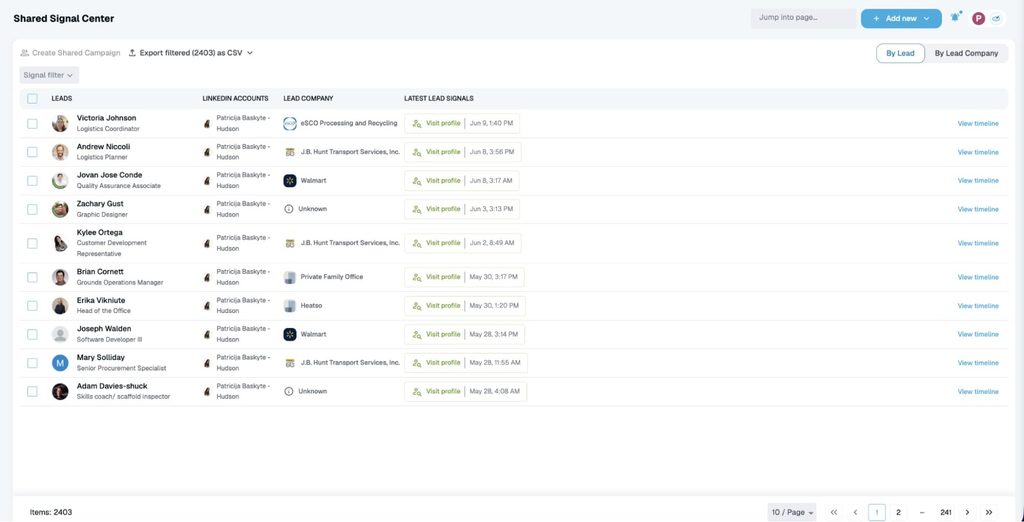
Our guide to LinkedIn outreach for lead gen agencies covers campaign types that suit client accounts.
Between reviews, you can monitor client campaigns with the Expandi MCP by asking an AI agent which campaigns are slowing down.
What should your agency do next with white label lead generation?
White label lead generation pays off once a client’s campaign earns replies by hand, before your brand and a retainer go behind it.
Pick one client this week and run the manual 100: one narrow segment, a warmup touch before every request, and messages you write yourself.
If it clears five positive replies, you have a campaign worth scaling across their accounts.
Book an agency walkthrough and bring that campaign, and we’ll show you how the white label and Workspaces would run it under your brand for every client you add.
FAQs about white label lead generation
White label means one product sold under many resellers’ brands, while private label means a product made or customized for a single seller. In lead generation, the two terms blur, so ask a vendor exactly what’s exclusive to your agency: the software, the lead data or the leads themselves.
Lead generation white label pricing follows one of three models: per seat, per connected LinkedIn account, or a custom agency plan. Expandi’s white label sits on its custom-priced Agency plan, built for 10+ seats. Price your retainer from your delivery hours and seat costs, then add your margin.
Promise a test result, and keep platform averages out of the contract. Reply rates swing by industry: in our H2 2026 data, Staffing and Recruiting campaigns replied at 18.9% to messages, against 8.8% for Computer Software. Run the manual 100 first and set the target from your client’s own numbers.
Your client’s own profile, or a real member of their team, should send them. LinkedIn’s User Agreement says each account must be in its owner’s real name, so every sender should be a real person on the client’s side.
Only if you tell them, because the white label keeps the vendor’s name out of the client’s view. Settle your disclosure policy before the first pitch so every client gets the same answer, and write ownership into the contract: who keeps the sending LinkedIn accounts and the lead data if the client leaves.
Two weeks per 100-message batch is a fair window, as long as you watch the calendar. January was the weakest month in our H1 2026 data, at 21.45% acceptance and 6.47% reply, so judge a January pilot against those January figures.



You’ve made it all the way down here, take the final step