How the LinkedIn Algorithm Works in 2026 (and How to Use It to Generate More Leads)

LinkedIn organic reach is down roughly 50% year over year, engagement is down 25%, and follower growth has slowed by 59% (Just Connecting’s 2025 Algorithm Insights Report, 1.8M posts analyzed).
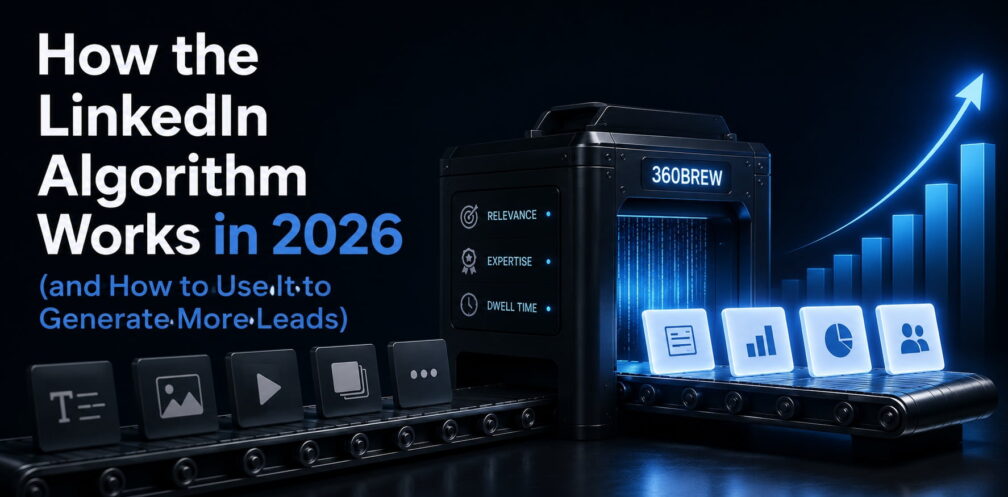
The platform rebuilt its ranking system around a single AI called 360Brew, which now reads each post for relevance, expertise, and dwell time instead of counting hashtags and reactions.
Working with it in 2026 looks like this:
- Write content designed to be saved (frameworks, specific stats, step-by-step breakdowns).
- Skip external links and engagement bait.
- Engage your network for 10 to 15 minutes before publishing.
- And run outbound against post engagers within 24 to 48 hours of every post that lands.
The result is fewer posts and more pipeline.
To put this guide together, we analyzed LinkedIn’s official 360Brew documentation and research papers, cross-referenced Richard van der Blom’s 2025 Algorithm Insights Report, and sat down with GTM leaders like Alina Vandenberghe (Chili Piper co-founder), Wes Bush (ProductLed founder), and Nick Tomic (Face2Face CEO and founder) on what’s working under the new system.
What follows: how 360Brew evaluates each post in 2026, the format hierarchy that wins right now, the five behaviors the algorithm now penalizes, and the operational layer that helps turn post engagement into an outbound pipeline.
Key Takeaways
- LinkedIn replaced its old multi-model ranking system with 360Brew, a 150-billion-parameter foundation model that handles feed ranking, content distribution, job recommendations, and connection suggestions through one unified system.
- Reach is down ~50% year over year, but content that earns saves, sends, and dwell time is outperforming previous benchmarks. Saves and sends are now the strongest distribution signals.
- 70% of a post’s total reach is decided in the first 60 to 90 minutes. Early engagement velocity, especially comments, determines whether the algorithm pushes the post wider.
- Format hierarchy in 2026: document carousels (highest engagement), polls (highest reach multiplier), native short video, then text. External link posts and engagement-bait formats are actively suppressed.
- Algorithmic reach only converts to pipeline when you act on it. Tools that detect post engagers and run personalized follow-up sequences (like Expandi’s Signals + Smart Sequences) are the bridge between visibility and real conversations.
How the LinkedIn Algorithm Works in 2026 (and How to Use It to Generate More Leads)

The LinkedIn algorithm changed completely in 2025. Here’s what happened.
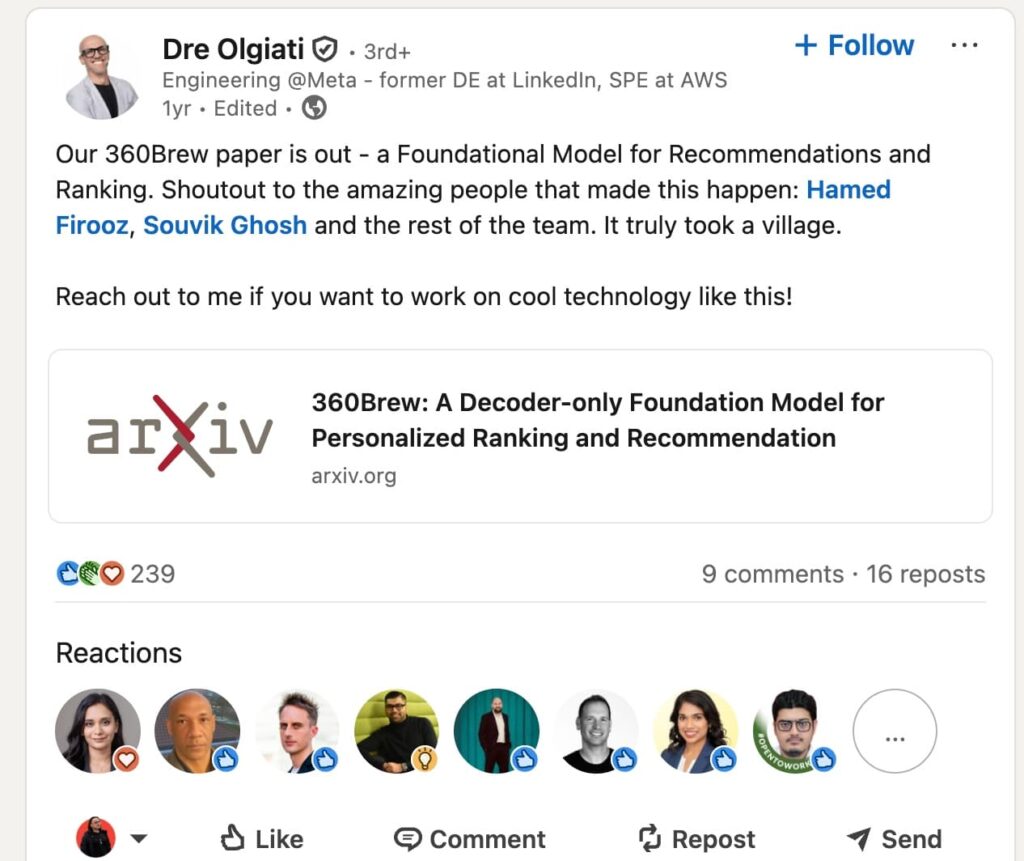
In late 2024 and through 2025, LinkedIn replaced its entire content ranking infrastructure with a single AI model called 360Brew, a 150-billion-parameter decoder-only foundation model trained on LinkedIn’s own networking data and interaction logs across feed, jobs, and connections (announced by Dre Olgiati on the LinkedIn FAIT team).
Where the old system ran thousands of separate task-specific models, 360Brew handles all things:
- Feed ranking.
- Job recommendations.
- Content distribution.
- And connection suggestions through one unified brain.
If your reach dropped through 2025, this is the structural reason.
The shift is bigger than a normal algorithm tweak.
Earlier ranking systems scored content against rules and signals that engineers wrote: hashtag matching, who follows whom, click patterns, time decay. 360Brew is a foundation model. It reads the text of your post, the metadata of your profile, and the context of what each viewer engages with, then generates a relevance score from semantic understanding rather than from counting. Rollout was gradual, hitting roughly 40 to 100% of platform surfaces by fall 2025 per LinkedIn’s engineering disclosures.
Who posted something matters less than what it’s about. The old algorithm prioritized content from your connections, which made network size a growth lever. The new algorithm prioritizes content tied to your professional interests, regardless of who posted it. A post from a stranger with demonstrated expertise on a topic you care about can now outrank a post from someone you’ve worked with for years.
Your profile is now part of the ranking input. 360Brew reads your headline, About section, experience, and posting history as a credibility signal before deciding how to distribute what you publish. Topic consistency matters more than network size. If you’re going to be discoverable in 2026, your LinkedIn profile needs to make it obvious what you’re an authority on.
How the algorithm evaluates your posts in 2026
Every LinkedIn post in 2026 passes through three sequential gates: a quality filter, a 60-90 minute velocity test, and expanded distribution, with ~70% of total reach decided in the first 90 minutes.
360Brew classifies content before any human sees it. Posts that resemble templated AI output, engagement-farming prompts, or spam patterns get throttled at this stage and never reach a real audience to be tested.
The model now handles relevance scoring across feed, search, and recommendations through the same unified system, which means the quality gate’s rules are consistent everywhere your content surfaces. Older tactics that produced bland-but-passable content are now actively penalized at the gate.
Posts that clear the gate enter the velocity test. The algorithm pushes each one to a small slice of your followers and watches what happens. Strong early engagement — especially comments and saves — signals to 360Brew that the content is worth distributing further.
Phase 3 is the long tail.
In mid-2025, LinkedIn tested an algorithm change that aggressively surfaced 2-to-3-week-old posts in feeds. After user complaints about staleness, the company walked back the most aggressive version in July 2025 but kept what LinkedIn spokesperson Bhairavi Jhaveri called “a little bit of a flex on recency” to prioritize relevance when appropriate. Evergreen content with strong velocity and saves can still pull LinkedIn impressions for weeks after publishing — just not at the wholesale scale the test reached.
The signals that matter most (and the ones that don’t)
Saves and sends carry more algorithmic weight than likes — a save is roughly 5x the weight of a like and 2x the weight of a comment, based on independent analyses of post performance under the new system. Comments still outweigh likes (commonly cited at 5 to 15x).
Dwell time, the seconds someone spends reading your post, is a top ranking factor. Likes are the weakest signal of the four.
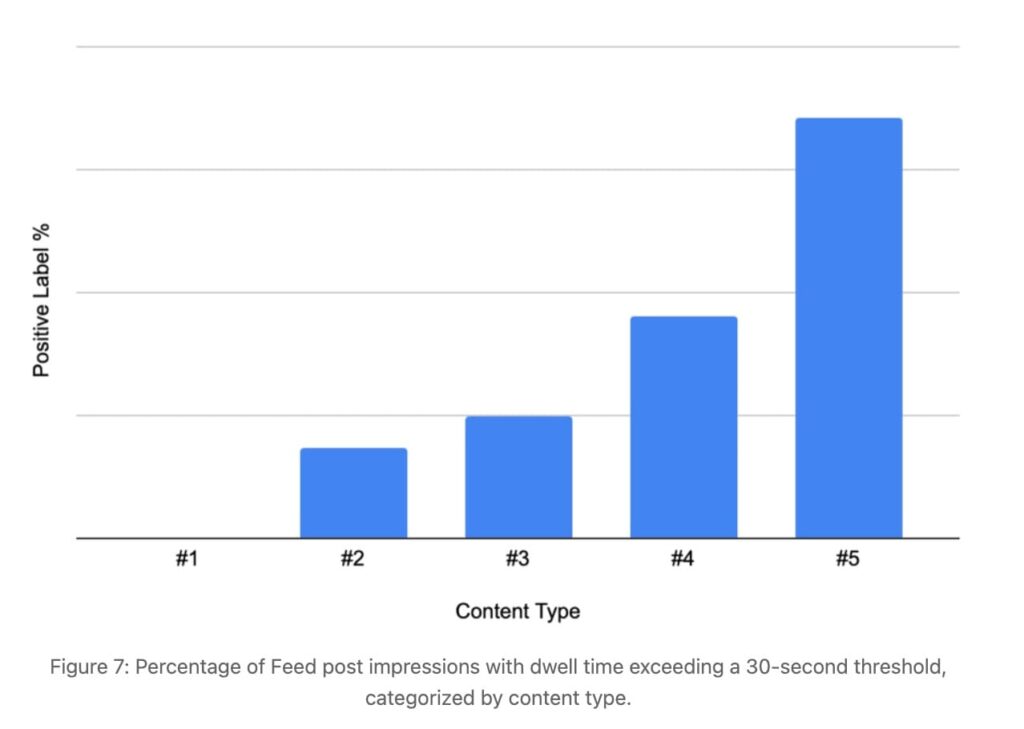
Dwell time is the clearest illustration of how the system has shifted. LinkedIn’s own engineering team has published on how they use dwell time as a ranking signal — a fast like is a noisier indicator of value than a long read. Their data shows the percentage of feed posts hitting a 30-second dwell threshold varies sharply by content type.
The algorithm pushes posts that earn sustained attention wider than posts that get a like-and-scroll. Reach goes to content that earns the second beat of attention.
The practical implication for content design: write for saves rather than surface engagement.
The posts that get bookmarked are the ones with frameworks, specific stats, step-by-step breakdowns, and templates. They’re “screenshot-worthy” in a literal sense, the kind of thing readers want to reference later.
If your post doesn’t contain something worth saving, the algorithm has no reason to keep distributing it.
What the LinkedIn algorithm rewards in 2026
The LinkedIn algorithm rewards content that hits four signals at once:
- Expert-led content on consistent topics.
- Posted from personal profiles.
- In native formats (documents, polls, video, text with images).
- That generates real conversation.
Quality beats frequency. One genuinely valuable post per week beats five forgettable ones.
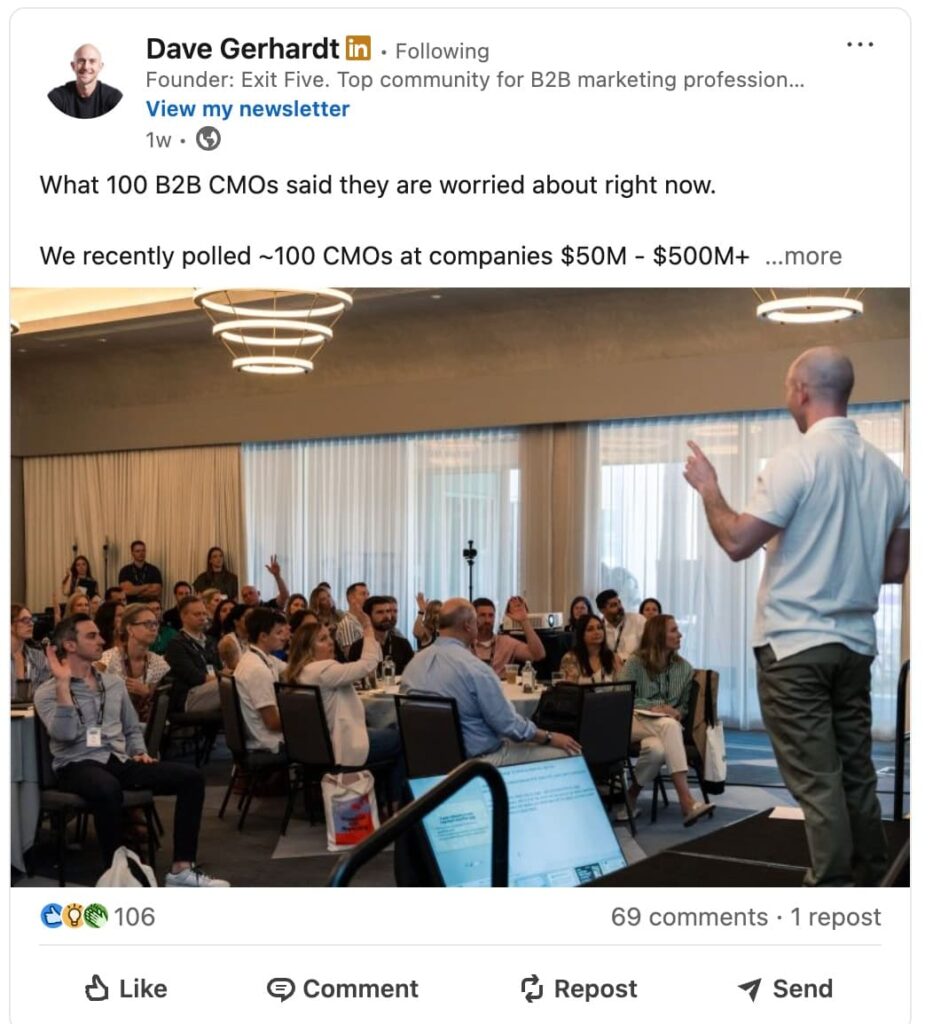
The algorithm rewards specialization over broad-spectrum posting. Personal profiles dominate consumption on the platform. For B2B teams, the highest-impact investment sits in executive and employee LinkedIn presence rather than the brand page.
The audience-first play, building a following through organic content on personal profiles before amplifying with paid, is now compounded by the algorithm’s structural preference for individual creators over brand pages. Investing in your founders and salespeople as creators is the strongest distribution move available on the platform in 2026.
The formats that win right now
The best-performing LinkedIn formats in 2026 are document carousels (1.39x reach, 1.30x engagement), image posts, and polls — carousels lead on combined reach and engagement, polls dominate raw reach but underperform on conversation, and posts with external links perform worst.
Format hierarchy in 2026, drawn from AuthoredUp’s 2026 LinkedIn benchmarks (3 million LinkedIn posts analyzed from personal profiles, March 2025 to February 2026):
| Rank | Format | Reach multiplier | Engagement multiplier | Share of all posts | Verdict |
|---|---|---|---|---|---|
| 1 | Document (carousel) | 1.39x | 1.30x | 4.88% | Frameworks, step-by-steps, save-worthy reference content |
| 2 | Image | 1.20x | 1.33x | 57.16% | Mixed-media storytelling — posts with the author in-photo see engagement lifts up to 50% |
| 3 | Poll | 1.78x | 0.37x | 1.16% | Pure visibility plays and conversation starters, not standalone content |
| 4 | Text-only | 1.07x | 0.78x | 11.59% | Thought leadership with strong hooks; optimal length 700 to 900 characters |
| 5 | Video | 0.86x | 0.93x | 10.61% | Sub-60-second vertical clips with brand visible in the first 4 seconds |
| 6 | Article | 0.69x | 0.44x | 6% | Long-form authority — but usually underperform carousels for the same effort |
| 7 | Reshare | 0.29x | 0.22x | 7.69% | Resharing others’ content with light commentary — usually the weakest performer relative to native posts. Use sparingly. |
Newsletters are worth a mention, too. Every newsletter edition triggers a push notification and an email to all subscribers, sidestepping the feed algorithm entirely. The distribution is unmatched once you’ve earned subscribers.
External link posts are among the worst-performing formats — roughly 60% reach reduction versus identical link-free posts, with the first-comment workaround now penalized as well.
If you need to drive traffic externally, share the key insight natively in the post and treat the click-through as a secondary outcome.
LinkedIn carousels work best at 8 to 12 slides. The algorithm now penalizes low completion rates, so a 15-slide deck where readers bounce on slide 3 hurts your distribution more than a tight 8-slide deck that gets fully read. LinkedIn carousel formatting matters more than length.
Richard van der Blom analyzed 1.8 million LinkedIn posts across 58,000 personal profiles for his 2025 Algorithm Insights Report, and landed on a single takeaway: the algorithm has changed, but a clear strategy still wins.
His LinkedIn playbook is straightforward: engage with your network before and after publishing, design posts for saves and meaningful comments rather than likes, and use Thought Leader Ads to bridge organic content with paid amplification when you want to extend a winning post’s life.
Topic consistency is the new growth hack
360Brew builds a profile of your expertise based on your posting history. If you post about ten different topics, the model can’t decide which audience to show your content to, and your reach suffers. The teams winning right now have narrowed to two or three core themes and stay disciplined.
Topic discipline is now an algorithm strategy in its own right. Posting across ten themes signals to 360Brew that you’re an authority on none of them.
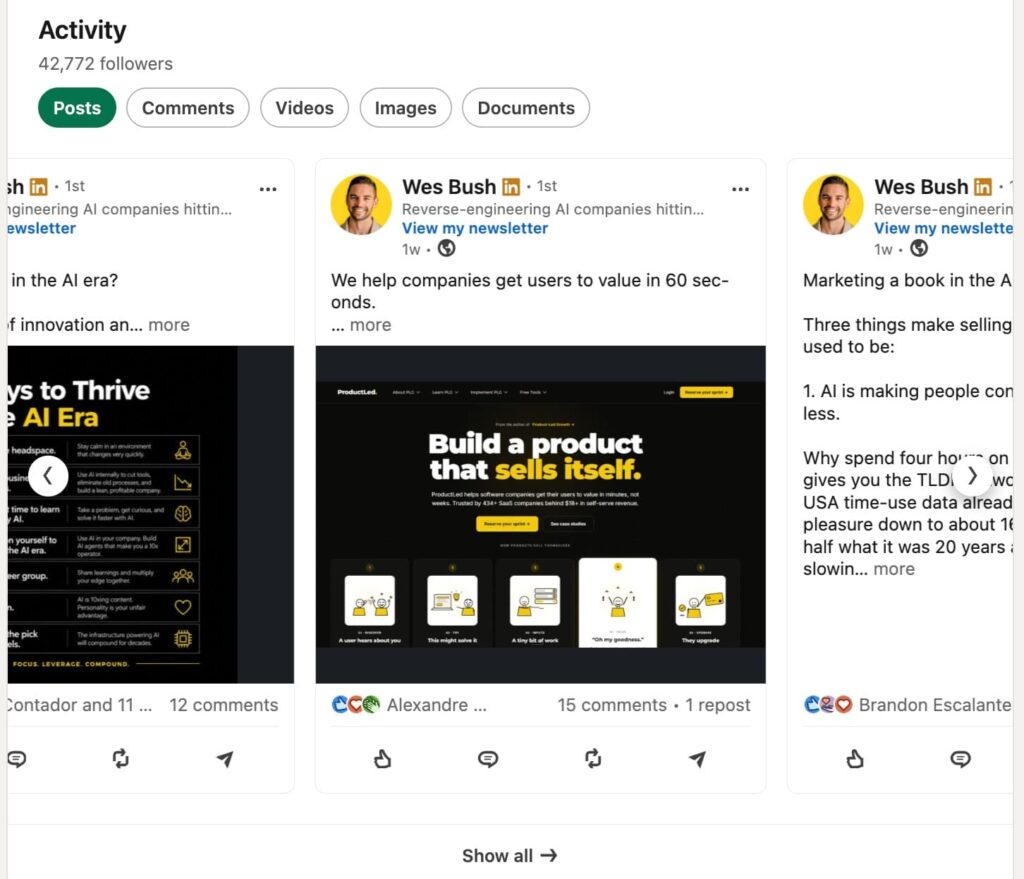
For example, Wes Bush posts about product-led growth and founder mechanics every day.
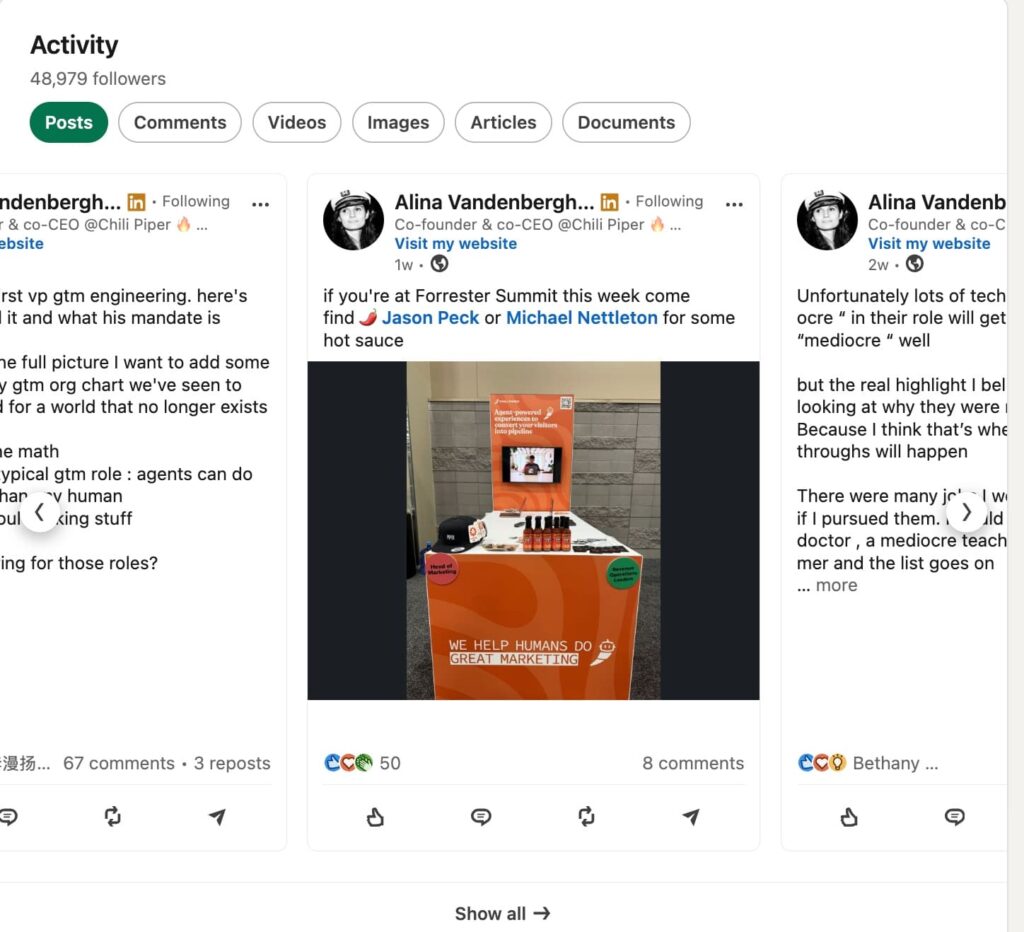
Alina Vandenberghe posts about what she wishes she’d known as a founder.
Both have built outsize organic reach by giving 360Brew a clear, repeated signal about what they’re an authority on. Inconsistent topic posting is now one of the fastest ways to dilute your distribution.
Vandenberghe’s framing on consistency from a recent GTM Society interview is worth repeating: “It took me 12 months to just feel comfortable pressing the post button. That’s the most important piece.” The algorithm rewards compounding more than it rewards velocity. Don’t give up three months before the compounding starts.
What the LinkedIn algorithm punishes in 2026
Five behaviors trigger distribution penalties under 360Brew: AI-templated content, engagement bait, automated pod engagement, external links in body, and hashtag stuffing.
| Behavior | Algorithmic penalty | Fix |
|---|---|---|
| AI-templated content | Throttled at the quality gate before reaching a real audience | Specific point of view + concrete detail — the stuff a generic LLM output won’t produce by default |
| Engagement bait (“Comment YES!”, “Tag someone!”) | Pattern-matched as low quality and suppressed | Write hooks that earn engagement on substance, not reaction-farming |
| Comment pods or automated engagement tools | Detected-automated comments capped in visibility, often below the post’s organic baseline | Skip pods. The penalty outweighs the boost |
| External links in the post body | ~60% reach reduction vs identical link-free posts. First-comment workaround penalized since early 2026 | Share the insight natively, treat the click-through as a secondary outcome |
| Hashtag stuffing | Reads as spam — the algorithm now uses semantic intent, not hashtag matching | Cap at three relevant hashtags max |
How to work with the LinkedIn algorithm in 2026
Across 1.8 million posts and 58,000 profiles, van der Blom’s research points to two moves with outsized leverage on the new algorithm: engage your network before and after publishing, and design every post for saves and meaningful comments instead of likes.
Here’s how that plays out in practice.
The 90-minute window: what to do before, during, and after you post
Engage with 5 to 10 posts in your feed for 10 to 15 minutes before you publish. Post. Then stay active for 90 minutes: reply to every comment within 15 minutes, engage with others’ content, and watch your engagement velocity. Pre and post engagement around publishing can lift reach by up to 20%, which compounds against the algorithm’s velocity test.
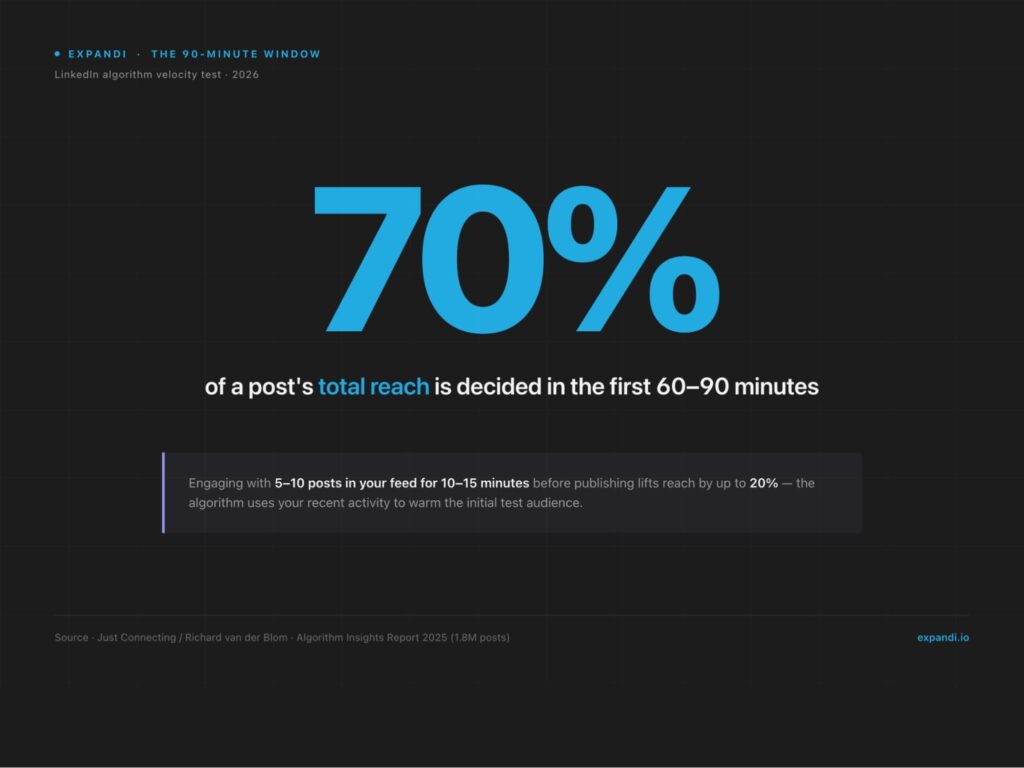
The LinkedIn algorithm uses your recent activity as one input to decide who’s likely to see your post in the test phase. If you’ve been engaging in the right communities just before publishing, the initial test audience is warmer. If you’ve been silent for hours, you’re starting cold.
Replying to comments within 15 minutes pulls each commenter back into the post for a second engagement and tells the algorithm the post is generating real conversation, deepening the velocity signal.
Multi-turn conversations between the author and a commenter (back-and-forth replies) amplify reach more than a single comment-and-reply pair.
How to design for saves
Concrete saving triggers, in order of impact:
- A clearly named framework with a memorable label
- A specific number readers will want to cite (“document carousels drive 1.39x more reach”)
- A step-by-step process with explicit settings or numbers
- A template or fill-in-the-blank prompt
Generic advice without one of these earns passive scrolls.
Design for 7 seconds on mobile
The vast majority of LinkedIn activity happens on mobile (van der Blom), and users scan posts in seconds before deciding whether to scroll. The first two lines (the hook above the “…see more” cut) and the visual presentation determine whether the rest of the post even gets read.
Structure every post for mobile-first readability. Short lines (under 12 to 15 words). White space between thoughts. A hook in the first sentence that’s specific and concrete rather than abstract. LinkedIn post formatting (bold, italics, line breaks) used sparingly to guide the eye. The whole goal is earning the second beat — the moment a reader taps “…see more”.
Turning LinkedIn algorithm visibility into outbound pipeline
Algorithmic reach only generates revenue when you act on it. When the algorithm shows your content to the right people and they engage, you have a 24 to 48-hour window to turn that visibility into pipeline. The teams running real outbound against post engagers compound across every post that performs. The teams collecting impressions get a vanity report at the end of the quarter.
The content-to-pipeline loop runs in six steps:
- Post content the algorithm rewards — native format, consistent topic, save-worthy value.
- The algorithm distributes it to your target audience.
- People engage: likes, comments, profile visits, saves.
- Identify who engaged.
- Reach out within 24 to 48 hours with a personalized message referencing the post.
- Open a conversation. Don’t lead with the pitch.
This is the bridge that makes LinkedIn social selling compound.
Nick Tomic describes the loop in a recent GTM Society interview:
“I had a post that got 50 comments. I used Expandi. I put an automation so that it would go through everybody that liked and commented. I added them on LinkedIn with a message saying, hey, I saw you engage with my case study. I booked a couple of demos from that.”
The framework behind the move scales: every post that performs becomes a fresh list of warm leads to run outbound against, and the more you publish, the more pipeline signal-based outreach generates.
This is where Expandi fits. Drop the URL of any LinkedIn post — yours or anyone else’s — into a Post Engagement lead list and Expandi pulls up to 2,500 to 3,000 people who liked or commented on it.
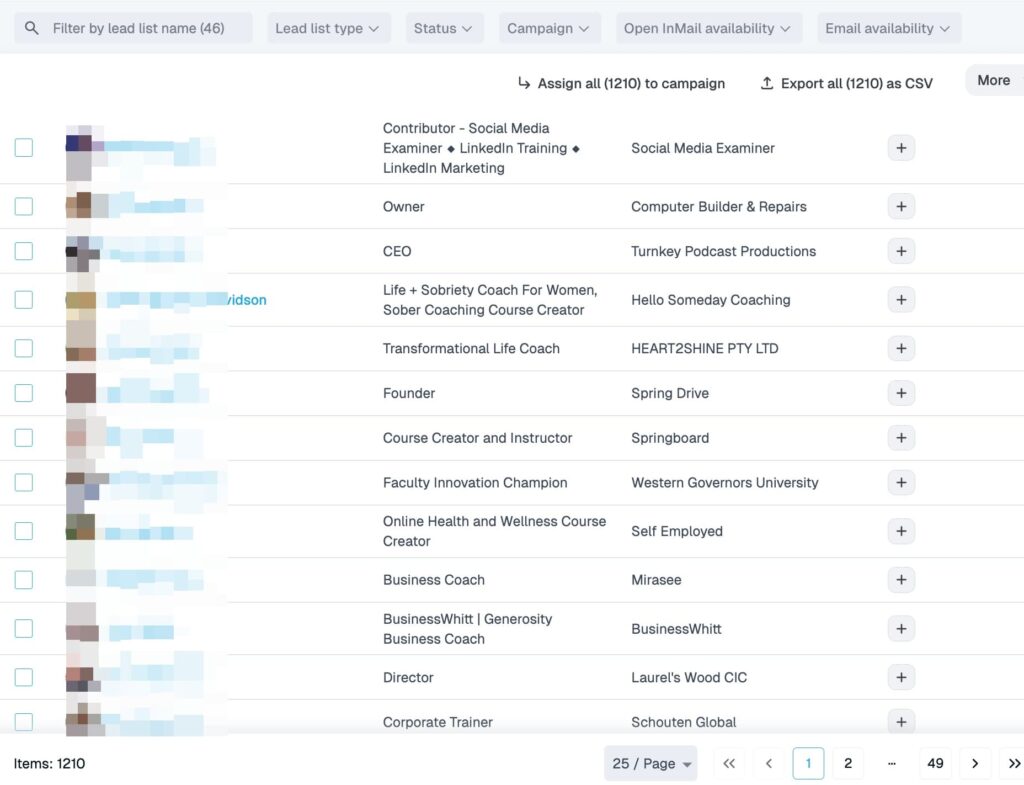
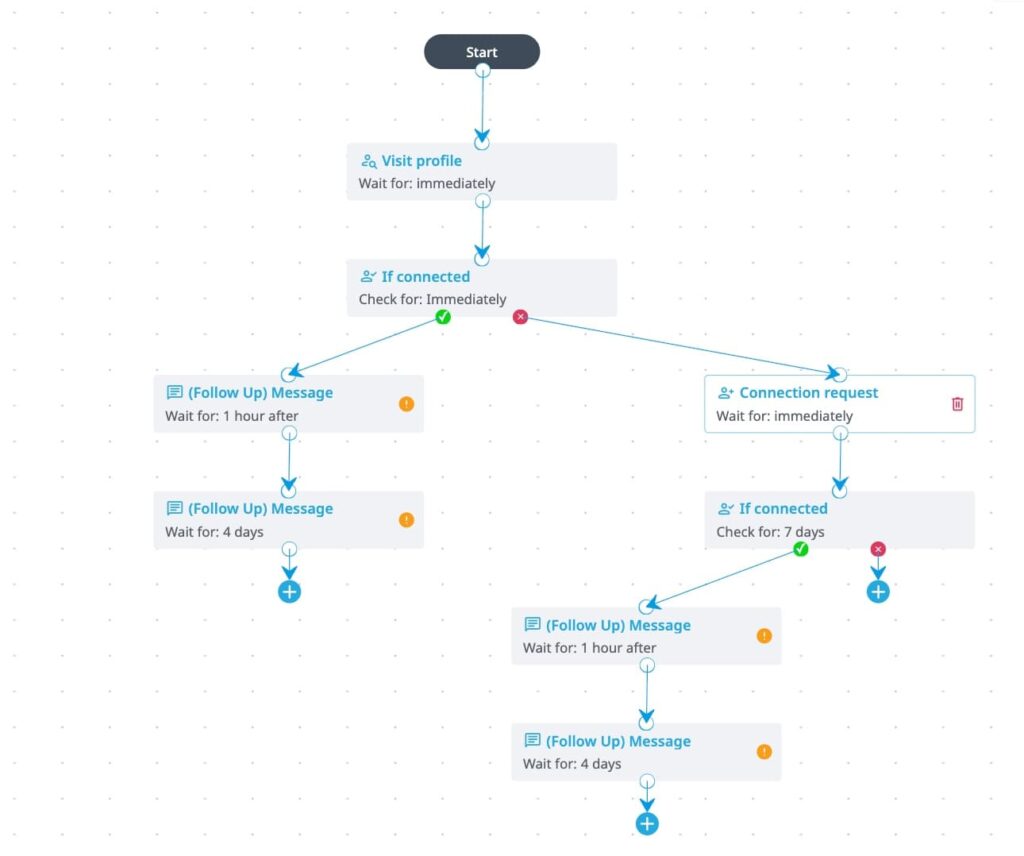
Then, push that list into a Builder campaign, write a connection request that references the specific post they engaged with, and you’re running personalized outbound against a warm audience inside an hour. Same loop Nick described, but built into a repeatable campaign you can re-run against every post that performs — yours or a competitor’s.
Chris Walker — founder of Refine Labs and now Passetto — has done the same kind of self-reported attribution work for years, and his data points to the same conclusion.
When you ask customers how they really found you, LinkedIn organic is consistently the top channel, even when traditional attribution software credits organic search or direct traffic. The algorithm creates the visibility. What you do with that visibility, especially how fast you reach out and how relevant the message is, determines whether it becomes LinkedIn outreach ROI.
LinkedIn algorithm in 2026: Frequently asked questions
360Brew is the single AI model that now runs LinkedIn’s feed ranking, job recommendations, content distribution, and connection suggestions, replacing thousands of separate models with one unified system. For posters, the practical shift is that 360Brew reads your content semantically (what it’s about, who finds it useful) rather than scoring it on the older rule-based signals like hashtag matching and click patterns. Rollout reached 40 to 100% of platform surfaces by fall 2025.
Marginally. The algorithm now scans your post copy directly for intent and keywords rather than relying on hashtags for topic classification, so stacking ten hashtags signals spam more than relevance. Three hashtags relevant to the post topic is the cap performance data may support — anything past that hurts more than it helps.
Average personal-profile engagement lands around 2 to 3% based on AuthoredUp’s analysis of 3 million posts. Document carousels run higher at 6 to 7%, polls hit 4 to 5% on engagement (despite their 1.78x reach multiplier), and company page posts typically sit at 1 to 2%. Anything above 4% on a personal profile is solidly above average.
Sparingly and intentionally. Tagging relevant people who’ll engage in the first 90 minutes helps your velocity test, since each tagged person who reacts strengthens the early engagement signal. Tagging dozens of unrelated people reads as spam to 360Brew’s quality gate and can suppress distribution before the post reaches a real audience.
No. The algorithm shows each post to roughly 2 to 5% of your network first, then decides whether to expand based on how that test audience engages. Saves, comments, and dwell time during the test window are what determine wider distribution.
Impressions count every time your post appears on a screen — one viewer can generate multiple impressions across separate sessions. Reach counts unique viewers. Both metrics matter, but for algorithmic distribution diagnostics, dwell time and engagement velocity tell you far more than either raw number.
Yes. LinkedIn explicitly limits visibility of comments it detects as automated, including those from external comment pods and engagement-trading tools. Buying engagement from a pod can cap your post’s reach below where it would have landed organically — the algorithm reads the coordination pattern even when individual comments look natural.
The bottom line on the 2026 LinkedIn algorithm
The algorithm has changed in 2025 and now reach is down for everyone. But the teams who understand 360Brew’s quality gate, the 90-minute velocity window, and the format hierarchy are getting better results than they did in 2023.
The catch is that algorithmic visibility only matters if you convert it into conversations.
If you want to put the second half of the playbook into practice, Expandi can help.
Use Signals to catch who engages with your posts, Smart Sequences to follow up personally within the 24-hour window, and Campaign Builder to make the algorithm-to-pipeline loop repeatable across every post that performs.Start a 7-day free trial to play around and explore the features before you commit.

You’ve made it all the way down here, take the final step