The LinkedIn Automation Compliance Checklist for Enterprise Buyers

Enterprise LinkedIn automation deals rarely stall because legal doubts the product.
They stall on documentation: a missing Data Processing Agreement, a vague data-handling clause, an entity detail no one can produce on request.
We’ve watched a 15-seat deal sit in legal review for weeks over paperwork that takes an afternoon to assemble.
This guide lays out:
- The four documents enterprise legal teams ask for.
- The two clauses that get a vendor disqualified on sight.
- And how to move a LinkedIn automation tool through internal compliance in days rather than months.
Key Takeaways
- Enterprise LinkedIn automation reviews stall on documentation, so legal asks for four standard documents, and a missing one stalls the deal more often than the product does.
- Have all four ready before the review starts: incorporation details, a Data Processing Agreement, the customer agreement, and the privacy policy.
- Two clauses get a vendor cut: an agreement that lets the vendor retain or resell your data, and data handling that gives no clear answer on where your data goes or under what legal mechanism.
- No vendor can claim “LinkedIn ToS compliance.” LinkedIn prohibits third-party automation outright. What legal can assess is the vendor’s data compliance and its account-safety risk profile.
- Expandi is EU-incorporated, with a published GDPR Data Processing Agreement and documented security measures, so the compliance pack is ready to hand to legal on day one.
The LinkedIn Automation Compliance Checklist for Enterprise Buyers


Why LinkedIn automation deals stall at the compliance stage
The actual product is rarely the blocker.
By the time a purchase reaches legal, the team that will run the outreach has already decided the tool works. What stalls the deal is the compliance review, and what stalls the compliance review is missing documentation.
It’s a common, expensive bottleneck. Secureframe found that 46% of companies say a lack of compliance certification has delayed sales.
Take Matthew Massing’s 15-seat Expandi rollout at Raft.ai. The product was approved quickly, but the deal nearly stalled in legal review: procurement needed a Data Processing Agreement that passed internal scrutiny before anyone would sign. Once the documentation cleared, the deal closed.
The good news is that the checklist is predictable. Legal asks for the same things across deals, so you can assemble the pack once and reuse it on every enterprise evaluation.
The four compliance documents legal teams ask for
Across enterprise reviews, legal requests the same four documents. Have them ready and you remove the back-and-forth that drags a review out for weeks.
1. Incorporation and registration details
Legal starts with who they’re really contracting with: the legal entity, its type, and its country of incorporation.
For a GDPR-exposed buyer, an EU-incorporated vendor is simpler to clear, since the contract sits under EU law from the start. Expandi contracts through LeadExpress B.V., a company registered in the Netherlands, which keeps the governing terms under EU jurisdiction.
2. Data Processing Agreement (DPA): the critical one
This is the critical document. Under GDPR Article 28, when a vendor processes personal data on your behalf, that relationship has to be governed by a binding Data Processing Agreement.
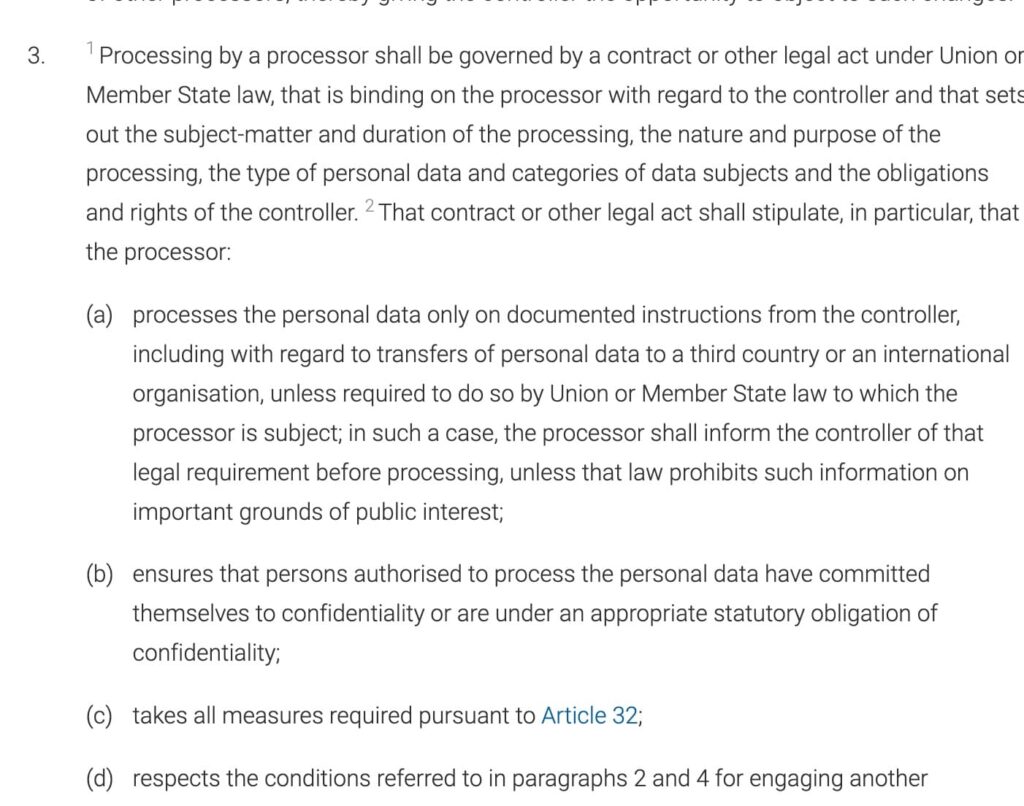
GDPR makes it mandatory, and the DPA has to cover eight obligations:
- Instruction-only processing.
- Confidentiality.
- Security measures.
- Sub-processor controls.
- Help with data-subject requests.
- Breach assistance.
- Deletion or return of data when the contract ends.
- And audit rights.
What legal checks inside it:
- That you (the controller) own the data.
- That the vendor processes it only on your instructions.
- How sub-processors are approved.
- The breach-notification timeline.
- And what happens to the data on termination.
Expandi publishes a DPA that covers these points — instruction-bound processing, sub-processor authorization with a right to object to changes, breach notification without undue delay, and deletion or return of data on termination with written confirmation that no copy is kept.
3. Customer agreement and terms of service
In the terms, legal reviews data ownership, the limitation of liability, the termination clauses, and how the agreement treats the LinkedIn relationship.
Expandi’s terms are governed by Dutch law and state plainly that the tool is not an official LinkedIn feature — which sets accurate expectations with legal rather than leaving them to find the gap later.

4. Privacy policy
EU legal teams read the privacy policy for four things:
- What data is collected.
- How long it’s retained.
- Who it’s shared with.
- How cross-border transfers are handled.
Expandi’s privacy notice sets retention windows (inactive accounts are anonymized or deleted after 12 months, for example) and discloses that some processing runs through providers outside the EU, with safeguards in place for those transfers.

Disclosing it is the point — legal can clear a transfer it can see, and stalls on one it has to go digging for.
The two clauses that get a LinkedIn automation vendor disqualified
Two clauses end an evaluation regardless of how good the product is. Find them early so you don’t spend a month on a vendor legal was always going to reject.
A right to retain or resell your data
If a vendor’s agreement lets it hold onto your prospect and customer data after the contract ends, or reuse and resell it, enterprise legal will walk.
Read the retention clause closely. If it quietly reserves the vendor’s right to reuse your data, to train its own models or improve its own product, treat that as a red line. Confirm it before you sign.
That data is your asset, and often your clients’.
What clears the bar is instruction-only processing and a clean deletion-on-termination clause.
Expandi’s DPA is instruction-bound and requires deletion or return of the data with written confirmation that no copy is retained, which answers the question before legal has to ask it.
Data handling with no clear answer
The second disqualifier is a vendor with no clear answer on where data is processed or under what legal mechanism.
For an EU buyer, “we’re not sure where the data goes” ends the conversation.
The answer legal wants is specific:
- Who processes the data?
- Where?
- And for any processing outside the EU, which transfer mechanism applies?
Common mechanisms include Standard Contractual Clauses and the EU-US Data Privacy Framework. A vendor that can name its mechanism clears the review. One that improvises does not.
The LinkedIn Terms of Service question for automation tools
Expect legal to ask whether the tool complies with LinkedIn’s Terms of Service.
The honest answer is that no third-party automation tool does, because LinkedIn’s User Agreement prohibits automated access to the platform outright. Any vendor claiming to be “LinkedIn-compliant” or “LinkedIn-approved” is telling you something LinkedIn has never said about anyone, and that should lower your trust.
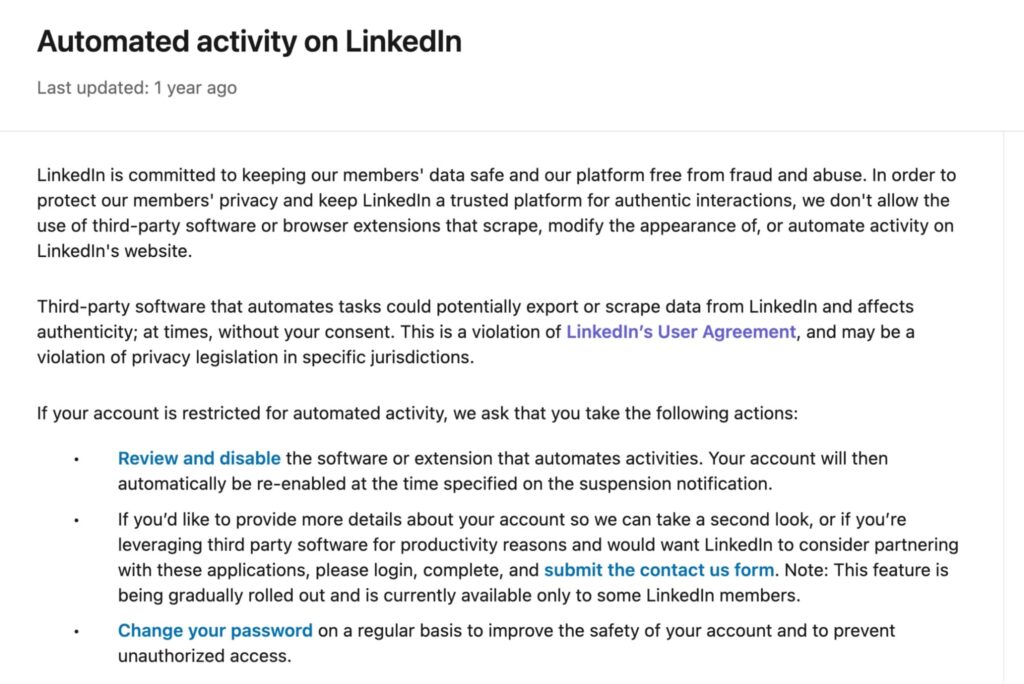
What legal can assess is two real things.
- First, the vendor’s own data compliance: the DPA, the privacy posture, and the documents above.
- Second, the operational risk profile, meaning how much the tool reduces the chance of a restricted account.
A tool that sends from a dedicated IP, stays inside LinkedIn’s limits, and mimics human behavior carries materially lower risk than a scraper.
That’s a risk claim, which is honest, where “ToS-compliant” is a claim no one can make.
Expandi runs cloud-based, dedicated-IP automation built around that risk profile, and its terms state directly that it is not an official LinkedIn feature.
SOC 2 and ISO 27001: do you need them?
Neither is legally required for LinkedIn automation.
Both are buyer-driven assurances:
- SOC 2 is an AICPA audit report common in the US market.
- ISO 27001 is an international certification recognized more widely outside it.
A procurement policy may require one, but the law does not — what the law requires is the DPA.
For mid-market deals, a DPA, a privacy policy, and a completed security questionnaire tend to clear the review.
Certification becomes a hard gate mainly in regulated industries: healthcare, fintech, government, where a buyer’s own obligations force it.
Expandi provides its:
- DPA.
- The security measures documented alongside it (encryption at rest, access controls, 2FA, VPN, and regular backups).
- And completed security questionnaires on request.
If your security policy specifically mandates a SOC 2 report or an ISO 27001 certificate, surface that at the start of the evaluation so procurement can weigh it early rather than late.
How Expandi’s documentation maps to the compliance checklist
Here’s how Expandi’s documentation lines up with the four-document checklist, so you can hand legal a complete pack in one pass:
- Incorporation — LeadExpress B.V., registered in the Netherlands (EU), named in the terms.
- Data Processing Agreement — published and GDPR Article 28-aligned: instruction-bound processing, breach notification without undue delay, sub-processor authorization with a right to object, and deletion or return on termination.
- Customer agreement — Dutch-law terms that state the LinkedIn relationship plainly.
- Privacy policy — retention windows, sub-processor categories, and transfer mechanisms disclosed.
- Security measures — the technical and organizational controls documented in the DPA’s annex, which answers many security-questionnaire items on their own.
From your Expandi contact, request the DPA, a completed security questionnaire, and confirmation of the sub-processors and transfer mechanism that apply to your jurisdiction.
For teams buying multiple seats, the agency and team setup and workspace permissions also come up in security review, so have those answers ready too.
How to fast-track internal compliance approval
The fastest reviews follow a sequence: send the right document to the right reviewer in the right order, and run the threads in parallel rather than one after another.
- Send legal the four-document pack up front — incorporation, DPA, terms, and privacy policy — before they ask for it. Pre-empting the request removes the first round of delay.
- Complete the security questionnaire in the same pass, and flag any SOC 2 or ISO 27001 requirement immediately so it surfaces on day one rather than week six.
- Answer the LinkedIn ToS question proactively, using the honest framing above: data compliance plus a lower-risk account-safety profile.
- Give procurement the entity and signatory details so the contract can be drafted in parallel with the legal review.
- Loop in your Expandi contact for jurisdiction-specific items — including sub-processors and the applicable transfer mechanism, so legal gets a precise answer the first time.
Run this way and a review that would have drifted for months across multiple stakeholders closes in days.
Clear compliance, then close the deal
Enterprise LinkedIn automation deals are won and lost on documentation, and the documentation is predictable. Have the four documents and a completed security questionnaire ready, answer the Terms of Service question honestly, and surface any certification requirement early. A compliance review stops being the thing that kills your timeline.
Expandi’s compliance pack, including the GDPR Data Processing Agreement, privacy notice, and security documentation, is ready to hand to legal.
Request Expandi’s compliance documentation and move your evaluation through procurement in days.
Frequently asked questions
Yes, if the tool processes personal data about people in the EU on your behalf. GDPR Article 28 requires that any controller-processor relationship be governed by a binding DPA covering eight set obligations, from instruction-only processing to deletion of data when the contract ends.
A vendor with no DPA fails EU legal review.
No. LinkedIn’s User Agreement prohibits third-party automation of the platform, so no vendor can truthfully claim to be “LinkedIn-compliant.”
What you can evaluate instead is the vendor’s data compliance and how much its design lowers the risk of an account restriction, including sending from a dedicated IP, respecting limits, and behaving like a human rather than a scraper.
Not as a legal matter. Both are buyer-driven, and neither is required by law. Many mid-market deals clear on a DPA, a privacy policy, and a completed security questionnaire.
Certification tends to become a hard requirement in regulated industries like healthcare, fintech, and government, so confirm your own policy before you make it a deal-breaker.
Expandi is incorporated in the EU (the Netherlands) and processes customer data under a published GDPR Data Processing Agreement, with documented security measures and disclosed retention periods.
For any processing outside the EU, the DPA points to GDPR transfer mechanisms. Confirm the specifics for your jurisdiction in the DPA or with your Expandi contact.
Expandi is a Netherlands-incorporated vendor, and its privacy notice discloses that some processing runs through providers outside the EU.
The DPA sets the transfer mechanism, specifically Article 46 safeguards including Standard Contractual Clauses, and names its sub-processors (for example CJ2 Hosting in the Netherlands and Zapier in the US), which is the level of detail enterprise legal expects to see.


You’ve made it all the way down here, take the final step