The 8-Step LinkedIn Warm-Up Sequence to Run Before Every Connection Request

Many LinkedIn connection requests fail because they land cold.
The prospect has never seen your name, so the request reads like every other pitch in their notifications, and they tap Ignore without a thought.
A LinkedIn warm-up sequence fixes that by putting your name in front of them a few times before you ever ask to connect.
- Open with a specific, no-pitch email.
- Like a recent post.
- Visit and follow their profile.
- Follow their company page.
- Only then, send the request. By the time it arrives, you’re a name they recognize.
- Then three spaced follow-ups turn the accept into a conversation.
We mapped the highest-accepting connection campaigns across our customer base at Expandi and found that the LinkedIn connection requests that land warm were almost never someone’s first touch. The reps clearing well above the cold-request average had already shown up in the prospect’s feed and notifications before the ask.
Below:
- How to warm up your account so it’s safe to run this playbook at all.
- Why cold LinkedIn connection requests often get ignored.
- The full eight-step sequence one step at a time.
- How to automate this whole warm-up sequence as a single Expandi campaign.
- A stripped-down version for when you’re short on time, and the results the sequence produces.
Key Takeaways
- A warm-up sequence puts your name in front of a prospect several times before the connection request, so it lands familiar rather than cold.
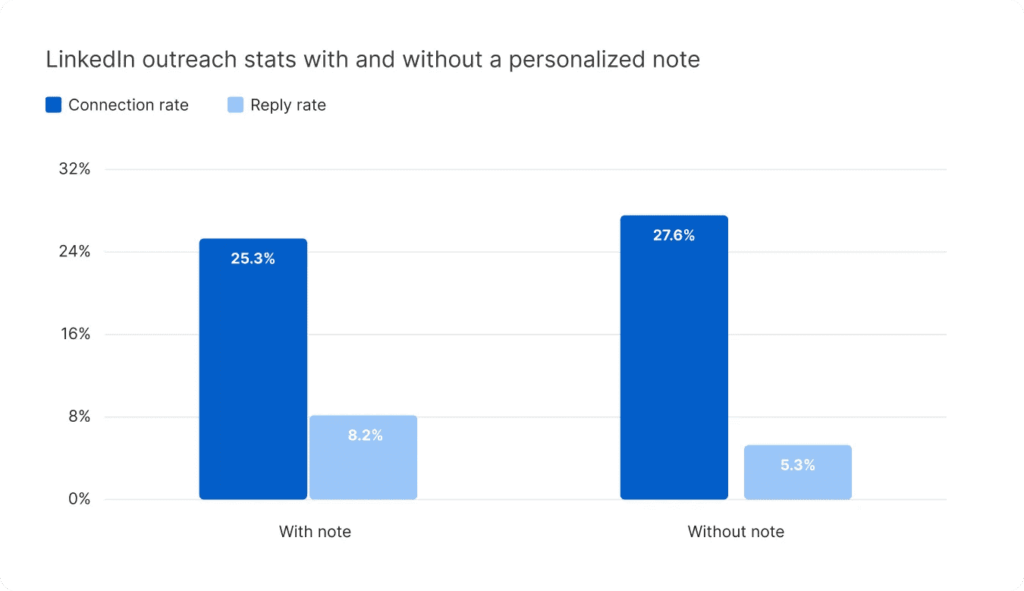
- Skip the note on the request itself. In Belkins’ 2026 data, no-note requests accept slightly higher (27.6% vs 25.3%), while a note lifts reply rate 55% after the accept — so save it for the follow-up.
- The touches that do the most are a post like, a profile visit and follow, and a company-page follow, all before you ask to connect.
- The follow-up matters more than the request. Three spaced messages (a question, a proof point, a graceful exit) are where replies happen.
- Expandi’s Builder campaign runs all eight steps automatically, including the company-follow touch most automation tools don’t offer.
The 8-Step LinkedIn Warm-Up Sequence to Run Before Every Connection Request

Warming up your LinkedIn account before you run this warm-up sequence playbook
Before any of this works, your account has to be safe to run a sequence at all.
If you fire dozens of actions a day from a new or dormant account, LinkedIn flags the spike.
Account warm-up means ramping your daily activity gradually so it reads as human: start at five to fifteen actions a day and build up over a couple of weeks before you run a full sequence.
Expandi handles this layer for you.
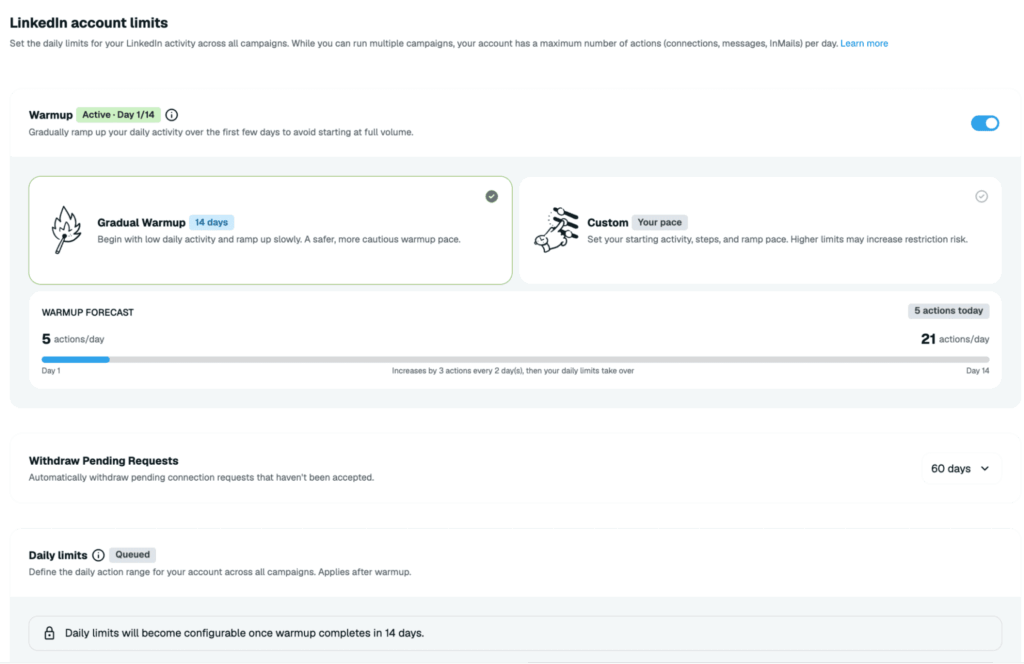
It runs each account from a dedicated country-based IP, auto-warms new accounts from low to safe limits, and enforces smart daily caps that keep you inside LinkedIn’s connection request limits.
Get the account warm first so outreach is safer, then warm up your prospects. The rest of this guide is about the second kind of warm-up.
Why cold LinkedIn connection requests get ignored
A cold request asks a stranger to vouch for you with nothing to go on. So, they often get ignored because there is no shared context or recognition.
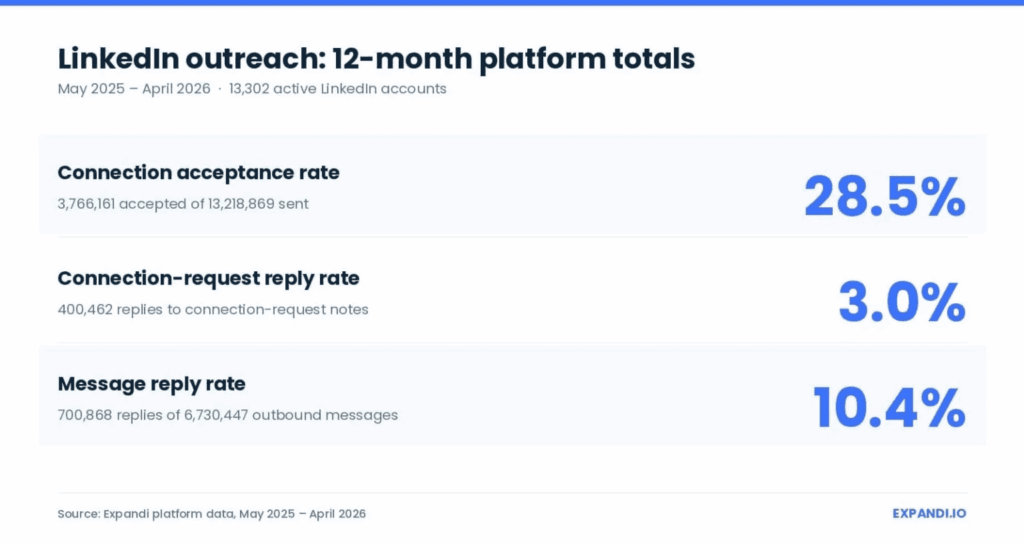
Across 13.2 million connection requests, the average acceptance rate sits at 28.5% in our 2026 LinkedIn outreach benchmarks. Roughly seven in ten requests go nowhere, and most of them are cold.
Familiarity is what flips that.
People accept requests from names they recognize, and they recognize names they’ve seen before, in their notifications, their feed, their profile viewers.
The warm-up sequence manufactures that recognition on purpose, one small touch at a time, so the request lands with context already attached.
Founders running this outbound playbook see it firsthand:
“When we do the outbound to our key ICP personas, people have already seen us, they’re aware of us… they recognize our faces and that’s worked really well for us.” — Morgan Edmondson, co-founder of Nesti, a personalized AI video tool for go-to-market.
The 8-step LinkedIn warm-up sequence to run before sending a connection request
Each step adds one touch. Stacked in order, they move a prospect from never having heard of you to recognizing your name before you ask to connect, then into a real conversation.
Here’s a quick overview on the warm-up sequence you should run before you send LinkedIn connection requests.
| Step | Action | What it does |
|---|---|---|
| 1 | Short email, no pitch | First touch off-platform |
| 2 | Like a recent post | Lands in their notifications |
| 3 | Visit + follow profile | Profile-viewer and follow signals |
| 4 | Follow company page | Signals interest, fills your feed |
| 5 | Connection request, no note | Lands familiar |
| 6 | Message 1: a question | Opens a conversation |
| 7 | Message 2: a proof point | Earns trust and authority |
| 8 | Message 3: graceful exit | Re-opens quiet threads |
Run them in this sequence:
Step 1: Send a short email first (if you have the address)
If you have their email, the warm-up starts here, before any LinkedIn action.
The email skips the pitch and the ask entirely. It’s one specific question or compliment that shows you know their world, so your name lands as someone worth recognizing rather than a stranger.
Keep it to two lines and leave the product out of it. For example:
“Subject: quick question on [company]’s [specific area]”
“Hi [first name], saw [company] is [specific signal or move] — are you running [related challenge] in-house, or leaning on [common approach in their space]?
Genuinely curious how teams your size are handling it right now.”
A sharp, specific question that proves you know the industry does more for recognition than any sales line.
No email address? Skip to step 2.
Step 2: Like a recent post
Like, or briefly comment on, something they posted in the last week or two to get on their radar.
A like drops you into their notifications with zero friction.
A short, specific comment does more, because it shows you read the post. One recent, relevant post is enough to show you’re paying attention.
Step 3: Visit and follow their profile
Then, visit their profile, and follow it.
The visit surfaces you in their Who viewed your profile list, as long as your visibility is public rather than private mode.
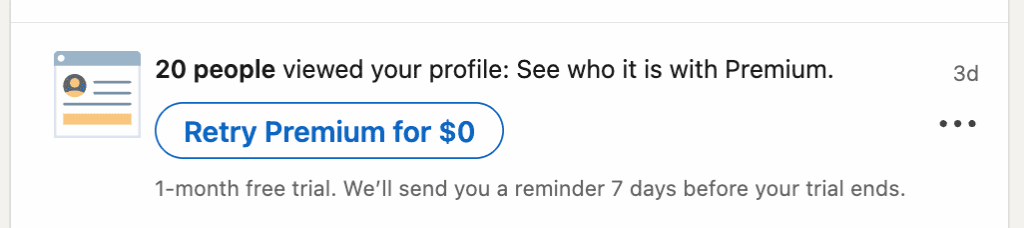
The follow adds a second light signal, since LinkedIn notifies non-connections when someone follows them. Two more passive touches, both building recognition before you ask for anything.
Step 4: Follow their company page
Follow the prospect’s company page.
It’s a warm-up touch many LinkedIn marketing tools don’t offer, and it signals interest in their world rather than a transactional connect.
It also keeps their company’s posts in your feed, which hands you something real to reference when you message later.
Step 5: Send the connection request (skip the note)
Now send the request.
By this point your name has shown up three or four times, so it reads as familiar rather than cold.
In their LinkedIn outreach study of 15M+ touchpoints, Belkins found that skipping the note gets you accepted slightly more often (27.6% without a note against 25.3% with one). Save your limited notes for after the accept, where a note lifts replies by 55% (8.2% against 5.3%).
For the wording itself, our connection message templates cover the requests and follow-ups by scenario.
Step 6: Message 1, one specific question
Once they accept, wait a day, then open with a single specific question tied to their world.
The goal of message one is simply a reply. Something like:
“Saw [company] is moving into [area] — how are you handling [specific challenge] there?”
One question they can answer in a sentence.
Step 7: Message 2, authority signal and one case study
If they reply, the second message earns trust with proof they can see for themselves.
Tie one specific result to what they told you in message one, then offer to send the receipts (a short Loom, a case study, a quick teardown) rather than just asserting a number.
“That’s the same wall [Company] hit. They went from [before] to [result] in [timeframe] — happy to send a 2-minute Loom walking through how, if it’s useful?”
One case study with no feature list works best here, kept to a couple of lines at most.
Step 8: Message 3, the graceful exit
If the thread goes quiet, the last message is a low-pressure out.
“All good if this isn’t a priority right now. I’ll stop crowding your inbox — but if [topic] ever moves up the list, you know where to find me.”
It costs you nothing and often pulls more replies than message two, because removing the pressure gives a busy prospect an easy reason to re-engage.
How to automate the LinkedIn warm-up sequence in Expandi
Run by hand, eight touches per prospect collapses past a handful of leads a day.
This whole sequence is one Builder campaign in Expandi.
The conditions route each prospect automatically:
- Has an email → send the email first, then start the LinkedIn touches.
- Already connected → skip the request and open with message one.
- Not connected → send the connection request, then message one once it’s accepted.
- They reply → send message two, the proof point.
- Thread stays quiet → send message three, the graceful exit.
To build it, drop the actions in order, put a delay on each, and add the conditions above so the path adapts to what the prospect does.
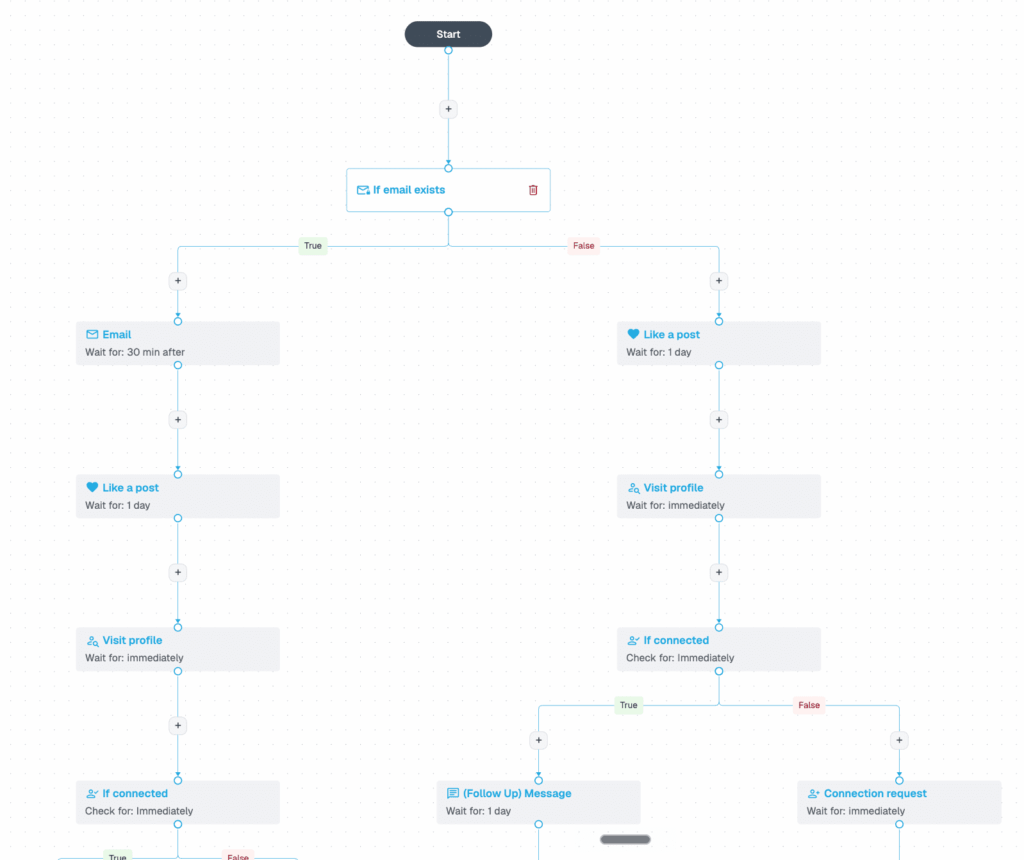
Set it once and it runs the full warm-up on every prospect. You can go a step further and let intent signals fire the sequence at the right moment, right after someone engages with your post, so you’re warming up people already paying attention.
The minimum viable LinkedIn warm-up sequence version (when you’re short on time)
No time for all eight steps? Keep the four that carry the most weight:
- Visit their LinkedIn profile.
- Like a recent post.
- Send the connection request.
- Send the first follow-up message once they accept.
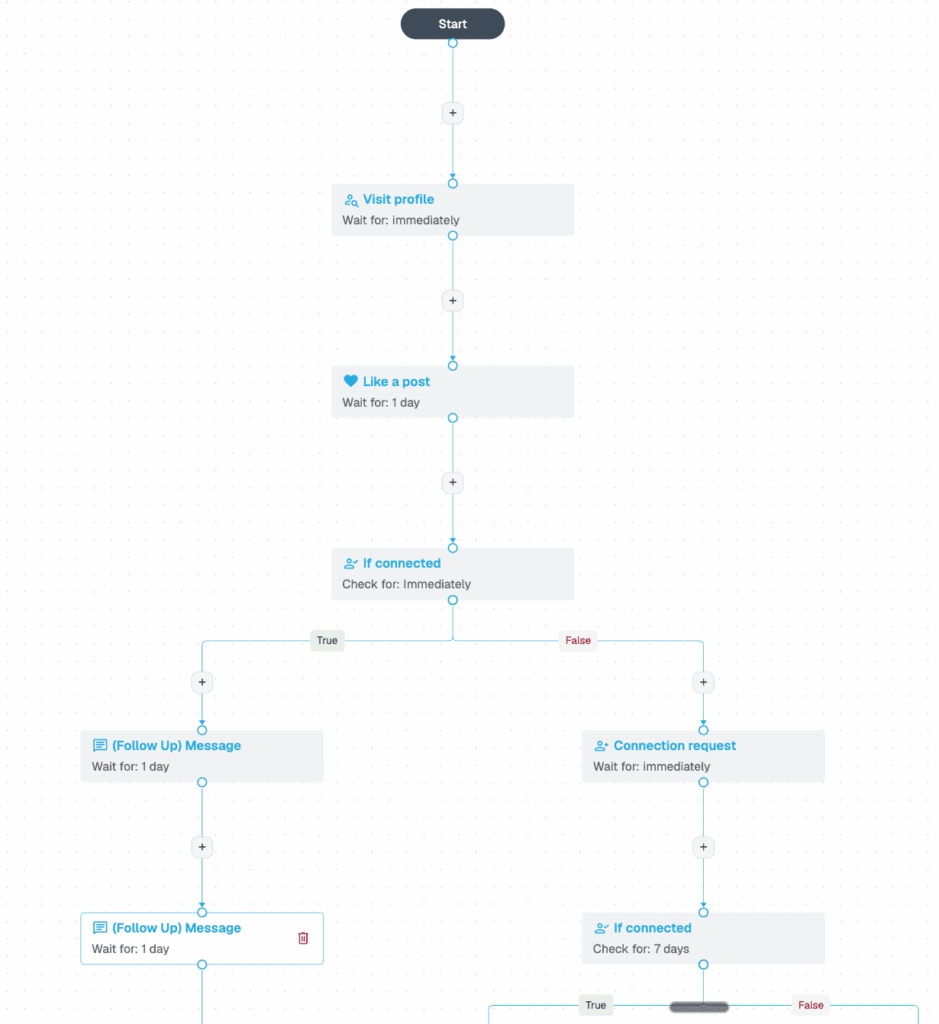
Four touches still beat a cold request, and they take seconds each. This is the full sequence with the email opener and the company-page follow trimmed out.
What you don’t cut is the follow-up: steps six through eight are where replies happen, and a well-timed follow-up does more for your reply rate than any single warm-up touch before the request.
What this LinkedIn warm-up sequence produces
The lift is measurable, and it comes mostly from the touches before and after the request, rather than the request itself.
Per Belkins’ 2026 study of 15M+ LinkedIn outreach touchpoints, warming a contact before the ask pays off: an already-connected prospect replies at 12.2%, against 7.9% for a standard cold connection campaign.
The warmer the relationship when you message, the higher the reply rate.
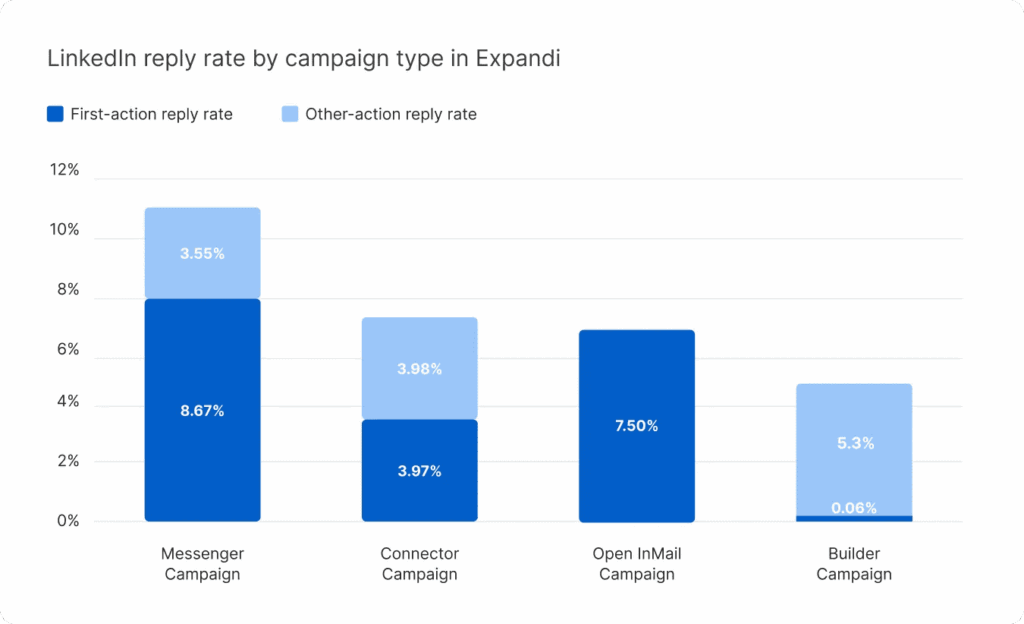
That’s more than a 50% lift in reply rate, and it comes from being warm rather than cold when the message lands.
Spacing matters too: a second follow-up generates 4.05% more responses in our State of LinkedIn Outreach report, which is exactly why the sequence ends in three messages rather than one.
Running the warm-up sequence before every connection request on auto-pilot
Warm beats cold for one reason: by the time you ask, you’re already a name they recognize.
Run the eight-step LinkedIn warm-up sequence before every connection request and your acceptance and reply rates climb without changing a word of your messaging.
Build it once as a Builder campaign and it runs on every prospect, including the company-follow touch most tools skip.
Start your free, 7-day Expandi trial and build your first warm-up sequence today.
Frequently asked questions
A day or two is enough. You’re aiming for recognition rather than a relationship, so a handful of light touches (a post like, a profile visit and follow, a company-page follow) over 24 to 48 hours does the job.
Stretch it longer and the touches lose their connection to the request.
No, it slightly lowers it. In Belkins’ 2026 study, no-note requests accepted at 27.6% vs 25.3% with a note. The note’s value shows up after the accept, where it lifts reply rate 55% (8.2% vs 5.3%), so save it for the follow-up.
Three to four before the request is the sweet spot. A post like, a profile visit, a follow, and a company-page follow are enough to make your name familiar without looking like you’re stalking the prospect.
More than that adds effort without adding much recognition.
Skip the post like and lean on the other touches: visit and follow their profile, follow their company page, and reference something about their company or role in the first message instead.
A quiet prospect just means you warm up with profile and company signals rather than content engagement.
Yes, as long as the volume stays human. Tools like Expandi run each account from a dedicated IP, auto-warm new accounts, and cap daily actions inside LinkedIn’s safe ranges.
Keep your action counts in those ranges and space the touches out, and an automated warm-up stays well within safe-use territory.
One specific question tied to the prospect’s world, with no pitch. The goal of the first message is a reply, so ask something they can answer in a sentence and leave the product out of it entirely. The proof point and the ask come later in the sequence.


You’ve made it all the way down here, take the final step