LinkedIn Demographics 2026: The Numbers That Matter for B2B Outreach

LinkedIn crossed 1.3 billion members in early 2026. But raw user counts don’t close deals. What matters is who those members are, what they earn, where they work, and how they use the platform.
Most B2B teams treat LinkedIn demographics as a vanity stat. They see “1 billion users” on a blog post, nod, and move on. The problem: without knowing which demographics match your ICP, you’re running outreach campaigns blind. You’re targeting the wrong seniority levels, missing high-income decision-makers, or ignoring the fastest-growing age segments entirely.
This guide breaks down every LinkedIn demographic category with 2025-2026 data — age, gender, income, education, location, industry, device usage, and engagement patterns. We pulled the data directly from Microsoft’s and LinkedIn’s official reports, and third-party research from Statista, Pew, Social Insider, Semrush, and others. Every stat is sourced and up-to-date for 2026.
If you’re building prospect lists, running LinkedIn outreach, or deciding where to allocate ad spend, this is the reference you’ll keep coming back to. Here’s the kind of demographics we’ll cover:
- LinkedIn user growth: where the platform stands in 2026.
- LinkedIn age demographics.
- LinkedIn gender demographics.
- LinkedIn income and buying power demographics.
- LinkedIn education demographics.
- LinkedIn location demographics.
- LinkedIn industry and job function demographics.
- LinkedIn device usage and engagement patterns.
- LinkedIn hiring and recruitment demographics.
- Turning LinkedIn demographic data into targeted outreach.
- LinkedIn demographics: Frequently asked questions.
Key Takeaways
- LinkedIn has 1.3 billion members globally with roughly 310 million monthly active users. The US leads with 250 million members, followed by India at 150-160 million and growing fast.
- The 25-34 age bracket dominates the platform at roughly 33-47% of all users depending on methodology, with Gen Z (18-24) making up another 20.5% and growing fastest.
- 53% of US college graduates use LinkedIn — the highest penetration rate of any social platform — making it the most educated B2B audience available.
- Expandi lets you turn LinkedIn’s demographic data into targeted outreach — build ICP-filtered prospect lists, trigger campaigns from real-time signals like profile views and post engagement, and run multichannel sequences that combine LinkedIn and email. Start with a 7-day free trial, no credit card required.
LinkedIn Demographics 2026: The Numbers That Matter for B2B Outreach


LinkedIn user growth: where the platform stands in 2026
LinkedIn hit 1.3 billion registered members as of Q4 FY2025, confirmed by Microsoft CEO Satya Nadella during the earnings call in January 2026. That’s an 8.3% year-over-year increase from the 1.2 billion reported the year before, and marks four consecutive years of double-digit member growth.
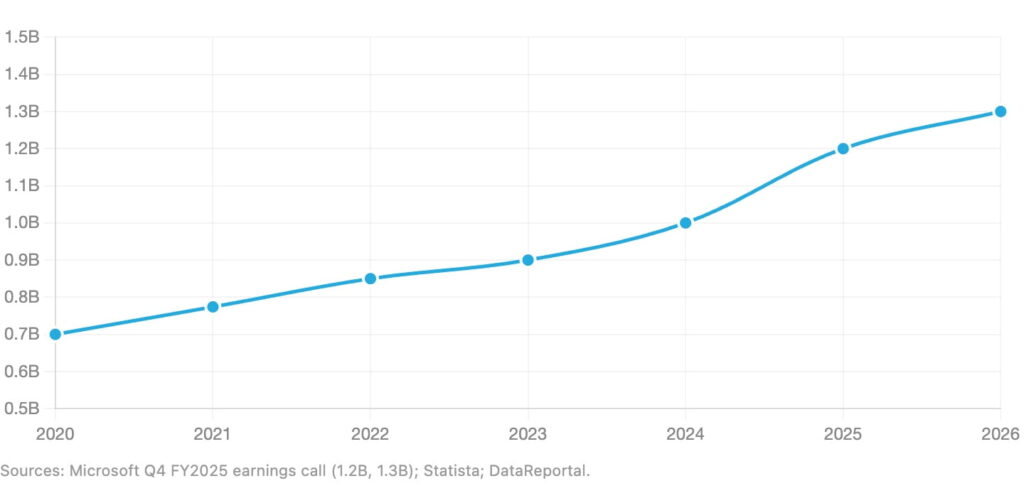
But registered members and active users are different numbers. LinkedIn doesn’t officially report monthly active users, though third-party estimates consistently place the figure around 310 million. That means roughly 24% of registered accounts are active in any given month.
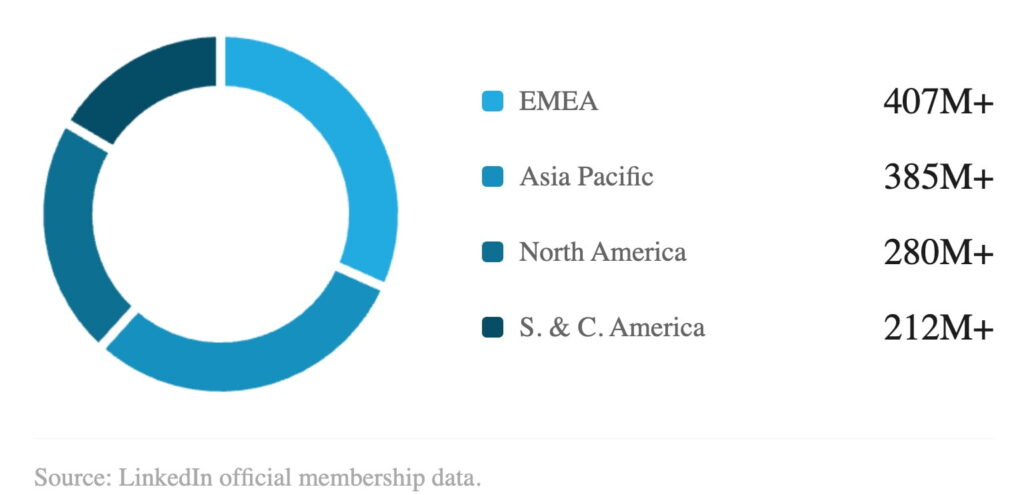
LinkedIn adds an estimated 5 to 8 million new members every month. EMEA is the largest regional user bloc at 407+ million members, with big markets like the UK, Germany, and Saudi Arabia leading the charge.
For B2B teams, the growth trajectory matters because it means the talent pool, prospect pool, and ad audience keep expanding — particularly in markets outside North America. If your outreach is still US-only, you’re leaving a lot of pipeline on the table.
LinkedIn age demographics
Age distribution on LinkedIn determines everything from messaging tone to content format to which job titles you’ll find in each bracket. It’s also one of the clearest signals within broader LinkedIn audience demographics. Here’s how it breaks down.
The 25-34 age group is the largest on the platform by a significant margin. Statista’s October 2025 survey data puts this cohort at 33.4% of all users, while advertising audience estimates from other analysts skew higher at 47%.
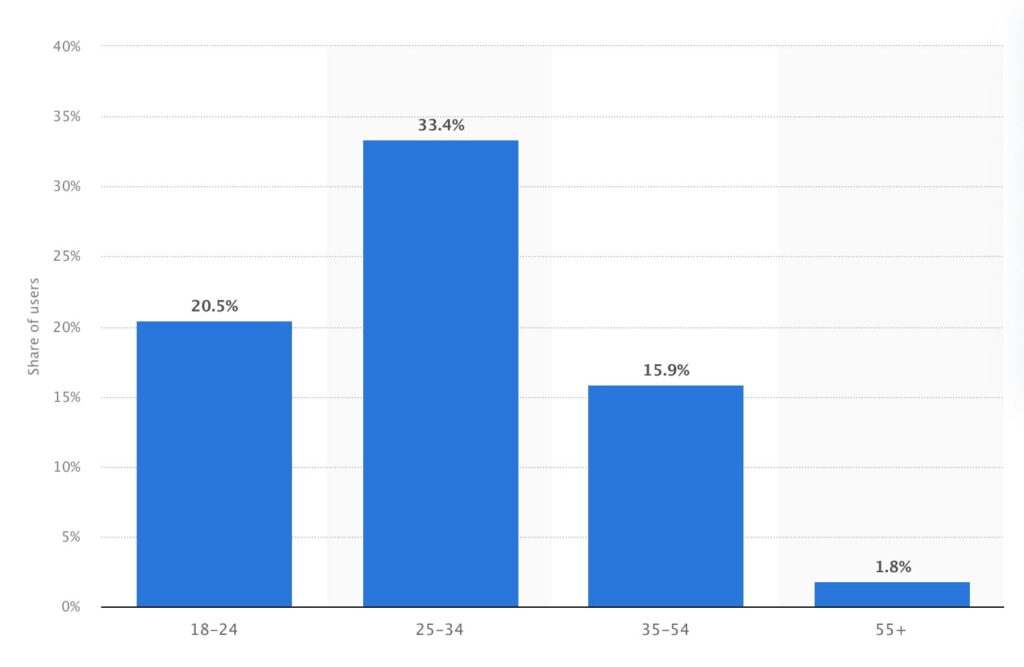
The difference comes down to measurement methodology — survey-based sampling vs. ad platform audience counts. Regardless of the exact number, millennials in their late twenties to mid-thirties are the dominant cohort.
Gen Z (18-24) is the fastest-growing segment and currently accounts for 20.5% of LinkedIn users. More students and early-career professionals are joining the platform before graduation, making this the segment to watch for the next several years.
The 35-54 bracket makes up approximately 26% of users. These tend to be mid-career to senior professionals: directors, VPs, and C-suite executives — who carry the highest purchasing authority but are less active in content creation.
Users 55 and older represent the smallest segment at under 4% of the user base. While this group is small in volume, it often includes senior executives and board members with influence on enterprise buying decisions.
What this means for outreach: if you’re targeting mid-level decision-makers, you’re competing for the attention of the 25-34 majority. If you’re going after C-suite, the 35-54 bracket is where to focus — and they respond better to direct, value-dense messaging than to content-style nurturing.
LinkedIn gender demographics
LinkedIn’s gender split has remained relatively stable over the past few years, though it’s slowly evening out.
As of late 2025, 56.8% of LinkedIn users globally identify as male, while 43.2% identify as female. In the US specifically, the split is similar at roughly 57% male and 43% female.
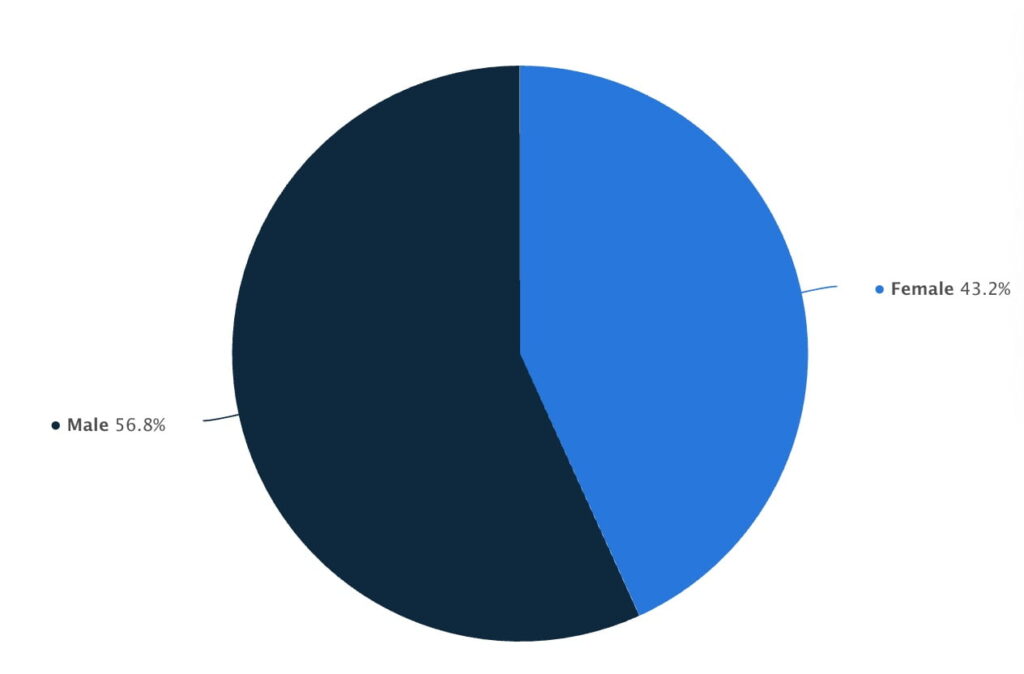
These numbers matter for ad targeting and outreach segmentation. If you’re selling into male-dominated industries like construction tech or heavy manufacturing, LinkedIn’s gender skew works in your favor. For industries with more gender balance (healthcare, education, HR), the platform still reaches a sizable female audience — 43% of 1.3 billion is over 550 million users.
For B2B teams, the practical takeaway is to build messaging and personalization around job function and seniority rather than gender alone. A Head of Marketing is a Head of Marketing regardless of gender — and LinkedIn marketing tools are built around professional attributes, not personal demographics.
LinkedIn income and buying power demographics
LinkedIn doesn’t publish a detailed income breakdown of its user base the way some consumer platforms do. Still, available data on LinkedIn user demographics points to a high-earning, high-authority audience.
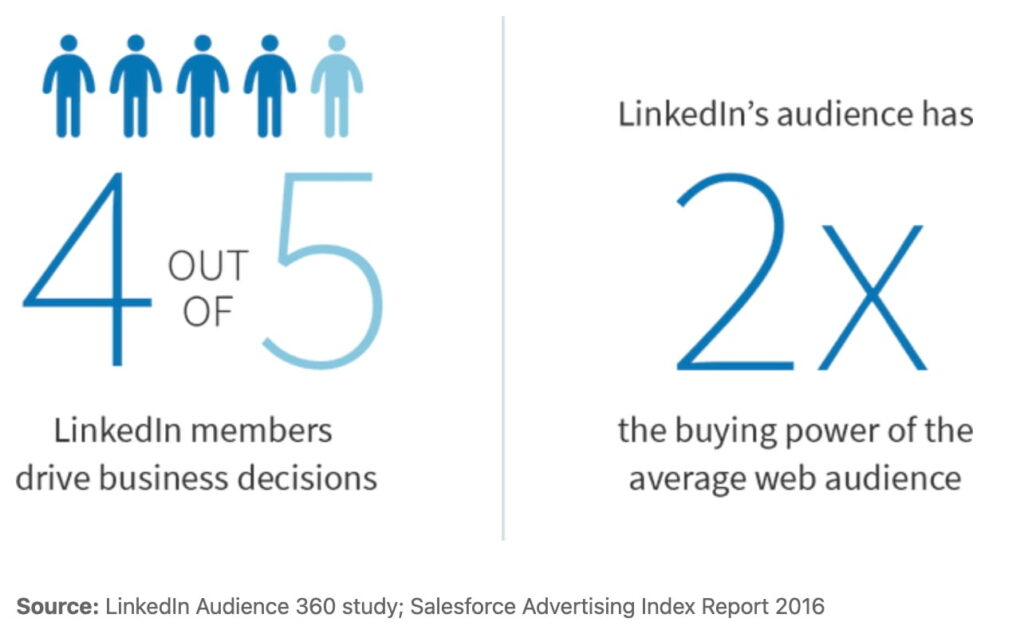
LinkedIn’s own ad targeting data reports that the platform’s audience has 2x the buying power of the average web audience. The same page lists 63 million decision-makers, 180 million senior-level influencers, and 10 million C-level executives among its members. And LinkedIn claims that 4 out of 5 members drive business decisions.
On the user side, LinkedIn’s user base correlates heavily with high income because it correlates heavily with education. 53% of Americans with a bachelor’s degree use LinkedIn, compared to just 28% of those with some college and 10% of those with a high school diploma or less. College graduates earn more than non-graduates on average, which is why LinkedIn’s audience skews toward higher earners even without a direct income breakdown.
What matters for B2B teams is the combination of professional authority and purchasing power. When 4 out of 5 members influence buying decisions at their companies, and 10 million of them sit in the C-suite, you’re reaching people who can say yes to a deal without three levels of approval.
For SDRs and sales teams running LinkedIn outreach, this means your messages are landing in inboxes that matter. That’s a different proposition entirely from cold emailing a junior employee who needs three levels of approval.
LinkedIn education demographics
LinkedIn is the most educated major social media platform, and it’s not close.
According to Statista’s February 2025 survey of US LinkedIn users, roughly a third hold a bachelor’s degree and another quarter hold a master’s degree or higher. By comparison, just 10% of US adults with a high school diploma or less use LinkedIn at all, per Pew Research’s social media fact sheet.
Facebook and Instagram’s user bases skew more toward high school and some-college education levels. This educational concentration on LinkedIn explains why the platform attracts knowledge workers, white-collar professionals, and senior leaders at higher rates than any other social platform.
For B2B content and outreach, the education demographic has a practical implication: your audience reads critically. They’ll spot generic copy, unsubstantiated claims, and recycled templates faster than audiences on other platforms. Messaging that relies on data, specificity, and proof of expertise performs better on LinkedIn because the audience expects it.
If you’re running thought leadership content alongside your outreach campaigns, this is worth keeping in mind. Building that credibility over time is what moves your LinkedIn SSI score, which measures how effectively you build your brand and engage with your network.
LinkedIn location demographics
LinkedIn’s 1.3 billion members are spread across 200+ countries and regions. LinkedIn’s own data breaks the regional distribution down as follows:
- Asia-Pacific: 385+ million members (largest region).
- Europe, Middle East, and Africa: 407+ million members.
- North America: 280+ million members.
- South and Central America: 212+ million members.
Within those regions, the top individual markets by user count are:
- United States – 250+ million.
- India – 150-160 million (fastest-growing major market).
- Brazil – 81-83 million.
- United Kingdom – 42 million.
- France – 33 million.
- Indonesia – 32 million.
- Canada – 26 million.
India has been the standout growth story, jumping from 130 million in April 2024 to an estimated 150-160 million by mid-2025. Southeast Asia and Latin America are also expanding rapidly.
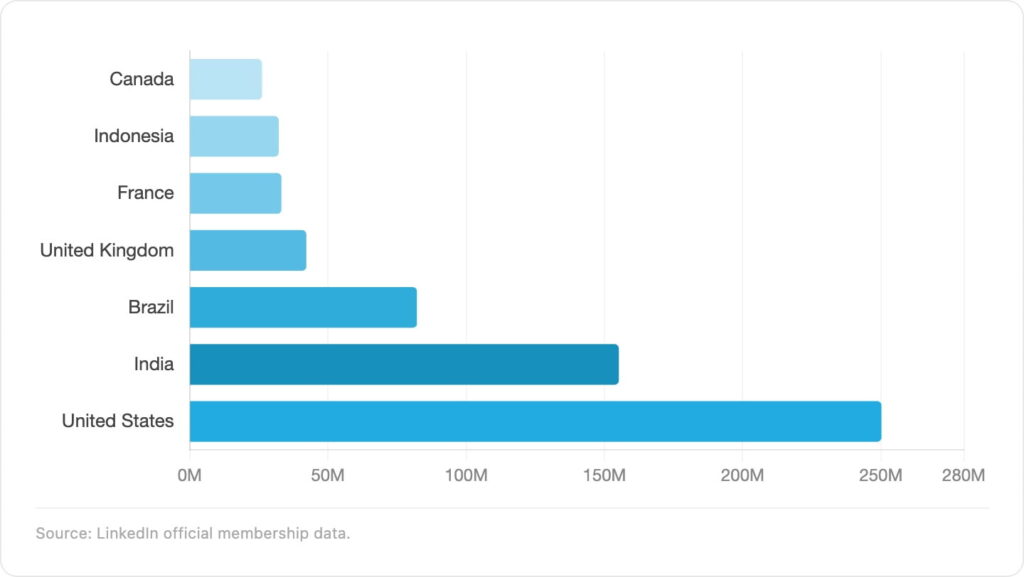
For teams running LinkedIn outreach or advertising, the geographic data reveals a few things. First, the US market is saturated, which means higher competition for attention and more crowded inboxes. Second, India and Brazil represent high-growth markets with rapidly expanding professional networks. Third, LinkedIn’s advertising audience reach varies by country — smaller professional hubs can have disproportionately high reach rates compared to their population size.
LinkedIn industry and job function demographics
Decision-maker concentration is where LinkedIn separates itself from every other social platform. LinkedIn’s own data shows the platform hosts 63 million decision-makers, 180 million senior-level influencers, and 10 million C-level executives — the highest concentration of purchasing authority on any social network. Four out of 5 members influence business decisions at their organizations.
For B2B outreach specifically, this density of decision-makers means you can build targeted prospect lists that skip the gatekeepers entirely. Using LinkedIn Sales Navigator’s advanced filters, you can segment by industry, company size, job title, seniority, and geography to build lists that match your exact ICP.
LinkedIn device usage and engagement patterns
How people use LinkedIn matters as much as who they are. Device behavior and engagement patterns shape when and how your outreach gets seen.
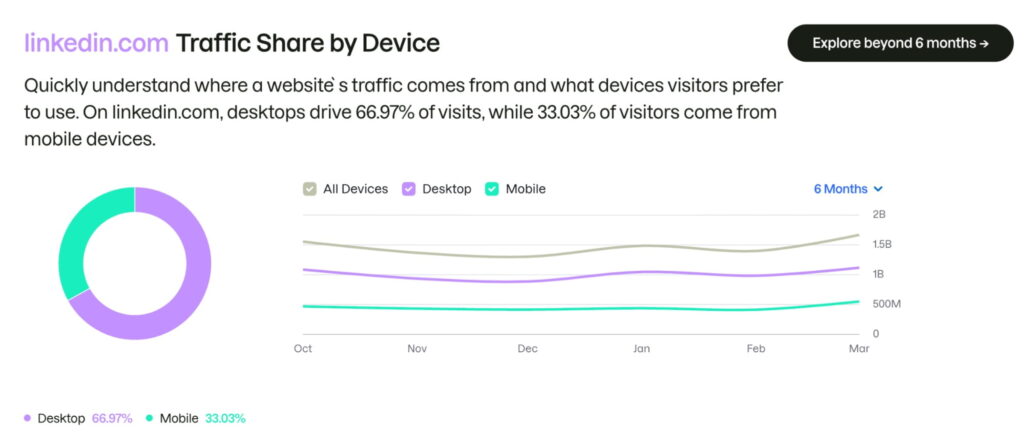
In the US, roughly 63% of LinkedIn.com traffic comes from desktop and 37% from mobile, based on Semrush data — though the split varies by country and doesn’t capture in-app usage.
The practical implication for outreach: keep connection request notes and initial messages short, since a significant portion of your prospects will read them on mobile.
Engagement rates on LinkedIn far outpace other social platforms. The average engagement rate across LinkedIn business pages sits at 5.2%, based on Social Insider’s analysis of 1.3 million posts from over 16,000 business pages. For context, Facebook averages 0.06% and X (formerly Twitter) averages 0.02%. That’s an 85x difference versus Facebook.
By content format, the breakdown is:
- Document/carousel posts: 7.0% engagement (highest).
- Video posts: 6.0% engagement.
- Image posts: 5.3% engagement.
- Text-only posts: variable, but still drive a majority of total platform interactions.
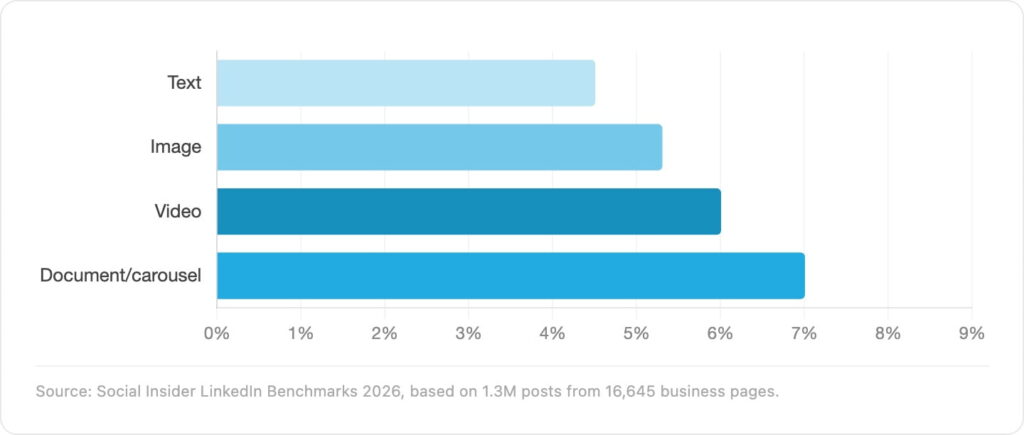
Video content on LinkedIn is growing rapidly: LinkedIn’s own data shows a 36% year-over-year increase in video consumption, and paid video ads are growing at roughly 30% year-over-year. LinkedIn Live events have also gained traction, with early data suggesting higher engagement than static posts.
For outreach teams, the device and engagement data point to a few tactical decisions.
If you’re running content alongside outreach (a smart play for warming leads), document and carousel posts get the highest engagement.
Third, timing matters: according to Sprout Social’s analysis of 2 billion engagements, LinkedIn content engagement peaks Tuesday through Thursday between 11am and 5pm – which also means your prospects are most active on the platform during those hours. Schedule connection requests and follow-up messages to land in the same window.
| Day | Best time to post (local time) | Engagement level |
|---|---|---|
| Monday | 1-2 PM | Peak |
| Tuesday | 11 AM – 5 PM | Peak |
| Wednesday | 11 AM – 4 PM | Peak |
| Thursday | 11 AM and 1-5 PM | Peak |
| Friday | 11 AM and 1-2 PM | Peak |
| Saturday | Avoid posting | Lowest |
| Sunday | Avoid posting | Lowest |
LinkedIn hiring and recruitment demographics
LinkedIn remains the dominant professional recruiting platform globally. LinkedIn’s own platform data shows the scale of hiring activity happening every minute:
- 90 people add new roles to their profiles.
- Approximately 8,200 job applications are submitted.
- 17,000+ new connections are made.
- 70+ million companies maintain a LinkedIn presence.
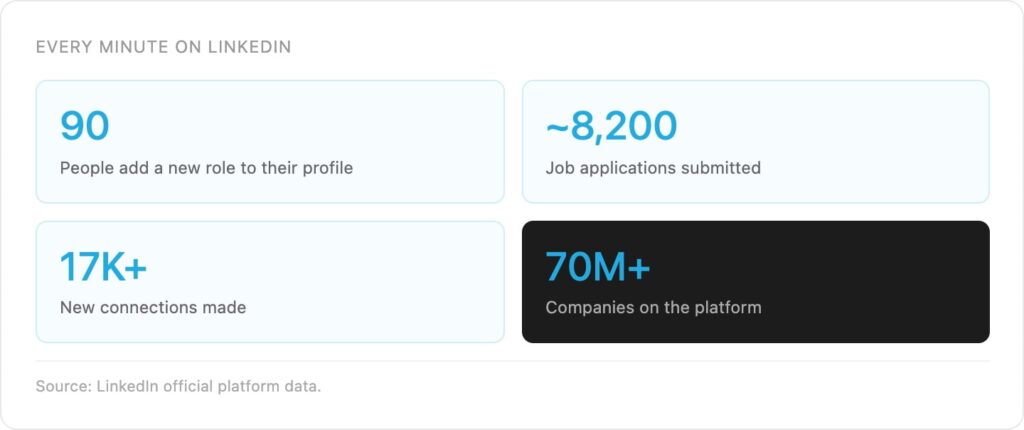
LinkedIn’s Future of Recruiting 2025 report highlights a major shift toward skills-based hiring. The number of paid job posts dropping degree requirements increased 16% between 2020 and 2023, and 93% of talent acquisition professionals now view accurate skills assessment as crucial for quality hires. Meanwhile, 73% of TA professionals agree AI will change how organizations hire.
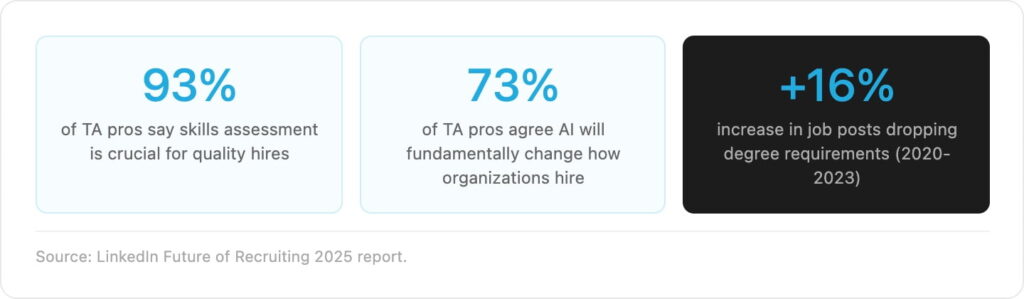
The report also notes a growing demand for soft skills that AI can’t replicate: relationship development skills among recruiters saw a 54x increase in demand year-over-year, alongside growing emphasis on communication, reasoning, and career advisory capabilities.
For B2B teams, the hiring data matters for two reasons. One, if you’re selling to recruiters or HR tech companies, LinkedIn is where your buyers live — and they’re actively using the platform daily. Two, the “Open to Work” signal is useful for outreach beyond recruitment: people changing roles are often re-evaluating their tech stack, making them receptive to product pitches during the transition window.
How to turn LinkedIn demographic data into targeted outreach
Most B2B teams read a stat like “1.3 billion members” and move on. Knowing just how many users there are on LinkedIn isn’t particularly useful on its own. The teams generating pipeline are using that data to build sharper ICP filters, time their outreach, and sequence across channels.
The demographic data in this article points to a specific LinkedIn audience profile:
- Users aged 25–44 (most active segment).
- College-educated professionals.
- Higher-than-average income brackets.
- Concentrated in tech, finance, and professional services.
- Active on mobile during business hours.
They hold decision-making roles at their companies, and they’re more likely to engage with content than users on any other B2B platform.
Here’s how to translate this into LinkedIn outreach:
- Build your ICP filters using demographic insights. Combine industry, seniority, company size, and geography to match the high-value segments identified above. LinkedIn Sales Navigator lets you stack these filters, and you can export those lists directly into outreach tools.
- Segment by signals. Signals tell you when they’re ready to engage. Someone who just viewed your profile, liked your post, or changed jobs is warmer than a cold list based purely on job title. Expandi’s signal-based campaigns let you build sequences triggered by these real-time behaviors: profile views, post engagement, and content interactions become automated campaign entry points.
- Match your message to the audience. If you’re targeting the 25-34 majority, keep messages informal and value-first. If you’re reaching the 35-54 C-suite bracket, lead with business outcomes and ROI data. LinkedIn’s educated, high-income user base responds to specificity — generic templates get ignored.
- Use content as a warm-up layer. With 5.2% engagement rates, LinkedIn content reaches further than on any other B2B platform. Post content your ICP cares about, then use Expandi’s post engagement URL feature to pull everyone who liked or commented on that post into a targeted lead generation campaign. It’s a natural conversation starter because the prospect already engaged with your thinking.
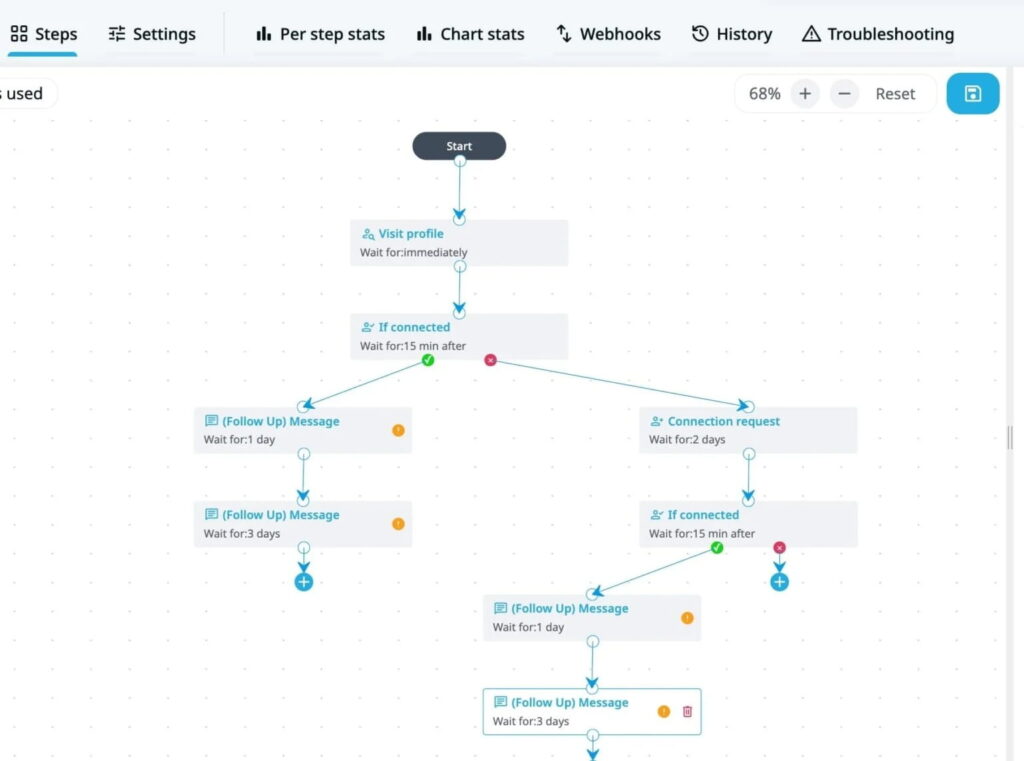
- Run multichannel sequences based on behavior. A single LinkedIn connection request isn’t enough for a high-intent audience that’s active across channels. Based on our analysis of 70,000+ campaigns run through Expandi, LinkedIn DMs generate a 10.3% average reply rate — double the 5.1% average for cold email. Combined, they compound. Expandi’s smart sequences let you build if-then logic around prospect behavior: send a connection request, and if it’s not accepted within a set number of days, follow up with an email. If they accept but don’t reply, trigger a profile view and a follow-up message. You meet prospects where they are instead of waiting on one channel to convert.
Ready to turn LinkedIn’s demographic data into pipeline?
The numbers in this article are a targeting blueprint. You know which age brackets hold purchasing authority, which industries are most active, when your prospects are most likely to be online, and what kind of content they engage with.
The teams that turn that into a pipeline don’t stop at knowing the data. They build ICP filters around it, time their outreach to match peak activity windows, and trigger campaigns from real signals — a profile view, a post like, a job change — rather than blasting cold lists and hoping for the best.
If you want to see how signal-based outreach works in practice, Expandi offers a 7-day free trial with no credit card required. Build your first targeted campaign using the demographic filters that match your ICP, and see how warm sequences compare to cold blasts.
LinkedIn demographics: Frequently asked questions
LinkedIn has 1.3 billion registered members as of early 2026, but monthly active users (MAU) sit around 310 million. That means about 24% of registered accounts are active in any given month.
According to LinkedIn Marketing Solutions, the platform is the top-performing channel for B2B lead generation from social media. Its engagement rate of 5.2% dwarfs other platforms. The combination of professional targeting, high-income users, and decision-maker density makes it the default B2B outreach channel.
The 25-34 age bracket is the largest demographic group on LinkedIn. Statista’s 2025 data puts it at 33.4% of all users, while advertising audience estimates run higher at around 47%. Either way, millennials in their prime career-building years dominate the platform – a mix of mid-level managers, senior individual contributors, and early-stage directors.
The United States leads with 250+ million LinkedIn members. India ranks second with an estimated 150-160 million users and is the fastest-growing major market. Brazil holds third place with approximately 81-83 million members. By region, Asia-Pacific leads overall with 385+ million members.


You’ve made it all the way down here, take the final step