4 Steps to Automate LinkedIn Post Engagement Outreach

TL;DR: The people who like and comment on your posts are the warmest leads on LinkedIn, and turning that into a systematic follow-up is where the pipeline hides. Expandi’s Signals feature captures every post engager by URL, filters them to your ICP, then runs an automatic message sequence. This means either delivering a lead magnet when someone comments a keyword, or opening a conversation with everyone who engaged. Here’s the full workflow, from post to booked meeting.
Your last post pulled 60 likes and 8 comments. It feels good. But if none of them resulted in a booked meeting, that’s the problem that needs addressing. The people who engaged with your post are the warmest leads you’ll find, at least the ones who match your ICP.
This guide shows you how to run LinkedIn post engagement outreach on autopilot with Expandi’s Signals feature, so that everyone who interacts with your post gets a timely, personal follow-up and your content stops being a mere vanity metric.
Why post engagers are your warmest leads
Cold outreach starts at zero. The person on the other end has never heard of you, has no idea whether they need you, got 10 near-identical pitches that same week, and owes you nothing.
However, an engager (someone who has engaged with your post) is a completely different story. They can see who you are (may already know you), they’ve agreed with your points, they did it publicly, and the topic is live in their head this week.
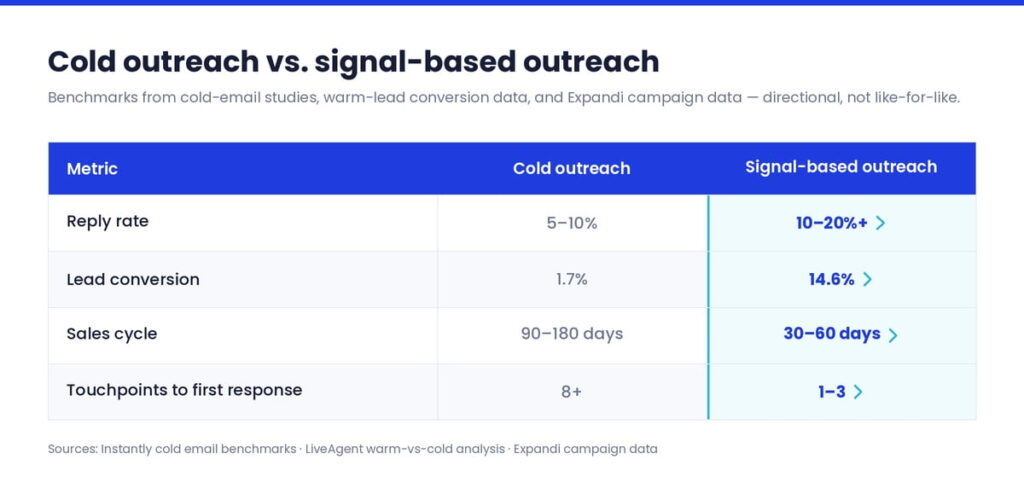
The numbers back this instinct. Warm, engagement-based outreach lands reply rates of 10 to 20%+ on targeted segments, against reply rates of 5 to 10% for a solid cold campaign (the average runs lower), per Instantly’s cold email benchmarks.
On conversion, the distance widens further. Engaged leads convert at around 14.6%, against 1.7% for cold contacts, according to LiveAgent’s warm-versus-cold analysis. This is signal-based outreach pointed at the warmest signal there is.
There’s a second reason this play works, and it starts before anyone presses the ‘like’ button. Personal profiles outperform company pages by a wide margin. A Refine Labs study found employees’ personal posts pulled 2.75x the impressions and 5x the engagement of their company page, despite smaller follower counts.
Personal profiles pull 2.75× the impressions and 5× the engagement of company pages. Your warm signals come from what you post yourself. (Refine Labs)
So the warm signals come from what you publish on your own profile, and LinkedIn’s current algorithm rewards exactly that. Expandi’s earlier content retargeting play proved the concept years ago. Signals is what makes it run on its own.
The LinkedIn post engagement outreach pipeline, in four steps
The entire thing runs in four moves, and each one hands off to the next.
- Post something your buyers care about, designed to pull engagement.
- Point an Expandi Signals campaign at that post’s URL so every qualified engager gets captured.
- Send a message that acknowledges what they already know about you.
- Deliver the payoff: a resource or a live conversation.
We’ll walk through all four below. First, though, one decision drives everything after it: which of the two plays you’re running.
Two versions of this play
Post engagement outreach comes in two versions, and the one you pick changes your post, message, targeting, and keyword setup. Choose carefully.
The Lead Magnet Play
You offer something concrete and ask people to comment a keyword to get it, like “Comment TEMPLATE and I’ll send you the cold-email framework we use.” Expandi watches the post, catches everyone who comments that keyword, auto-delivers the resource, and then rolls into a follow-up sequence.
This method self-qualifies because typing the keyword is a small commitment that filters for genuine interest. It suits creators and teams with an asset worth trading for a comment, such as a checklist, a template pack, a teardown, or a mini-guide.
The Conversation Play
No offer, no keyword. You message everyone who liked or commented on a strategic post and open a dialogue off the back of it. This fits high-value posts where the goal is a relationship rather than a download, like a founder’s point of view, a contrarian take, a customer win, or a hard-earned lesson. Since there’s no lead magnet doing the filtering, your ICP settings inside Expandi do the heavy lifting instead.
Step 1: Create a post built to pull engagement
The Signals campaign can only capture people who interact. So, the post has to deserve that interaction first, or the rest of the campaign has nothing to work with.
Lead with a hook that stops the scroll in the first two lines, because that’s all LinkedIn shows before the “…more” cut. Open on a specific claim, a number, a name your buyer knows, or a moment of tension they recognize. Skip the windup and the “I’m humbled to announce” openers.
Write the body for one reader, in plain second person, and keep the paragraphs short enough to read on a phone. Give the idea away for free. The post that teaches something out-earns the post that teases it.
Then ask for the action outright. For the Lead Magnet Play, name the keyword and the reward in one line: “Comment PLAYBOOK and I’ll send it over.” For the Conversation Play, end on a question your audience will want to answer in the comments. The comment is your conversion event, so make commenting the easiest thing on the page.
Step 2: Set up the Expandi Signals campaign
Setup takes about 20 minutes. Here’s the order of operations inside Expandi.
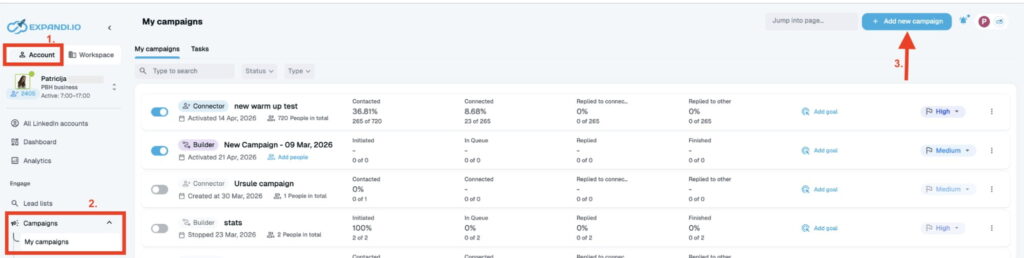
Pick Signals → Post Engagement as your lead source. The Signals action always sits as the first step of the campaign — everything else in the flow hangs off it.
Then add your ICP filter as the first condition after it. The Signals step pulls in everyone who engages, so the filter is what decides who actually gets messaged. Set your criteria and route non-matches to no action:
- Job title
- Industry
- Company size
- Location
A student or a competitor who likes your post still lands in the campaign, but they never receive a message. This is the gate that keeps a viral post from flooding your outreach with the wrong people.
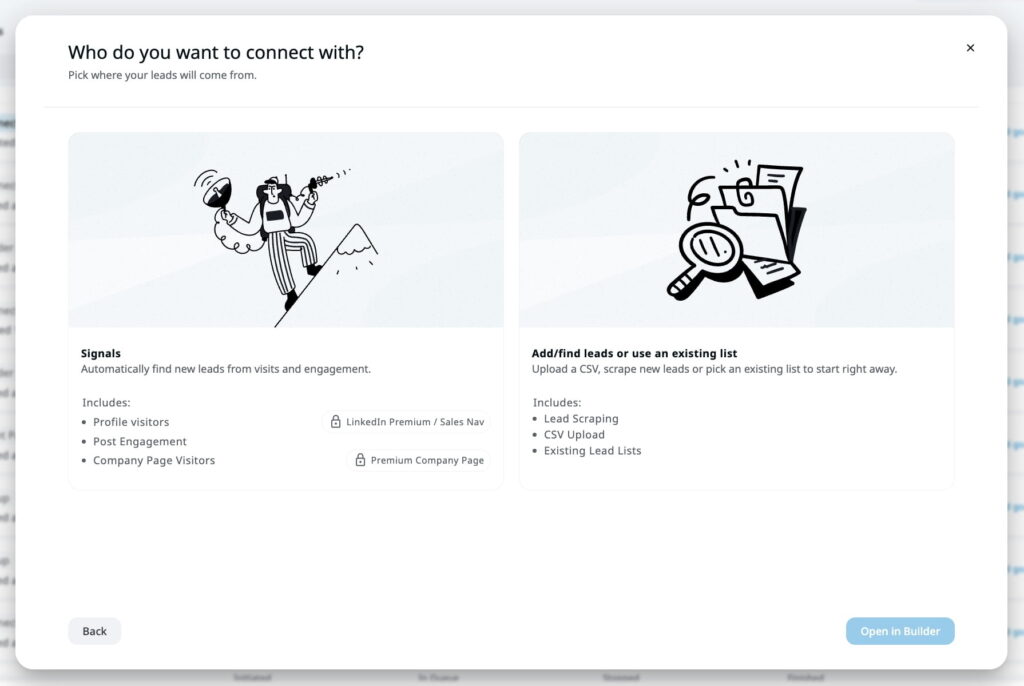
Add the post next. Paste the URL into a post engagement search and choose which interactions count: reactions, comments, or both. You can track up to 3 posts in one campaign, which is handy for testing formats against each other.
For the Lead Magnet Play, set the keyword. Expandi will only pull commenters who typed it, so “TEMPLATE” captures the people who want the template and ignores everyone else.
Attach the sequence last. Connect a Smart Campaign built in the Campaign Builder with your messages and wait timers. The builder supports branching logic, so the path forks based on whether someone connected, replied, ignored you, or asked for more.
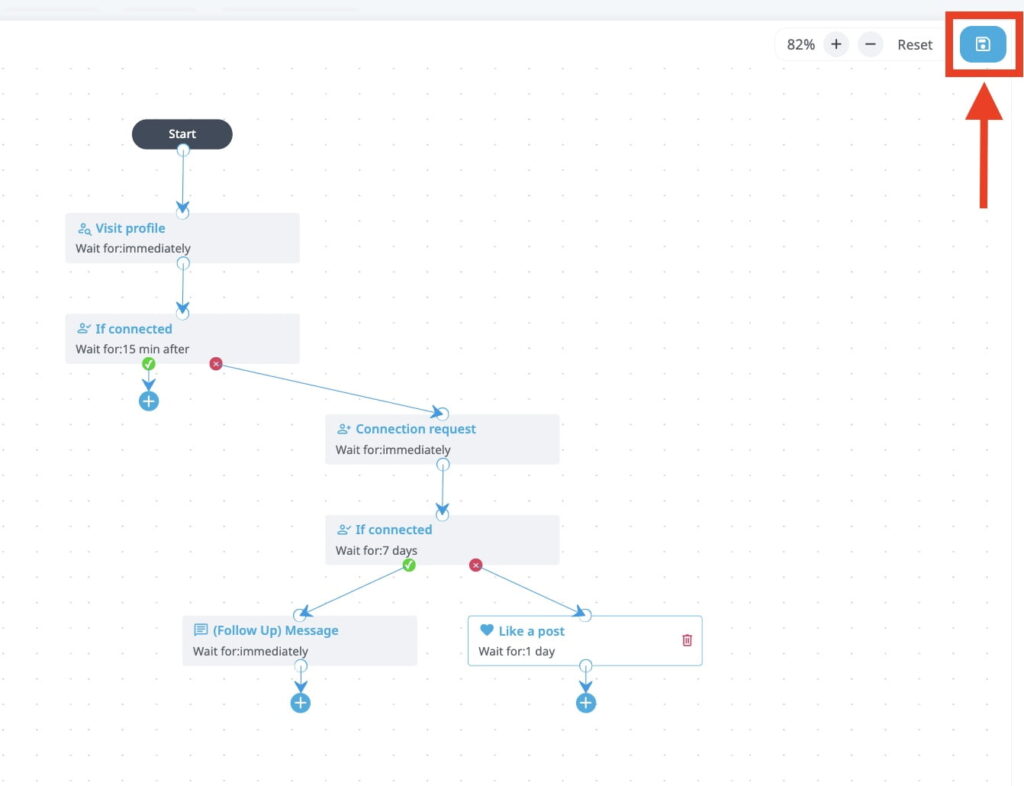
One thing to build into that sequence is the connection status.
You can only DM your 1st-degree connections, so an engager you’re not connected to can’t receive the resource directly. For those leads, the flow opens with a connection request, and the delivery message fires once they accept. In practice that means your commenters split into two paths: existing connections get the resource right away, everyone else gets it a step later.
The Campaign Builder’s branching handles this automatically, but write your connection request with the promise in mind: “Sending over the [resource] you commented for” gets accepted faster than a blank request.
Step 3: Write the message
The one advantage you hold over cold outreach is context, so spend it in the first line. Reference the post. Everything else flows from there.
Conversation Play opener:
“Hey {firstName}, glad the post on [topic] hit home. Curious what your read is, are you seeing the same thing on your side?”
That’s the entire message. You’re continuing a thread they already stepped into, so there’s no pitch to make yet.
Lead Magnet delivery, sent automatically once Expandi processes the comment:
“Hey {firstName}, here’s the [resource] you asked for: [link]. Shout if anything’s unclear.”
Then the value-add follow-up, 2 or 3 days later:
“Did you get a chance to look at the [resource]? One thing it doesn’t cover: [specific tactical insight]. Does that line up with what you’re running into?”
That second message is where the conversation truly opens, because you’re adding something the resource (like a PDF) can’t and asking about their situation. Skip it, and you’re back to pitching strangers who happen to hold your resource. Keep every message readable in one glance, contractions on, and lead with them rather than you.
Step 4: Deliver the value
How you deliver depends on the play you chose.
For a lead magnet, delivery is automatic and hands-off, which is the point. The person comments, the resource goes out on its own (inside your sending limits and active hours), and the follow-up timer starts. Your only job is to make the asset truly useful, because a weak resource turns a warm lead cold faster than no resource at all.
For a conversation, the “delivery” is your attention. When someone replies, step out of the automation and answer like a person. This is the hand-off, where a human takes the thread. Expandi’s smart inbox keeps every reply from every campaign in one view, so a warm answer doesn’t sit unread for days behind your other tabs.
One rule holds across both plays. The sequence exists to open conversations. Closing is a human job, and the moment a prospect engages back, a person should be taking the reins.
The benchmarks: cold vs signal-based
These pull from cold-email benchmarks, warm-lead conversion studies, and Expandi’s own campaign data. They come from different sources, so read them as directional, not a like-for-like promise.
Put it in volume terms. Expandi reports that 1,000 cold LinkedIn DMs convert around 17 leads and close 1 or 2 deals over 3 to 6 months. Run those same 1,000 touches as signal-based outreach, and the figure jumps to about 146 leads and 14 to 20+ deals in 1 to 2 months. The company puts the revenue difference at 8 to 10x, and notes it moves with industry, deal size, and ICP complexity.
Same 1,000 touches. Cold: ~17 leads, 1–2 deals in 3–6 months. Signal-based: ~146 leads, 14–20+ deals in 1–2 months — about 8–10× the revenue. (Expandi)
For a wider baseline, Expandi’s 2026 benchmark report, built on 13.2 million connection requests, pegs the average cold acceptance rate at 28.5%. A warm audience that already engaged with your content clears that bar comfortably, because you’re no longer a stranger in the request queue.
Average cold acceptance rate: 28.5%, across 13.2M connection requests. A warm audience clears that bar comfortably. (Expandi 2026 benchmark)
How to make this a monthly habit
One campaign is a test. The pipeline shows up when this becomes a habit.
Pick your beat. Match it to the best times to post on LinkedIn, and run a Signals campaign against your best performer. A workable rhythm is 1 or 2 engagement-optimized posts a week. You don’t need every post in a campaign, only the ones that pull your ICP.
Rotate your angles so the automation never develops a tell. Vary the hook, the format, the ask, and the visual across posts, and let the ICP filter stay constant underneath. Over a month, you’ll learn which topics attract buyers and which attract your peers.
Track attribution properly. Tag which post sourced each conversation so you can tie booked meetings back to specific content. After 4 to 6 weeks, you’ll see a pattern. A handful of themes drive most of the qualified replies. Publish more of those, point Signals at them, and the loop compounds.
Review performance by campaign and by post. That’s where the gains stack up. Compare reply rates across posts, prune the topics that draw the wrong crowd, and double down on whatever’s booking meetings. This last part is what moves the pipeline.
Turn your next post into pipeline with Expandi
Likes and comments are the opening move in a conversation that would usually stop there. Treat them as a start and the follow-up writes itself. Every qualified engager is telling you, in public, that your idea landed. Leaving them in the notifications tab is a pipeline walking out the door.
The play is simple to run and hard to argue with. Post what your buyers care about, capture everyone who engages, follow up before you fade from their mind, and let the sequence carry the rest. Expandi’s Signals feature turns that from a manual chore into a system that springs into action every time you publish.
Point your next post at a Signals campaign and collect what your content was already earning. Start a free Expandi trial and set up your first post engagement campaign in about 20 minutes.
FAQ about LinkedIn post engagement
Yes. People who engage with your post have already shown interest in your topic, so your follow-up reaches a warm audience instead of a cold list. Published benchmarks put warm reply rates at 10 to 20%+ against 5 to 10% for cold, and engaged-lead conversion near 14.6% against 1.7%. Getting timing and relevance right manually can be a challenge, but a Signals campaign handles both automatically.
Yes. In a post engagement Signals campaign you set a keyword, like “GUIDE.” Expandi captures everyone who comments that word, filters them against your ICP, delivers the resource in a DM (existing connections get it directly; everyone else gets a connection request first, with delivery on acceptance), and triggers a follow-up sequence. Commenters who don’t fit your ICP get filtered out, so only qualified prospects enter the flow.
You can track up to 3 posts in a single Signals campaign, which lets you test formats side by side. A sustainable cadence is one campaign a week against your strongest engagement post. That keeps a steady stream of warm leads entering your pipeline without needing every post to carry a campaign.



You’ve made it all the way down here, take the final step