What Is a Go-to-Market Strategy? (Your 7-Minute Crash Course)


Key Takeaways
- A go-to-market strategy settles five key decisions: target market, positioning, channels, pricing, and sales motion.
- It pays off early: 6sense’s 2025 research shows B2B buyers contact vendors 61% into their journey, and favored vendors win ~80% of deals.
- The three main types are sales-led (complex/high-priced), product-led (self-serve/trials), and marketing-led (high search demand).
- Marketing strategy is a subset of GTM, focusing on product communication and promotion.
- For sales-led models, Expandi automates LinkedIn outreach using signal-based triggers.
What Is a Go-to-Market Strategy? (Your 7-Minute Crash Course)


A go-to-market (GTM) strategy is a tactical plan defining how a company brings a product or service to market. It aligns marketing, sales, and product teams around target buyers, competitive positioning, distribution channels, pricing, and sales motions to drive sustainable revenue.
Through GTM Society – a community of over 400 founders and operators – we have analyzed more than 70 go-to-market executions. Regardless of product type, every successful strategy addresses the same five foundational decisions.
Here’s what this 7-minute GTM strategy crash course covers:
- The five decisions every go-to-market plan settles.
- Proof that GTM work pays off before sales ever joins the deal.
- Sales-led, product-led, and marketing-led motions, with a fit guide for each.
- Where a go-to-market strategy ends and a marketing strategy begins.
- The next step once the definitions are settled.
What does a go-to-market plan cover?
A comprehensive go-to-market plan synthesizes five interconnected core decisions:
- Who to sell to.
- How to position.
- Where to reach buyers.
- What to charge.
- How the sale happens.
Every framework you’ll encounter, from the four Ps to nine-step guides, unpacks some version of these five.
1. Target market: Identifying your high-intent buyers
First, define the specific segment, company profiles, and buyer personas your product solves problems for today. A tightly defined ideal customer profile (ICP) outperforms a broad addressable market at launch, as every downstream channel and pricing decision depends on this foundation.
For outbound teams this decision becomes literal: the ideal customer profile turns into the search filters that build your prospect lists. Our guide to using LinkedIn Sales Navigator shows how that translation works in practice.
2. Positioning: Articulating your competitive advantage
Next, establish why a buyer should select your solution over competing alternatives or maintaining the status quo. Effective positioning concisely pairs the problem with your unique value proposition in terms buyers can easily champion internally.
Good positioning names the alternative and the difference in one sentence a buyer could repeat to their boss.
3. Channels: Selecting your primary go-to-market pathways
The routes your product travels to the buyer: outbound outreach, search, paid media, partners, marketplaces, events.
Per McKinsey’s 2024 B2B Pulse survey, modern buyers evaluate solutions across ten or more touchpoints. The objective is not to cover every channel, but to master two or three proven B2B prospecting methods tailored to your ICP.
4. Pricing: Aligning value metric with market expectations
The number, the model behind it (per seat, usage, flat), and where the entry point sits against alternatives. Pricing signals positioning as loudly as any messaging does.
5. Sales motion: Structuring the path to conversion
Finally, outline the end-to-end customer journey from initial discovery to contract execution; whether via self-serve checkout, consultative sales calls, or complex enterprise cycles. This choice governs your B2B sales strategy, hiring structure, and unit economics.
Why is a go-to-market strategy important?
A go-to-market strategy matters because buying decisions form before a vendor ever hears from the buyer. Skip the strategy and you compete for deals that are already leaning toward someone else.
The 2025 B2B Buyer Experience Report from 6sense, a study of nearly 4,000 B2B buyers, found that buyers make first contact 61% of the way through their buying journey. And 95% of the time, the vendor that eventually wins was already on the buyer’s day-one shortlist.
The pre-contact favorite closes roughly four deals in five.
Getting onto that day-one shortlist is GTM work: positioning buyers remember, presence in the channels they research in, pricing they can anticipate. Sales skill decides the last 39% of the journey.
The strategy decides whether you were ever in the running. Founders who have lived it also rank the strategy work above the build.
Matija Nakic, CEO and co-founder of Farseer, a planning and forecasting platform for mid-market and enterprise finance teams, put it this way in a GTM Society interview, after describing years spent scaling a deeply technical product:
“This is an engineering problem, and it for us kind of was easier to solve than these go-to-market problems.” — Matija Nakic, Farseer
The 3 main types of go-to-market strategies
Go-to-market strategies group into three main types, named for the team that creates the revenue:
- Sales-led.
- Product-led.
- Marketing-led.
Here is how the three types of go-to-market strategies compare:
| GTM type | Who creates revenue | Typical deal shape | Best for |
|---|---|---|---|
| Sales-led | Sales reps through outbound and demos | High-value contracts, longer cycles | Enterprise and complex products |
| Product-led | The product through free trials or freemium | Low entry price, self-serve upgrades | Tools one user can adopt fast |
| Marketing-led | Content and campaigns feeding inbound | Mid-range deals, shorter consideration | Categories with strong search demand |
Selecting the right GTM model depends on deal complexity, target contract value, and buyer preference. Below is an in-depth breakdown of how each motion functions in practice.
Match the motion to your deal size and to how your buyers prefer to buy, because each type carries different costs, cycle lengths, and team shapes.
1. Sales-led GTM strategy
Sales reps drive revenue: they prospect, book meetings, run demos, and negotiate contracts.
Outbound channels open the conversations, and LinkedIn anchors the prospecting mix.
In our State of LinkedIn Outreach H1 2026 report, LinkedIn DMs replied at 10.3% on average against 5.1% for cold email.
Best for: complex or high-priced products, enterprise buyers, and deals that need a human to walk stakeholders through ROI.
2. Product-led GTM strategy
The product sells itself. Buyers sign up, hit value inside the product, and upgrade to paid, so signup, activation, and conversion metrics replace the demo call.
Wes Bush, founder of ProductLed, a consultancy that helps SaaS companies build free-trial and freemium motions, defined it in a recent GTM Society interview:
“It’s where you allow people to try before you buy. So you sign up for a free trial or a free motion for a product, like Spotify free trial.” — Wes Bush, ProductLed
Best for: tools a single user can adopt in minutes, lower entry prices, and buyers who would rather test than sit through a demo.
Conversations like that one are the fastest way to sharpen your own GTM thinking.
GTM Society, Expandi’s free community with 400+ members, holds 70+ expert interviews like it, plus a full GTM course and live Q&A sessions, with no membership fee.

3. Marketing-led GTM strategy
Content, SEO, paid media, and events build demand, and buyers arrive already educated. A light-touch sales process or self-serve checkout closes what marketing sourced.
Best for: categories buyers research on their own, products with broad search demand, and teams playing a longer compounding game.
Real companies blend the three: a product-led motion with sales assist on larger accounts, or a sales-led motion fed by marketing-led demand.
The label describes the lead engine, and the lead engine is what you staff and budget around first.
GTM strategy vs. marketing strategy
While frequently used interchangeably, go-to-market strategy and marketing strategy differ fundamentally in scope, timeline, and ownership:
| Differentiation Factors | GTM Strategy | Marketing Strategy |
|---|---|---|
| Scope | An overarching business plan uniting sales, product, pricing, and marketing around customer acquisition. | A tactical subset focused strictly on brand messaging, demand generation, and promotion. |
| Lifecycle | Event-driven initiatives built around discrete milestones like product launches or market expansions. | Operate continuously to sustain brand presence and pipeline generation over time. |
| Decision Ownership | Determine commercial models, pricing tiers, and sales channels. | Accept these parameters as inputs and craft the messaging to promote them effectively. |
Automating your go-to-market strategy
Definitions only get you to the starting line. The value shows up when you pick a motion, build the workflows underneath it, and decide which of those workflows run on autopilot.
For the execution side, our breakdown of using AI for lead generation is the practical next read: 12 workflows real GTM teams run in 2026, from intent signals to AI-drafted outreach.
And if the motion you land on is sales-led, the outreach layer is where the strategy meets the day-to-day.
A LinkedIn automation tool like Expandi runs that layer for you:
- Signal-based triggers start sequences the moment a lead changes jobs or engages with your content.
- Smart sequences branch across LinkedIn and email based on behavior.
- The AI Analyzer drafts messages and sorts replies by sentiment so reps work hot leads first.
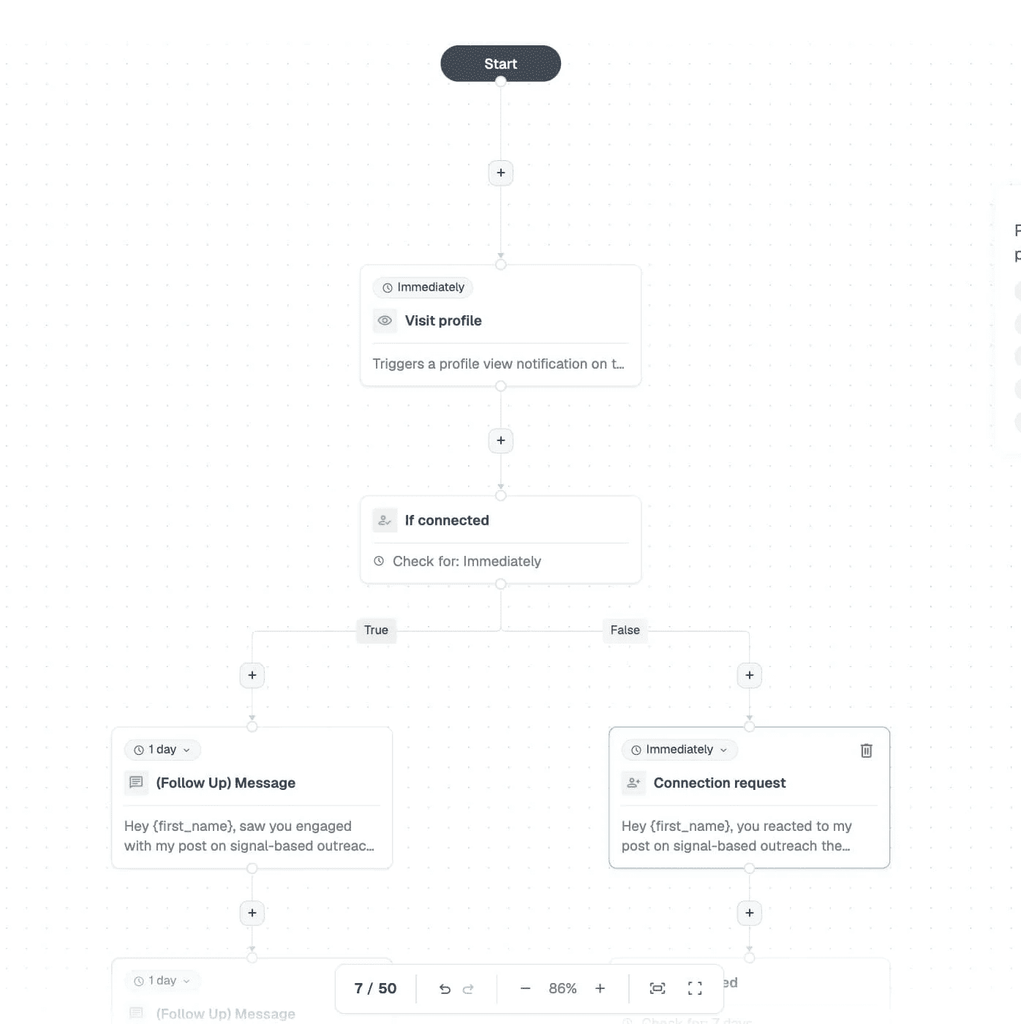
The outcome is coverage without headcount: hundreds of prospects worked simultaneously, follow-ups that never slip, and reps spending their day on live conversations rather than sending touches one by one.
Campaign-level acceptance and reply data then feeds the strategy back — when a segment stops replying, you know weeks before the pipeline shows it.
Launch your go-to-market strategy this week
A successful go-to-market strategy relies on clarity and execution. By defining your target market, positioning, channels, pricing model, and sales motion on day one, you establish a scalable foundation for revenue growth.
Align your cross-functional teams around these five pillars today, select the primary motion suited to your buyers, and iterate based on real market feedback.
If your motion is sales-led and LinkedIn is the channel, start your 7-day Expandi free trial and put the outreach layer on autopilot while you refine the rest.
Frequently asked questions
A first working version takes days rather than months. Draft the five core decisions (target market, positioning, channels, pricing, sales motion) on one page in a working session, then pressure-test it against real buyer conversations over two to four weeks.
Enterprise launches with legal, partner, and regional layers can take a quarter or more to plan.
Yes, whenever the route to revenue changes. Entering a new market or segment, launching a major feature, moving upmarket, or answering a new competitor resets the same five decisions a launch does.
The advantage the second time around is data: win rates, channel performance, and churn reasons show which parts of the current strategy to keep.
Give it one named owner with cross-functional input. At an early-stage company that owner is a founder, because GTM decisions touch product, pricing, and hiring at once.
As the team grows, product marketing or a revenue leader coordinates it, with sales, marketing, and product each executing their lane. When everyone owns GTM, nobody does.
Pick one leading metric per funnel stage and benchmark it before launch. For a sales-led motion, watch connection acceptance rates, reply rates, meetings booked, and pipeline created.
For product-led, watch signup-to-activation and trial-to-paid conversion. When leading metrics hold up but revenue lags, fix the sales motion. When nothing enters the funnel, revisit targeting and positioning first.





You’ve made it all the way down here, take the final step