AI for Sales Prospecting: The LinkedIn Playbook for 2026

Key Takeaways
- AI made prospecting faster, but not necessarily easier.
- It made low-effort prospecting worse and high-effort prospecting scalable.
- On LinkedIn, it means using AI to prepare and time your outreach and to draft a first touch that a human still signs off on.
- Using AI to scale your LinkedIn outreach motion done right can improve your reply rate & protect your account.
AI for Sales Prospecting: The LinkedIn Playbook for 2026


Thanks to advances in artificial intelligence, most guides will now offer you AI as a shortcut for prospecting, which absolutely has its merits. However, AI doesn’t make the process easier in every scenario. In fact, it makes low-effort prospecting worse, but can make high-effort prospecting scalable.
If you just aim it at volume, it will flood LinkedIn with generic outreach that might cost you replies and your reputation in your network. But if you direct it at the jobs it does well, it will enhance a process that already works.
This is the LinkedIn-first version of that playbook, where AI does the watching and drafting, and a human still has the last word over who gets contacted and when.
What AI for sales prospecting means
AI for sales prospecting is AI applied to finding, researching, timing, and personalizing your outreach. It’s narrower than AI sales tools as a whole, which also covers forecasting and call coaching.
The LinkedIn version calls for its own approach. Instead of database firmographics, it runs on behavioral signals, such as who viewed your profile, who engaged with your post, who changed jobs, and so on.
Across 13.2 million connection requests, Expandi found that sender seniority and company size barely register in terms of acceptance (a 5-person startup and a 10,000-person enterprise end up in the same range).
What moves the numbers in a more meaningful way is who you target and when you reach out to them. How you word the message is further down the importance checklist.
How is AI for sales prospecting used?
AI earns its keep on three jobs, and the rest is where overreaching tends to happen.
1. Research and enrichment
AI builds a usable picture of a prospect fast, and cleans the list before you ever reach out.
In the second part, teams leave the most value on the table. Ilija Cosic, who reviews campaigns at Expandi, estimates that of the 1,500 people a Sales Navigator search returns, “from 40 to 70% of people are just absolute garbage,” because “LinkedIn is just hallucinating the search results.”
So, score the export before launch: split it into batches of about 100 rows, rate every row 1 to 5, and campaign only the 4s and 5s. Post-launch AI can’t bail out an oversized send, which makes this the highest-return step. Feed those lists from your lead generation filters and your closed-won records, and treat the resulting ICP as a hypothesis you keep testing.
2. Timing: reading signals instead of guessing
Timing is what most of the process hangs on, because a relevant message at the wrong moment still fails.
Here, you rely on signals, or observable events like a profile visit, a post engagement, a new hire, or a funding round that show a prospect might care at this moment. Treat it as context, not proof of intent, as a profile visit can simply be out of curiosity, and a funding round means a budget exists, not that it’s aimed at you.
Besnik Vrellaku, founder of Salesflow.io, builds targeting on exactly this, where first-party and intent data are combined to “focus on those quality data points [that] double your conversion rates.”
Glenn Miseroy, Expandi’s CEO and co-founder, watched the personalization arms race peak and reverse: “The better I write a sequence, the more information I know about you… In practice, it looks creepy.” Timing does the work that depth was supposed to.
Signal-based outreach steps in when the specific LinkedIn moment happens, as opposed to triggering on a schedule. Expandi’s Signals feature adds a prospect after a profile visit or post engagement and screens them against your ICP first (some visitor signals need LinkedIn Premium).
Callout box: Expandi’s connection-note reply rate fell from 3.5% in May 2025 to 2.2% in April 2026, a 37% relative decline. Expandi points to template fatigue, note-visibility changes, and habituation as possible causes, and recommends warm touches as a hedge. Message replies held near 10.4%.
3. First-draft personalization at scale
AI drafts a personalized first touch across your entire list in minutes, but a draft is still a draft. Prompt it from each prospect’s context, cut it back to one relevant point, and have a human read it before it’s sent.
Dynamic placeholders and enrichment webhooks push real per-prospect detail into the copy, so scale doesn’t force everyone into the same template. The limit is relevance, not effort: personalization only compounds a message the audience was already open to.
Where AI for sales prospecting can go wrong
AI fails at prospecting when teams direct it at volume instead of relevance, not due to the model being weak. If you give AI a bad list and a generic prompt, it will just produce more bad outreach, faster.
You have a lot more to lose here than just some performance figures, since a flood of obviously AI-written messages trains your market to ignore you. On LinkedIn, that damage happens within the network you’re selling into.
Michel Lieben, founder of the agency ColdIQ, frames content as the trust layer beneath outbound. A cold pitch sends the prospect straight to your profile, and a poorly optimised profile costs you the deal:
“If I have a LinkedIn profile with nothing on it… [and] I received 40 other pitches in my inbox, why would I consider this guy?”
Aneesh Lal, who runs The Wishly Group, makes the same point from the other side: “You have to build that relationship with your audience first.” And as GTM operator Alex Vacca puts it, trust is now the scarce resource: “It’s more important to build trust than to actually come up with crazier and crazier offers.” If the recipient doesn’t know you, no promise in your message can replace actual credibility, and no amount of AI polish can fabricate it.
LinkedIn vs. email and CRM-native AI prospecting
The two processes run on different fuel, which is why LinkedIn needs its own playbook.
| Dimension | LinkedIn-native AI prospecting | Email / CRM-native AI prospecting |
|---|---|---|
| Primary signal | Profile visits, post engagement, job changes, connection activity | Firmographic, funding, and database intent data |
| Main channel | LinkedIn connect and message, often paired with email | Email and CRM tasks |
| Personalization input | What the prospect recently did in public | Stored database fields and past deals |
| Risk if generic | Account restriction and brand damage inside your own network | Spam folder and low reply rates |
| Best fit | Relationship-led founder and SDR motions on LinkedIn | High-volume database outbound |
The big vendor guides describe the right column because they sell the database. The left column is where LinkedIn-led teams operate, within the opening those guides leave.
Expandi’s signal-based sales prospecting in practice
Ilija has built this signal-based workflow at Expandi for creators and operators who post lead magnet content on LinkedIn (the “comment X and I’ll send it over” format), filtered to founders and owners at companies with 11 to 500 employees.
Here’s how the build runs:
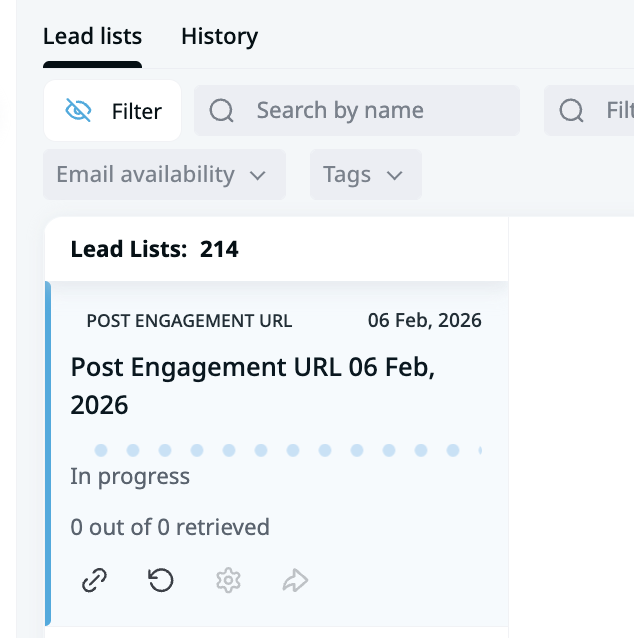
- Expandi’s post engagement lead list tool collects the profiles that reacted to or commented on a chosen post, auto-refreshes, and assigns them to an email campaign. Comments can be filtered by keyword.
- A continuously refreshed table keeps the campaign always-on instead of a one-time pull.
- Routing sends contacts with an email to an email campaign, and the rest to a LinkedIn campaign.
- The ICP filter inside the Campaign Builder handles role, company size, and geography.
- The copy speaks to the pain the signal revealed: “I noticed you’re posting relevant content. How are you separating these people?”
The numbers back the approach. In an audit of 14 campaigns, the two campaigns that were already performing well were left alone, including a Belgian consultancy at 44.5% acceptance and 11.4% replies, with 76.6% of its list still unworked. This proves that finishing a well-targeted list beats rewriting copy on a poorly chosen one.
Common mistakes to avoid when using AI for sales prospecting (and how to fix them)
Most AI prospecting failures come from a handful of habits.
| Mistake | The fix |
|---|---|
| One AI “selling profile” fired at every prospect | Segment by pain; write to one buyer per campaign |
| Treating AI drafts as final copy | Human review before sending; cut to one relevant point |
| Leaning on firmographic data, ignoring LinkedIn signals | Add profile visit and post-engagement triggers |
| Trusting the raw platform export | Score rows 1 to 5 pre-launch; campaign only 4s and 5s |
| Stuffing every detected signal into the copy | Mention one signal at most, and only when it’s relevant |
| Scaling before the motion works | Prove it on a small segment by hand first |
| Firing a scheduled step on stale profile data | Re-check the profile before each send |
How to bring AI into your LinkedIn prospecting workflow
Start small, and prove each step before you automate it.
- Run the motion by hand first: Automation multiplies whatever you feed it, including a process that doesn’t work to begin with. Start conversations manually until you can identify a few that performed well and say why.
- Define a tight ICP and target on triggers, not questions: Frame the assumption about the recipient that your opener makes into the list as something observable, like a restructure, an acquisition, or a competing tool in their stack. Don’t ask them to confess a problem to a stranger.
- Choose a segment that can buy: Read the funnel down to the stage at which you’re paid. Strong replies with no revenue means the list, not the copy, is wrong.
- Build one smart sequence with a human check before the first touch on your best accounts. Don’t automate end-to-end on day one.
- Re-check the profile before every send (as people change jobs), and keep volume modest. LinkedIn doesn’t sanction third-party automation but can restrict accounts it flags, so the account is the asset you protect first.
- Track reply rate before and after as your baseline metric.
Start a free Expandi trial and build the workflow on your own outreach.
Frequently asked questions
No. LinkedIn automation is the sending layer, the tool that fires connection requests and messages on a schedule. AI prospecting is the intelligence around it: research, signal detection, scoring, and drafting. Automation without the AI blasts a list; AI without safe automation can’t reach anyone at scale.
Yes. LinkedIn-native prospecting runs on behavioral signals and a clear ICP more than on a large CRM. A small team can pull signals from profile visits and post engagement, enrich contacts with a lightweight table, and run sequences without an enterprise database behind it.
Very little without a human read. Use AI for the first draft and the per-prospect detail, then cut to one relevant point and check it before it sends. Doing it wrong would be to ship raw model output at volume, which appears generic and costs you reply rate.
A signal is a single observed event, like a profile visit or a post like. An intent score is a model’s estimate of buying likelihood, often stacking several signals with firmographic fit. Use signals to time outreach, and scoring to decide which accounts earn a human.




You’ve made it all the way down here, take the final step