The Ultimate Guide to GTM Engineering in 2027


Key Takeaways
- GTM engineers build the revenue engine; SDRs and AEs run on it.
- The core loop is: data → signals → enrichment → scoring → routing → outreach → feedback.
- Timing beats copy. The best plays trigger on real buying signals, not on calendar dates.
- It’s an AI-first role now: 95% of postings mention AI, LLMs or agents (Onfire).
- MCP is the newest layer, letting AI agents operate tools like your CRM and LinkedIn outreach directly, with humans approving what goes out.
- The premium isn’t paid for building workflows. It’s paid for workflows the sales team actually uses.
What is GTM engineering?
GTM engineering is the practice of building automated systems that find, enrich, prioritise and reach the right buyers at the right moment as part of a wider go-to-market-strategy. A GTM engineer treats pipeline generation as an engineering problem: data in, logic in the middle, relevant outreach out.
In practice, that means wiring together data providers, signals, a CRM, AI and outreach tools into workflows that run without someone copy-pasting between tabs.
The term is new, but the work isn’t. Clay coined “GTM engineer” in 2023, though growth and RevOps teams were already building enrichment waterfalls years earlier.
The role has grown fast. GTM engineer job postings grew 205% year over year, and about 3,000 roles were open in early 2026. Google Trends shows no search interest for the term until February 2025 with interest peaking in June 2026.
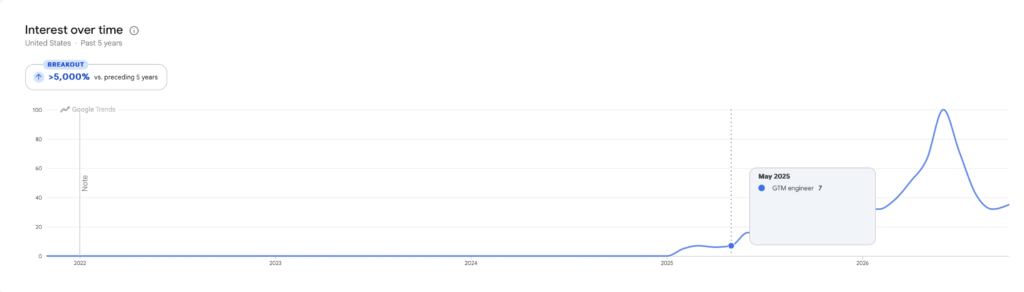
It’s also still small. Around 1,500 people in the USA currently hold the title on LinkedIn as of November 2026, and 91% of companies with a GTM engineer have exactly one. One person, building systems, carrying a whole revenue team’s leverage.
This guide is written for the people building those systems, and for the leaders deciding whether they need one.
What does a GTM engineer do?
A GTM engineer builds and maintains the systems that decide who your team contacts, when, and with what. Most of the week splits across five jobs.
- Build the target universe. Turn the ICP into a living account and contact list, pulled from data providers, CRM records and LinkedIn.
- Wire up signals. Track the events that mean signal a good time to reach out: job changes, hiring spikes, funding, website visits, profile views and post engagement.
- Enrich and score. Fill gaps with waterfall enrichment and AI research, then rank accounts so reps work the warmest first.
- Route and trigger outreach. Push qualified leads into the right sequence, owner and channel automatically.
- Measure and fix. Track what converts, find where the system leaks, and debug it when something silently stops.
The fifth job is where good GTM engineers separate themselves from the pack.
A GTM workflow can be built in an afternoon. Knowing why it sent 12 messages instead of 40 last Tuesday is the real skill.
As JB Daguené, founder of Evergrowth, put it in a GTM Society interview:
The difference between a good and a great cold email is not the copy — it’s the timing, and timing comes from signals.
Most of a GTM engineer’s work is making that timing visible and actionable.
GTM engineer vs RevOps vs SDR vs growth marketer
GTM engineers build new revenue workflows; RevOps keeps the core systems reliable; SDRs run the conversations; growth marketers own demand. The lines often blur in small teams, but the centre of gravity differs.
| Role | Main job | Typical output | Measured on |
|---|---|---|---|
| GTM engineer | Build and automate pipeline-generating systems | Signal workflows, enrichment pipelines, routing logic, AI agents | Pipeline created, speed to lead, reply and meeting rates |
| RevOps | Run and govern the revenue tech stack | CRM hygiene, reporting, forecasting, territory and comp plans | Data accuracy, forecast accuracy, process adoption |
| SDR / BDR | Turn targets into conversations and meetings | Calls, messages, booked meetings | Meetings booked, pipeline sourced |
| Growth / demand gen marketer | Create demand and capture inbound | Campaigns, content, paid, lifecycle programmes | MQLs, cost per opportunity, sourced revenue |
The most common confusion is with RevOps. A practical split: RevOps maintains the foundation, and GTM engineers build and test new growth experiments on top of it.
In most companies under 200 people, one person does both. That’s fine, as long as someone owns the maintenance work, because workflows go stale fast when nobody is watching them.
The GTM engineering tech stack
A GTM engineering tech stack has 6 layers, each feeding the next: data, signals, enrichment and scoring, routing, execution and measurement. AI agents connected through MCP now work across the middle layers.
The loop matters as much as the layers. What converts in measurement should change which signals you watch and how you score them.
You don’t need a tool per layer. Fewer tools mean fewer syncs to break; Expandi, for example, covers LinkedIn signals and execution in one place and connects to your CRM through native integrations, webhooks, API and MCP.
5 GTM engineering plays to copy
The highest-return plays all share one trait: a real event triggers the workflow, enrichment adds context, and outreach references why you’re reaching out now. Here are 5 and what tends to break in each.
Play 1: Warm LinkedIn engagement → same-week outreach
People who view your profile, engage with your posts or check your company page are telling you something. Most teams never act on it.
- Trigger: profile view, post like or comment, company page visit
- Logic: filter against ICP (title, company size, industry); drop competitors and existing customers
- Action: add to a short LinkedIn sequence that references the topic they engaged with, not the fact you saw them
- What breaks: volume spikes after a viral post flood the sequence with non-ICP leads. Cap daily adds and keep the ICP filter strict.
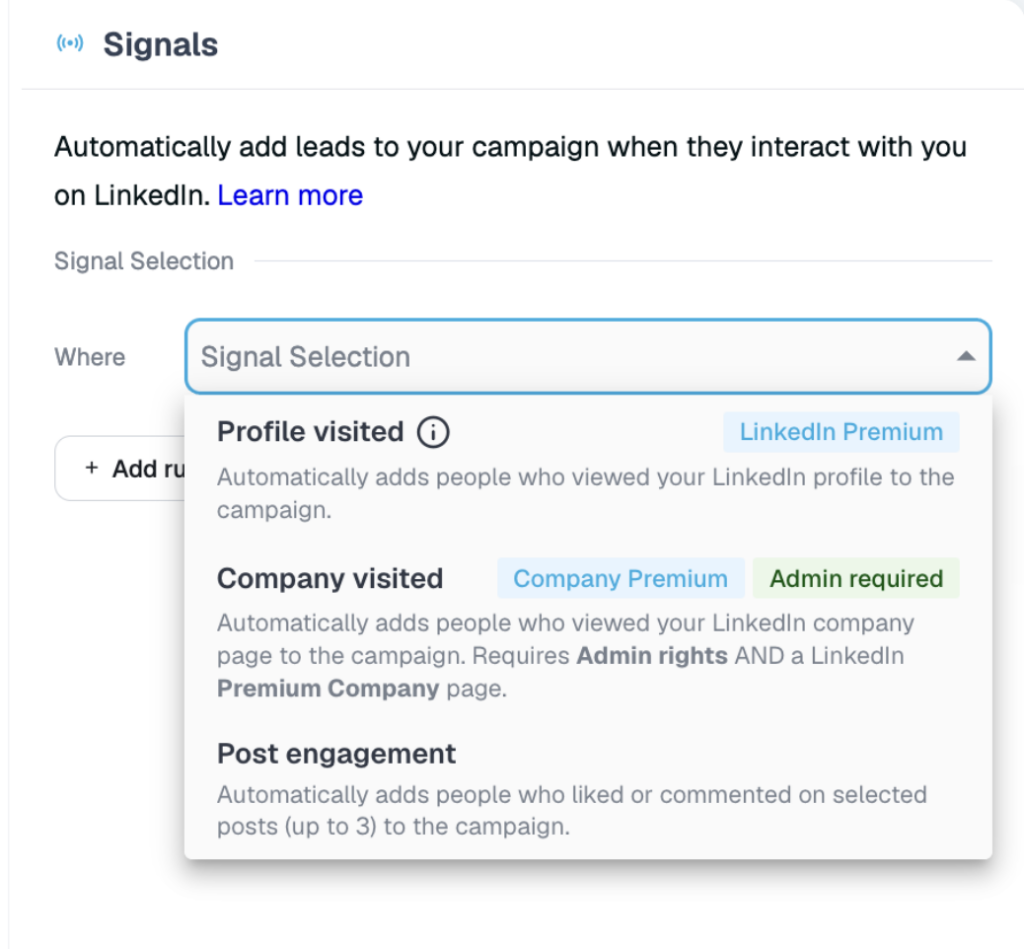
Expandi’s engagement signals capture these moments and feed them straight into your outreach campaigns.
Play 2: Job change → champion follow
When a past customer or champion moves to a new company, they arrive with budget, a mandate and a reason to rebuild their stack.
- Trigger: a contact from closed-won deals changes company
- Logic: check the new company against ICP; check it isn’t already a customer
- Action: route to the account owner with context on what they bought before; start a congratulations-first sequence
- What breaks: stale CRM data. If contacts lack LinkedIn URLs, job-change matching fails silently. Enrich URLs first.
Play 3: Hiring spike → problem hypothesis
Job postings are public statements of priority. A company hiring five SDRs is building an outbound motion; a company hiring its first RevOps lead has a messy stack.
- Trigger: new postings for roles related to your solution
- Logic: an AI step reads the job description and extracts the likely problem and tools mentioned
- Action: outreach to the hiring manager that references the initiative, not the job ad
- What breaks: recruiting agencies and reposted ads. Deduplicate by company and filter out staffing firms.
Play 4: Enrichment waterfall for every new lead
No single data provider has everything. A waterfall queries providers in order until it finds a verified value.
- Trigger: a new lead enters the CRM or a campaign
- Logic: try provider A for a work email; if missing or unverified, try B, then C; stop at first verified hit
- Action: write the result back to the CRM and to outreach placeholders
- What breaks: cost. Without stop conditions, every lead hits every provider. Log cost per enriched field.
Play 5: Closed-lost revival
Deals lost on timing often come back. Most teams never check.
- Trigger: 90 days after closed-lost with reason “timing” or “budget”, or a new signal on that account
- Logic: check for new leadership, funding or hiring at the account
- Action: a short multi-channel sequence that references what changed since the last conversation
- What breaks: lost-reason fields left blank. Make them required in the CRM before building this.
Want to turn your website into a GTM playbook? Grab our free GTM playbook skill to use with the Expandi MCP here.
How to build your first GTM engineering workflow
Start with one signal, one segment and one sequence, and prove it creates meetings before you add anything else. Most failed GTM engineering projects tried to automate everything at once.
- Pick one outcome. For example: “Book 10 more meetings a month with RevOps leaders at 50–500 person SaaS companies.” A workflow without a target can’t be judged.
- Choose one signal you trust. Start with a warm one, like post engagement or profile views from your ICP. Warm signals convert faster, so you get feedback sooner.
- Write the ICP as rules, not adjectives. “Mid-market SaaS” can’t be automated. “Software industry, 50–500 employees, title contains RevOps or Revenue Operations, located in US/UK/EU” can.
- Map the data you need. List every field the message and routing require (first name, company, signal topic, email). Then find where each one comes from.
- Build the enrichment and filter step. Add missing data, drop non-ICP leads, and deduplicate against the CRM and active campaigns.
- Write the sequence around the signal. The first message should make sense only because of the trigger. If it would work for anyone, rewrite it.
- Add guardrails. Daily caps, sending hours, exclusion lists and a human approval step for anything unusual. On LinkedIn, respect limits and warm-up so the account survives.
- Log everything. Every lead that enters, every filter that removes it, every action taken. You’ll need this the first time numbers look wrong.
- Run it for 2–4 weeks, then review. Compare reply and meeting rates against your baseline outreach. Kill it, fix it or scale it.
As Alexandra Harris, co-founder of CogniStream, said in a GTM Society interview:
“Get the insight, understand what converts, what messaging resonates, and then scale up.”
Scaling a workflow before it’s proven only scales the waste.
AI agents and MCP: the new layer of GTM engineering
AI has moved from a step inside workflows to an operator of them. GTM engineers now design what AI agents can do, with what context, and where a human must approve.
Where AI fits in the workflow
The first wave put an LLM call inside each row: research this company, summarise this profile, write this opening line. That still works and is still the bulk of AI use in GTM.
The current wave is agents with tool access. Instead of a GTM engineer wiring every step, an agent connected to the right tools can take a goal and do the steps.
The hiring data reflects the shift: 95% of GTM engineer postings mention AI, LLMs or agents, and 40% ask for Claude proficiency.
What MCP changes
MCP (Model Context Protocol) is the open standard that lets AI assistants like Claude and ChatGPT read from and act in other software. For GTM engineers, it removes a lot of glue code.
Before MCP, connecting an AI to your outreach tool meant APIs, webhooks and middleware. With MCP, you connect once, and the AI can use the tool’s actions directly from a chat, a workflow tool like n8n or Make, or a coding agent.
What this looks like with Expandi MCP
Expandi MCP lets an AI assistant operate your LinkedIn outbound across the whole loop:
- Qualify leads against your ICP and build custom lists
- Write enrichment back as placeholders for personalisation
- Turn a brief into a multi-step campaign draft
- Draft replies to incoming messages using full lead context
- Diagnose why a campaign stalled and report the real numbers
The guardrails matter for anyone building on it. Campaigns are created as drafts, replies wait for approval, and the AI works inside the account’s daily limits and warm-up. It can only do what the connected user can already do.
Set it up with our guides to connecting Expandi to Claude or connecting Expandi to ChatGPT.
Context is the real GTM engineering work
An agent with tool access and no context produces generic work at scale. The GTM engineer’s job shifts to building the context layer: ICP rules, offer, tone, exclusions and examples of good output.
The job data agrees: data skills appear 3.5x as often as prompt engineering in GTM engineer postings
Expandi’s outbound skills package this context into a company profile that every agent task reads. For more on getting AI tools to produce usable output, see our guide to using ChatGPT effectively.
GTM engineer skills, salary and hiring
The best GTM engineers combine systems thinking, data skills and enough sales sense to know what a rep will actually use. The median US GTM engineer earns about $159K (Cargo).
Skills that matter
- Data and logic: SQL, spreadsheets, data modelling and deduplication. 56% of postings ask for working SQL, Python or JavaScript.
- APIs and automation: webhooks, REST APIs, and tools like n8n, Make and Zapier.
- The core stack: the average posting names 6.4 tools. Clay appears in 66%, HubSpot in 50%, Salesforce in 48% and Claude in 45%.
- AI: designing prompts, agent context and evaluation, not just using a chatbot.
- Commercial judgement: knowing what makes a buyer reply and what makes a rep trust the system.
GTM engineer salary (US, 2026)
Pay is high and varies widely. Cargo’s analysis of 509 US postings that disclosed pay found a $135K–$190K middle range.
| Level | Median US base |
|---|---|
| Mid | $155K |
| Senior | $175K |
| Founding GTM engineer | ~$195K + equity |
| Staff | $219K |
Source: Cargo, disclosed salaries in US job postings, April–July 2026.
Outside the US, pay is much lower: Onfire puts the non-US median near $75K (Onfire).
Should you hire in-house, use an agency or upskill someone?
- Hire a GTM engineer when you have more pipeline ideas than capacity to build them, and reps who will use what gets built.
- Use an agency when you need a few proven plays running quickly and don’t yet know which ones will stick. Many GTM engineers work in agency or consulting roles for exactly this reason.
- Upskill internally when you have a curious SDR or RevOps person who already builds their own shortcuts. They know the sales team’s reality, which is half the job.
Metrics that prove GTM engineering works
Judge GTM engineering on pipeline and speed, not on how many workflows exist. Track these per workflow, against a baseline from before it launched.
| Metric | What it tells you |
|---|---|
| Meetings booked per workflow | Whether the play creates real conversations |
| Pipeline created and win rate | Whether those conversations turn into revenue |
| Reply rate vs baseline outreach | Whether signal-based timing beats cold lists |
| Speed to lead (signal → first touch) | Whether the system acts while the signal is still warm |
| Match and enrichment rate | Whether the data layer is good enough to personalise |
| Cost per enriched lead and per meeting | Whether the workflow is economical at scale |
| Rep adoption | Whether the sales team actually uses what was built |
The last one is the most overlooked. Cargo’s salary analysis makes the same point: the premium goes to engineers who get their systems adopted, not just built.
Common GTM engineering mistakes
Most GTM engineering failures come from automating before validating, or from building systems nobody maintains.
- Automating a play that hasn’t worked manually. If 20 hand-sent messages get no replies, 2,000 automated ones won’t either.
- Treating more volume as the goal. As Michel Lieben of ColdIQ said in a GTM Society interview: “Every bad email trains your prospect to ignore your next one.”
- Building for the builder, not the rep. Workflows that need a manual to use don’t get used.
- No logs, no alerts. Workflows fail silently. Without logs, nobody notices until the pipeline report.
- Ignoring channel limits. Pushing LinkedIn volume past safe limits risks the account that every other workflow depends on.
- Tool sprawl. Every new tool adds a sync, a cost and a failure point. Consolidate where one platform covers several steps.
- Giving AI access without context. Agents connected to your tools need your ICP, offer, exclusions and approval rules, or they’ll produce generic work at scale.
FAQs
Do you need to code to be a GTM engineer?
Not always, but it helps. Most of the work happens in no-code and low-code tools, yet 56% of postings ask for SQL, Python or JavaScript (Onfire). Being able to drop into a script when a workflow demands it is what separates senior engineers.
How do you become a GTM engineer?
Most GTM engineers move in from sales, growth or RevOps rather than software engineering. Build two or three real workflows end to end, document the results, and learn one enrichment tool, one automation tool and one AI assistant well.
Is GTM engineering just a Clay job?
No. Clay coined the term and remains the most common tool, but only 3 of 209 postings Onfire analysed named Clay and nothing else (Onfire). Employers hire for the ability to assemble a system.
Does a small team need a GTM engineer?
A team with fewer than five reps usually needs GTM engineering, not a dedicated GTM engineer. Start with an agency, a founder who enjoys building, or an SDR with a technical streak.
Where does LinkedIn fit in a GTM engineering stack?
LinkedIn is both a signal source and an execution channel. Engagement, profile views and job changes are some of the strongest timing signals, and LinkedIn is where many B2B buyers actually reply. It needs an execution layer that respects platform limits.
Will AI agents replace GTM engineers?
Agents replace much of the manual building, not the design. Someone still has to decide which signals matter, define the ICP as rules, set guardrails and judge whether a workflow is working.
Build the engine, then let your team run it
GTM engineering turns pipeline generation from a numbers game into a system: real signals, clean data, relevant outreach and a feedback loop that keeps improving.
Start small. One signal, one segment, one sequence, measured against your baseline. Then add the next play once the first one earns its place.
For LinkedIn, Expandi covers the signal and execution layers in one place, with CRM integrations, API, webhooks and MCP to connect it to the rest of your stack.
Your next step: start a free 7-day Expandi trial, then connect it to Claude or ChatGPT and build your first signal-based play.

Related Articles

You’ve made it all the way down here, take the final step