45 Sales Email Templates That Convert in 2026

Key Takeaways
- Email is still the top B2B outreach channel: 73% of B2B marketers say it outperforms calls, events, and paid ads for reaching prospects (Forbes, 2025).
- Sales email templates work when they act as a starting frame you personalize, not a copy-paste script sent as-is.
- The 45 templates below cover seven common situations: cold outreach, connection intros, trigger events, product-focused pitches, follow-ups, inbound handling, and special cases like referrals and objection handling, and every template includes a subject line, body copy with personalization tokens, and a follow-up.
- The best-performing sales emails share four things: clear audience match, warmed-up sending domain, a short specific subject line, and a single CTA.
45 Sales Email Templates That Convert in 2026


Sales email templates save time, but only when the shell is worth reusing. A template that reads like every other cold pitch in the inbox will not get a reply, no matter many times you send it.
According to Forbes’ 2025 email marketing statistics, 73% of B2B marketers say email is their most effective channel for reaching prospects, ahead of phone calls, events, and paid ads.
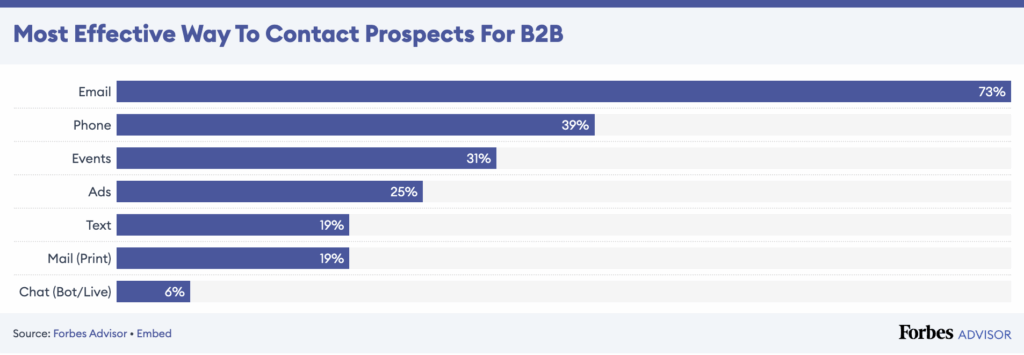
So, the channel works, but the messages inside it are what many reps still get wrong.
This guide covers 45 sales email templates you can pick up, personalize, and send. They are organized by the seven situations sales teams write into most often: cold outreach, connection intros, trigger events, product pitches, follow-ups, inbound conversations, and special cases like referrals and objection handling.
Before the templates, a short section on what separates a sales email that gets a reply from one that gets deleted.
How To Write A Sales Email That Gets Responses?
Sales emails don’t exist in a vacuum. You could copy any template below and send it as-is, but the reply rate will depend on four things you set up before the send: your audience, your sending domain, your subject line, and your CTA. Get these right and the templates work harder. If you get them wrong, no template will save you.
Filter your target audience first
Every sales email should start with a clear picture of who receives it. Before you write, know:
- Who the prospect is and what their role covers
- What their company does and what stage they’re at
- What their goals and pain points look like
- How your product or service fits into that picture
- Whether you have any prior touchpoint (a mutual contact, shared background, or engagement on their content)
Once you know the audience, editing a template to match their context takes minutes. Skipping this step turns a good template into a generic pitch.
Warm up your email account
Email warm-up is how you prove to inbox providers that your sending domain is legitimate. Warm-up tools send emails between real accounts to build a healthy sending reputation, so your cold campaigns land in the primary inbox rather than spam.
Skip this step and your reply rate collapses regardless of how good the copy is. See our full guide on how to warm up your email account for the setup.
Write a subject line worth opening
The subject line is the first (and often only) part of your email a prospect reads. Its job is one thing: earn the click.
Short, specific, and low on hype tends to work. “Quick question about {company}’s pipeline setup” beats “Boost your sales performance today” every time. The first sounds like a person, the second sounds like a marketing email.
For a longer walk-through, see how we approach subject lines in our guide to email marketing KPIs, which covers open rate benchmarks and what a healthy subject line looks like against them.
End with one clear CTA
Every sales email should ask for one thing. Not two or three, just one. The most common CTAs in B2B sales emails are:
- A short discovery call
- A demo request
- A yes/no reply to gauge interest
- A calendar link to book directly
Match the CTA to where the prospect is in your outreach. A first-touch cold email asking for a 30-minute demo will lose. A first-touch cold email asking “worth a 10-minute chat?” performs better because the ask is proportionate to the context.
For how CTAs fit into a full outreach flow, see our guide to building an email sequence.
Top 45 Sales Email Templates To Copy And Send
Below are 45 sales email templates grouped by the situations sales teams write into most. Every template is a starting frame. Replace the personalization tokens with real details before you send.
Cold Outreach Sales Email Templates
The hardest emails to write are the ones sent to someone who has never heard of you. The 10 templates below cover the most common cold outreach patterns.
#1 The quick call cold email
Good for a first-touch email in B2B sales. It’s short, states the reason for reaching out, and asks for a proportionate CTA. Ask for a short call, not a demo.
Subject line: Quick question?
Email body:
“Hi {first name},
I’m reaching out because I saw {relevant personalization}.
I’m building out my network with leaders in the {industry} field, and it looks like we could add value to each other’s networks.
My company is {overview of your company}. We’re currently working on {your offer}.
Would you be open to a quick 10-minute call next week?
Sincerely, {Your name} {Company position}”
Follow-up subject line: Following up on {your offer}
Follow-up body:
“Hey {first name},
Following up on my earlier email about {your offer}.
If it’s a fit, let me know your availability for a 10-minute call over the next two weeks.
Looking forward to hearing from you.
Regards, {Your name}”
#2 AIDA framework cold email
AIDA (Attention, Interest, Desire, Action) is one of the oldest copywriting frameworks and still works for cold email. The template below walks through each step in order.
Subject line: {First name}, question about {specific pain point}
Email body:
“Hi {first name},
Noticed {company} recently {trigger, e.g. hired, launched, expanded}. Congrats on that.
Most {role} teams running through this stage hit the same problem: {specific pain point}. It usually shows up as {observable symptom}.
We helped {similar customer} run this playbook and cut {metric} by {number}% inside a quarter.
Worth a 15-minute walk-through of how they did it?
Best, {Your name}”
Follow-up subject line: Re: {specific pain point}
Follow-up body:
“Hi {first name},
Bumping this in case it got buried.
Happy to send the {customer} case study over so you can decide whether the call is worth your time. Reply with ‘send it’ and I’ll drop it in.
{Your name}”
#3 PAS (Problem, Agitate, Solution) cold email
PAS names a problem, sits with it for a beat, then presents your solution. It’s blunt, and it works when the problem is one your prospect actually has.
Subject line: {Company}’s {problem area} setup
Email body:
“Hi {first name},
Most {industry} teams I talk to are running {common approach}. The issue: it drops off around {stage of funnel}, which usually costs them {estimated impact}.
If that sounds familiar at {company}, we’ve built an approach that handles {specific outcome}. Happy to walk you through how {reference customer} used it.
15 minutes next week?
{Your name}”
Follow-up subject line: Following up on {problem area}
Follow-up body:
“Hi {first name},
Circling back on my last email.
If timing isn’t right, no worries. Just let me know whether this is on your roadmap and I’ll follow up when it makes more sense.
Thanks, {Your name}”
#4 Lead generation social proof email
When you’re cold-reaching someone with no prior connection, borrowing credibility from an existing customer helps. This template does that in a few lines.
Subject line: Quick question for {first name}
Email body:
“Hey {first name},
Saw that you {personalization}. Nice work.
Reaching out because I run outbound for {your company}. We recently helped {reference customer A} and {reference customer B} achieve {1-2 sentence result}, and I’ve got a few ideas on how to run the same play at {prospect company}.
Worth a quick 10-minute call this Wednesday or Thursday?
Kind regards, {Your name}”
Follow-up subject line: Sneak peek
Follow-up body:
“Hey {first name},
I recorded a short video audit of your current {relevant asset, e.g. LinkedIn ads, landing page, sequence}.
Three quick fixes are in the video: [URL].
Happy to walk through a full playbook on a 15-minute call if the audit is useful.
Best, {Your name}”
#5 Direct value proposition cold email
Some prospects respond better to a plain, direct pitch. No wind-up, no small talk. Just what you do and what it’s worth.
Subject line: {Value in numbers} for {company}
Email body:
“Hi {first name},
Short version: we help {ICP description} cut {metric} by {number}% within {timeframe}.
For a company at {company}’s stage, the impact usually looks like {specific dollar or time saving}.
If that’s worth 15 minutes, here’s my calendar: {link}.
{Your name}”
No follow-up needed. The CTA is a calendar link. If they don’t book, drop them into a nurture sequence instead of pinging again.
#6 Question-based cold email
Asking a question is one of the strongest ways to get a reply. It creates an obligation to respond, and it lets you skip the pitch until you know the prospect’s context.
Subject line: How are you handling {specific workflow}?
Email body:
“Hi {first name},
I’ve been talking to a few {role}s at companies your size about how they’re handling {specific workflow}.
The teams I’ve spoken to are split roughly 50/50 between {approach A} and {approach B}. Curious which side {company} is on.
Reply with a quick word and I’ll share what the other teams are finding.
Thanks, {Your name}”
Follow-up subject line: Missed you
Follow-up body:
“Hi {first name},
Following up on my question about {specific workflow}.
Even a one-word reply helps, and I’ll happily share the pattern I’m seeing across the other conversations.
{Your name}”
#7 Compliment opener cold email
A specific, honest compliment is a stronger opener than a generic one. This template works when you’ve actually engaged with the prospect’s content or product.
Subject line: {First name}, your take on {specific topic}
Email body:
“Hi {first name},
Read your recent {post/podcast/article} on {specific topic}. The point about {specific detail} stood out. Most people writing about this skip that part.
I run {your company}, and we work with {ICP}. Given how you’re thinking about {topic}, I’d be curious to compare notes on how {your area} is showing up in your world.
Open to a 15-minute call?
Best, {Your name}”
Rule: if the compliment is generic, don’t send this template. A vague “great post!” opener reads as manipulation.
#8 Founder-to-founder cold email
Founders reply to other founders more often than they reply to reps. This template is short, direct, and skips the sales polish.
Subject line: Founder to founder, quick question
Email body:
“Hi {first name},
Founder of {your company} here. We’re the {short one-line pitch}.
I noticed {trigger about their company}. Wondering how you’re thinking about {specific problem your product addresses} at this stage.
Open to 15 minutes to compare notes?
{Your name}”
#9 Video pitch cold email
A short Loom or Vidyard video attached to a cold email lifts reply rates because it feels personal and takes effort. This template teases the video and directs the reader to click.
Subject line: Made you a 90-second video, {first name}
Email body:
“Hi {first name},
Made a quick 90-second video walking through three things I’d change on {specific asset, e.g. landing page, LinkedIn campaign, email sequence} at {company}: {video link}.
No pitch in the video. Just observations. If it’s useful, happy to jump on a call and go deeper.
{Your name}”
Follow-up subject line: Did you get a chance?
Follow-up body:
“Hi {first name},
Just checking whether the video came through. Roughly a 90-second watch: {video link}.
Would love your take.
{Your name}”
#10 Data-driven cold email
If you have a proprietary data point relevant to your prospect’s world, lead with it. Data is one of the few openers that survives inbox fatigue.
Subject line: {Number}% of {ICP} are getting this wrong
Email body:
“Hi {first name},
We ran a study across {sample size} {ICP} accounts and found that {finding: the specific data point}.
Curious where {company} sits on this. If you’d like to see the full breakdown, I’ll send it over, no call required.
Reply ‘send it’ and I’ll drop it in.
{Your name}”
Introduction And Connection Sales Email Templates
Templates 11 through 16 handle the first email in a relationship: an introduction, a warm connection, or a partnership pitch.
#11 Scheduling a meeting email
Good for a prospect who hasn’t heard of you but fits your ICP. The template shows you’ve done research on their goals and pain points before reaching out.
Subject line: Hey {first name}
Email body:
“Hey {first name},
I noticed how well {company} is executing on {the prospect company’s visible goal}.
From talking to similar teams in {industry}, I’ve seen most run into {common pain point} at your stage.
Would seeing {specific benefit} without {pain point} be relevant for {company}?
I’ve helped similar companies achieve {result} and have a few ideas that might apply.
Would 15 minutes over the next two weeks work?
Kind regards, {Your name}”
Follow-up subject line: Looks like I missed you
Follow-up body:
“Hi {first name},
Following up on my last email. Wanted to check whether {strategy to tackle their pain point} was worth a conversation.
Happy to run through it whenever works. Here’s my calendar: {calendar link}.
Best, {Your name}”
#12 The new connection email
For a first outreach to someone you’ve engaged with on LinkedIn. It emphasizes common ground and keeps the ask small.
Subject line: Hey {first name}, nice to meet you
Email body:
“Hello {first name},
Came across your profile on LinkedIn. Enjoyed your post about {specific personalization}.
I’m {your name} and I run {short description of what your company does}.
Always keen to trade notes with people working in {their space}. Would you be open to a quick 10-minute value-exchange call this week?
If so, grab a time here: {calendar link}.
Kind regards, {Your name}”
Follow-up subject line: Following up on {offer}
Follow-up body:
“Hi {first name},
Not sure if my previous email reached you. Wanted to circle back once more.
I have a few ideas on how {prospect’s company} could hit {specific goal}. Worth 10 minutes of your time?
Looking forward to hearing from you.
Best, {Your name}”
#13 Mutual connection email
Nothing warms a cold email faster than a shared connection. This template opens with the shared name and moves quickly to the ask.
Subject line: {Mutual contact’s name} suggested I reach out
Email body:
“Hello {first name},
{Mutual contact} and I were talking last week about {relevant topic}. Your name came up as someone who’s been thinking about {specific area}.
I’m writing a piece on {relevant topic} and would love your input. It’s here if you have five minutes: {link}.
Happy to trade feedback on anything you’re working on in return.
All the best, {Your name}”
Follow-up subject line: How was the piece, {first name}?
Follow-up body:
“Hello {first name},
Circling back on the piece about {topic}. Would love your take.
If it’s easier, a 15-minute call this week works too, if easier. I can walk through it and get your thoughts live.
Kind regards, {Your name}”
#14 Alma mater connection email
Shared college is a low-effort personalization that consistently lifts reply rates. Use it when it’s genuinely true. Never fake it.
Subject line: {College} alumni, quick hello
Email body:
“Hi {first name},
Saw you graduated from {college}. I was there in {your years}. Small world.
I noticed you’re now running {their role} at {company}. Curious how you ended up in {field}, and what the current challenge looks like on your end.
I run {your company}, which works with {ICP}. Would love a quick call to compare paths.
Best, {Your name}”
#15 Warm intro request email
For asking a mutual connection to introduce you to a prospect. Keep it short. The person doing the intro will forward your email.
Subject line: Quick favor: intro to {prospect name}?
Email body:
“Hi {mutual contact},
Hope you’re well. Quick ask.
Would you be open to introducing me to {prospect name} at {prospect company}? We’re building for {ICP}, and I’ve been trying to get on their radar. Their team is a strong fit for what we do.
If you’re up for it, I’ve drafted a forwardable intro below to make it easy:
Hi {prospect name},
Meet {your name}, founder of {your company}. They help {short description of what you do}, worth a look if {relevant reason for the prospect}.
Leaving you two to it.
Fully understand if it’s not the right moment. Either way, thanks for reading.
{Your name}”
#16 Partnership sales email
For pitching a partnership when you’re not sure who owns partnerships at the target company. It doubles as a research email. If the recipient isn’t the right person, they’ll usually forward it.
Subject line: Partnership idea for {prospect company}
Email body:
“Hello {company} team,
I’m {your name} at {your company}. We work in {your space} and serve {ICP}.
I’m reaching out because I think there’s a partnership fit between our companies: your customers hit {problem your product addresses}, and our product handles it directly. Together we could build {short partnership concept}.
If partnerships isn’t your area, I’d be grateful if you could point me to the right person.
Thanks, {Your name}”
Follow-up subject line: Partnership follow-up
Follow-up body:
“Hi {contact name},
Thanks for pointing me to you. Following up on the partnership idea I mentioned in my earlier email.
Happy to jump on a call to walk through the concept in more detail. What does your calendar look like next week?
Best, {Your name}”
Trigger Event Sales Email Templates
Trigger events, such as funding rounds, executive hires, product launches, and awards, give you a legitimate reason to reach out. Templates 17 through 20 handle the most common ones.
#17 Funding / growth trigger event email
Use when the prospect’s company has raised money, expanded, or hit a milestone. The template ties your outreach to their moment.
Subject line: {Company}’s {trigger event}
Email body:
“Hi {first name},
Saw {company}’s {trigger event, e.g. Series B, expansion, product launch}. Congrats.
Companies scaling through this stage usually run into {specific problem your product solves} within {timeframe}. We’ve helped {reference customer at similar stage} get ahead of it.
Worth a short call to walk through what they did?
Kind regards, {Your name}”
Follow-up subject line: Post-{trigger event} playbook
Follow-up body:
“Hi {first name},
Following up on {trigger event}.
Happy to send over the case study I mentioned. No call needed unless it lands. Reply ‘send it’ and I’ll drop it over.
{Your name}”
Tip: Sales Navigator’s job change and company update alerts make finding these triggers repeatable. See our full guide to using Sales Navigator for outbound.
#18 Job change email
New role, new pressure, new budget. A prospect starting a job is often actively looking for tools to build their new team’s stack.
Subject line: Congrats on the {new role} at {new company}
Email body:
“Hi {first name},
Saw you started as {new role} at {new company}. Congrats.
Most {role}s in the first 90 days of a new role are figuring out which tools their team actually needs. If {product category} is on your list, I’d be happy to run through what {reference customer in same role} set up in their first quarter.
Worth a 15-minute conversation?
{Your name}”
#19 Company news / press mention email
Similar to the funding trigger, but broader. Any real news the prospect’s company has made (a hire, an award, a product update, a media mention) is a legitimate opener.
Subject line: Saw the {news outlet} piece on {company}
Email body:
“Hi {first name},
Saw the {news outlet} coverage on {company}’s {news topic}. The point about {specific detail from the article} caught my attention. It lines up with what a few of our customers are working on right now.
I run {your company}. Given what you’re building, I’d be curious to compare notes on {relevant angle}.
Open to a short call next week?
{Your name}”
#20 The congratulatory email
For building rapport without pitching. Not every sales email needs to sell. Some just need to keep you visible to a warm prospect.
Subject line: Nice work on {achievement}, {first name}
Email body:
“Hey {first name},
Wanted to drop a note to congratulate you on {specific achievement}. Impressive result for a company at your stage.
No agenda here, just cheering from the sidelines. Looking forward to seeing where you take it next.
{Your name}”
Product And Service Sales Email Templates
Templates 21 through 27 are for pitching a product, demo, or trial. They work best when the prospect already knows the category exists and is evaluating options.
#21 Demo request email
For a prospect who has requested a demo or shown interest. Move quickly and give them a way to book directly.
Subject line: {First name}, ready when you are
Email body:
“Hi {first name},
Thanks for the demo request. Before we jump on, a few quick questions so I can tailor the walk-through:
- What’s the specific problem you’re trying to solve with {product category}?
- Who else will be on the call?
- What does your current setup look like?
Once I have those, I’ll customize the demo. In the meantime, here’s my calendar for a 30-minute slot: {calendar link}.
Best, {Your name}”
Follow-up subject line: About the demo
Follow-up body:
“Hi {first name},
Wanted to check whether you’d had a chance to think about scheduling the demo.
A few things worth knowing before the call:
- {Reason 1 the demo will be valuable}
- {Reason 2}
- {Reason 3}
Grab a time here when it works: {calendar link}.
Regards, {Your name}”
#22 Free trial sales email
Use once a prospect is inside a free trial. Highlight what they’ve done and open the door to the paid plan without hard-selling.
Subject line: What’s next, {first name}?
Email body:
“Hi {first name},
Noticed {company} has already hit:
- {Trial milestone 1}
- {Trial milestone 2}
- {Trial milestone 3}
Solid start. There are a handful of features you haven’t touched yet that would likely make the biggest difference for {their specific goal}. Happy to walk through them on a 15-minute call.
Book a time here: {calendar link}.
Best, {Your name}”
Follow-up subject line: Trial expiring soon
Follow-up body:
“Hey {first name},
Quick note: your trial expires in {number} days.
Before it does, worth 15 minutes to walk through what a rollout would look like for your team? I’ll pull together specifics on {relevant use case} for {company}.
{Calendar link}
Kind regards, {Your name}”
#23 Growth-focused outreach email
For a prospect at a company that’s clearly scaling. The template ties your outreach to their current growth trajectory.
Subject line: {Company}’s next stage
Email body:
“Hello {first name},
I’ve been watching {company} for a while, since {colleague X} first mentioned you.
The move to {recent growth signal, e.g. new market, new hire, new product} caught my eye. Companies at this exact stage tend to hit {specific problem your product solves} inside the next quarter or two.
We’ve helped {reference customer at similar stage} work through it. Would a 15-minute walk-through of what they did be useful?
Best, {Your name}”
Follow-up subject line: Following up
Follow-up body:
“Hi {first name},
Circling back on my earlier note. Attached is the case study I mentioned: {case study link}.
If it lands, happy to jump on a call to talk through applying it at {company}.
Regards, {Your name}”
#24 Case study share email
When you have a case study that directly matches the prospect’s situation, sending it with no pitch attached is often more effective than pitching first.
Subject line: How {reference customer} solved {specific problem}
Email body:
“Hi {first name},
{Reference customer} is roughly {company}’s size and was running into {specific problem}. They put together a playbook that cut {metric} by {number}% inside {timeframe}.
Full case study is here: {link}.
No pitch attached. Thought it might be useful given what you’re working on. Happy to talk through the specifics if it’s relevant.
{Your name}”
#25 CMO-specific email
Persona-specific templates work when the pitch matches the role’s actual priorities. This one is written for a CMO. Replace with any senior role if you tailor the priorities.
Subject line: Pipeline coverage at {company}
Email body:
“Hi {first name},
Most CMOs I talk to are being asked the same question by their CEO right now: what’s the pipeline-to-quota ratio, and can we prove it’s not vanity?
{Your company} works with revenue teams at {ICP} to close the gap between reported pipeline and pipeline that actually closes. Two customers in {their industry} have used it to shift their coverage ratio from {before} to {after} in a quarter.
Worth 20 minutes to see how they did it?
Best, {Your name}”
#26 Enterprise decision-maker email
For senior leaders at large companies. Skip the personalization games. They’ve seen every trick. Lead with substance.
Subject line: {Specific business outcome} at {company}
Email body:
“Hi {first name},
I’ll keep this short.
{Your company} works with {two or three enterprise references}. In each case, we’ve moved {specific business metric} by {number}% within {timeframe}.
Given what {company} has publicly shared about {their strategic priority}, this looks like a fit. Would 20 minutes make sense in the next two weeks?
If timing isn’t right, happy to send a short overview instead. Just say the word.
Best, {Your name}”
#27 Founder / SMB opener email
For pitching founders of small companies. Founders respond to plain language and specific value.
Subject line: {First name}, 30-second idea for {company}
Email body:
“Hi {first name},
Quick one.
Founders at {company}’s stage usually hit {specific problem}. We’ve built the fix. Takes about a day to set up and pays for itself inside a month for teams your size.
Full walk-through is a 15-minute call: {calendar link}. If a call isn’t your style, I’ll happily send the details over async.
{Your name}”
Follow-Up Sales Email Templates
Most sales are lost in the follow-up. Templates 28 through 34 handle the situations where the prospect went quiet, missed a meeting, or needs a nudge.
#28 Post-demo follow-up email
Send within 24 hours of the demo. Summarize what came up, restate the specific value, and hand back one clear next step.
Subject line: Recap from our call
Email body:
“Hi {first name},
Thanks for the time today. Quick recap of what we covered:
- {Point 1 from the demo}
- {Point 2}
- {Point 3}
Based on what you shared about {their situation}, the setup that would move {metric} fastest is {specific recommendation}.
Next step: {specific action, e.g. pricing review, trial setup, or second call with wider team}.
Grab a time here: {calendar link}.
Best, {Your name}”
#29 Meeting no-show follow-up email
Assume the miss was accidental. Rescheduling is easier when you keep the tone light.
Subject line: Missed you today
Email body:
“Hi {first name},
Wanted to check in — we had our call scheduled for {time}, and it looks like something came up.
Totally happens. Here’s my calendar to reschedule when it works: {calendar link}.
{Your name}”
#30 Breakup / final follow-up email
The last email in a sequence. It works because it removes pressure and often surfaces a real reason for the silence.
Subject line: Closing the loop
Email body:
“Hi {first name},
I’ve reached out a few times about {topic} and haven’t heard back, so I’ll stop here.
If the timing isn’t right, that’s fine. Happy to circle back in a quarter or two.
If I’ve been reaching out for the wrong reason, let me know and I’ll close the file.
Either way, thanks for your time.
{Your name}”
#31 Post-webinar follow-up email
For prospects who attended a webinar or watched the recording. Reference something specific from the session. Otherwise the email reads like every other post-event blast.
Subject line: Following up on {webinar name}
Email body:
“Hi {first name},
Thanks for joining {webinar name} last week. The question about {specific topic from the webinar} came up a few times, and it’s worth a longer conversation than we had time for.
If you’d like to walk through how {reference customer} applied the framework we covered, I’ve got 15 minutes free next week: {calendar link}.
{Your name}”
#32 Content download follow-up email
Someone downloaded your ebook, guide, or template. They’ve raised their hand. This is your chance to open the conversation.
Subject line: Anything I can clarify from the guide?
Email body:
“Hi {first name},
Saw you downloaded {content asset}. Hope it’s been useful.
The questions I usually get after that guide are:
- {Common question 1}
- {Common question 2}
- {Common question 3}
If any of those are on your mind, happy to answer over email or on a 15-minute call. Which works?
Best, {Your name}”
#33 Reactivation / win-back email
For a prospect who went cold months ago. Reference the original context, then give them a reason to re-engage.
Subject line: Remember {original topic}?
Email body:
“Hi {first name},
Last spoke back in {timeframe} about {original topic}. Wanted to circle back for two reasons.
First: we’ve since built {new feature or capability} that directly addresses what you flagged as a blocker.
Second: {reference customer at similar stage} just published results using it: {short one-line outcome}.
If either changes the picture at {company}, I’d love to reconnect.
{Your name}”
#34 Out-of-office reply follow-up
You sent an email, got an auto-reply, and now they’re back. Use their absence as a hook to restart the conversation.
Subject line: Welcome back, {first name}
Email body:
“Hi {first name},
Welcome back from {reference to their OOO, e.g. vacation or offsite}.
Before you left, we were discussing {feature, product, or topic}. You mentioned you needed to check with {stakeholder} before moving forward.
Any luck on that conversation? Happy to jump on a call this week if it’s easier.
Kind regards, {Your name}”
Inbound And Post-Sale Sales Email Templates
Templates 35 through 40 are for handling inbound conversations and customers who are already inside your product.
#35 Turning inbound leads into clients
Someone showed interest, whether that’s filling out a form, replying to an ad, or opening a chat. This template thanks them and moves the conversation forward.
Subject line: Thanks for signing up, {first name}
Email body:
“Hi {first name},
Thanks for signing up.
I put together a short video walking through the questions I usually get in the first week: {video link}.
The three outcomes we help teams hit fastest are:
- {Goal 1}
- {Goal 2}
- {Goal 3}
If you’d like to talk through which of those maps to {company}’s situation, grab a time here: {calendar link}.
Kind regards, {Your name}”
Follow-up subject line: How’s the video?
Follow-up body:
“Hello {first name},
Following up on the video I sent. Any questions come up?
Happy to jump on a quick call or answer async. Whichever works.
Best, {Your name}”
#36 Post-signup welcome email
For customers or trial users who just signed up. Keep it warm, useful, and short. No pitch yet.
Subject line: You’re in — here’s where to start
Email body:
“Hi {first name},
Welcome. Three things worth doing in your first 24 hours:
- {First action}
- {Second action}
- {Third action}
If you get stuck on any of them, reply to this email and I’ll help directly.
{Your name}”
#37 Free resource share email
For nurturing a prospect who isn’t ready to buy but is worth staying visible to. Send something useful with no strings attached.
Subject line: Thought you might like this
Email body:
“Hi {first name},
Came across {resource, e.g. article, tool, template, or report} and thought of you. It lines up with what you mentioned about {specific context from a prior conversation}.
Link: {URL}
No agenda. Happy to talk through it if it’s useful; otherwise, enjoy.
{Your name}”
#38 Trial expiring email
For a trial user in their final week. The goal is a conversation about the paid plan, not a hard sell.
Subject line: Your trial expires {date}
Email body:
“Hi {first name},
Your trial ends on {date}. Wanted to check in before it does.
A few options from here:
- Move to a paid plan and pick up where you left off
- Extend the trial by another week if you need more time to test
- Close it out and revisit later
Whichever way you’re leaning, happy to help. Reply and let me know.
Best, {Your name}”
#39 Upsell / cross-sell email
For customers already on a paid plan who could get more value from a higher tier or additional module.
Subject line: One thing worth adding to your setup
Email body:
“Hi {first name},
Reviewing your account, noticed you’re getting good use out of {current feature or plan}.
One capability that would likely fit well is {upsell feature}. Customers on your plan who added it typically see {specific benefit} within {timeframe}.
Happy to walk through the details on a 15-minute call, or send a quick overview if that’s easier.
Best, {Your name}”
#40 Renewal email
For a customer whose contract is up for renewal. Reference the outcomes so far, then confirm the next term.
Subject line: Renewal for {company}
Email body:
“Hi {first name},
Your current contract with us renews on {date}. Wanted to check in ahead of that.
Quick recap of the last term:
- {Outcome 1}
- {Outcome 2}
- {Outcome 3}
A few things worth talking through before we roll the next term:
- Adjustments to the current setup
- Any new use cases on your roadmap
- Pricing and terms
15 minutes at your convenience: {calendar link}.
Best, {Your name}”
Special Situation Sales Email Templates
Templates 41 through 45 cover the situations that don’t fit anywhere else: talent, referrals, objections, and follow-ups on social conversations.
#41 Talent sourcing email
For prospecting to companies that need help with hiring or recruitment.
Subject line: Is this relevant for {company}?
Email body:
“Hi {first name},
I’m {your name} at {your company}. We work with {ICP} on {your value area}.
Looking at {company}’s hiring page, it’s clear you’re expanding into {specific area}. Teams at this stage typically need a steadier flow of qualified applicants than the current sourcing channels can produce. That’s the gap we close.
Two similar companies used our approach to {specific outcome} inside a quarter.
Worth 15 minutes to see whether it fits?
{Your name}”
Follow-up subject line: Case study from {reference customer}
Follow-up body:
“Hello {first name},
Following up with the case study I mentioned. {Reference customer} was solving for the same sourcing gap I flagged for {company}: {link}.
15 minutes worth it?
{Your name}”
#42 Referral request email
For asking a happy customer to refer someone in their network. Ask directly. Most customers are willing to help if you make it easy.
Subject line: Small ask
Email body:
“Hi {first name},
Small ask.
You’ve mentioned {a similar company or role} a few times. If you know anyone there — or in a similar situation — who might get value from what we’ve been doing together, would you be open to introducing us?
Happy to draft the intro to make it easy. Fully understand if it’s not the right moment.
Thanks either way, {Your name}”
#43 Objection handling email (price)
For a prospect who has gone quiet after the pricing conversation. Address the objection directly and reopen the conversation.
Subject line: On the pricing question
Email body:
“Hi {first name},
Wanted to circle back on the pricing question from our last call.
A few things worth knowing:
- Most teams at your stage recover the cost within {payback period} based on {specific driver}.
- We have a {smaller plan or phased rollout option} if the full package is more than you need in year one.
- {Reference customer} started on a similar scoped setup and expanded once the results came in.
Happy to walk through any of the above.
{Your name}”
#44 Social media conversation follow-up email
You had a good exchange with someone in the comments of a LinkedIn post, a Reddit thread, or another social channel. Move it to email.
Subject line: Following up on our {platform} conversation
Email body:
“Hello {first name},
Enjoyed the back-and-forth on {platform} about {topic}. Your point about {specific comment they made} stuck with me.
Wanted to keep the conversation going. What you described sounds like exactly what we’ve built for at {your company}. Worth a longer conversation than the comment thread allows.
15 minutes this week?
Best, {Your name}”
Follow-up subject line: Our {platform} thread
Follow-up body:
“Hi {first name},
Bumping this one in case it got buried.
Genuinely think there’s something worth exploring together based on what you shared on {platform}. When would work?
Thanks, {Your name}”
#45 Ask for feedback email
For customers who have been active for a few months. Feedback emails often surface expansion opportunities and reference stories at the same time.
Subject line: Two questions
Email body:
“Hi {first name},
You’ve been using {product} for {timeframe} now. Wanted to ask two quick questions:
- What’s the single most useful thing about how you’re using it today?
- What’s the one thing you wish worked differently?
Both answers will help shape the roadmap, and I’ll route your feedback directly to the product team.
Thanks, {Your name}”
FAQs About Sales Email Templates
A good sales email template covers four things: a subject line short enough to earn the click, an opener that grounds the email in the prospect’s context, one clear body message tied to a specific value or pain point, and one CTA. Templates work when they act as a scaffold you customize before sending, not a script you copy-paste as-is.
Skip the tricks. Prospects can spot a manufactured hook from the preview pane. What actually earns attention is specificity: a real detail about the prospect’s company, a concrete data point about a peer, or a plain-language question that fits their current situation. Keep it under 100 words and end with one clear ask.
Open by naming a shared context (a mutual connection, a shared background, or something specific about the prospect’s work). Introduce yourself and your company in one sentence. State why you’re reaching out in one sentence. End with a proportionate CTA (usually a short call, not a demo). See the introduction and connection templates above (11–16) for working examples.
There’s no single best cold email template. The right one depends on your ICP, the sender’s role, and the stage of outreach. That said, three templates cover most first-touch cold outreach in B2B: the direct value proposition (template #5) for prospects who prefer plain pitches, the AIDA framework (template #2) for prospects who need to be walked through the case, and the question-based cold email (template #6) for prospects who respond better to conversation than to pitches.
When a prospect says no, keep the response short, professional, and low-pressure. Thank them for the honest answer, ask one specific question about the reason (budget, timing, incumbent tool), and offer to circle back in a defined timeframe. Something like:
“Hi {first name},
Appreciate you closing the loop.
One quick question if you have a second: was it a timing issue, or a fit issue with what we do?
Either way, happy to circle back in {timeframe} if things shift. Thanks for the honest answer.
{Your name}”
Most rejections aren’t permanent. A short, honest reply keeps the door open for later.
Ready To Start Sending Sales Email Templates That Convert?
The 45 templates above are a starting frame. Every one of them will work better with real personalization: the prospect’s actual context, a real trigger, and a specific reason for the email. Copy the shell, replace the tokens, and send.
When you’re ready to run the templates at volume across LinkedIn and email in the same sequence, Expandi handles both channels from one workspace. View pricing or start a 7-day free trial and put these templates to work in your first campaign.



You’ve made it all the way down here, take the final step