12 LinkedIn Sales Navigator Benefits in 2026 (by Plan)

You probably found yourself here because you’re wondering whether LinkedIn Sales Navigator is worth the cost. Honestly? If LinkedIn prospecting is a weekly part of your sales motion, then LinkedIn Sales Navigator deserves a spot in your GTM stack. Specifically, it offers more precise search, buyer signals worth acting on, and far less time spent digging through profiles by hand.
There’s data to back that up. Forrester’s study estimated a 312% ROI and a monthly cost that pays itself back within 6 months. The North American companies surveyed reported a 30% growth in revenue through targeting higher quality leads and having access to accurate prospect data to personalize messaging.
There’s more to consider than that though which is why we’ve dug deeper into the benefits of LinkedIn Sales Navigator to break down what each Sales Navigator plan includes, what it costs in 2026 and when it earns its place in your sales stack.
Key Takeaways
- Core covers everything a solo seller needs to prospect: 50+ filters, saved searches, 50 InMail credits a month, relationship tools, and AI research summaries.
- Advanced is the team plan. It adds shared lists, TeamLink, Buyer Intent, Smart Links, CSV book-of-business upload, and usage reporting.
- Advanced Plus is the CRM plan, with CRM sync, activity writeback, embedded LinkedIn data, and ROI reporting.
- Sales Navigator sharpens who you target and when you reach out. It won’t lift replies on its own. In Expandi’s H2 2026 data, Sales Navigator leads accepted connection requests slightly more often than CSV imports, but replied at exactly the same rate.
12 LinkedIn Sales Navigator Benefits in 2026 (by Plan)


Quick look at the 12 benefits of Sales Navigator
Here’s the short version of what each tier adds. The full breakdown below explains where each benefit is useful and whether it justifies moving beyond Core.
| # | Benefit | Core | Advanced | Advanced Plus |
|---|---|---|---|---|
| 1 | Search without LinkedIn’s commercial-use limit | ✓ | ✓ | ✓ |
| 2 | Use 50+ lead and account filters | ✓ | ✓ | ✓ |
| 3 | Save searches and get fresh-lead alerts | ✓ | ✓ | ✓ |
| 4 | Act on Spotlights and account alerts | ✓ | ✓ | ✓ |
| 5 | Send 50 InMails a month | ✓ | ✓ | ✓ |
| 6 | Find warm paths and related prospects | ✓ | ✓ | ✓ |
| 7 | Research leads and accounts with AI | ✓ | ✓ | ✓ |
| 8 | Send Sales Navigator audiences into Expandi | ✓ | ✓ | ✓ |
| 9 | Share team knowledge with TeamLink and shared lists | ✓ | ✓ | |
| 10 | See Buyer Intent signals | ✓ | ✓ | |
| 11 | Track content engagement with Smart Links | ✓ | ✓ | |
| 12 | Sync Sales Navigator with your CRM | ✓ |
What is LinkedIn Sales Navigator?
LinkedIn Sales Navigator is LinkedIn’s paid prospecting product for B2B sellers. It sits on top of LinkedIn’s network of more than 1 billion members and adds deeper search, lead tracking, alerts, and sales research tools.
LinkedIn offers 3 Sales Navigator plans:
- Core for individual sellers
- Advanced for teams
- Advanced Plus for companies that want a native CRM connection.
- Recruiters hiring candidates should look at Recruiter Lite or another LinkedIn Talent Solutions product instead.
This article is about one question: is the subscription worth the money, and which tier fits? For setup steps and search tactics, read our complete Sales Navigator prospecting guide.
Sales Navigator plans and pricing in 2026
Core starts at $119.99 per license on monthly billing, or $1,079.88 a year (about $89.99 a month).
Advanced starts at $159.99 monthly, or $1,799.88 a year (149.99 a month).
Advanced Plus is quote-only.
Those are LinkedIn’s published US starting prices as of October 2026. Taxes, promotions, region, and even the device you buy on can change what you see, so check Sales Navigator’s current plan comparison page before you commit.
| Feature | Free LinkedIn | Core | Advanced | Advanced Plus |
|---|---|---|---|---|
| Starting US price | $0 | $119.99 monthly or $89.99/month billed annually | $159.99 monthly or $149.99/month billed annually | Custom quote |
| Search | Commercial-use limit; LinkedIn doesn’t publish a fixed allowance | Sales Navigator search; up to 2,500 lead results and 1,000 account results visible per search | Same as Core | Same as Core |
| InMail | No monthly InMail allowance | 50 per month; up to 150 can accumulate | 50 per month; up to 150 can accumulate | 50 per month; up to 150 can accumulate |
| Lead IQ and Account IQ | No | Yes | Yes | Yes |
| Relationship Explorer | No | Yes | Yes | Yes |
| TeamLink and shared work | No | No | Yes | Yes |
| Buyer Intent and Smart Links | No | No | Yes | Yes |
| Native CRM sync and writeback | No | No | No | Yes |
| Best fit | Occasional networking | Individual seller prospecting every week | Sales teams that need shared research and reporting | Teams that need Sales Navigator tied to CRM records |
Summarizing who each Sales Navigator plan is best for
- For a founder or solo seller who prospects weekly, Core is usually enough.
- Advanced earns the extra spend once several reps need the same lists, warm-introduction paths, and reporting on who’s actually using their seat.
- Advanced Plus only makes sense when you need Sales Navigator activity written back to your CRM.
Weighing Sales Navigator against another paid LinkedIn tier? Compare the full set of LinkedIn account types before you buy.
Benefits included with every Sales Navigator plan
Every tier includes the search and research features a solo seller needs. The first 8 benefits below come with Core, Advanced, and Advanced Plus, although a few of the related signals depend on your tier.
1. Search without LinkedIn’s Basic commercial-use limit
On a free (Basic) account, LinkedIn caps your searches once it decides you’re using them commercially. Sales Navigator removes that limit. It doesn’t remove every limit, though: each search still shows a maximum of 2,500 lead results (100 pages) and 1,000 account results (40 pages).
LinkedIn can also still restrict unusual activity. A paid seat isn’t a license to view profiles or send outreach indiscriminately.
The real benefit is consistent access to a much bigger prospect pool. If you prospect every week, that reliability is worth more than any promise of “unlimited” volume.
2. Use 50+ lead and account filters
This is where most people feel the difference first. Sales Navigator has more than 50 filters across lead and account search, so you can narrow by role, seniority, company headcount, geography, recent activity, and relationship signals. Account filters let you find the right companies first, then pick the right people inside them.
Boolean search adds another layer. For instance, VP NOT (assistant OR SVP) keeps VP profiles and excludes two common false positives. LinkedIn currently allows a maximum of 15 Boolean operators in a single Sales Navigator query.
Group membership and recent-post filters still belong in the toolkit, but they don’t need full walkthroughs here. See our guide to Sales Navigator filters for field-by-field instructions, then use the prospecting guide for complete search workflows.
3. Save searches and get fresh-lead alerts
Build a good audience once, and a saved search keeps feeding it. You can save up to 50 lead searches and 50 account searches. LinkedIn reruns them weekly and alerts you when new people or companies match.
This matters most when your market shifts slowly. Someone gets promoted into your target role, or a company grows into your headcount range, and they show up without you rebuilding the search.
When the criteria are stable, pair a saved search with an evergreen Sales Navigator campaign. Just review new matches before they get a message, so a loose filter doesn’t quietly fill the campaign with poor fits.
4. Act on Spotlights and account alerts
Spotlights and alerts answer a question every rep cares about: why might this person be more open to talking today than last month? That context lets you message a smaller, well-timed group instead of sending one opener to everyone.
Clément Dumont, co-founder of The Growth Syndicate, describes “cold outreach that’s hyper-personalized and genuinely helpful” as a short-term tactic that can also build brand. Spotlights and alerts supply useful context for that kind of message, provided you confirm the signal before mentioning it.
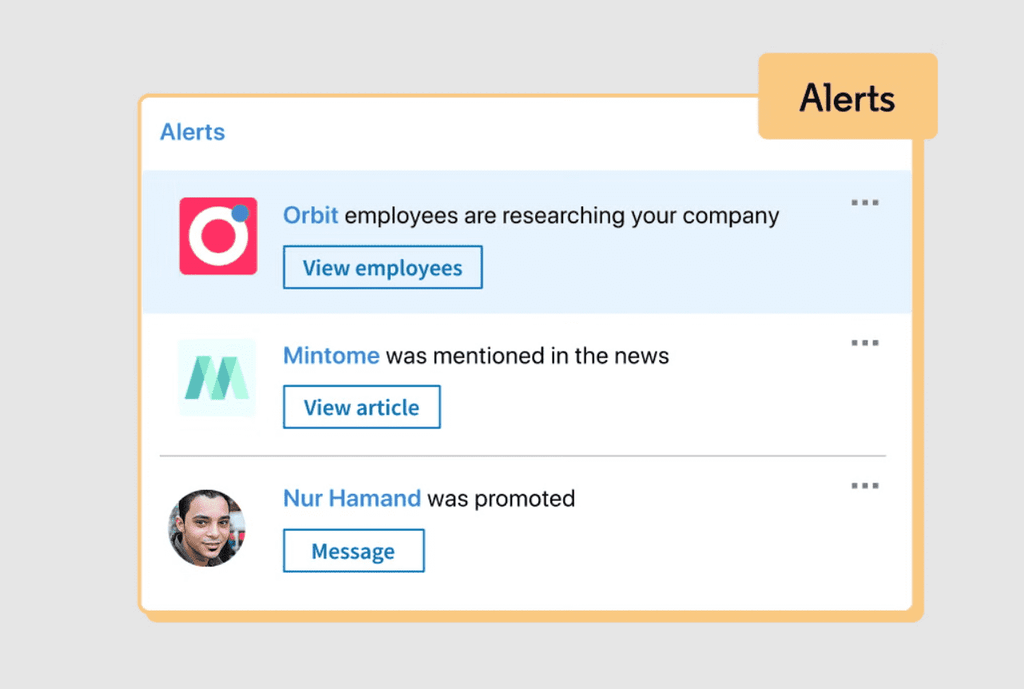
Sales Navigator can alert you when:
- A saved lead changes role or company
- A saved lead shares a post
- A saved account posts or hires senior staff
- A company raises money, completes an acquisition, or changes its hiring or headcount
- A prospect views your profile or accepts your connection request
- People at a saved account engage with your company’s content or visit its LinkedIn page (website visits count too, once Buyer Intent and the LinkedIn Insight Tag are set up)
- Someone opens a Smart Link, on eligible plans
- A teammate shares or updates a list
Some of these depend on your plan or setup. Buyer Intent needs Advanced or Advanced Plus, and sponsored-content engagement needs Advanced Plus.
Signal check: An alert is a reason to look closer, not a reason to hit send. Confirm what changed before you mention it in outreach.
Our signal-based outreach guide shows how to turn an alert into a message that actually feels relevant to your prospect.
5. Send 50 InMails each month
Every Sales Navigator plan includes 50 InMail credits a month. InMail lets you contact a LinkedIn member outside your network, complete with a subject line.
Unused credits carry over, but the balance caps at 150. LinkedIn says these credits must be used within 90 days, and it’s currently not possible to purchase extra Sales Navigator InMail credits.
So think of InMail as a tool for a short list of hard-to-reach accounts, not a fix for loose targeting. Save it for people with a real reason to hear from you, and build each message around that reason. Read our guide to automating LinkedIn InMail campaigns and copy our full workflow!
Wondering when to use LinkedIn InMail vs Messages? Read our guide to learn when to use each.
6. Find warm paths and related prospects
Relationship Explorer comes with every plan. It surfaces relevant people at an account and shows relationship clues that can help you approach them with some context. Advanced and Advanced Plus go further, with TeamLink paths through your coworkers.
Personas let you define your ideal lead by seniority, function, job title, and geography. Sales Navigator then applies those definitions across search, account pages, and Relationship Explorer, and recommends leads based on who you save and how you use the tool.
Treat these as starting points. A Persona match tells you someone looks right on paper, not that they have a need or the authority to buy, so check each profile before saving it.
Check out our guide on finding high volumes of leads every week without burning through your InMail credits.
7. Research leads and accounts with AI
Lead IQ and Account IQ create AI-generated research summaries inside Sales Navigator. LinkedIn’s dedicated Help Center pages say both are included with Core, Advanced, and Advanced Plus.
Lead IQ condenses a prospect’s profile and activity. Account IQ summarizes company information and can surface priorities or business context. Coverage varies by language and data, and some companies simply won’t have enough for a full summary. LinkedIn also warns that the AI can get things wrong, so verify anything you plan to put in a message or say on a call.
The payoff is time. A rep can get the gist of an account in a minute, then open the underlying source before relying on any detail. One catch: Lead IQ currently only works when your LinkedIn.com language is set to English, and it isn’t available on mobile.
Signal check: An alert gives you a timely reason to look closer. Confirm what changed before mentioning it in outreach.
8. Send Sales Navigator audiences into Expandi
Sales Navigator finds the audience. Expandi runs the outreach sequence you approve.
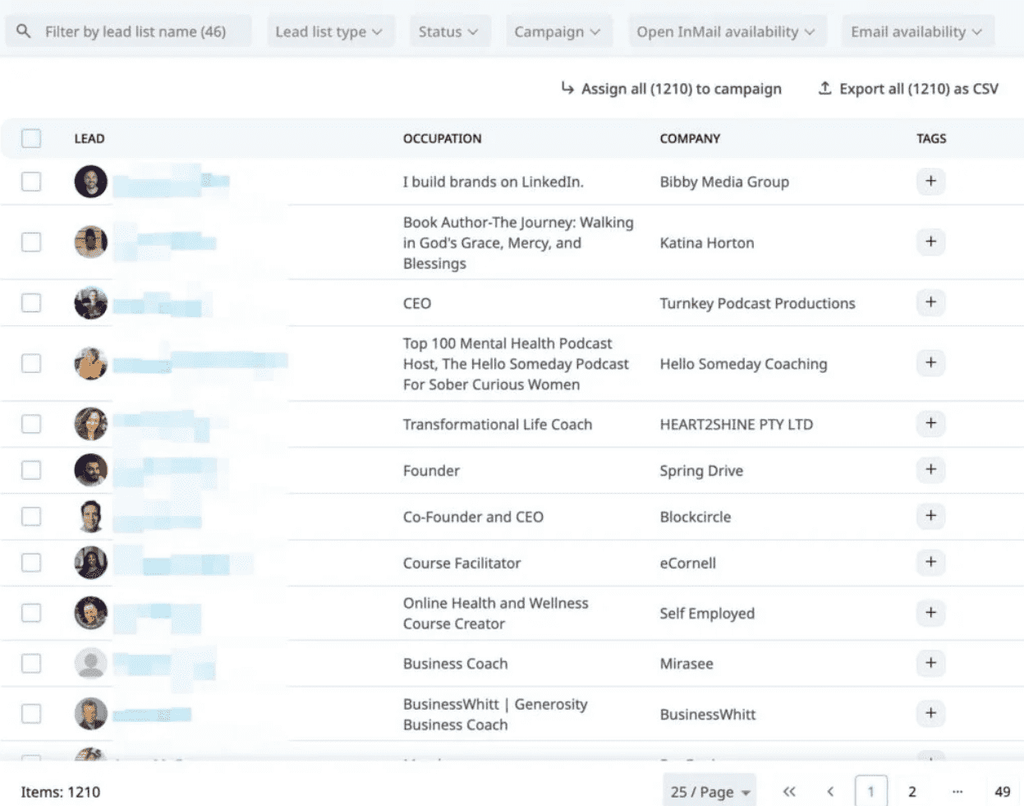
Build a filtered search in Sales Navigator, copy the URL, and paste it into Expandi. You can review the imported audience and connect it to a campaign without exporting a spreadsheet.
If your team already works in Claude or another compatible AI client, Expandi MCP can take a brief, prepare the lists, and draft the campaign for you. The draft lands in the Campaign Builder for your review. The AI doesn’t activate it, and it doesn’t touch campaigns that are already running.
In this setup, Sales Navigator stays your research layer and Expandi handles the campaign flow.
Extra benefits with Sales Navigator Advanced
Advanced is the collaboration tier. It starts paying off when several sellers work the same market and managers want to see whether the seats are actually being used.
9. Share team knowledge with TeamLink and shared lists
TeamLink shows which of your colleagues are connected to a prospect, which gives the rep a possible route to a warm introduction. TeamLink Extend widens that view beyond licensed sellers to coworkers who opt in. LinkedIn’s current plan documentation lists both for Advanced and Advanced Plus.
Advanced also lets teams share custom lists and saved searches. A manager builds the account list once, and every rep works from the same version. Detailed usage reporting shows admins who’s using their seat and which features have caught on.
You can upload a CSV book of business, too. That gives Sales Navigator your existing accounts to monitor and base recommendations on.
This is the clearest reason to upgrade from Core. If every rep builds their own lists and keeps useful relationship context to themselves, you’re paying for the same research several times over.
10. See Buyer Intent signals
Buyer Intent (Advanced and Advanced Plus) rolls LinkedIn activity up into account-level signals, so you can see which companies are showing interest and prioritize them.
Depending on your setup, those signals can include engagement with your company page or content. Sponsored posts and visits to your website can feed in too, once the right configuration is in place. LinkedIn says Buyer Intent draws on more than 180 signal types.
Intent tells you where to look first. It can’t tell you what the account needs, or prove anyone is actively buying. Open the account, look at who’s involved, and base your outreach on evidence you can actually see.
11. Track content engagement with Smart Links
Smart Links (Advanced and Advanced Plus) put your sales content behind a single trackable link.
When a prospect opens it, Sales Navigator shows you how they engaged with the material. That’s a timely reason to follow up, plus a hint about which page or asset caught their attention. Smart Links work best mid-conversation, when the prospect is expecting the resource.
Managers get something out of it as well: they can see which resources reps send and whether prospects open them, which is handy for coaching. Just don’t let an open move the deal forecast on its own.
The Advanced Plus benefit: CRM sync and writeback
Advanced Plus is for teams that want their LinkedIn activity living inside CRM records. It can pull CRM information into Sales Navigator and write selected Sales Navigator activity back out.
12. Sync Sales Navigator with your CRM
LinkedIn lists native CRM Sync for HubSpot, Microsoft Dynamics 365, Oracle Sales, and Salesforce. Depending on configuration, teams can save relevant CRM leads and accounts in Sales Navigator, view opportunity context, create or update CRM records, and log InMails or messages back to the CRM.
Advanced Plus also includes embedded profile experiences and ROI reporting. These features are useful when managers need LinkedIn work reflected in the system used for pipeline reviews. Sync behavior depends on the CRM and admin setup, so confirm the exact fields and update schedule during procurement.
Teams that don’t need Advanced Plus can still pass LinkedIn campaign data into HubSpot or Salesforce through Expandi’s integrations. This route doesn’t recreate every Sales Navigator CRM feature, but it can cover the campaign records a smaller team needs.
When is LinkedIn Sales Navigator not worth it?
Sales Navigator is hard to justify if you only prospect now and then, or if your addressable market is tiny. It’s also wasted money when nobody looks after the saved searches and alerts once they’re set up. And it won’t rescue weak targeting or generic messages.
We checked this against our own data. Expandi’s State of LinkedIn Outreach H2 2026 compared nearly 11,000 campaigns and 2.2 million contacted prospects. Sales Navigator leads accepted connection requests 19.8% of the time, versus 18.5% for CSV imports. Reply rates were identical.
In plain terms, that’s about 1 extra acceptance for every 77 invitations you send.

This was an observational comparison, so the lead source may not be what caused the gap. What the numbers do support: pay for Sales Navigator when its search and alerts will help you pick a better audience or save real research time. Don’t expect the subscription by itself to move your reply rate.
Sales Navigator pros and cons
| Pros | Cons |
|---|---|
| 50+ lead and account filters | Core starts at $119.99 a month on monthly billing |
| Saved searches and timely alerts | Visible results are capped per search |
| AI summaries on every paid tier | AI summaries still require source checking |
| Relationship paths and lead discovery | Several team features require Advanced |
| Team collaboration and reporting on Advanced | Native CRM sync requires Advanced Plus |
| Direct fit with an Expandi URL-import workflow | Conversion doesn’t improve automatically |
The short version: choose Core if one seller will use it every week. Go for Advanced when shared lists, TeamLink, Buyer Intent, or reporting would genuinely change how your team works. Ask for an Advanced Plus quote only when native CRM sync has a clear owner and a use case you can measure.
FAQ
LinkedIn offers free trials of Core and Advanced to eligible members. Under the current rules, you can’t have an active paid LinkedIn subscription, and you can’t have used a LinkedIn free trial in the past 365 days. Availability also varies by region and plan.
No. Sales Navigator licenses are assigned to individual users, and LinkedIn’s User Agreement prohibits account sharing. Advanced can be purchased online for up to 5 licenses, but larger or more complex deployments may require a sales-assisted contract.
Sales Navigator can supply the audience for an Expandi campaign, but no third-party tool can guarantee an account will avoid restrictions. LinkedIn’s User Agreement prohibits unauthorized scraping and automated activity, and LinkedIn can restrict unusual usage, so keep campaign limits conservative. Review the audience before launch, then monitor the account.
Recruiter Lite is the closer fit for an individual recruiter or a small business with light hiring needs. It has candidate-focused search and 30 monthly InMails. Sales Navigator is designed for finding buyers and building B2B sales relationships, so choose it when revenue prospecting is the job.
So, are the benefits of LinkedIn Sales Navigator worth the cost in 2026?
If LinkedIn is where your prospects come from every week, and you’ll actually use the filters and alerts, then yes. Core covers most individual sellers. Advanced pays off through team collaboration and intent signals, and Advanced Plus is for companies that need native CRM sync.
What you’re buying is a better way to find and keep track of prospects. Who you choose to contact, and what you say to them, still decides what happens next.
Got a filtered Sales Navigator audience ready to go? Try Expandi free for 7 days and turn it into an outreach sequence you review before anything sends.





You’ve made it all the way down here, take the final step