20 Cold Email Call to Action Examples That Work in 2026

Key Takeaways
- On a first touch, ask for interest. Save the calendar ask for later touches.
- One email, one CTA. Extra asks split attention and cost replies.
- Escalate across the sequence: interest, value, specific time, then a clean breakup.
- Skip designed buttons in cold outreach. A typed question reads like a person wrote it.
- Expandi’s Builder sequences run this escalation automatically, with AI-drafted follow-ups matched to each touch.
20 Cold Email Call to Action Examples That Work in 2026

A cold email call to action decides what happens after the read: reply, ignore, or delete.
We pulled the highest-replying email campaigns running through our platform at Expandi and the endings that win do two things: keep the ask small, and match it to how warm the prospect already is.
This guide gives you 20 CTA examples that do both, plus the data on which ask fits which touch.
Here’s what this guide covers:
- 20 cold email call to action examples, sorted by the job each ask does.
- What a study of 304,174 sales emails says about interest asks versus meeting asks.
- A 4-stage framework for escalating the CTA across a sequence.
- How to end a cold email in 3 steps, from setup sentence to sign-off.
- Six full templates that show the CTAs in context, including a breakup email.
What makes a cold email call to action work?
A cold email call to action works when it asks for the smallest commitment the prospect can give: an opinion, a yes to curiosity, a one-word reply.
Gong Labs analyzed 304,174 sales emails and found that on a first touch, asking about interest books more meetings than asking for time.
The study, first published in 2020, grouped effective CTAs into three types:
- Specific CTA: asks for a meeting at a named day and time.
- Open-ended CTA: asks for a meeting with no time attached.
- Interest CTA: asks whether the topic is worth exploring.
The interest CTA won the cold stage.
Gong’s read on why: time is the one resource decision-makers guard hardest, and a stranger asking for it triggers loss aversion. Interest costs nothing to give.
So the first touch sells the conversation, and the meeting comes after the nod.
The ending also has to clear a high bar, because cold email is the harder channel to begin with.
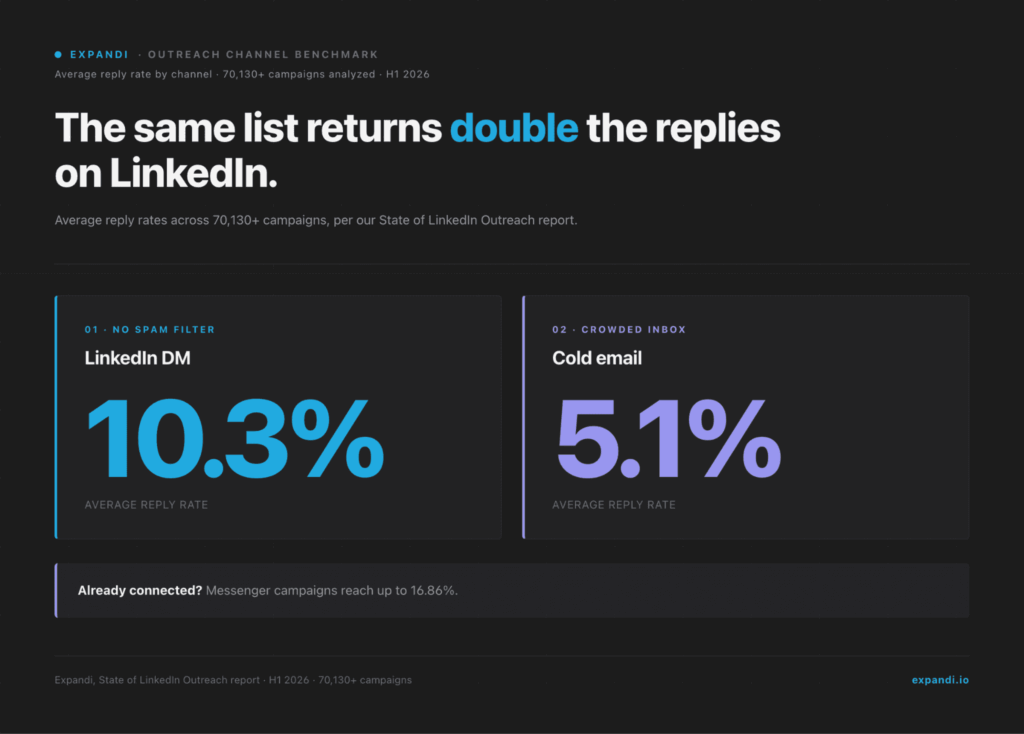
Per our State of LinkedIn Outreach H1 2026 report, built on 70,000+ outreach campaigns, cold emails average a 5.1% reply rate, against 10.3% for LinkedIn DMs.
An open you earned with a good subject line is too expensive to waste on a weak ask.
20 effective cold email call to action examples
Here are 20 cold email call to action examples, grouped by the job each ask does. Pick one per email, match it to how warm the prospect is, and rewrite it in the words you’d use with a colleague.
1. Interest CTAs for a first touch
These ask for curiosity rather than time, which makes them the default for a first email to a stranger:
- “Worth exploring?” The lowest-friction yes there is, dropped right after you name a specific pain.
- “Interested in seeing how [peer company] handles this?” Curiosity plus social proof in one line.
- “Is fixing [pain] on your radar this quarter?” Asks about priority, and a no still tells you where you stand.
- “Open to a look at the numbers behind this?” Sells the data before any demo talk.
- “Am I reading it right that [assumption] is a live issue for your team?” Invites a correction, which people love to give.
2. Qualifying questions that start a thread
Qualifying CTAs trade a tiny piece of information for a reply, and either answer opens a conversation:
- “Are you running outbound in-house, or through an agency?” Either answer hands you the next email.
- “Who owns [process] on your team?” Routes you to the right person while starting a thread with this one.
- “Are you using any AI lead generation tools or handling it manually?” Maps their stack in one reply.
- “How are you dealing with [pain] right now?” Open by design, so keep it for prospects who already engaged once.
3. Value-share CTAs that give before they ask
Value-share CTAs offer something the prospect keeps whether or not they ever buy:
- “Want the two-minute teardown of your [asset]? Reply and I’ll send it over.”
- “Mind if I send the one-pager?”
- “We benchmarked [metric] for teams like yours. Want the numbers?”
- “Happy to record a three-minute video audit of your setup. Useful?”
4. Specific-time CTAs for warm prospects
Calendar asks work once interest is established, so aim these at replies, referrals, and engaged leads rather than first touches:
- “Does Tuesday at 2 pm or Thursday at 10 am work for a 15-minute call?”
- “Open to 15 minutes next week? Grab any slot here: [calendar link].”
- “Should I send over an invite for Thursday?”
- “You mentioned [pain] in your reply. Worth a quick call to walk through the fix?”
5. Breakup CTAs that end the sequence clean
The last email in a sequence closes the loop without pressure, and it gives a busy prospect an easy way to answer honestly:
- “Closing the loop on my end. If [pain] resurfaces, this thread will be here.”
- “Should I check back next quarter, or close your file?”
- “A one-line answer is plenty: interested, later, or no?”
The 4-stage cold email CTA framework
A cold email sequence escalates its call to action in four stages: interest, value, specific time, breakup.
Each touch earns the next ask, which is how cold email sequences keep replies coming past the first send.
Stage 1: open with an interest ask
The first email closes on an interest CTA from the list above.
You’re asking the prospect to admit the problem matters, and that admission is the whole win. Resist the urge to attach a calendar link as a backup, because the second ask undercuts the first.
Stage 2: follow up with value
The second touch gives before it asks again: the teardown, the benchmarks, the one-pager you offered.
Write it like a note to a colleague rather than a formal follow-up. In our own campaign data, a second follow-up adds 4.05% more responses, so this touch earns its place even when the first stays silent.
Stage 3: name a specific time
Once the prospect engages, switch to a specific-time CTA. In Gong’s data, the specific ask more than doubles its booking rate after interest is established, from 15% on cold first touches to 37% once a deal is live.
The calendar link that would have sunk email one closes email three.
Stage 4: send the breakup email
After three or four silent touches, close the sequence with a breakup CTA. It reads as respect for the prospect’s time, and it converts silence into an answer you can act on.
If email stays quiet altogether, the ask may fit the other channel better. Our cold email vs. LinkedIn message breakdown covers when to switch.
How to end a cold email in 3 steps
Every cold email ending has three working parts: a setup sentence that bridges from the body, the CTA itself, and the sign-off. Get the first two right and the third takes care of itself.
The ending sits on top of the fundamentals, so pair this with our cold email outreach best practices guide for everything upstream of the last two lines.
Step 1: write the setup sentence
The setup sentence is the line right before the ask, and its job is to hand the prospect a reason to act. Restate the payoff in their terms, in one line.
“Teams that fixed this freed up about a rep-day per week” sets up an ask. “Let me know your thoughts” sets up nothing.
Step 2: make one ask
One email, one CTA. A question plus a calendar link plus a “P.S. here’s our case study” hands the prospect a menu, and menus get closed for later.
Cut every ask except the one that matches the stage you’re in.
Keep the ask honest, too. Urgency earns its place when it’s real, like an ROI window tied to their quarter. Manufactured deadlines on a first touch read as pressure, and pressure gets archived.
A phrasing tactic worth an A/B test: write the ask from the prospect’s side of the table.
“Send me the teardown” hands the reply words to say yes with, where “would you like me to send it” asks them to compose a response from scratch. Expandi’s built-in A/B testing settles which version your list answers.
Step 3: keep the sign-off short
A plain “Thanks, [first name]” closes stronger than an elaborate signature block. Heavy signatures with images and four links dilute the one link that matters and can hurt rendering in strict inboxes.
The sign-off’s only job is to end the email like a person wrote it.
Cold email call to action mistakes that are killing your reply rate
The fastest way to sharpen an ending is to cut what drags it down. Start with these:
- Stacking two or three asks in one email.
- “Thoughts?” with nothing specific to have thoughts about.
- Asking a stranger for 30 or 60 minutes on the first touch.
- “Let me know if you’re interested”, which asks for effort with no direction.
- Guilt follow-ups like “Did you see my last three emails?”
- Fake urgency and manufactured deadlines on a first send.
6 effective cold email call to action examples in action
A CTA lands only as well as the email above it sets it up, so here are 6 full templates with the ask in context.
Swap the placeholders for your prospect’s details and rewrite one line at a time until it sounds like you.
1. The job-change congratulations email
The email:
Subject: congrats on the new role
Hi {first_name},
Saw you stepped into the {job_title} seat at {company_name} this month. Congrats. Stepping in mid-quarter means inheriting someone else’s outbound motion, and pipeline coverage is the number everyone asks about in the first 90 days.
We put together a benchmark on what teams your size see from LinkedIn and email outreach. Worth exploring?
Why the CTA works: the trigger is fresh, the pain is specific to a new leader, and the ask costs one word. The benchmark gives them a reason to say yes beyond politeness.
2. The value-upfront email
The email:
Subject: two fixes for {company_name}’s outreach
Hi {first_name},
I ran {company_name} through the audit we use for clients and two things stood out: [specific issue 1] and [specific issue 2]. Both are quick fixes, and I wrote them up.
Want the writeup? No call attached to it.
Why the CTA works: value arrives before any ask, and “no call attached” removes the exact fear that keeps prospects from replying to value offers.
3. The mutual-event email
The email:
Subject: fellow {event_name} attendee
Hi {first_name},
Saw we’re both registered for {event_name} next month. I work with {job_title}s on [outcome], and half of what we run today came out of hallway conversations at last year’s edition.
Are you around on the workshop day?
Why the CTA works: the shared context does the warming, and the ask is logistics rather than a pitch. A yes creates a real-world touchpoint no sequence can match.
4. The shared-group email
The email:
Subject: also in {group_name}
Hi {first_name},
We’re both in {group_name}, and your comment on [topic] lined up with what we see across client accounts. We built a safer way to handle [job-to-be-done] than the scraping tools that get passed around in there.
Am I right that [assumption about their setup] is how you’re doing it today?
Why the CTA works: the verify-assumption ask invites a correction, and corrections come with context you can build the next email on.
5. The webinar-registrant email
The email:
Subject: before Thursday’s session
Hi {first_name},
Saw your registration for Thursday’s webinar on [topic]. I’m helping shape the Q&A, and I’d rather it cover real setups than generic questions.
Quick one so the hour is useful for you: are you running [process] today, or still evaluating?
Why the CTA works: the qualifying question is framed as a favor to the prospect, and the answer segments them for the follow-up after the event.
6. The breakup email
The email:
Subject: closing the loop
Hi {first_name},
I’ve reached out a few times about [pain] and heard nothing back, which I read as timing, priorities, or me having the wrong person. Fair enough on all three.
I’ll stop here. If it turns into a live issue next quarter, this thread is where the benchmark will be waiting.
Should I check back then, or close your file?
Why the CTA works: it hands the prospect a graceful exit and a one-word way to keep the door open, and either answer beats silence. For more endings like this one, our 20 email outreach templates include a full breakup section.
Putting cold email CTA escalation on autopilot
Escalating a CTA across four stages is a sequencing job, and sequencing is what outreach automation is for.
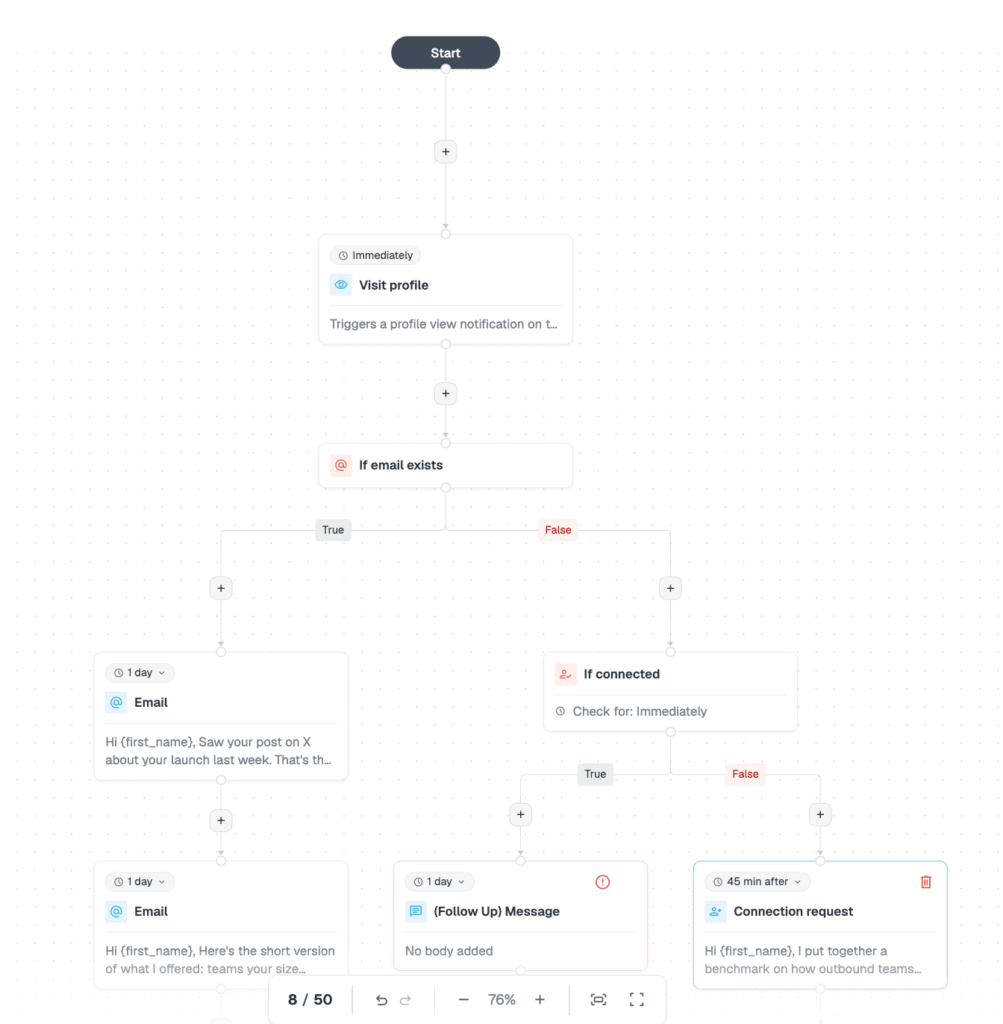
Expandi’s Builder campaigns run if-then sequences (20 actions, 11 conditions) that escalate the ask touch by touch:
- Interest question first.
- Value share if they open.
- Time ask once they engage.
- Breakup email after silence.
Signal-based outreach starts the sequence when a prospect shows intent, like a profile view or post engagement, so the stage-1 ask lands while interest is warmest.
The AI Analyzer drafts messages and follow-ups matched to your campaign goal and sorts incoming replies by sentiment (Interested, Maybe, or Not interested), so a yes to an interest CTA gets a fast human response while the sequence handles everyone else.
That combination is how sales teams scale personalized outreach past the volume one SDR can hand-write.
Effective cold email call to action: match the ask to the moment
An effective cold email call to action earns replies by staying small and staying in step with the relationship: interest on the first touch, value on the second, a named time once the prospect leans in, and a clean breakup when they stay quiet.
One ask per email, a setup sentence that hands them a reason, and a sign-off that gets out of the way. Steal the 20 examples above, then let the sequence do the escalating.
Ready to run interest-to-breakup sequences without babysitting them? Start your 7-day Expandi free trial and build your first escalating campaign today.
Frequently asked questions
End a cold email with three parts: a setup sentence that restates the payoff in the prospect’s terms, one low-friction call to action, and a short sign-off like “Thanks, [name]”.
On a first touch, the call to action should ask for interest or a small piece of information rather than a meeting. Keep the whole ending to three lines or fewer.
A good cold email call to action asks for the smallest possible commitment, like “Worth exploring?” or “Are you handling [process] in-house?”.
Questions about interest or priorities pull more replies than requests for time, because a reply costs seconds while a meeting costs half an hour. Save the calendar ask for a prospect who has already engaged.
In marketing email, buttons win: Campaign Monitor’s own A/B tests measured a 28% lift in click-throughs from a button over a text link.
Cold outreach is the exception. A designed button flags the message as a campaign the second the eye lands on it, and campaigns get deleted on sight in a cold inbox.
End a cold email with a typed question or, at the heaviest, one bare text link. Save the buttons for newsletters, product updates, and the marketing emails where a designed layout is expected.
Save the meeting ask for later touches. A stranger guards their calendar, so a first email closes better on a curiosity question llike “Worth exploring?” than on a request for time.
Once the prospect replies or clicks, a specific day-and-time ask becomes the stronger close. Ask for curiosity first and the calendar second.
One. A single ask gives the prospect a single decision, and that clarity is what gets answered between meetings on a phone screen.
Multiple asks, like a question plus a calendar link plus an attachment, turn a ten-second reply into a task that gets postponed. Cut everything except the ask that fits the stage.
A breakup email is the final message of a sequence, sent after several touches with no reply. It closes the loop politely, states that you’ll stop reaching out, and offers a low-effort way to respond, like “Should I check back next quarter, or close your file?”. It converts silence into an answer and leaves the door open for better timing.



You’ve made it all the way down here, take the final step